
“The resistance of More and Fisher to the royal supremacy in Church government was a heroic stand. They realised the defects of the existing Catholic system, but they hated and feared the aggressive nationalism which was destroying the unity of Christendom. They saw that the break with Rome carried with it the risk of a despotism freed from every fetter. More stood forth as the defender of all that was finest in the medieval outlook. He represents to history its universality, its belief in spiritual values, and its instinctive sense of otherworldliness. Henry VIII with cruel axe decapitated not only a wise and gifted counselor, but a system which, though it had failed to live up to its ideals in practice, had for long furnished mankind with its brightest dreams.”
Winston Churchill


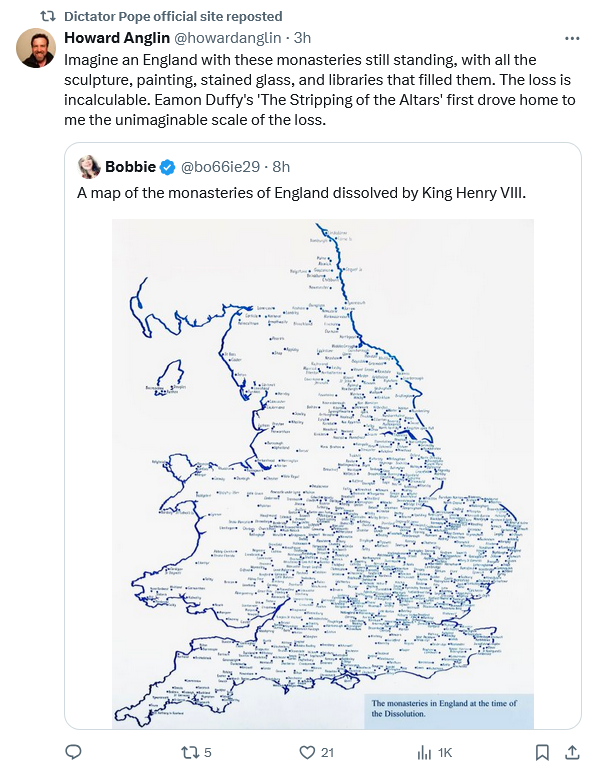
And in this respect, of course, all of Europe should look back in great sadness at the wanton destruction of just about everything that built the greatest civilization in human history. To add insult to injury, the process of destruction now is led from within, by the Church’s own hierarchy.
Our Lady of Akita, Ora pro nobis.
Thank you for posting the map. Impressive and at the same time a very sad loss on so many levels.
This reminds me of England being known as the Dowry of Mary. https://rcdow.org.uk/news/england-is-marys-dowry-a-new-dedication-for-today/
A few paragraphs from the above website:
“Why is England called the ‘Dowry of Mary’?
Unique among all the nations, the Catholics of England have believed for centuries that their country is in a special sense the Dowry of Mary. The word ‘dowry’ (from the Latin dos, meaning ‘donation’, ‘gift’ or ‘endowment’) is commonly understood as the donation accompanying a bride upon marriage. In medieval English law, however, the meaning was reversed, in that a husband would set apart a portion of his estate designated for the maintenance of his wife, should she become a widow. On landed estates the Dower House is a property set aside for precisely that purpose. The historical understanding of England as Mary’s Dowry is understood in this sense: that England has been set apart for Our Lady. Indeed, the very use of the term ‘Our Lady’ or the ‘ Lady Mary’ to refer to the Blessed Virgin Mary, although common in Western Europe from the twelfth century onwards, has a more ancient history in England, where the first extant example comes from an Anglo-Saxon poet at the end of the eighth century.
The title ‘Dowry of Mary’ is believed to originate from the reign of St Edward the Confessor (1042-1066) though the precise origin is unclear. It had become widespread by the middle of the fourteenth century and around the year 1350 a mendicant preacher stated in a sermon that ‘it is commonly said that the land of England is the Virgin’s dowry’, thus reflecting the origin of the title in the deep devotion of its people to the Mother of God in the Middle Ages.
On the feast of Corpus Christi in 1381, King Richard II (1377-1399) dedicated England to Our Lady in a ceremony at Westminster Abbey as an act of thanksgiving for his kingdom being saved in the wake of the Peasants’ Revolt of that year. “