
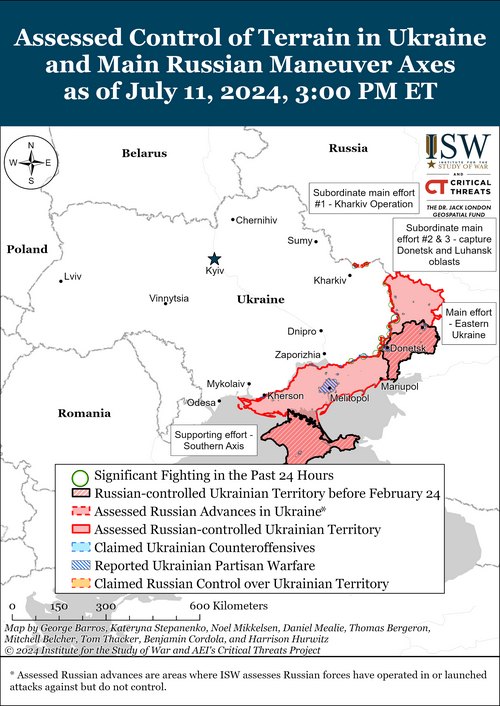
From The Institute for the Study of War:
Russian Offensive Campaign Assessment, July 11, 2024
Angelica Evans, Grace Mappes, Riley Bailey, Christina Harward, and Frederick W. Kagan
July 11, 2024, 6:50pm ET
Click here to see ISW’s interactive map of the Russian invasion of Ukraine. This map is updated daily alongside the static maps present in this report.
Click here to see ISW’s 3D control of terrain topographic map of Ukraine. Use of a computer (not a mobile device) is strongly recommended for using this data-heavy tool.
Click here to access ISW’s archive of interactive time-lapse maps of the Russian invasion of Ukraine. These maps complement the static control-of-terrain map that ISW produces daily by showing a dynamic frontline. ISW will update this time-lapse map archive monthly.
Note: The data cut-off for this product was 1:30pm ET on July 11. ISW will cover subsequent reports in the July 12 Russian Offensive Campaign Assessment.
Russian authorities reportedly attempted to assassinate leading figures in the European defense industrial base (DIB), likely as part of Russian efforts to disrupt and deter Western aid to Ukraine and Russia’s wider efforts to destabilize NATO members. CNN reported on July 11 that five US and Western officials stated that US intelligence uncovered a Kremlin plan in early 2024 to assassinate German arms manufacturer Rheinmetall CEO Armin Papperger.[1] US intelligence reportedly informed the German government, which was able to foil the plot. CNN reported that the planned assassination against Papperger was one of multiple plans to kill European defense industry executives, but that the plot against Papperger was the “most mature.” European authorities have reported that Russian actors and proxies have conducted sabotage and other hybrid warfare operations aimed at deterring and disrupting Western aid to Ukraine, and NATO and its member states have repeatedly warned about intensifying Russian hybrid operations on NATO member territory.[2]
Finnish authorities reported an increase in GPS “malfunctions” in the past week and that most disruptions to aviation and maritime GPS and radar originate from within Russia.[3] Finnish federal transport and communications agency Traficom told Finnish outlet Iltalehti on July 11 that GPS “malfunctions” have increased in the past week in reference to a specific incident in the Gulf of Finland overnight on July 10-11.[4] A Finnish maritime pilot reported on X (formerly Twitter) that he experienced severe GPS and radar malfunctions overnight while guiding other boats near Kotka and Hamina on Finland’s southern coast.[5] The pilot published footage of his radar malfunctioning and reported that GPS was unavailable for 90 percent of the route between the Orrengrund pilot substation and Hamina harbor.[6] Reports of increased GPS and radar disruptions in the Gulf of Finland cohere with reports of Russian GPS jamming affecting Baltic states and other areas of Europe. Likely Russian jamming from Kaliningrad has previously jammed the GPS of a plane carrying then–UK Defense Minister Grant Shapps and forced Finnish aircraft carrier Finnair to ground multiple flights out of Finland.[7] The GPS interference in the Baltics forced Finnair to cancel flights to Tartu, Estonia until the Tartu airport implemented an approach solution for planes flying into the airport that does not rely on GPS.[8] Russia’s apparent GPS jamming is likely part of Russia’s intensifying hybrid campaign directly targeting NATO states likely aimed at undermining support for Ukraine and NATO unity.[9]
Ukraine intends to hold a second meeting of the Global Peace Summit by the end of 2024 and reportedly plans to invite Russia to participate. Deputy Head of the Ukrainian Presidential Office Ihor Zhovkva stated on June 21 that Ukraine wants to hold the second meeting of the summit by the end of 2024, and Ukrainian President Volodymyr Zelensky stated on July 4 that “Russian representatives must be present” at any subsequent summit that discusses a legitimate plan to end the war.[10] Bloomberg reported on July 11 that a Ukrainian official stated that Ukraine wants to convene the second meeting of the summit before November 2024 and invite Russian representatives.[11] The Kremlin pointedly stated that Russian representatives would not have attended the first meeting of the Global Peace Summit in Switzerland in June even if they had been invited.[12] Russian President Vladimir Putin has indicated that he is opposed to any agreement short of Ukrainian surrender, however, despite other Kremlin officials continuing to feign interest in meaningful negotiations.[13] The first meeting of the Ukrainian-initiated Global Peace Summit aimed to create a global consensus on negotiations about the war in Ukraine so that Ukraine and its international partners can present a joint peace plan to a Russian representative at a subsequent peace summit, and Ukraine has never indicated that it intends to exclude Russia entirely from its peace process.[14]
European Union (EU) leadership is reportedly considering restricting Hungary’s power as EU Council president following Hungarian Prime Minister Viktor Orban’s meeting with Russian President Vladimir Putin in Moscow and his efforts to present himself as a potential mediator between Russia and Ukraine. POLITICO Europe, European Pravda, and Ukrainian outlet Suspilne reported on July 8, 9, and 11 that they obtained a copy of a letter from Orban to European Council President Charles Michel detailing Orban’s July 5 meeting with Russian President Vladimir Putin and various claimed Russian positions on negotiations and the frontline situation in Ukraine.[15] Orban reportedly advocated for immediate peace negotiations in the letter and claimed that he did not offer any opinions or policy proposals to Putin on behalf of the EU or EU Council during his visit to Moscow.[16] Orban claimed in the letter that he will continue his efforts to facilitate negotiations and “clarify the possibilities for achieving peace” in the coming weeks. The Financial Times (FT) reported on July 10 that, according to three people familiar with the matter, the EU’s legal service told member states that Orban’s trip to Moscow may have violated a series of EU treaties that forbid any “measure that could jeopardize the attainment of the Union’s objectives.”[17] Several diplomats told FT that many EU member states are considering boycotting ministerial meetings in Hungary and that a sub-group of member states are discussing how to use the EU treaty to restrict Hungary’s power and influence as EU Council president. Pro-European political group Renew Europe president Valerie Hayer called on the European Council to prematurely terminate Hungary’s EU Council presidency following Orban’s visit to Moscow.[18] Orban has previously flouted EU foreign policy and norms, including opposing sanctions against Russia, and will likely continue to use his position as EU Council president to posture himself as a potential mediator for the end of Russia’s invasion of Ukraine.[19]
The Russian government continued efforts to root out critical voices and consolidate control over the Russian information space. Russian federal censor Roskomnadzor stated on July 11 that the agency may require social media account owners with a daily audience of over 1,000 people to provide identifying information to Roskomnadzor in the future.[20] Roskomnadzor stated that in accordance with a Russian law requiring consumers to have “reliable information” about the owner of an information distributor, the agency could require account owners to provide their full name and contact information to the Russian government. Roskomnadzor noted that it will prohibit Russian companies from advertising on the social media pages of owners who have not provided their information to the agency. The Russian government has likely identified the individuals behind most prominent Russian social media accounts but is likely aiming to identify the owners of smaller social media accounts that claim to have insider information into the inner workings of the Russian government, military, or companies. BBC reported in September 2023 that advertisements are a significant money-making method for more prominent Russian milbloggers, and Roskomnadzor likely hopes to force smaller channels whose owners may need the supplemental income to provide their information by restricting their advertisement revenue.[21]
The Russian Federal Security Service (FSB) claimed that it prevented a terrorist attack against an Orthodox church in Maykop, Republic of Adygea on July 11.[22] The FSB claimed that a man from Central Asia, supposedly affiliated with an unspecified international terrorist organization, planned to murder the church’s clergy and security guards and burn down the church. The FSB claimed that officers found and seized prohibited materials, the flag of an unspecified terrorist organization, a knife, and components of an incendiary device belonging to the man. The Russian government opened an investigation into the terrorist attack.
Key Takeaways:
- Russian authorities reportedly attempted to assassinate leading figures in the European defense industrial base (DIB), likely as part of Russian efforts to disrupt and deter Western aid to Ukraine and Russia’s wider efforts to destabilize NATO members.
- Finnish authorities reported an increase in GPS “malfunctions” in the past week and that most disruptions to aviation and maritime GPS and radar originate from within Russia.
- Ukraine intends to hold a second meeting of the Global Peace Summit by the end of 2024 and reportedly plans to invite Russia to participate.
- European Union (EU) leadership is reportedly considering restricting Hungary’s power as EU Council president following Hungarian Prime Minister Viktor Orban’s meeting with Russian president Vladimir Putin in Moscow and his efforts to present himself as a potential mediator between Russia and Ukraine.
- The Russian government continued efforts to root out critical voices and consolidate control over the Russian information space.
- The Russian Federal Security Service (FSB) claimed that it prevented a terrorist attack against an Orthodox church in Maykop, Republic of Adygea on July 11.
- Ukrainian forces advanced north of Kharkiv City; and Russian forces recently advanced south of Siversk, northwest of Avdiivka, and west of Donetsk City.
- Russian federal subjects (regions) continue to use monetary incentives as part of Russia’s crypto-mobilization recruitment efforts.
Go here to read the rest. The War news is mostly not war news.

