
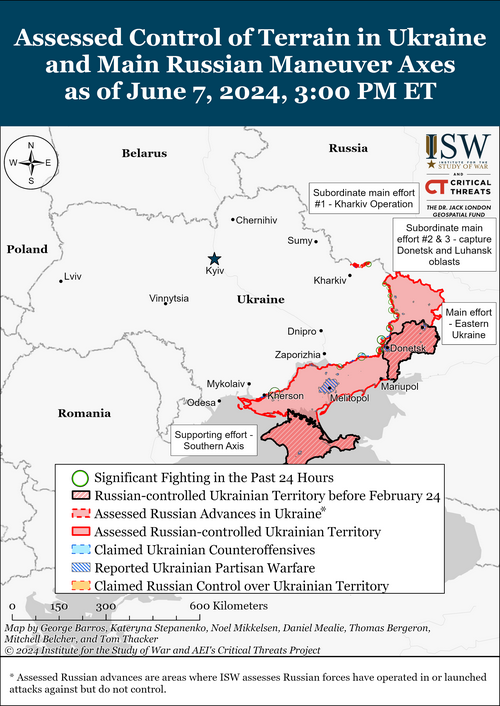
From The Institute for the Study of War:
Russian Offensive Campaign Assessment, June 7, 2024
Riley Bailey, Christina Harward, Nicole Wolkov, Grace Mappes, and George Barros
June 7, 2024, 10:00pm ET
Click here to see ISW’s interactive map of the Russian invasion of Ukraine. This map is updated daily alongside the static maps present in this report.
Click here to see ISW’s 3D control of terrain topographic map of Ukraine. Use of a computer (not a mobile device) is strongly recommended for using this data-heavy tool.
Click here to access ISW’s archive of interactive time-lapse maps of the Russian invasion of Ukraine. These maps complement the static control-of-terrain map that ISW produces daily by showing a dynamic frontline. ISW will update this time-lapse map archive monthly.
Note: The data cut-off for this product was 1:15pm ET on June 7. ISW will cover subsequent reports in the June 8 Russian Offensive Campaign Assessment.
Russian President Vladimir Putin articulated a theory of victory in Ukraine on June 7 that assumes that Russian forces will be able to continue gradual creeping advances indefinitely, prevent Ukraine from conducting successful operationally significant counteroffensive operations, and win a war of attrition against Ukrainian forces. Putin stated following his speech at the St. Petersburg International Economic Forum (SPIEF) that Russia does not need to conduct another call-up of reservists similar to Russia‘s September 2022 partial mobilization because Russia is not trying to rapidly achieve its military objectives in Ukraine.[1] Putin acknowledged that the current Russian military contingent committed to the war in Ukraine (reportedly the Russian military’s entire combat-capable ground force as of January 2024) would be insufficient for a rapid victory but suggested that Russian forces are instead pursuing a more gradual approach.[2] Putin stated that Russian forces aim to “squeeze” Ukrainian forces out “of those territories that should be under Russian control” and therefore Russia does not need to conduct another mobilization wave.[3] Putin asserted that Russian crypto-mobilization efforts are sufficient for this approach and that Russia has recruited 160,000 new personnel so far in 2024 (a figure consistent with reports that the Russian military recruits between 20,000-30,000 recruits per month).[4]
Putin’s assessment that gradual Russian gains will allow Russia to achieve his goals in Ukraine is predicated on the assumption that Ukrainian forces will be unable to liberate any significant territory that Russian forces seize and that the Russian military will be able to sustain offensive operations that achieve gradual tactical gains regardless of heavy losses. Western intelligence has previously assessed that Putin assesses that US and Western support to Ukraine is “finite” and that Russian forces have blunted Ukrainian efforts to retake significant territory.[5] Putin’s assessment has been reinforced by the recent months of delayed Western security assistance and corresponding Ukrainian materiel constraints, which allowed Russian forces to seize and maintain the theater-wide initiative and conduct consistent offensive operations throughout eastern Ukraine that achieved gradual tactical gains.[6] Putin’s June 7 comments support ISW’s previous assessment that Putin’s assessment of Ukrainian capabilities and how Putin’s perceived limits to Western support would incentivize Putin to pursue creeping offensive operations indefinitely if more rapid operations that lead to rapid decisive results seem unattainable.[7]
Putin’s theory of victory rests on Russia’s ability to outlast and overcome pledged Western security assistance to Ukraine and Ukrainian efforts to mobilize more of its economy and population for the war effort, indicating that Putin likely assesses that Russian forces will be able to leverage their advantages in manpower and materiel to overwhelm on Ukrainian forces. Putin’s apparent assessment that Russia can “squeeze” Ukrainian forces out of all the lands it desires to occupy assumes that Ukraine will not acquire and sustain the manpower and materiel required to prevent indefinite Russian attempts to gradually advance along the front or needed to contest the initiative and conduct operationally significant counteroffensive operations. Ukrainian forces have previously shown that when they are well provisioned, they can prevent Russian forces from making even marginal tactical gains, force Russian offensive operations to culminate, and launch counteroffensive operations that liberate operationally significant territory.[8] Russian forces are currently leveraging the theater-wide initiative in Ukraine to dictate a tempo of fighting that generates casualties roughly equal to or slightly less than the rate of newly generated forces, which has allowed Russian forces to sustain their overall offensive tempo in Ukraine.[9] Russia is also further mobilizing its defense industrial base (DIB) and is generally far ahead of Ukraine and the West in this regard.[10] Putin and the Russian military command likely assess that Russian numerical manpower and materiel advantages will allow Russia to sustain this force generation replacement rate and field the required materiel needed to sustain indefinite creeping advances.
This strategy largely relies on Russia’s ability to retain the theater-wide initiative, which Ukrainian forces can contest if Ukraine addresses its ongoing manpower challenges and receives sufficient, timely, and consistent Western security assistance.[11] Western security assistance pledges and Ukrainian force generation efforts will eventually allow Ukraine to accumulate the forces and materiel it needs to contest the initiative if ongoing Russian offensive operations are not successful in forcing Ukraine to divert manpower and materiel to defensive operations.[12]
Russian efforts to prevent Ukraine from accumulating the personnel and resources Ukraine needs to contest the initiative therefore are a part of an attritional war approach, in which the Russian military command believes that ongoing Russian offensive operations will inflict relatively more significant losses on Ukrainian forces and force Ukraine to divert manpower and materiel to stabilize the front instead of preparing for future counteroffensive efforts. This approach also requires that Russian forces avoid suffering outsized losses that would prevent Russia from sustaining offensive operations. There are limits to Russian force generation, as Putin himself admits with his continued aversion to another partial mobilization wave, and Russia’s ability to expand its DIB has extensively relied on the refurbishment of extensive Soviet-era stocks, which are a finite resource.[13] Putin and the Russian military command likely calculate that these limits will not begin constraining Russia’s ability to sustain its offensive tempo in Ukraine in the near-to-medium term, however. This approach requires that Ukraine is not able to inflict losses on Russian forces that decrease this offensive tempo or force Russian offensive efforts to culminate. ISW continues to assess that Ukraine should contest the initiative as soon as possible because Russian forces are reaping a variety of benefits from holding the initiative, including their ability to pursue a strategy of attritional warfare.[14]
Putin’s theory of victory hinges on a critical assumption that the West will abandon Ukraine to Russian victory, either on its own accord or in response to Russian efforts to persuade the West to do so, and it is far from clear that the West will do so. Putin notably did not identify what specific goals he assesses gradual tactical Russian gains will achieve, although the Russian military command has likely previously believed that such gains would encourage Western debates about continued support for Ukraine and cause weakened Western support that exacerbates Ukrainian materiel constraints.[15] Putin also did not specify which territory “should” be under Russian control, part of continued Kremlin rhetoric that purposefully leaves open room for further territorial conquest in Ukraine.[16] The current rate of Russian advance suggests that Russian forces may pursue individual operationally significant objectives over the course of many months if not years, and efforts to not bound the Kremlin’s territorial objectives likely intend to justify indefinite creeping offensive operations as long as it takes to achieve Western and Ukrainian capitulation.[17] Putin may believe that as long as Russia can prevent Ukraine from contesting the initiative he can lock in limited territorial conquests while encouraging Western debates about continued aid to Ukraine once current pledges of security assistance are expended.
The end of Western security assistance would eventually lead to the collapse of the frontline and total Russian victory in Ukraine, a reality that recent months of delayed Western security assistance has further highlighted.[18] The West must proactively provide Ukrainian forces with the necessary equipment and weapons at the scale, timing, and regularity that Ukrainian forces require for operations that liberate significant swaths of occupied Ukraine and challenge Putin’s belief that he can gradually subsume Ukraine should rapid total victory appear unreachable. The West also maintains the ability to substantially disrupt Russian operations at scale by allowing Ukraine to use Western-provided weapons to strike Russia’s operational rear and deep rear areas in Russian territory.[19] The West must not surrender to Russia’s strategic effort to destroy Western commitment to Ukrainian survival and must remember that Ukrainian victory has always been possible as long as the West remains committed to that goal.[20]
Putin indirectly indicated that Ukrainian strikes on Russian territory with Western-provided weapons do not cross a supposed Russian “red line” that would result in Russian nuclear escalation. Putin stated that Russia’s nuclear doctrine calls for Russia to only use nuclear weapons in the event of “exceptional cases” of threats to Russia’s sovereignty and territorial integrity.[21] Putin stated that he does not think such an “exceptional” case has arisen so “there is no such need” for Russia to use nuclear weapons. Ukrainian forces have struck military targets in Belgorod Oblast with US-provided HIMARS systems using GMLRS since early June 2024.[22] Putin’s June 7 statement is a significant rhetorical reversal given that Putin and other Kremlin officials have previously threatened Russian nuclear weapon use should Western states allow Ukraine to strike into Russian territory with Western-provided weapons.[23] Western and Ukrainian policies and actions have crossed Russia’s supposed “red lines” several times throughout the war without drawing a significant Russian reaction, indicating that many of Russia’s “red lines” are most likely information operations designed to push the West to self-deter.[24]
Putin heavily focused on proposals to solve Russia’s labor shortage issues during his speech at SPIEF on June 7. Putin outlined a 10-point plan to grow the Russian economy and acknowledged that Russia is suffering from demographic challenges and labor shortages.[25] Putin called on the Russian government to enact multiple reforms to increase the labor supply and productivity, such as improving education and training, automating and digitalizing Russian industry, increasing the use of artificial intelligence (AI), and increasing spending on research and development. Putin highlighted the necessity of migrant labor to increase Russia’s economic growth but stated that Russia has not yet developed a “meaningful” migration policy. Putin specified that Russia only needs skilled and educated migrant laborers with a knowledge of Russian language and culture and who will “not create any problems for local citizens in the workplace and in life.” Putin ended his SPIEF appearance by stating that Russia “will treat the culture and traditions of [non-ethnically Russian] peoples of the Russian Federation” with respect as “unity is [Russia’s] strength.” Putin has touted Russia as a unified multiethnic and multinational state, but his June 7 statements demonstrate the differing policies and perceptions towards the indigenous, federally recognized peoples of Russia and migrants.[26] Putin’s migration policy proposals demonstrate how the Kremlin continues to struggle to balance Russia’s need for migrants to compensate for labor shortages and wide-scale anti-migrant sentiments in Russia, particularly as the Kremlin tries to further mobilize the Russian defense industrial base (DIB).
Putin attempted to frame Russia’s economic issues in a positive light, likely to prepare Russian citizens to make more personal sacrifices as Russia sustains a protracted war in Ukraine at the expense of Russian citizens’ standards of living. Putin framed Russia’s labor shortages as resulting from Russia’s alleged “record low” unemployment, not a consequence of Russia’s full-scale invasion of Ukraine.[27] Putin stated that people who have reached retirement age have experience and knowledge that is useful to the Russian economy and that many pensioners have “aspirations” to continue working. Putin proposed that the Russian government annually increase pensions starting in February 2025 for pensioners who continue to work even after they reach retirement age. Putin met with St. Petersburg Governor Alexander Beglov before his speech at SPIEF, during which Beglov presented the idea of increasing pensions as a direct request from working pensioners.[28] Large-scale protests erupted in Russia in 2018 when the Kremlin announced a raise in the retirement age, and Putin is likely trying to use monetary incentives to push pensioners to choose to work beyond the retirement age to help ease Russia’s labor shortages.[29] Putin also highlighted the strength of Russia’s DIB, claiming that Russia has increased its production of ammunition by more than 20 times in an unspecified time frame and that Russia has superior aviation and armored vehicle technology than the West.[30] Putin claimed that the Russian DIB has increased its production of civilian products by about five percent over the past two years, likely to justify Russia’s increased defense spending and recent efforts to mobilize the DIB to civilians. Sberbank CEO Herman Gref, however, stated on June 7 at SPIEF that the alleged “unprecedented” growth of wages in Russia will last at most another year.[31]
Putin continued efforts to portray Ukrainian President Volodymyr Zelensky as an illegitimate president and identified the Ukrainian Verkhovna Rada (parliament) as a legitimate actor with which the Kremlin can negotiate instead of Zelensky. Putin’s recent statements are the latest in a series designed to obfuscate the legality of Zelensky’s extended term by misrepresenting the Ukrainian Constitution and Ukrainian laws.[32] Putin continued to claim that Zelensky is an illegitimate actor who has “usurped” power in Ukraine as the Ukrainian Constitution does not allow for a Ukrainian president to extend his term beyond the five-year fixed term.[33] Putin cherrypicked specific articles of the Ukrainian Constitution to make his argument, including articles he also recently grossly mischaracterized or took out of their legal context during a speech on May 28.[34] Putin claimed on June 7 that the Verkhovna Rada’s power is extended under a period of martial law and that presidential powers should be “transferred to the speaker of the Rada” under articles 109, 110, and 111 of the Ukrainian Constitution now that Zelensky has “usurped” power.[35] Article 109 states that “the resignation of the President of Ukraine enters into force from the moment he or she personally announces the statement of resignation at a meeting of the Verkhovna Rada of Ukraine.”[36] Article 110 states that “the inability of the President of Ukraine to exercise his or her powers for reasons of health shall be determined at a meeting of the Verkhovna Rada of Ukraine and confirmed by a decision adopted by the majority of its constitutional composition.”[37] Article 111 states that “the President of Ukraine may be removed from office by the Verkhovna Rada of Ukraine by the procedure of impeachment, in the event that he or she commits state treason or other crime.” Putin is invoking these articles to suggest that Zelensky’s extended term is “illegal” and that the Verkhovna Rada is the single authority to assume power should Zelensky resign, be impeached, or otherwise leave office before the natural end of his term. Putin also invoked Article 83, which states that in the event of martial law, the Verkhovna Rada’s powers are extended, and Article 103, which states that a Ukrainian president’s term is five years – again claiming that presidential terms cannot be extended under martial law while the Verkhovna Rada’s term can be extended.[38]
Putin claimed that the Ukrainian Constitution does not mention extending the Ukrainian presidential term, but this statement ignores the Ukrainian legal framework about martial law. Article 19 of the Ukrainian law “On the Legal Regime of Martial Law” states that presidential and Verkhovna Rada elections are prohibited under martial law and forbids the Ukrainian president from abolishing martial law as long as there exists a “threat of attack or danger to the state independence of Ukraine and its territorial integrity.”[39] Article 64 of the Ukrainian constitution states that “under conditions of war or a state of emergency, specific restrictions on rights and freedoms may be established with the indication of the period of validity of these restrictions” except for the rights and freedoms stipulated by certain articles, none of which are mentioned above.[40]
Putin’s recent focus on legitimizing the Verkhovna Rada and its speaker in lieu of Zelensky highlights a target for Russian destabilization operations.[41] ISW has repeatedly assessed that recent Russian information operations aim to sow multiple divisions between the Ukrainian people, military, military leadership, and political leadership to undermine domestic and international support for Zelensky and Ukraine’s decision to defend against the Russian invasion.[42] Ukrainian intelligence has identified a Russian information campaign called “Maidan-3” that specifically aims to spread doubt about Zelensky’s legitimacy and has projected that these information operations will peak from late May to July 2024.[43] These information operations may intend to set informational conditions to eventually declare a Kremlin-backed actor as Ukrainian president, Verkhovna Rada speaker, or another title with whom the Kremlin claims it can “legally” negotiate with instead of Zelensky.[44] Two figures previously floated as possible replacements for Zelensky have since emerged in the wake of these information operations.[45] Former pro-Russia Ukrainian MP Viktor Medvedchuk recently participated in the information operation to discredit Zelensky.[46] Former pro-Russia Ukrainian President Viktor Yanukovych traveled to Minsk on May 24 for an unspecified reason, and Ukrainian intelligence described Yanukovych’s last trip to Minsk in 2022 as a Kremlin effort to prepare Yanukovych for a “special operation” to be reinstated as president of Ukraine.[47]
Putin attempted to introduce his children and the children of other senior Russian officials to the public sphere at SPIEF, likely to set conditions for them to eventually assume high-profile and powerful roles in the Russian government. Independent Belarusian outlet Vot Tak reported that Putin’s youngest daughter Katerina Tikhonova spoke virtually on a June 6 panel about the role of defense industrial organizations and discussed Russian technological development and import substitution.[48] Vot Tak also reported that Putin’s eldest daughter Maria Vorontsova spoke on a panel about biotechnology on June 7.[49] Vot Tak reported that Tikhonova spoke at SPIEF in 2021 in a panel about BRICS and that Vorontsova has only previously attended SPIEF as a guest where she did two interviews on the sidelines.[50] Kremlin newswire TASS characterized Tikhonova as Innopraktika Company General Director and notably went out of its way to promote Vorontsova’s professional titles and accolades by highlighting her position as Deputy Head of the Russian Faculty of Fundamental Medicine at Moscow State University and a member of the Russian Association for the Promotion of Science, and a Candidate of Medical Science (equivalent to a PhD of Medical Science).[51] TASS did not mention their familial connection to Putin. TASS is likely attempting to portray Tikhonova and Vorontsova as authoritative figures and to introduce them as trustworthy and knowledgeable individuals to the Russian public.
A Russian insider source claimed that the children of other senior Russian officials participated in SPIEF including: both sons of former Foreign Intelligence Service (SVR) Head and current Russian Institute for Strategic Studies Director Mikhail Fradkov – First Deputy Administrator of the Presidential Administration Pavel Fradkov and CEO and Chairperson of Russian state-owned bank Promsvyazbank Pyotr Fradkov; Kremlin Spokesperson Dmitry Peskov’s daughter Yelizaveta Peskova; Presidential Aide Nikolai Patrushev’s son Russian Agriculture Minister Dmitry Patrushev; Presidental Administration Head Anton Vaino’s son the Kremlin’s Agency for Strategic Initiatives’ youth work head Alexander Vaino; Russian oligarch Boris Rotenberg’s son Vice President of Gazprombank Roman Rotenberg; Presidental Administration First Deputy Head Sergei Kiriyenko’s son Alexander Kiriyenko; Security Council Secretary Sergei Shoigu’s daughter Ksenia Shoigu; and Putin’s first cousin once removed (“niece”) and Defenders of the Fatherland Foundation Chairperson Anna Tsivileva.[52]
US National Security Council Senior Director for Arms Control, Disarmament, and Nonproliferation Pranay Vaddi stated that the US has prepared a new nuclear weapons policy specifically to deter Russia, the People’s Republic of China (PRC), North Korea, and Iran.[53] Vaddi stated at the 2024 Arms Control Association meeting that the US may have to deploy more strategic nuclear weapons in the coming years and that the US should be prepared if the US president makes such a decision.[54] Vaddi stated that the US remains committed to international arms control and non-proliferation values and agreements. Vaddi stated that Russia has repeatedly rejected talks with the US to negotiate a successor to the New START strategic arms limitation pact, which expires in 2026, and that the PRC has refused to discuss expanding its nuclear arsenal with the US.
The US Department of Defense (DoD) announced a $225 million security assistance package for Ukraine on June 7.[55] The package includes missiles for HAWK air defense systems; Stinger anti-aircraft missiles; ammunition for HIMARS; 155mm and 105mm artillery rounds; M113 armored personnel carriers; Tube-Launched, Optically-Tracked, Wire-Guided (TOW) missiles; Javelin and AT-4 anti-armor systems; and other materiel.[56]
French President Emmanuel Macron announced on June 6 that France will provide Ukraine with an unspecified number of Mirage 2000-5 fighter jets and equip and train a brigade of 4,500 Ukrainian soldiers.[57] Macron stated that Ukrainian pilots will likely train between five and six months on Mirage-2000-5 aircraft in France and stated that Ukraine will have Mirage-2000-5 pilots by the end of 2024.[58]
The Russian Supreme Court declared an organization that does not exist as “extremist” on June 7, consistent with previous ISW assessments that Russia seeks to expand the legal definition of “extremism” to increasingly prosecute domestic anti-war sentiment. The Russian Supreme Court declared the “Anti-Russian Separatist Movement” and its “structural divisions” as extremist in accordance with a Russian Ministry of Justice request to this effect submitted on April 26.[59] Russian opposition media has noted that no such organization exists, and Russian authorities have previously designated other non-existent organizations meant to encompass broader “social movements” as “extremist.”[60] Russian authorities likely intend to use this new extremist designation to further prosecute anti-war sentiment among Russians and within occupied Ukraine, particularly movements opposing Russia’s occupation of Ukraine and movements within ethnic minority communities advocating for better treatment of Russian military personnel and mobilized personnel from these communities.[61]
The Kremlin continues efforts to destabilize the Balkans and dismantle the 1995 Dayton Accords that ended the 1992-1995 Bosnian War, likely as part of a larger strategic effort that seeks to divide and distract Europe. Russian President Vladimir Putin and President of Republika Srpska (the Serbian political entity within Bosnia and Herzegovina) Milorad Dodik met on June 6 in St. Petersburg, and Dodik attended the St. Petersburg International Economic Forum (SPIEF).[62] Dodik announced in a June 7 interview with Kremlin newswire TASS that Republika Srpska will adopt a Russia-style “foreign agents” bill, which would restrict the activities of non-profit organizations that receive foreign funding, that the government had previously withdrawn.[63] Dodik also stated Republika Srpska’s intention to hold a referendum on its independence from Bosnia and Herzegovina at an unspecified date.[64] The Kremlin has previously leveraged its relationship with Republika Srpska to further influence the Balkans, sow divisions in the West, and undermine the Dayton Accords to throw the Balkans into turmoil.[65]
Key Takeaways:
- Russian President Vladimir Putin articulated a theory of victory in Ukraine on June 7 that assumes that Russian forces will be able to continue gradual creeping advances indefinitely, prevent Ukraine from conducting successful operationally significant counteroffensive operations, and win a war of attrition against Ukrainian forces.
- Putin’s theory of victory rests on Russia’s ability to outlast and overcome pledged Western security assistance to Ukraine and Ukrainian efforts to mobilize more of its economy and population for the war effort, indicating that Putin likely assesses that Russian forces will be able to leverage their advantages in manpower and materiel to overwhelm on Ukrainian forces.
- Putin’s theory of victory hinges on a critical assumption that the West will abandon Ukraine to Russian victory, either on its own accord or in response to Russian efforts to persuade the West to do so, and it is far from clear that the West will do so.
- Putin indirectly indicated that Ukrainian strikes on Russian territory with Western-provided weapons do not cross a supposed Russian “red line” that would result in Russian nuclear escalation.
- Putin heavily focused on proposals to solve Russia’s labor shortage issues during his speech at SPIEF on June 7.
- Putin attempted to frame Russia’s economic issues in a positive light, likely to prepare Russian citizens to make more personal sacrifices as Russia sustains a protracted war in Ukraine at the expense of Russian citizens’ standards of living.
- Putin continued efforts to portray Ukrainian President Volodymyr Zelensky as an illegitimate president and identified the Ukrainian Verkhovna Rada (parliament) as a legitimate actor with which the Kremlin can negotiate instead of Zelensky. Putin’s recent statements are the latest in a series designed to obfuscate the legality of Zelensky’s extended term by misrepresenting the Ukrainian Constitution and Ukrainian laws.
- Putin attempted to introduce his children and the children of other senior Russian officials to the public sphere at SPIEF, likely to set conditions for them to eventually assume high-profile and powerful roles in the Russian government.
- US National Security Council Senior Director for Arms Control, Disarmament, and Nonproliferation Pranay Vaddi stated that the US has prepared a new nuclear weapons policy specifically to deter Russia, the People’s Republic of China (PRC), North Korea, and Iran.
- The US Department of Defense (DoD) announced a $225 million security assistance package for Ukraine on June 7.
- French President Emmanuel Macron announced on June 6 that France will provide Ukraine with an unspecified number of Mirage 2000-5 fighter jets and equip and train a brigade of 4,500 Ukrainian soldiers.
- The Russian Supreme Court declared an organization that does not exist as “extremist” on June 7, consistent with previous ISW assessments that Russia seeks to expand the legal definition of “extremism” to increasingly prosecute domestic anti-war sentiment.
- The Kremlin continues efforts to destabilize the Balkans and dismantle the 1995 Dayton Accords that ended the 1992-1995 Bosnian War, likely as part of a larger strategic effort that seeks to divide and distract Europe.
- Russian forces recently advanced near Svatove, near Chasiv Yar, and northwest of Avdiivka.
Go here to read the rest. Putin basically tells his people not to expect any great war winning offensive this year.

