
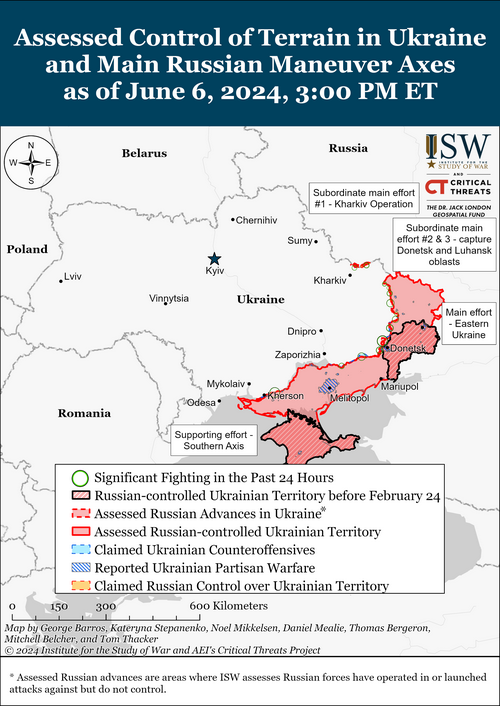
From The Institute for the Study of War:
Russian Offensive Campaign Assessment, June 6, 2024
Riley Bailey, Christina Harward, Nicole Wolkov, Grace Mappes, and George Barros
June 6, 2024, 8:35pm ET
Click here to see ISW’s interactive map of the Russian invasion of Ukraine. This map is updated daily alongside the static maps present in this report.
Click here to see ISW’s 3D control of terrain topographic map of Ukraine. Use of a computer (not a mobile device) is strongly recommended for using this data-heavy tool.
Click here to access ISW’s archive of interactive time-lapse maps of the Russian invasion of Ukraine. These maps complement the static control-of-terrain map that ISW produces daily by showing a dynamic frontline. ISW will update this time-lapse map archive monthly.
Note: The data cut-off for this product was 1:10pm ET on June 6. ISW will cover subsequent reports in the June 7 Russian Offensive Campaign Assessment.
Russian President Vladimir Putin sought to repackage long-standing, tired threats about direct confrontation with the West by claiming that Russia will provide long-range strike capabilities to unspecified actors for strikes against the West. Putin’s threat aims to influence Western decision-making about Ukraine’s ability to strike military targets within Russia using Western-provided weapons but notably does not threaten escalation in Ukraine or through direct confrontation, suggesting that the Kremlin may be adjusting to select Western perceptions about the credibility of such Russian threats. Putin stated during a meeting with the heads of foreign press organizations on the sidelines of the St. Petersburg International Economic Forum (SPIEF) on June 5 that Russia could begin supplying long-range weapons to unspecified adversaries of the West as a “symmetrical response” to the lifting of some Western restrictions on Ukraine’s use of Western-provided weapons to strike military targets within Russia.[1] Putin rhetorically asked why Russia should not have the right to supply weapons of a similar class (compared to those the West has allowed Ukraine to use for strikes on Russian territory) to unspecified actors that will conduct strikes on Western “sensitive targets.”[2] Kremlin actors routinely threaten to directly strike Western targets in an effort to use Western fears of escalation with Russia to encourage the West to self-deter its support for Ukraine, and Putin’s June 5 threat is not a notable inflection in this regard.[3]
Putin may assess that select Western actors will be more concerned about Russia providing long-range strike capabilities to actors willing to attack the West than the Kremlin’s tired rhetoric about direct confrontation between the West and Russia. Russia is very unlikely to directly provide scarce high-end long-range strike capabilities to other actors, however, since it uses many of these systems for large-scale strikes against Ukraine. It is also unclear what systems Putin means by weapons of a “similar class.” The United Kingdom lifted restrictions on Ukraine’s ability to use Storm Shadow cruise missiles with a range of over 250 kilometers for strikes against military targets within Russia, which is the Western system with the longest range that Ukrainian forces are currently permitted to use for such strikes.[4] The kinds of long-range strike systems Russia could ostensibly give other actors would be limited if Putin’s “proportional” threat is credible. Russia’s likely unwillingness to provide long-range systems does not preclude Russian efforts to help the West’s adversaries acquire long-range strike capabilities, however. Russia is reportedly providing North Korea with ballistic missile technology in return for North Korea’s provision of artillery munition to Russia, for example.[5] Putin and the Kremlin have threatened escalation at every critical juncture in Western debates about support for Ukraine, and this latest threat aims to constrain the easing of remaining Western restrictions on Ukraine’s ability to strike military targets within Russia using Western weapons.[6] Lifting remaining restrictions on Ukraine’s use of Western weapons can allow Ukrainian forces to substantially degrade Russian operations by eliminating Russia’s ability to use Russian territory as a sanctuary space to optimize its rear areas to support Russia’s campaign to destroy Ukrainian statehood.[7]
Russian naval vessels will make a port call in Cuba on June 12–17, likely as part of a larger effort to invoke the historical memory of the Cuban Missile Crisis as part of Russia’s reflexive control campaign to encourage US self-deterrence. The Cuban Ministry of the Revolutionary Armed Forces announced on June 6 that four Russian vessels from the Northern Fleet – the Admiral Gorshkov frigate, the Kazan nuclear-powered cruise missile submarine, the Academic Pashin replenishment oiler, and the Nikolai Chiker rescue tug – will make an official visit to the port of Havana from June 12 to 17.[8] Reuters reported that a senior US official stated that the Russian vessels may also stop in Venezuela on an unspecified date in Summer 2024.[9] The Russian Ministry of Defense (MoD) stated that Russia’s objective is to ensure a Russian naval presence in “operationally important areas of the far ocean zone.”[10] Russian media noted that the Admiral Gorshkov is carrying Zircon hypersonic missiles, which the Kremlin has touted as capable of carrying a nuclear warhead.[11] The Cuban Ministry of Revolutionary Armed Forces specifically claimed, however, that none of the vessels are carrying nuclear weapons, so the Russian port call “does not represent a threat to the region.”[12] ISW is unable to verify this Cuban assertion. The Russian Navy’s port calls in states in the Western hemisphere that have historically strained relationships with the US aim to highlight Russia’s strong relations with these states and are likely part of Russia’s reflexive control campaign to force the US to self-deter and not enact policies that offer further support to Ukraine. Putin has repeatedly used nuclear saber-rattling to push the West to self-deter during times when the West has faced key moments on critical policy decisions in how to best support Ukraine.[13] The Kremlin likely hopes that the clear allusion to the Cuban Missile Crisis and the inclusion of a reportedly nuclear weapons–capable ship will force the West to engage in self-deterrence. The Kremlin likely coordinated the announcement of the Russian navy’s port calls in Cuba with Putin’s threats to provide long-range strike capabilities to unspecified actors for strikes against the West, as both activities can instill fear in the West. Putin notably did not threaten escalation in Ukraine or direct confrontation between Russia and the West.
Putin inadvertently indicated on June 5 that Russian forces may be suffering roughly 20,000 monthly casualties in Ukraine, which, if accurate, would be roughly equal to or just below the number of new personnel that Russia reportedly generates per month. Putin inadvertently suggested that roughly 5,000 Russian personnel are killed in action in Ukraine each month, which further suggests that roughly 15,000 Russian personnel are wounded in action, assuming a standard three-to-one wounded-to-killed casualty ratio.[14] ISW cannot confirm Putin’s suggested casualty rate and his apparent inadvertent admission does not serve as a clear claim about Russian casualties in Ukraine. Putin’s suggested figure does align somewhat with the lower end of Ukrainian reporting about Russian casualty rates, however. Ukrainian Ground Forces Commander Lieutenant General Oleksandr Pavlyuk stated on May 2 that Russian forces suffer about 25,000 to 30,000 killed and wounded personnel per month.[15] Ukrainian Main Military Intelligence Directorate (GUR) Deputy Chief Major General Vadym Skibitskyi reported on January 15, 2024, that Russia recruits around 30,000 personnel per month.[16] Ruslan Pukhov, the head of the Moscow-based Center for Analysis of Strategies and Technologies and a member of a Russian Ministry of Defense (MoD) civilian advisory board, similarly claimed in mid-April 2024 that current Russian crypto-mobilization efforts are generating roughly 30,000 new personnel each month.[17] Russian officials are reportedly concerned about decreasing recruitment rates ahead of the expected Russian Summer 2024 offensive effort, and it is unclear if the Russian Ministry of Defense (MoD) has maintained the roughly 30,000 recruitment rate it reportedly had in January and April of 2024.[18]
Russian forces have notably established a more sustainable force generation apparatus in recent months for ongoing offensive operations and have intensified efforts to establish operational- and strategic-level reserves.[19] Russian forces have leveraged their possession of the theater-wide initiative in Ukraine to dictate a tempo of fighting in recent months that would generate casualties roughly equal to or slightly less than the rate of newly generated forces.[20] This has allowed Russian forces to immediately replenish losses along the frontline and sustain their overall offensive tempo in Ukraine but has set limits on the extent to which Russian forces can intensify offensive operations in any given direction.[21] The marginal amount of additional newly generated forces not immediately committed to the front as reinforcements has allowed Russian forces to gradually establish operational reserves.[22] Pavlyuk stated in early May 2024 that Russian forces intended to generate about 100,000 more personnel for use in offensive operations this June and July and 300,000 more personnel by the end of 2024.[23] Russia will likely fall far short of this immediate and near-term goal, even at the lower limit of reported or suggested monthly Russian casualties and the upper limit of reported monthly Russian force generation. ISW continues to assess that likely poorly trained and equipped Russian operational- and strategic-level reserves are unlikely to be ready to act as a first-echelon penetration force or as a second-echelon exploitation force capable of conducting large-scale assaults in 2024 if Ukrainian forces have the wherewithal to resist them.[24]
Limitations on Western capabilities to train partner pilots on F-16 fighter jets are reportedly creating bottlenecks that will affect Ukraine’s ability to effectively field F-16s in the future. Politico reported that Denmark, Norway, the Netherlands, and Belgium plan to send over 60 F-16 aircraft to Ukraine in Summer 2024.[25] Politico reported on June 5 that US, European, and Ukrainian officials and lawmakers stated that US, Danish, and Romanian F-16 pilot training facilities can only train a limited number of Ukrainian pilots, however. Politico reported that US Air Force Spokesperson Laurel Falls stated that the US National Guard is planning to train 12 Ukrainian pilots by the end of September 2024. The Danish training facility is reportedly training eight Ukrainian pilots, but this facility will reportedly close in November 2024, and the Romanian training facility is reportedly not yet operational. A full squadron of 20 aircraft requires 40 pilots. A former DoD official reportedly stated that if the current training constraints continue, Ukraine will only have enough pilots for a full squadron at the end of 2025. Ukraine will not be able to use all the Western-provided aircraft as effectively as possible until the necessary number of Ukrainian pilots complete training.
Select Western countries have indicated that Ukraine will be permitted to use F-16s for strikes within Russia but Ukraine’s ability to operate F-16s near the international border is contingent on Ukraine’s ability to destroy air defense assets in Russia.[26] Ukrainian President Volodymyr Zelensky stated on May 18 that Ukraine needs about 120–130 advanced fighter aircraft to achieve air parity with Russia but that Russia’s biggest advantage is Western-imposed restrictions prohibiting Ukraine from using Western-provided weapons to strike military targets in Russia.[27] Ukraine may be able to set conditions to have Ukrainian aviation operate in the air domain to support Ukrainian ground operations if Ukraine is able to sufficiently destroy Russian air defense assets within Russia using Western long-range strike capabilities, obtain a sufficient cadre of pilots capable of flying F-16s, and receive a timely delivery and a sufficient number of F-16 airframes.
French authorities are investigating multiple recent pro-Russian sabotage and societal influence operations in France amid continued Russian hybrid war measures against NATO states and France aimed at weakening support for Ukraine. French media reported on June 5 and 6 that French authorities detained a man with pro-Russian beliefs and dual Ukrainian-Russian citizenship at a hotel on the outskirts of Paris after the man sustained injuries from making explosives in his hotel room.[28] French media reported that French authorities assess that the man sought to attack French security assistance allocated to Ukraine and that authorities found additional explosives, materials to make explosives, small arms, money, and passports in the man’s hotel room. The man reportedly fought with the Russian military for two years in an unspecified location (presumably in Ukraine) prior to this incident.[29] NBC reported that a source within the French National Anti-Terrorist Prosecutor’s Office stated that it is “too early for us to say” whether the incident is connected to a Russian sabotage campaign, though French and other European intelligence agencies have recently warned about a projected increase in Russian sabotage operations in the coming weeks.[30] Macron plans to meet with Ukrainian President Volodymyr Zelensky on June 7 in Paris and Reuters reported that French officials may use the visit to announce the transfer of French military trainers to Ukraine.[31] Russian actors may be attempting to use sabotage attacks to degrade French support for Ukraine or disrupt French efforts to prepare materiel and military trainers for deployment to Ukraine. French authorities are also investigating potential Russian Federal Security Service (FSB) involvement in recent incidents likely aimed at fomenting domestic unrest and distrust of Macron.[32]
The Russian Investigative Committee announced the arrest of a French citizen on June 6 following the early June arrest in France. The Russian Investigative Committee announced and published footage of Russian authorities detaining an unspecified French citizen under charges of failing to provide proper documentation required by law for legally designated “foreign agents.” The Russian Investigative Committee claimed in its report that the French citizen also spent “several years” on multiple trips to Russia collecting information about the Russian military that “can be used against the security of the [Russian] state” if “foreign sources” obtain this information, essentially accusing the man of espionage but not yet formally charging him with espionage-related offenses.[33] Reuters reported that Swiss-based nonprofit Center for Humanitarian Dialogue stated that Russian authorities arrested Laurent Vinatier, who worked as a Russia and Eurasia advisor for the center, and that French President Emmanuel Macron also confirmed Vinatier’s arrest.[34]
Ukrainian forces struck an oil refinery in Rostov Oblast and reportedly struck an oil depot in Belgorod Oblast on the night of June 5 to 6.[35] Rostov Oblast Governor Vasily Golubov acknowledged that a fire started at the Novoshakhtinsk oil refinery after a drone strike.[36] Geolocated footage published on June 6 shows a fire at the Novoshakhtinsk oil refinery in Rostov Oblast.[37] Radio Svoboda published satellite imagery on June 6 showing that the Ukrainian strike hit a liquified hydrocarbon gas production site.[38] Radio Svoboda reported that the Novoshakhtinsk oil refinery has a capacity of five million tons per year, and a prominent Russian milblogger claimed that the facility is mostly export oriented.[39] Ukrainian forces previously struck the Novoshakhtinsk oil refinery in June 2022 and March 2023.[40] Belgorod Oblast Governor Vyacheslav Gladkov claimed on June 6 that a Ukrainian drone strike caused a fire at an oil depot in Starooskolsky Gorodskoy Okrug.[41] ISW has not observed visual confirmation of the reported Ukrainian strike on the oil depot in Starooskolsky Raion.
Ukrainian Verkhovna Rada Committee on Human Rights, Deoccupation, and Reintegration Deputy Chairperson Ruslan Horbenko estimated that the Ukrainian military will recruit roughly 120,000 personnel in 2024, although the apparent slow arrival of Western security assistance will likely limit Ukraine’s ability to sufficiently provision and equip these forces at scale in the near-term.[42] Horbenko stated in an interview with Ukrainian outlet Ukrinform published on June 6 that the Ukrainian military command and frontline commanders stated that the Ukrainian military needs 100,000 to 110,000 recruits in 2024. Western military aid to Ukraine is unlikely to provision and equip these forces with sufficient materiel given the current rate and limited scale at which Western military aid is arriving in Ukraine. Ukrainian President Volodymyr Zelensky recently acknowledged that the slow arrival of US security assistance is complicating Ukrainian efforts to commit reserves to ongoing Ukrainian defensive operations since the Ukrainian military is unable to sufficiently equip reserve brigades to conduct rotations for frontline units.[43] The arrival of US and Western military assistance to Ukrainian forces on the frontline at scale will likely aid Ukrainian efforts to bring reserves closer to their intended end strength and sufficiently provision new planned brigades.
Russian and Taliban officials expressed interest in bilateral cooperation, indicating that Russia will likely soon delist the Taliban as a prohibited organization in Russia. Taliban acting Minister of Labor and Social Relations Abdul Umari gave an interview to Kremlin newswire TASS at the St. Petersburg Economic Forum (SPIEF) on June 6 in which he expressed interest in expanding economic and energy ties with Russia and stated that the Taliban is “looking forward to Russia’s decision to exclude [the Taliban] from the list of banned organizations [in Russia].”[44] Russian President Vladimir Putin expressed support for delisting the Taliban on May 28, ahead of the Taliban delegation’s visit to Russia.[45] Russian Security Council Secretary Sergei Shoigu stated at a meeting with the security council secretaries of Collective Security Treaty Organization (CSTO) member states that Russia is concerned about the situation in Afghanistan and claimed that there are unspecified “new militant training camps” in Afghanistan and unspecified terrorists are moving from Syria and Iraq to Afghanistan.[46] Shoigu’s statement indicates that Russia is likely interested in cooperating with the Taliban to degrade the Islamic State-Khorasan Province (IS-KP), an adversary of the Taliban and the perpetrators of the March 22 Crocus City Hall attack in Moscow.[47]
Key Takeaways:
- Russian President Vladimir Putin sought to repackage longstanding, tired threats about direct confrontation with the West by claiming that Russian will provide long-range strike capabilities to unspecified actors for strikes against the West. Putin’s threat aims to influence Western decision-making about Ukraine’s ability to strike military targets within Russia using Western-provided weapons but notably does not threaten escalation in Ukraine or through direct confrontation, suggesting that the Kremlin may be adjusting to select Western perceptions about the credibility of such Russian threats.
- Russian naval vessels will make a port call in Cuba on June 12–17, likely as part of a larger effort to invoke the historical memory of the Cuban Missile Crisis as part of Russia’s reflexive control campaign to encourage US self-deterrence.
- Putin inadvertently indicated on June 5 that Russian forces may be suffering roughly 20,000 monthly casualties in Ukraine, which, if accurate, would be roughly equal to or just below the number of new personnel that Russia reportedly generates per month.
- Limitations on Western capabilities to train partner pilots on F-16 fighter jets are reportedly creating bottlenecks that will affect Ukraine’s ability to effectively field F-16s in the future.
- French authorities are investigating multiple recent pro-Russian sabotage and societal influence operations in France amid continued Russian hybrid war measures against NATO states and France aimed at weakening support for Ukraine.
- The Russian Investigative Committee announced the arrest of a French citizen on June 6 following the early June arrest in France.
- Ukrainian forces struck an oil refinery in Rostov Oblast and reportedly struck an oil depot in Belgorod Oblast on the night of June 5 to 6.
- Ukrainian Verkhovna Rada Committee on Human Rights, Deoccupation, and Reintegration Deputy Chairperson Ruslan Horbenko estimated that the Ukrainian military will recruit roughly 120,000 personnel in 2024, although the apparent slow arrival of Western security assistance will likely limit Ukraine’s ability to sufficiently provision and equip these forces at scale in the near-term.
- Russian and Taliban officials expressed interest in bilateral cooperation, indicating that Russia will likely soon delist the Taliban as a prohibited organization in Russia.
- Russian forces recently advanced within Vovchansk, southeast of Kupyansk, northeast of Siversk, northwest of Avdiivka, south of Velyka Novosilka, and near Krynky.
- Russia’s continued demographic crisis will present long-term constraints on human capital within Russia.
Go here to read the rest. Well, if the Russian ships are visiting Cuba, I guess that reduces the risk they will be sunk by Ukrainian drones and missiles. Soviet attempts to become a sea power were something of a joke during the Cold War. Now, it is merely farce.

