
Cromwell: I put it to the Court that the prisoner is perverting the law—making smoky what should be a clear light to discover to the Court his own wrongdoing!
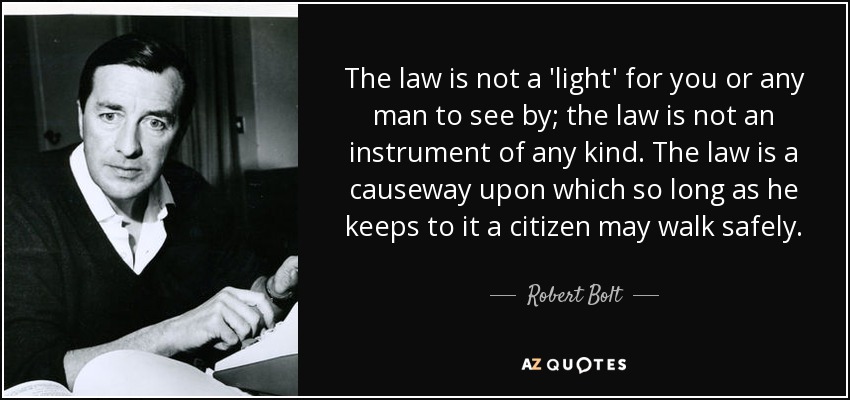
More: The law is not a “light” for you or any man to see by; the law is not an instrument of any kind. The law is a causeway upon which, so long as he keeps to it, a citizen may walk safely.
Robert Bolt, A Man for All Seasons
(I wrote this below back in the early days of the blog. It seems relevant today.)
At the beginning of this post we see the scene in the movie where the playwright Bolt has Saint Thomas defending the proposition that the Devil should be given the benefit of Man’s law. I believe that is a perfectly accurate statement of the view of Saint Thomas. If a law is unjust, as laws not infrequently are, then the law should be changed. However, for laws to be ignored or to be actively disobeyed in order for some good to be achieved would have struck him as anathema.
That laws and legal procedure often left much to be desired he made clear in his book Utopia:
They have no lawyers among them, for they consider them as a sort of people whose profession it is to disguise matters and to wrest the laws, and, therefore, they think it is much better that every man should plead his own cause, and trust it to the judge, as in other places the client trusts it to a counsellor; by this means they both cut off many delays and find out truth more certainly; for after the parties have laid open the merits of the cause, without those artifices which lawyers are apt to suggest, the judge examines the whole matter, and supports the simplicity of such well-meaning persons, whom otherwise crafty men would be sure to run down; and thus they avoid those evils which appear very remarkably among all those nations that labour under a vast load of laws. Every one of them is skilled in their law; for, as it is a very short study, so the plainest meaning of which words are capable is always the sense of their laws; and they argue thus: all laws are promulgated for this end, that every man may know his duty; and, therefore, the plainest and most obvious sense of the words is that which ought to be put upon them, since a more refined exposition cannot be easily comprehended, and would only serve to make the laws become useless to the greater part of mankind, and especially to those who need most the direction of them; for it is all one not to make a law at all or to couch it in such terms that, without a quick apprehension and much study, a man cannot find out the true meaning of it, since the generality of mankind are both so dull, and so much employed in their several trades, that they have neither the leisure nor the capacity requisite for such an inquiry.
However, More saw that ignoring or disobeying even unjust laws was “a short route to chaos”. As he succinctly put it: “I would uphold the law if for no other reason but to protect myself.”
Robert Bork, the man who would have given the deciding vote to overturn Roe if had been confirmed by the Senate for the Supreme Court, has written an essay here on Saint Thomas More and the law. This passage expresses what I believe:
“Individualism in the law, as in matters of faith, produces the substitution of private morality for public law and duty. This is precisely what More thought Luther was encouraging in his own day, and it is even more prominent in ours. That may be seen in the growth of legal nullification, the refusal to be bound by external rules, that is not only widespread among the American people but, more ominously, in the basic institutions of the law. More applied his injunction as much to the judge on the bench as to rioters in the street. We all recognize rioters as civil disobedients but we are less likely to recognize that the judge who ignores law or who creates constitutional law out of his own conscience is equally civilly disobedient. In 1975 Alexander Bickel, in The Morality of Consent, recounted the then recent American experience with disrupters in the streets, but added: “The assault upon the legal order by moral imperatives was not only or perhaps even most effectively an assault from the outside.” It came as well from a Court that cut through law to do what it considered “right” and “good.” Our law schools now construct theoretical justifications for that particularly corrosive form of civil disobedience, explaining that judges should create, and enforce as constitutional law, individual rights that are nowhere to be found in the Constitution.”
Against the backdrop of Justices disregarding the law, it is not surprising that jurors are refusing to be bound by either law or evidence if the results do not fit their personal views. Our representatives enact the laws but juries scattered across the country vote on them again, often overturning the democratic choice. This pernicious practice occurs not only sub silentio but is coming into the open. There is even a national organization, the “Fully Informed Jury Association,” to justify and encourage jury lawlessness. Some nullification occurs because black jurors think the law is arrayed against them or out of racial solidarity (the O. J. Simpson verdict), but other defiances reflect libertarian attitudes and personal disapproval of the law (the Jack Kevorkian acquittals). According to the Washington Post, a poll shows that three out of four Americans say they would disregard the judge’s instructions if the law contravened their own ideas of right and wrong.
People should act to change bad laws. If a law so seriously compromises a person’s conscience that obeying it would appear to that person to be active complicity in evil than disobedience of the law, with the willingness to be punished for the disobedience, may be called for by that individual. Otherwise, even bad or foolish laws should be obeyed until they can be changed, short of “a long train of abuses and usurpations, pursuing invariably the same object evinces a design to reduce them under absolute despotism” which justifies a rising in revolt by a people. To act otherwise is to reduce the law to mere opinion and to cause our civil society to descend to the rule of the strongest or the loudest.
So, basically I agree with Saint Thomas that even the Devil should be given the benefit of Man’s law for our own safety’s sake.


The opening sentence of the last paragraph by Judge Bork reminds me of the OJ trial, where some of the jurors openly said afterwards that they were never going to convict OJ to get back at the LAPD.
Steven.
Just how many jurors have, prior to the Trump trial, harbored the same sentiment that OJ’s jurors harbored? (Trump is toast and I get to push him down into the toaster.) Ofcourse that’s the question on many people’s mind. Evidence? Lack thereof and a guilty verdict against Trump is just going to convince me that these jurors were more than happy to do their part to throw justice out the window and on what premise?
The lies of Cohen?
Prayers are being said….
To save the Republic.
Trump needs our prayers. If only to booster the hearts of the citizens that believe in the law and a fair, unbiased Judicial system.
The causeway has been narrowed and narrowed in most places, particularly blue places, so that it resembles a tightrope. So many laws, often poorly considered laws, have me made the average citizen guilty that we must live teetering on this tightrope. It’s been that way for decades.
You shouldn’t have to rely on “oh, they don’t enforce that”
Now, the business with Trump highlights that there are people with power (and without scruples) who will drag you off of the tightrope and swear you jumped.
Every time they give Trump reason to say”I’m their target, just like you” he gains more support. And he should.
In the matter of juries, if there is even one honest juror who votes for conviction, the case may retried. In the case of a corrupt administration, king, president or magistrate the matter can be subject to being resolved without the judicial process. Bill Clinton clearly committed perjury but was never tried for the offense. Hillary clearly destroyed government records but was never tried. Biden clearly moved government records in a criminal manner but was also never tried. Trump clearly used very poor judgment but that is not a crime and yet he is charged and delivered to a magistrate. Item by item, respect for the law is diminished until it has little left of its high function to provide the referenced light to civilization. What follows is anarchy and following that is tyranny.