
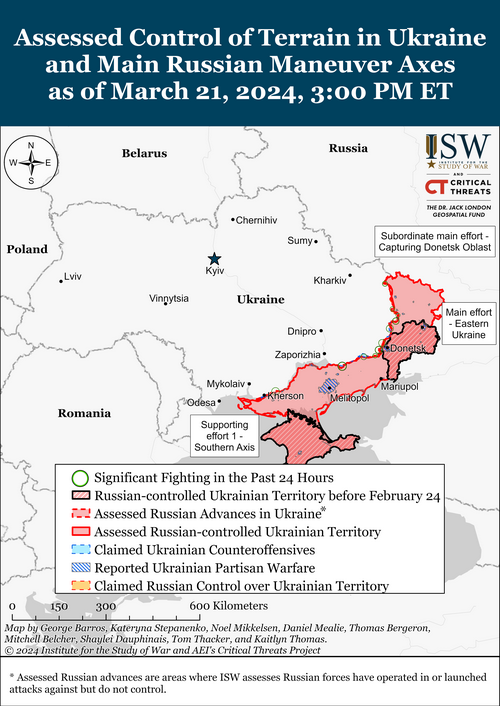
From The Institute for the Study of War:
Russian Offensive Campaign Assessment, March 21, 2024
Angelica Evans, Riley Bailey, Nicole Wolkov, Christina Harward, Grace Mappes, and Frederick W. Kagan
March 21, 2024, 6:35pm ET
Click here to see ISW’s interactive map of the Russian invasion of Ukraine. This map is updated daily alongside the static maps present in this report.
Click here to see ISW’s 3D control of terrain topographic map of Ukraine. Use of a computer (not a mobile device) is strongly recommended for using this data-heavy tool.
Click here to access ISW’s archive of interactive time-lapse maps of the Russian invasion of Ukraine. These maps complement the static control-of-terrain map that ISW produces daily by showing a dynamic frontline. ISW will update this time-lapse map archive monthly.
Note: The data cut-off for this product was 12:15pm ET on March 21. ISW will cover subsequent reports in the March 22 Russian Offensive Campaign Assessment.
The Russian military command appears to be forming reserves capable of sustaining ongoing offensive operations in Ukraine, but these reserves are unlikely to be able to function as cohesive large-scale penetration or exploitation formations this year. Ukrainian military observer Kostyantyn Mashovets stated on March 21 that the Russian military command plans for the bulk of its “strategic reserves” to be operational ahead of Russia’s reported summer 2024 offensive but suggested that it is unlikely that Russia’s “strategic reserves” will be equipped to their full end strength by this time due to materiel and manpower shortages.[1] Mashovets cited Russia’s 44th Army Corps (AC), a formation that Russia is reportedly forming as part of the Leningrad Military District (LMD), and Russia’s 163rd Armored Repair Plant as examples of how materiel limitations will constrain the formation of Russian “strategic reserves.” Mashovets stated that the Russian military command will likely only be able to provide 55 to 60 percent of the arms and equipment that the 44th AC will need by the end of 2024. Mashovets similarly stated that Russian authorities are attempting to double the 163rd Armored Repair Plant’s production volumes but that this effort will likely not be completed until the end of 2024 instead of in summer 2024 as planned. Mashovets suggested that Russia’s ability to produce new weapons and equipment and modernize old systems “does not correspond” with how quickly Russia hopes to equip its strategic reserves. Mashovets’ assessment is consistent with ISW’s assessment that Russian defense production is capable of sustaining the current tempo of Russian offensive operations but is unlikely to be able to fully support a potential operational or strategic-level mission in 2024.[2]
Large-scale Russian manpower losses are likely more significant than armored vehicle losses at this point in the war, particularly since Russian forces adjusted their tactics and transitioned to infantry-heavy ground attacks to conserve armored vehicles at the expense of greater manpower losses in fall 2023.[3] Ukrainian Main Military Intelligence Directorate (GUR) Deputy Chief Major General Vadym Skibitskyi previously reported that Russia is capable of generating forces at a rate equal to Russian monthly personnel losses (roughly 25,000 to 30,000 personnel per month) and that Russia would have to conduct “mobilization” (likely referring to large-scale mobilization) to establish a “powerful strategic reserve.”[4] The British International Institute for Strategic Studies (IISS) think tank reported on February 12 that Russia is likely able to sustain its current rate of vehicle losses (over 3,000 armored fighting vehicles annually and nearly 8,000 since February 2022) for at least two to three years by mainly reactivating vehicles from storage.[5]
It is unclear what kind of “strategic reserve” Russia is forming based on open-source reporting but known Russian manpower and material limitations suggest that Russia will likely not commit these “strategic reserves” as a cohesive formation to fighting in Ukraine but will instead use them as a manpower pool to replenish losses along the frontline. Russia’s “powerful strategic reserves” could in theory be capable of serving as a first-echelon, penetration force or second-echelon exploitation force, capable of conducting large-scale mechanized assaults into Ukrainian defensive lines and making operationally significant advances if they were fully equipped and properly trained. ISW forecasts that Russia will not develop a strategic reserve that can serve in such capacities, however, due to the limitations discussed above.[6] Russia’s ongoing crypto-mobilization efforts have proven capable of sustaining Russia’s current offensive efforts in Ukraine despite heavy losses and could be capable of recruiting the manpower necessary to form more limited Russian operational reserves.[7] The formation of additional reserves would likely allow the Russian military to backfill losses in Ukraine without taking a significant operational pause between Russia’s ongoing localized offensive efforts this spring and Russia’s anticipated summer 2024 offensive effort, which ISW previously assessed Russian forces are attempting to avoid despite difficult weather and terrain conditions.[8]
Russian offensive tactics will likely increasingly pressure Ukrainian defenses as long as delays in Western security assistance persist. Russian forces are generally relying on their manpower and materiel superiority to conduct a relatively consistent tempo of assaults against Ukrainian positions along the frontline in hopes of wearing down Ukrainian defenders and setting conditions for exploiting Ukrainian vulnerabilities.[9] Russian forces are also expanding their use of tactical aviation, drones, and electronic warfare (EW) systems in Ukraine to prepare for and support these assaults while reportedly conducting artillery fire exceeding Ukrainian artillery fire by a ratio of up to ten to one.[10] Russian forces have significantly increased guided and unguided glide-bomb strikes against rear and frontline Ukrainian positions in 2024, notably employing mass glide-bomb strikes to tactical effect in their seizure of Avdiivka in mid-February.[11] Russian and Ukrainian forces have heavily integrated drones into their reconnaissance-fire complexes (RFC) along the frontline, and Russian forces rely on drones both before and during assaults.[12] A Ukrainian commander stated on March 20 that Russian forces in the Bakhmut direction currently operate first-person view (FPV) drones at night after Russian artillery units conduct indirect fire during the day, suggesting that Russian forces continue to experiment with tactical drones and may be deconflicting artillery and drone strikes temporally.[13] Russian forces are widely employing EW systems throughout the front to disrupt Ukraine’s own drones and are reportedly increasingly equipping armored vehicles with EW systems to minimize the threat that Ukrainian drones pose to mechanized assaults.[14] Russian artillery advantages allow Russian forces to provide extensive artillery preparation and coverage for Russian assaults and are likely allowing Russian forces to systematically degrade Ukrainian fortifications.
Ukrainian military observer Tatarigami stated on March 20 that Russian forces conduct offensive operations near Bilohorivka (south of Kreminna) and in many other sectors of the front according to the following sequence: Russian forces first conduct reconnaissance with drones, strike Ukrainian forces with glide bombs, conduct artillery preparations, advance with small squad- to company-sized infantry or lightly mechanized groups, attack Ukrainian positions from 50 to 150 meters away with FPV drone support, and then, if successful, seize positions and quickly fortify them.[15] Tatarigami added that once Russian forces sufficiently degrade the Ukrainian defense in an area, Russian forces will then commit larger, company-sized assault groups to exploit vulnerabilities.[16] Tatarigami’s observations are consistent with ISW’s observations of the general chronology of the majority of current Russian assaults along the front. Russian forces do routinely change the size of assault groups and the amount of equipment they use in assaults, however, likely to test Ukrainian responses and exploit tactical opportunities in specific sectors of the front.[17]
Overall materiel shortages will likely limit how Ukrainian forces can conduct effective defensive operations while also offering Russian forces flexibility in how to conduct offensive operations. Ukrainian ammunition shortages are reportedly forcing Ukraine to husband artillery shells, constraining Ukrainian artillery units from conducting effective counterbattery fire and likely preventing Ukrainian forces from relying on artillery fire to repel Russian assaults.[18] Tatarigami stated that constrained Ukrainian artillery resources complicate Ukrainian efforts to push Russian forces from recently captured positions and often necessitate that Ukrainian forces conduct more costly counterattacks.[19] Open-source investigations indicate that Ukraine’s ammunition shortage and inability to conduct sufficient counterbattery warfare has likely allowed Russian forces to establish stationary artillery fire positions allowing for higher and more sustained rates of fire.[20] Ukrainian air defense missiles shortages will likely continue to limit Ukraine’s ability to contest air space over occupied Ukraine and threaten the Russian tactical aircraft conducting routine glide-bomb strikes.[21] Well-provisioned Ukrainian forces have repeatedly shown that they are able to prevent these Russian offensive tactics from producing tactical gains, however.[22]
Russian forces conducted a larger series of missile strikes targeting Kyiv City on the night of March 20 to 21. The Ukrainian Air Force reported that Russian forces launched two Iskander-M/KN-23/Kh-72M Kinzhal ballistic and “aeroballistic” missiles and 29 Kh-101/Kh-555 cruise missiles from 11 Tu-95MS from Volgodonsk, Rostov Oblast and Engels, Saratov Oblast and that Ukrainian air defenses and mobile fire units shot down all of the missiles over Kyiv Oblast.[23] “Aeroballistic missiles” likely refer to air-launched Kh-72M2 Kinzhal missiles, as Iskander-Ms and North Korean KN-23s are ground-launched.[24] The Kyiv City Military Administration noted that Russian forces have not targeted Kyiv City with missiles strikes in the past 44 days.[25] Ukrainian outlet Suspilne reported that its sources in the GUR stated that the Russian missile strikes targeted GUR positions.[26] Ukrainian President Volodymyr Zelensky stated that Patriot and other Western-provided air defense systems can down Russian ballistic missiles but noted that Ukraine does not currently have enough of these systems to cover other areas of Ukraine.[27]
NATO Military Committee Chairperson Admiral Rob Bauer stated that neither Ukraine nor NATO prompted Russia to invade Ukraine and that Ukrainian forces’ adaptations and innovations have in part changed modern warfare. Bauer stated on March 21 that “Russia’s war against Ukraine has never been about any real security threat coming from either Ukraine or NATO” and that Russian President Vladimir Putin has “not achieved any of his strategic objectives.”[28] ISW continues to assess that Putin invaded Ukraine in 2022 not to defend Russia against a nonexistent threat from NATO but rather to weaken and ultimately destroy NATO — a goal he still pursues.[29] Putin has claimed that Russia did not start the war in 2022 and that Russia’s invasions of Ukrainian territory in 2014 and 2022 were part of a defensive campaign aimed at protecting Russian people and the Russian state — false narratives that are meant to hide Russia’s aggression.[30] ISW also continues to assess that Putin’s maximalist goals in Ukraine, which amount to complete Western and Ukrainian capitulation and expansionist territorial gains, remain unchanged.[31]
Bauer also stated that Ukrainian forces have “fundamentally changed many aspects of modern warfare” and have quickly adapted and innovated, including by using Soviet-style equipment with modern Western materiel.[32] Ukraine’s innovations on the battlefield include its successful employment of so-called FrankenSAM hybrid air defense systems and experimentation and production of different drone technologies for combat missions on the battlefield.[33] Ukrainian officials have recently stated that Ukrainian forces have proven that a well-trained army with more advanced weapons can defeat an enemy with numerical manpower and materiel superiority but that Ukrainian forces can only maintain their superior capabilities with Western support, such as the provision of long-range, high-precision munitions and ammunition for Western-provided artillery systems.[34]
The Russian Ministry of Defense (MoD) announced on March 21 that Vice Admiral Konstantin Kabantsov became acting Commander of the Russian Northern Fleet.[35] Kabantsov previously served as the Northern Fleet’s First Deputy Commander and replaced Admiral Alexander Moiseev who became acting Commander-in-Chief of the Russian Navy.[36]
Bloomberg reported on March 20 that an unspecified source close to the Kremlin stated that the all-Russian pro-Ukrainian incursions into Belgorod Oblast are forcing the Russian military to divert forces from the frontline to Belgorod Oblast, although ISW has not observed such claims.[37] It is unclear what forces Bloomberg’s source is referencing. Russian milbloggers claimed that Russian airborne conscripts repelled recent raids in Tetkino, Kursk Oblast and that elements of the 2nd Spetsnaz Brigade repelled recent raids in Belgorod Oblast.[38] Russian officials stated that Russian military, Federal Security Service (FSB) border personnel, and Rosgvardia personnel repelled recent incursions into Russia, and Chechen Republic Head Ramzan Kadyrov claimed that units of the Chechen “Zapad-Akhmat“ Battalion repelled raids from Kharkiv Oblast.[39] Russia previously deployed similar forces to defend against Russian pro-Ukrainian border incursions in June 2023.[40] ISW continues to assess that the Kremlin must balance between the reputational cost of accepting that pro-Ukrainian forces will sometimes be able to conduct minimally effective cross-border raids into Russia while conserving its military resources for use in Ukraine and the resource cost of allocating additional forces and means to border security to reassure the Russian populace at the expense of its military operations against Ukraine.[41] The Kremlin may not suffer as high a reputational cost for limited border incursions in 2024 as it did in 2023 due to ongoing censorship efforts, however.
US sanctions continue to influence the financial sector in post-Soviet countries, as two banks in Kazakhstan recently banned the use of Russia’s “Mir” national payment system to prevent secondary sanctions. Kazakhstan’s Freedom Finance Bank stated on February 28 that it suspended operations with the “Mir” payment system due to US sanctions.[42] Kazakhstan‘s Bereke Bank also stopped issuing cash from cards using the “Mir” system on March 6.[43] Russia’s Sberbank, which fell under Western sanctions in 2022, previously owned Bereke Bank, and a company owned by the Kazakh government bought over 99 percent of Bereke Bank’s shares in September 2023, leading the US Treasury Department to remove sanctions on Bereke Bank in March 2024.[44] ISW previously reported that Armenia’s Central Bank will reportedly ban the use of the “Mir” system on March 29 and that 17 of 18 Armenian commercial banks will stop using the system on March 30.[45] The US imposed sanctions against the “Mir” system’s operator, the National Payment Card System Joint Stock Company, in February 2024.[46]
Key Takeaways:
- The Russian military command appears to be forming reserves capable of sustaining ongoing offensive operations in Ukraine, but these reserves are unlikely to be able to function as cohesive large-scale penetration or exploitation formations this year.
- Russian offensive tactics will likely increasingly pressure Ukrainian defenses as long as delays in Western security assistance persist.
- Russian forces conducted a larger series of missile strikes targeting Kyiv City on the night of March 20 to 21.
- NATO Military Committee Chairperson Admiral Rob Bauer stated that neither Ukraine nor NATO prompted Russia to invade Ukraine and that Ukrainian forces’ adaptations and innovations have in part changed modern warfare.
- The Russian Ministry of Defense (MoD) announced on March 21 that Vice Admiral Konstantin Kabantsov became acting Commander of the Russian Northern Fleet.
- Bloomberg reported on March 20 that an unspecified source close to the Kremlin stated that the all-Russian pro-Ukrainian incursions into Belgorod Oblast are forcing the Russian military to divert forces from the frontline to Belgorod Oblast, although ISW has not observed such claims.
- US sanctions continue to influence the financial sector in post-Soviet countries, as two banks in Kazakhstan recently banned the use of Russia’s “Mir” national payment system to prevent secondary sanctions.
- Russian forces recently made confirmed advances near Bakhmut and in east (left) bank Kherson Oblast amid continued positional engagements along the entire line of contact on March 21.
- Russian officials continue to highlight the work of Russia’s defense industrial base (DIB) in supporting the Russian invasion of Ukraine.
Go here to read the rest. This is interesting:
Ukrainian military observer Tatarigami stated on March 20 that Russian forces conduct offensive operations near Bilohorivka (south of Kreminna) and in many other sectors of the front according to the following sequence: Russian forces first conduct reconnaissance with drones, strike Ukrainian forces with glide bombs, conduct artillery preparations, advance with small squad- to company-sized infantry or lightly mechanized groups, attack Ukrainian positions from 50 to 150 meters away with FPV drone support, and then, if successful, seize positions and quickly fortify them.[15] Tatarigami added that once Russian forces sufficiently degrade the Ukrainian defense in an area, Russian forces will then commit larger, company-sized assault groups to exploit vulnerabilities.[16] Tatarigami’s observations are consistent with ISW’s observations of the general chronology of the majority of current Russian assaults along the front.
Reminds me of the Storm troop tactics used by the Germans in 1918.

