
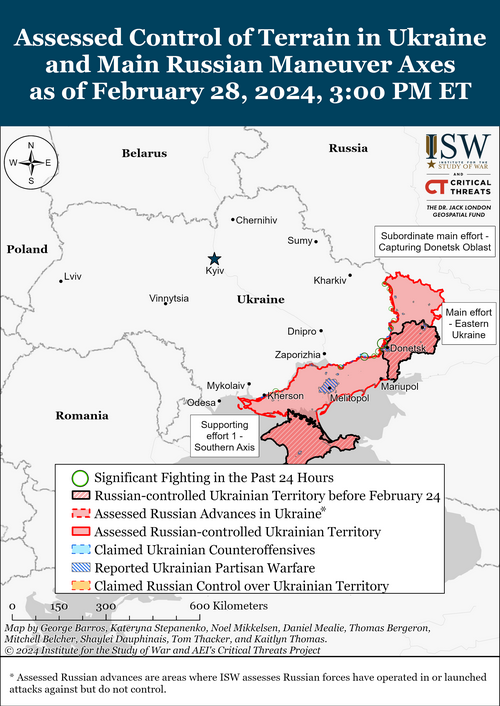
From The Institute For The Study of War:
Russian Offensive Campaign Assessment, February 28, 2024
Angelica Evans, Riley Bailey, Grace Mappes, Karolina Hird, and Frederick W. Kagan
February 28, 2024, 7:15pm ET
Click here to see ISW’s interactive map of the Russian invasion of Ukraine. This map is updated daily alongside the static maps present in this report.
Click here to see ISW’s 3D control of terrain topographic map of Ukraine. Use of a computer (not a mobile device) is strongly recommended for using this data-heavy tool.
Click here to access ISW’s archive of interactive time-lapse maps of the Russian invasion of Ukraine. These maps complement the static control-of-terrain map that ISW produces daily by showing a dynamic frontline. ISW will update this time-lapse map archive monthly.
Note: The data cut-off for this product was 1:30pm ET on February 28. ISW will cover subsequent reports in the February 29 Russian Offensive Campaign Assessment.
Pro-Russian Moldovan breakaway region Transnistria held the Seventh Congress of Transnistrian Deputies on February 28 and adopted a series of decisions that likely aim to provide the Kremlin with justifications for a wide range of possible escalatory actions against Moldova — actions the Kremlin can pursue both immediately and over the long-term.[1] The Congress of Transnistrian Deputies adopted seven decisions, including a request to the Russian State Duma and Federation Council for Russian “defense” of Transnistria in response to alleged increasing pressures from Moldova. Transnistrian officials specifically used “zashchita” (защита), a word that means both “defense” and “protection” in their request, likely to set conditions for the Kremlin to interpret “defense” in a military sense if it so chooses. Transnistrian officials invoked the obligations of the Russian “peacekeeping mission” in Transnistria and the roughly 220,000 Russian citizens they claim are residing in Transnistria in their request for Russian “defense.” Transnistrian officials likely aim for these appeals to serve as the basis for any potential Russian intervention in Transnistria and Moldova in the near or long term as they cohere with Russian justifications for previous interventions, most notably its invasions of Ukraine.[2] The Kremlin has increasingly promoted rhetoric about Russia’s ”compatriots abroad,” which include ethnic Russians and Russian speakers, to further justify its war in Ukraine and to likely set informational conditions for provocations in countries where Russian ”compatriots” live.[3] The Kremlin has also used the idea of protecting its “compatriots abroad” to justify the fact that Russian troops have occupied Transnistria since 1992, and Transnistrian officials likely made appeals concerning Transnistrian residents with Russian citizenship to set further informational conditions for the Kremlin to escalate Russian activities in Transnistria and Moldova.[4] Russian Foreign Minister Sergei Lavrov stated on February 14 that Russia is ”concerned” about Russian citizens in Transnistria and “will not allow them to become victims of another Western adventure.”[5]
The Congress of Transnistrian Deputies’ also specifically called for the United Nations (UN) and European Parliament to stop alleged Moldovan violations of Transnistrian rights and freedoms, for the Organization for Security and Cooperation in Europe (OSCE) to influence Moldova into an “adequate dialogue,” for the Commonwealth of Independent States (CIS) to prevent escalation on the Dniester River, and for the International Committee for the Red Cross (ICRC) to ensure the rights of Transnistrian residents.[6] Transnistrian officials also called on participants to return to the 5+2 negotiation process for the Transnistrian conflict, which includes Russia, Ukraine, Transnistria, Moldova, and the OSCE as mediators and the European Union (EU) and US as observers. These appeals to multilateral organizations and negotiating formats aim to legitimize Transnistria as a sovereign entity separate from Moldova without pressing claims for its independence while also providing the Kremlin with prepared justifications for escalation and intervention in the name of fulfilling both Russia’s and others’ international obligations. The Congress of Transnistrian Deputies’ appeal to the Russian-led CIS notably could be interpreted as permitting the CIS to “prevent escalation” both in Moldova and Transnistria as it does not specify a side of the Dniester River. The appeals’ focus on protecting Transnistrian rights and freedoms likely aims to set conditions for the Kremlin to apply a similar narrative about preventing “discrimination” and “genocide” against “Russians” in Moldova as the Kremlin did ahead of and during the full-scale invasion of Ukraine.[7]
Kremlin officials and mouthpieces continue to set information conditions to use Transnistria and pro-Russian Moldovan autonomous region Gagauzia to destabilize Moldova but have yet to indicate how and to what specific end they intend to leverage such information conditions.[8] These Transnistrian appeals notably do not call on Russian forces to take specific actions and are likely broadly scoped to give the Kremlin the widest set of possible courses of action (COA) for escalations and interventions aimed at destabilizing Moldova. These Transnistrian appeals are also not time delimited and allow the Kremlin to address various appeals whenever it deems necessary or expedient. The Transnistrian appeals set long-term justifications for the Kremlin to pursue escalations and interventions against Moldova regardless of the outcome of its war in Ukraine.
The Kremlin has yet to signal an immediate route for escalation following the Congress of Transnistrian Deputies, although Russian President Vladimir Putin may respond to the Transnistrian requests during his speech to the Russian Federal Assembly on February 29.[9] The Russian Ministry of Foreign Affairs (MFA) reported on February 28 in response to the Transnistrian Congress of Deputies’ appeal that protecting the interests of Transnistrian residents and Russia’s “compatriots” is one of Russia’s priorities and promised to “carefully consider” the Transnistrian requests.[10] Russian State Duma Committee on the CIS Affairs First Deputy Chairperson Konstantin Zatulin stated that the Duma will consider Transnistria’s proposals in consultation with Putin and the Russian MFA as soon as the proposals arrive.[11] Russian State Duma Committee on International Affairs First Deputy Chairperson Alexei Chepa stated that Transnistrian appeals to Russia imply economic assistance and that there is currently no talk of Russia providing Transnistria military assistance.[12] Russia would be challenged to get concrete military assistance to Transnistria in any event because it is landlocked and bordered by Ukraine on one side and Moldova (and beyond that, Romania) on the other. Chepa added that the Transnistrian requests will contribute to “faster decision-making” on Russia’s part.[13] Russian Federation Council Committee on International Affairs First Deputy Chairperson Vladimir Dzhabarov stated that the Federation Council will consider providing humanitarian support to Transnistria but that the “political question” (likely referring to the political status of Transnistria) is “out of the equation for now.”[14]
The Kremlin can use the outcomes of the Congress of Transnistrian Deputies to justify a range of possible COAs that are not mutually exclusive. The most likely course of action (MLCOA) is that the Kremlin will use the Congress as a springboard to intensify hybrid operations aimed a destabilizing and further polarizing Moldova ahead of Moldova-European Union (EU) accession negotiations and the upcoming Moldovan presidential election in June and November 2024, respectively. The most dangerous course of action (MDCOA) is that the Kremlin may decide to formally annex Transnistria in the future in order to justify military intervention against Moldova in the long-term.
- COA 1: The Kremlin may decide to not take any action immediately following the February 28 congress and allow the status quo between Transnistria and Moldova to continue. If Putin envisions a particular time frame for the development of Russian intervention in Moldova, and the Transnistrian authorities are attempting to expedite this timeframe with their requests, then Putin may decide that he is unwilling to exploit Transnistrian requests and refuse to take action or even acknowledge the requests in the immediate future. Putin may decide to engage with the requests at a later date, however.
- COA 2: The Kremlin may place increased diplomatic pressure on Moldova to revoke its recent Customs Code that went into effect on January 1, 2024. Transnistrian officials have consistently identified Moldova’s new customs regulations as the crux of their recent complaints against Moldovan authorities and continue to identify the new customs regulations as part of Moldova’s “economic war” against Transnistria as a key issue, including during the February 28 congress.[15] The Kremlin may also choose to provide additional economic support to Transnistria through humanitarian aid, financial aid, or new trade agreements as part of its efforts to further pressure Moldova‘s economy and force Moldova to capitulate to Transnistrian demands to revoke Moldova‘s new Customs Code. Moldova’s changes to its Customs Code are essential in aligning Moldova with EU regulations as part of Moldova’s path towards EU membership.[16]
- COA 3: The Kremlin may also attempt to send additional military assistance to Transnistrian forces in the future, although it is currently unclear how the Kremlin would hope to transport military equipment or personnel to Transnistria. If the Kremlin chooses to interpret “defense” in a military sense, Russia could send military assistance in the form of additional Russian “peacekeepers” or military equipment and weapons to Transnistria. It is unclear how Russia would transport this material to Transnistria given that Russia would likely have to fly the materiel through Ukrainian or Romanian (NATO) airspace or attempt a large-scale ground operation through Odesa Oblast, which Russian forces are highly unlikely to conduct as it would draw personnel away from their ongoing offensive efforts in eastern Ukraine and likely fail in any event.
- MLCOA: The Kremlin may intensify hybrid operations aimed at destabilizing and further polarizing Moldovan politics and society ahead of June 2024 European Union (EU)-Moldova accession negotiations and the November 2024 Moldovan presidential election in order to undermine and delay Moldova’s future accession to the EU. ISW previously assessed that the EU’s December 14, 2023 announcement on launching membership talks with Moldova likely triggered the Kremlin’s preparations for a possible hybrid operation against Moldova and that the Kremlin will likely intensify information operations accusing the West of waging an anti-Russian hybrid war against Moldova and/or accusing Moldova of preparing to attack civilians in Transnistria.[17]
- MDCOA: The Kremlin may decide to formally annex Transnistria in the future in order to justify military intervention against Moldova in the long-term. The Kremlin previously used similar justifications, particularly the protection of Russian citizens and “compatriots” abroad, to justify military intervention against Georgia and Ukraine.[18] ISW has not observed any clear indications of Russian military preparations to intervene in Transnistria or Moldova.[19] Russian military intervention would be challenging for Russia since Moldova (and Transnistria) is landlocked and only accessible through Romania or Ukraine. ISW previously assessed that the Russian forces currently in Transnistria could threaten the stability of Moldova, but ISW has observed no indicators that they are preparing to do so.[20]
Ukrainian forces reportedly conducted another strike on a Russian personnel concentration in occupied Donetsk Oblast, once again sparking ire amongst Russian milbloggers and re-surfacing concerns about Ukraine’s use of HIMARS systems. A Russian Telegram user who claims to be an employee of an unspecified branch of Russian special services reported that a Ukrainian HIMARS strike hit a gathering of personnel of the 155th Naval Infantry Brigade (Pacific Fleet) during a military awards ceremony in Olenivka, Donetsk Oblast on the night of February 27.[21] The Russian source claimed that the strike killed 19, including the deputy brigade commander, a major, and a captain, and wounded 12, including brigade commander Colonel Mikhail Gudkov. The Russian source accused the Russian command of being aware of Ukrainian drone reconnaissance activity in the area but ignoring the available information ahead of the strike. Ukrainian forces have conducted two similar HIMARS strikes against Russian troop concentrations over the past week, targeting a training ground near occupied Volnovakha, Donetsk Oblast on February 20 and a training ground in occupied Podo-Kalynivka, Kherson Oblast on February 22.[22] One milblogger noted that “these are no longer isolated mistakes,” and suggested that Ukraine is deliberately striking such gatherings of Russian personnel in a “clinical” manner.[23] Russian milbloggers appear increasingly concerned that Ukrainian forces are able to exploit poor Russian operational security practices (such as large gatherings in near-rear areas under Ukrainian aerial reconnaissance) using well-timed and well-targeted HIMARS strikes, which continue to generate discontent in the Russian information space.
Russia continues cracking down on actors it deems “foreign agents” to consolidate control over the Russian information space ahead of the March 2024 presidential election. The Russian State Duma adopted a law on February 28 banning Russians from advertising the content of individuals and organizations legally designated as “foreign agents” and from advertising their own content on platforms that these “foreign agents” own. ISW previously assessed that this law, if passed, would impact Russian opposition media’s ability to operate and reliably report in Russia, and at least one Russian opposition journalist has already suspended their work due to the new advertising ban.[24] Russian outlet RBK reported that large Russian advertising agencies are already including unilateral termination clauses in their advertising contracts in case the Kremlin designates a client as a foreign agent during the term of their contract.[25] Russian opposition outlet Verstka reported on February 28 that the Kremlin has more than doubled its criminal prosecutions of designated foreign agents for violating Russian censorship laws from 2022 to 2023, most commonly for allegedly spreading ”fake” information about the Russian military or promoting extremism.[26] Some Russian regional authorities are also increasing efforts to discourage violations of Russian censorship laws; the Krasnodar Krai Legislative Assembly is considering a bill that would deprive Russians convicted of spreading fake information, discrediting the Russian military, or promoting extremism of their ability to vote in Russian elections.[27]
A Financial Times (FT) investigation published on February 27, reportedly based on leaked classified Russian military documents from 2008-2014, outlines Russia’s purported criteria for the use of tactical nuclear weapons. FT reported that the documents show that Russia has war-gamed avenues for employing tactical weapons and alleged that the files show that Russia has a lower threshold for using nuclear weapons “if the desired result can’t be achieved through conventional means” than Russian officials have ever publicly admitted.[28] FT stated that the criteria for a nuclear response vary between “an enemy incursion on Russian territory” to more specific parameters, such as “the destruction of 20 percent of Russia’s strategic ballistic missile submarines.” FT noted that unspecified experts have confirmed that the documents remain relevant to Russian nuclear doctrine despite the fact that they are over a decade old. ISW cannot independently verify the legitimacy of the documents but has frequently observed that Russian actors invoke nuclear rhetoric and threats of nuclear weapons use to target the Western information space and instill concern aimed at weakening Western support to Ukraine.[29] It has long been established that Russian nuclear doctrine includes the option to use nuclear weapons in conventional wars at thresholds much lower than Western states.
Turkey and China appear to be pursuing their own negotiation platforms for a settlement in Ukraine, which the Kremlin will likely exploit to further its long-standing narratives regarding negotiations and the war. Chinese Special Representative for Eurasian Affairs Li Hiu will visit EU states, Ukraine, and Russia starting on March 2 to conduct a round of shuttle diplomacy regarding a political solution to the war in Ukraine.[30] Russia previously seized on China’s approach to a vaguely defined political peace plan for Ukraine to claim that China supports Russia’s war effort in Ukraine, as ISW previously reported.[31] Turkish President Recep Tayyip Erdoğan similarly announced on February 28 that Ankara is prepared to provide another negotiations platform for Russia and Ukraine.[32] The Kremlin will likely weaponize these proposed platforms to further the narrative that Ukraine is the party refusing negotiations. ISW continues to assess that the Kremlin is not interested in good-faith negotiations with Ukraine and has no interest in ending the war on anything but Russia’s articulated terms.[33]
Key Takeaways:
- Pro-Russian Moldovan breakaway region Transnistria held the Seventh Congress of Transnistrian Deputies on February 28 and adopted a series of decisions that likely aim to provide the Kremlin with justifications for a wide range of possible escalatory actions against Moldova — actions the Kremlin can pursue both immediately and over the long-term.
- The Kremlin has yet to signal an immediate route for escalation following the Congress of Transnistrian Deputies, although Russian President Vladimir Putin may respond to the Transnistrian requests during his speech to the Russian Federal Assembly on February 29.
- The Kremlin can use the outcomes of the Congress of Transnistrian Deputies to justify a range of possible COAs that are not mutually exclusive.
- Ukrainian forces reportedly conducted another strike on a Russian personnel concentration in occupied Donetsk Oblast, once again sparking ire amongst Russian milbloggers and re-surfacing concerns about Ukraine’s use of HIMARS systems.
- Russia continues cracking down on actors it deems “foreign agents” to consolidate control over the Russian information space ahead of the March 2024 presidential election.
- A Financial Times (FT) investigation published on February 27, reportedly based on leaked classified Russian military documents from 2008-2014, outlines Russia’s purported criteria for the use of tactical nuclear weapons.
- Turkey and China appear to be pursuing their own negotiation platforms for a settlement in Ukraine, which the Kremlin will likely exploit to further its long-standing narratives regarding negotiations and the war.
- Russian forces made confirmed advances near Svatove, Avdiivka, and Donetsk City.
- Russian Defense Minister Sergei Shoigu inspected the Tula State University’s Military Training Center and several defense industrial base (DIB) enterprises in Tula Oblast on February 28.
- Russian occupation authorities are using early voting for the Russian presidential election to cloak Russia’s illegal occupation of Ukraine in a veneer of fabricated legitimacy.
Go here to read the rest. Moldova has long been on Putin’s hit list, and it may be next if Putin prevails in the Ukraine, a very big if.

