
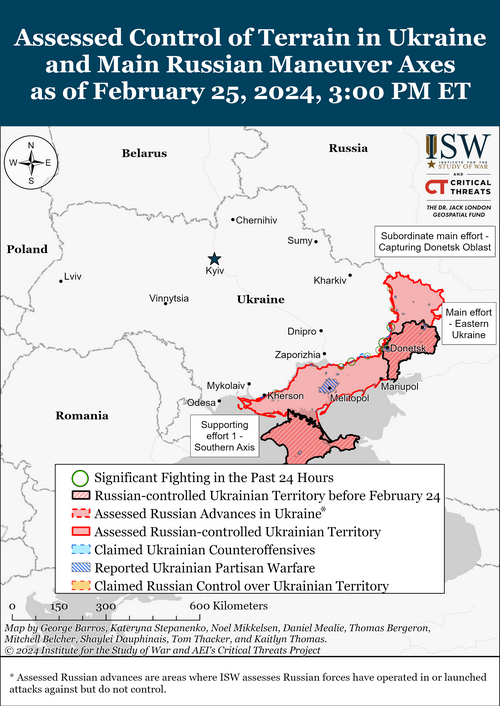
From The Institute for the Study of War:
Russian Offensive Campaign Assessment, February 25, 2024
Nicole Wolkov, Angelica Evans, Christina Harward, Karolina Hird, and Frederick W. Kagan
February 25, 2024, 4:30pm ET
Click here to see ISW’s interactive map of the Russian invasion of Ukraine. This map is updated daily alongside the static maps present in this report.
Click here to see ISW’s 3D control of terrain topographic map of Ukraine. Use of a computer (not a mobile device) is strongly recommended for using this data-heavy tool.
Click here to access ISW’s archive of interactive time-lapse maps of the Russian invasion of Ukraine. These maps complement the static control-of-terrain map that ISW produces daily by showing a dynamic frontline. ISW will update this time-lapse map archive monthly.
Note: The data cut-off for this product was 12pm ET on February 25. ISW will cover subsequent reports in the February 26 Russian Offensive Campaign Assessment.
Click here to read ISW’s latest warning update on the possibility of Transnistria, a pro-Russian breakaway region of Moldova, calling for Russian annexation or taking other action to support Russian hybrid operations against Moldova.
Russian officials and state media largely refrained from publicly discussing the two-year anniversary of Russia’s full-scale invasion of Ukraine on February 24, likely in an effort to avoid addressing Russia’s failure to achieve its stated war aims at significant human costs. Russian opposition outlet Agentstvo Novosti reported on February 25 that Russian state TV channels Rossiya 1 and Channel One (Perviy Kanal) and Gazprom Media-owned TV channel NTV did not mention the two-year anniversary of the start of Russia’s full-scale invasion of Ukraine in broadcasts on February 24.[1] Agentstvo Novosti stated that Russian political commentator Mikhail Leontev noted in a February 24 broadcast of the “Vremya” program on Channel One that it was the two-year anniversary of the start of the war but did not offer further statements on the topic. ISW observed minimal discussion by Russian government officials on the two-year anniversary of the start of Russia’s full-scale invasion on February 24.
Russian officials and state-run and state-affiliated TV channels likely refrained from commenting on the two-year anniversary of the start of Russia’s full-scale invasion to avoid drawing attention to Russia’s failures to achieve its stated strategic goals in Ukraine and its more immediate goals of seizing all of Luhansk and Donetsk oblasts, while also suffering high personnel losses. A recent Russian opinion poll indicated that Russian sentiments about the war in Ukraine have largely remained unchanged in recent months and that most Russians are largely apathetic to the war, though most do not support a second wave of mobilization.[2] Russian President Vladimir Putin and Russian government officials likely refrained from highlighting the second anniversary of Russia‘s full-scale invasion in an effort to maintain public apathy toward the war that, in part, allows Russian officials to continue the war without significant public backlash. ISW continues to assess that Putin is likely aware that a second mobilization wave would be widely unpopular and is concerned that such a measure would generate widespread discontent.[3] Putin may, however, become less concerned about public sentiment after his reelection in March 2024 and determine that Russian force generation requirements outweigh the risks of widespread domestic discontent.
Ukrainian officials discussed Ukraine’s goals and priorities for 2024 on February 25 and highlighted the need for continued Ukrainian innovation and Western aid to accomplish Ukraine’s objectives. Ukrainian Defense Minister Rustem Umerov stated that Ukraine is doing everything “possible and impossible” to make a breakthrough along the frontline and that Ukraine has an undisclosed plan for 2024 that will not only bring “hope” but also yield tangible results.[4] Umerov and Ukrainian Commander-in-Chief Colonel General Oleksandr Syrskyi visited several Ukrainian command posts in the Lyman, Bakhmut, Avdiivka, and other directions and noted the importance of protecting Ukrainian personnel from Russian drone and air strikes in certain areas of the front.[5] Ukrainian President Volodymyr Zelensky noted that Ukraine hopes to further reduce Russia’s advantage in battlefield artillery systems, currently estimated to be at a 6 to 1 advantage, ahead of future Ukrainian counteroffensive operations.[6] Zelensky warned that Ukraine could continue to lose territory meter by meter if Ukraine does not receive and produce additional artillery systems.[7] Ukrainian Deputy Commander-in-Chief Colonel Vadym Sukharevskyi highlighted Ukraine’s newly-formed Unmanned Systems Force as an important next step in Ukraine’s war effort that is intended to improve Ukrainian efficiency, systematization, and analysis of drone use.[8] Sukharevskyi reiterated that Ukrainian forces are not trying to use drones to replace artillery systems, but rather as additional weapons to defeat the Russian military.[9] Ukrainian Main Military Intelligence Directorate (GUR) Head Lieutenant General Kyrylo Budanov stated that Ukraine needs significant volumes of long-range weapons from Ukraine‘s Western allies, and Zelensky expressed confidence in Western provisions of long-range weapons.[10] Umerov noted that there is a critical difference between the allocation and provision of Western aid to Ukraine, and Budanov added that Russia and Ukraine are currently competing to see who will get the “upper hand” on the battlefield.[11] Several Ukrainian officials, including Zelensky, highlighted plans to hold the first Ukrainian Peace Formula Summit in Switzerland this year and emphasized the importance of further developing Ukraine’s partnership with NATO in 2024.[12]
Drone footage posted on February 25 shows Russian forces committing apparent war crimes near Bakhmut. The footage shows Russian forces executing nine Ukrainian prisoners of war (POWs) who had just surrendered near Ivanivske (on the outskirts of Bakhmut).[13] The execution of POWs is a violation of the Geneva Convention on the Treatment of POWs.[14] The February 25 footage is the fourth such instance of video evidence showing Russian forces executing Ukrainian POWs in the past two weeks alone.[15]
The Russian information space continues to be highly sensitive to the recent losses of A-50 long-range radar detection aircraft, suggesting that the issue of deploying and defending these aircraft is of great concern. Ukrainian Main Military Intelligence Directorate (GUR) Lieutenant General Kyrylo Budanov stated that Ukrainian forces prepared the operation to shoot down the A-50 for two weeks.[16] Budanov stated that Russia has six more A-50s left and cryptically suggested that another A-50 will “fall” and force Russia to stop sortieing the planes “round-the-clock.” A Russian milblogger claimed that Russian forces reported “to the top” (likely meaning to Russian high command) that a Ukrainian Patriot missile shot down the A-50, but the milblogger and others expressed doubt that this version of events was true and criticized the “systemic” problem of Russian personnel only thinking of themselves and their careers out of “self-preservation.”[17] Ukrainian media previously reported that sources in the Ukrainian GUR stated that Ukraine downed the A-50 with modified S-200 systems.[18] Another Russian milblogger claimed that the loss of a second Russian A-50 this winter is problematic as Russia already had a shortage of these aircraft before its full-scale invasion of Ukraine.[19] The milblogger claimed that Russia will not be able to modernize many A-50s into A-50Us for a number of unspecified technical and organizational reasons and offered possible alternatives, including creating inferior “ersatz” airborne and early warning control systems (AWACS) or purchasing similar aircraft from China.
Ukrainian Main Military Intelligence Directorate (GUR) Head Lieutenant General Kyrylo Budanov stated that Russia has not received any long-range missiles from Iran as of February 25.[20] Reuters reported on February 21, citing alleged Iranian sources, that Iran provided Russia hundreds of short-range ballistic missiles (SRBMs) in early January 2024.[21] ISW has not yet observed visual evidence of Russian forces using Iranian missiles in Ukraine but has frequently observed increased Russo-Iranian military cooperation over the backdrop of the war.[22]
Key Takeaways:
- Russian officials and state media largely refrained from publicly discussing the two-year anniversary of Russia’s full-scale invasion of Ukraine on February 24, likely in an effort to avoid addressing Russia’s failure to achieve its stated war aims at significant human costs.
- Russian officials and state-run and state-affiliated TV channels likely refrained from commenting on the two-year anniversary of the start of Russia’s full-scale invasion to avoid drawing attention to Russia’s failures to achieve its stated strategic goals in Ukraine and its more immediate goals of seizing all of Luhansk and Donetsk oblasts, while also suffering high personnel losses.
- Ukrainian officials discussed Ukraine’s goals and priorities for 2024 on February 25 and highlighted the need for continued Ukrainian innovation and Western aid to accomplish Ukraine’s objectives.
- Drone footage posted on February 25 shows Russian forces committing apparent war crimes near Bakhmut.
- The Russian information space continues to be highly sensitive to the recent losses of A-50 long-range radar detection aircraft, suggesting that the issue of deploying and defending these aircraft is of great concern.
- Ukrainian Main Military Intelligence Directorate (GUR) Head Lieutenant General Kyrylo Budanov stated that Russia has not received any long-range missiles from Iran as of February 25.
- Russian forces recently made confirmed advances near Bakhmut and Krynky amid continued positional engagements along the entire line of contact on February 25.
- Russian authorities continue efforts to recruit Ukrainian citizens in occupied Ukraine into the Russian military.
- Ukrainian Verkhovna Rada Human Rights Ombudsman Dmytro Lubinets stated on February 25 that Russia is holding over 28,000 Ukrainian citizens captive in Russian prisons.
Go here to read the rest. Putin thought he was launching a 30 day War. Instead it is two years and counting.

