
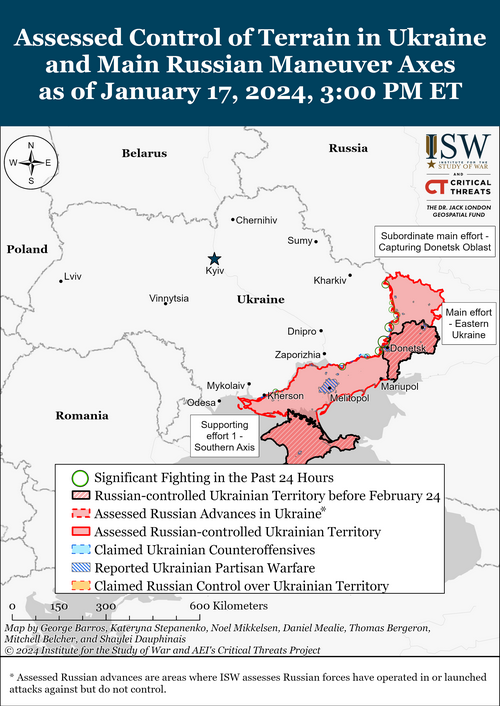
From The Institute for the Study of War:
Russian Offensive Campaign Assessment, January 17, 2024
Riley Bailey, Nicole Wolkov, Grace Mappes, Christina Harward, Angelica Evans, George Barros, and Frederick W. Kagan
January 17, 2024, 8pm ET
Click here to see ISW’s interactive map of the Russian invasion of Ukraine. This map is updated daily alongside the static maps present in this report.
Click here to see ISW’s 3D control of terrain topographic map of Ukraine. Use of a computer (not a mobile device) is strongly recommended for using this data-heavy tool.
Click here to access ISW’s archive of interactive time-lapse maps of the Russian invasion of Ukraine. These maps complement the static control-of-terrain map that ISW produces daily by showing a dynamic frontline. ISW will update this time-lapse map archive monthly.
Note: The data cut-off for this product was 12:30pm ET on January 17. ISW will cover subsequent reports in the January 18 Russian Offensive Campaign Assessment.
Note: ISW has added a new section on Ukrainian defense industrial base (DIB) efforts to the daily Russian Offensive Campaign Assessment to track the development of Ukraine’s DIB and the international support for Ukraine’s DIB efforts. ISW will be publishing its assessments in this section based on public announcements, media reporting, and official statements.
A Ukrainian intelligence official reported that Russian forces lack the necessary operational reserves to conduct simultaneous offensive efforts in more than one direction in Ukraine. Ukrainian Main Military Intelligence Directorate (GUR) Deputy Chief Major General Vadym Skibitskyi reported on January 17 that Russia does not have enough reserves to conduct large-scale offensive operations in several directions at the same time.[1] Skibitskyi stated that it is impossible for Russian forces to conduct strategically or operationally significant offensive operations without “powerful” reserves and implied that Russia does not have such reserves.[2] Skibitskyi noted that mobilization measures are ongoing in Russia, likely referring to the current Russian crypto-mobilization campaign that relies heavily on volunteer recruitment and the coercive mobilization of convicts and migrants.[3] It is unclear if Russia’s ongoing crypto-mobilization campaign has provided or would be able to provide the increased number of personnel that an intensified Russian offensive effort would require. Skibitskyi reported on January 15 that Russia recruits about 30,000 personnel per month, which the Russian military uses to replenish losses and form reserve regiments, and that Russia would need to conduct “mobilization” (likely referring to another “partial mobilization” like Russia conducted in September 2022 or a large-scale general mobilization) to establish a “powerful strategic reserve.”[4] Skibitskyi’s statements suggest that although the Russian military is able to generate enough manpower to conduct routine operational-level rotations in Ukraine, Russian forces may not necessarily be able to generate manpower at a rate that would allow Russian forces to quickly re-establish the operational reserves necessary for simultaneous offensive efforts in several directions.[5]
Russian Security Council Deputy Chairperson Dmitry Medvedev reiterated on January 17 that the elimination of Ukrainian statehood and independence remains one of Russia’s core war aims. Medvedev claimed that “the presence of an independent state on historical Russian territories” is a “constant reason for the resumption of hostilities” and that Ukraine’s very existence as an independent state is therefore “mortally dangerous” for Ukrainians.[6] Medvedev claimed that an independent Ukraine will never be a legitimate state regardless of who leads the government and that a future conflict for Ukrainian territory is inevitable whether or not it is a new conflict or the continuation of the current Russian war in Ukraine.[7] Medvedev’s January 17 statement is one of many recent signals from senior Russian officials, including President Vladimir Putin, that Putin and the Kremlin have no interest in good-faith negotiations with Ukraine and that Putin’s maximalist war aims in Ukraine remain unchanged.[8] Medvedev attempted to portray Russia’s commitment to these maximalist objectives as unwavering by claiming that Ukrainian accession to the European Union (EU) or NATO will not prevent future conflict.[9] Medvedev notably did not define what he considers to be historical Russian territories, but Putin has defined historical Russian lands as the territory of the former Russian Empire and Soviet Union.[10] Medvedev’s opacity may be intentional, as the Kremlin’s loosely defined concept of “historical Russian territories” allows the Kremlin to pursue expansionist objectives wherever and whenever it so determines in a broad area including Central Asia, the Caucuses and parts of Eastern Europe.[11] Medvedev’s emphasis on the destruction of any Ukrainian state on these “historical Russian territories” could indicate that some actors in the Kremlin prioritize expansionist objectives over the identified objective of regime change under calls for the “de-nazification” of Ukraine.
Russian forces conducted a series of missile and drone strikes largely targeting Odesa and Kharkiv cities on the night of January 16 to 17. The Ukrainian Air Force stated that Russian forces launched two S-300 missiles from Belgorod Oblast towards Kharkiv City and 20 Shahed-136/-131 drones from Primorsko-Akhtarsk, Krasnodar Krai and that Ukrainian forces shot down 19 of the drones over Zaporizhia, Mykolaiv, Odesa, Dnipropetrovsk, and Kirovohrad oblasts.[12] Ukraine’s Southern Operational Command stated that Russian drones largely targeted Odesa City.[13] Ukrainian officials reported that Russian drones and missiles damaged residential buildings in Odesa and Kharkiv cities.[14]
Ukraine successfully employed a Ukrainian-refurbished hybrid air defense system (FrankenSAM) for the first time. Ukrainian Minister of Strategic Industries Oleksandr Kamyshin stated on January 17 that Ukrainian forces destroyed a Russian Shahed drone with a hybrid air defense system — referring to the so-called FrankenSAM systems that merge advanced Western air defense missiles with modified Soviet launchers or other missile launchers — for the first time.[15] Kamyshin noted that the full development of Ukraine’s own air defenses will take years, so Ukraine is creating home-made air defense systems using Soviet components and Western missiles. ISW continues to assess that Western provisions of air defense systems and missiles remain crucial as Ukraine develops its defense industrial base (DIB).[16] Kamyshin also stated that Ukraine has doubled its ammunition production for NATO-caliber artillery systems.[17] Ukraine began domestically producing 155mm shells, which are a NATO-standard used by Western-supplied guns that Ukraine’s defense industrial base (DIB) had never produced before, no later than September 2023.[18]
Germany and France announced additional military assistance to Ukraine on January 16. German Chancellor Olaf Scholz announced on January 16 that Germany will provide Ukraine with military goods worth more than seven billion euros (roughly $7.62 billion) in 2024.[19] The German government announced that the aid package includes ammunition for Leopard tanks, armored personnel carriers, reconnaissance drones, and Marder infantry fighting vehicles.[20] Germany provided 5.4 billion euros ($5.89 billion) worth of military assistance to Ukraine in 2023.[21] French President Emmanuel Macron announced on January 16 that he would finalize a bilateral security agreement with Kyiv during a visit to Ukraine in February 2024.[22] Macron also stated that France will send 40 SCALP long-range missiles and “several hundred” unspecified bombs to Ukraine in the coming weeks.
Western officials highlighted Ukraine’s battlefield successes at the Davos World Economic Forum on January 16 and 17. NATO Secretary General Jens Stoltenberg and US National Security Advisor Jake Sullivan noted that Ukraine has opened a corridor to export grain in the Black Sea, weakened the Russian Black Sea Fleet (BSF), and liberated more than half of its territory that Russian forces captured since the beginning of Russia’s full-scale invasion.[23] Sullivan also highlighted Ukraine’s efforts to develop its own defense industrial base (DIB).[24] US Secretary of State Antony Blinken stated that a ceasefire between Ukraine and Russia is unlikely in the near future — in line with ISW’s long-standing assessment that Russia is not interested in engaging in meaningful, good-faith negotiations with Ukraine.[25] Ukrainian President Volodymyr Zelensky met with Vietnamese Prime Minister Pham Minh Chinh and Ghanan President Nana Akufo-Addo and called on them to support Ukraine’s peace formula.[26] Zelensky also met with Polish President Andrzej Duda and discussed bilateral relations, the situation on the battlefield in Ukraine, and Ukraine’s accession to the European Union (EU).[27]
The Russian ultranationalist community will likely concretize xenophobia and insecurities about Russia’s ethnic composition as key shared principles within the community in 2024, as Russian ultranationalists continue to seize on incidents involving migrants and non-ethnic Russian groups to call for anti-migrant policies and express growing hostility towards non-ethnic Russians in Russia. Russian information space actors within the ultranationalist milblogger community have increasingly fixated on singular incidents that implicate migrant communities in acts of violence or resistance in 2023 and have weaponized this rhetoric to call on Russian officials to more widely mobilize migrants to fight in Ukraine, curtail migrants’ access to social and economic opportunities, and substantively change Russia’s existing migration policies.[28] Russian ultranationalists have also increasingly advocated for ethnic Russians to receive more domestic power in Russia and continue to promote hyper-nationalist ideologies that are generating domestic tensions between ethnic minority communities and ethnic Russians.[29] s may malign the nominal rights to autonomy that many non-ethnic Russian communities have through their respective federal Russian republics and are likely to react harshly to discussions centering on the political, economic, and social concerns of non-ethnic Russians.[30]
The Kremlin’s ongoing attempt to court the Russian ultranationalist community will likely generate increasing friction between the Kremlin’s desired rhetoric and policies concerning migration and interethnic relations and those of Russian ultranationalists. Russian officials appear to have tolerated or even endorsed ultranationalists’ increasing anti-migration rhetoric since it likely generated social pressures that have augmented Russian efforts to coerce migrants into military service in Ukraine.[31] The Kremlin now appears to be struggling to reconcile efforts to increase Russian industrial capacity while also coercing migrants into military service and disincentivizing them from working in Russia.[32] Any efforts to appease Russian ultranationalists will likely only exacerbate inconsistent and contradictory Kremlin policies concerning migrants. Hostility towards non-ethnic Russians in Russia directly contradicts Russian President Vladimir Putin’s effort to promote the concept of a wider and ethnically inclusive “Russian World” (Russkiy Mir) that encompasses non-ethnic Russians in both modern Russia and the former territory of the Soviet Union and Russian Empire.[33] The Kremlin continues to rely on the ultranationalist community in its effort to solidify pro-war sentiments, hyper-nationalism, Russian orthodoxy, and “traditional” social values as core tenets of the Russian state.[34] The Kremlin will likely struggle to balance these parallel efforts as Russian ultranationalists display increasing animus to non-ethnic Russians in Russia and in neighboring countries.
Significant protests erupted in Baymak, Bashkortostan Republic, following a Russian court’s guilty verdict for a prominent Bashkort activist, prompting a swift Russian government response as well as backlash from the Russian ultranationalist community. Bashkortostan’s Baymaksky Court found prominent Bashkort activist Fail Alsynov guilty on January 11 of inciting ethnic hatred and sentenced him to four years in prison, which the court announced publicly on January 17 following a closed-door trial.[35] Alsynov allegedly gave a speech on April 28, 2023, that insulted ethnic groups from the Caucasus.[36] Hundreds of Alsynov’s supporters had gathered at the courthouse ahead of his January 17 verdict announcement, and protests involving hundreds to thousands of supporters lasted for hours following the verdict. Some Russian opposition sources reported that 2,000-5,000 people protested in support of Alsynov and that responding Russian authorities detained anywhere from five to several dozen protestors.[37] The reported scale of the Baymak protest appears comparable to if not larger than that of the antisemitic riots in Dagestan in October 2023.[38] Footage shows Russian riot police using tear gas and stun grenades to dispel the protestors, two of whom Russian police beat with batons and 20-40 of whom sought medical attention following the protests.[39] Russian law enforcement reportedly detained around 20-40 protestors, and Alsynov’s supporters negotiated with Russian law enforcement to cease protests for the day in exchange for the release of the detained protestors.[40] The protests have dispersed as of this publication, though it is unclear whether activists are planning for further protests on subsequent days. Hundreds to thousands of activists gathered outside the Baymaksky Court in the days leading up to the public announcement of Alsynov’s sentence, suggesting that the size of the protests on January 17 was not necessarily spontaneous.[41]
Russian authorities appear to be better equipped to handle the Bashkortostan protests than the October 2023 Dagestan protests. The Russian Investigative Committee announced on January 17 that it is opening a criminal investigation into the protest for the organization of and participation in “mass riots” and for the use of violence against authorities.[42] Multiple Telegram channels that the Bashkort activists reportedly used to coordinate and spread news of the protest became temporarily unavailable on January 17, a possible Russian government censorship attempt to limit the protest from growing or spreading.[43] The Russian ultranationalist community latched onto the Bashkortostan protest in anger despite the swift government response. Some criticized Alsynov’s supporters as “extremists” and “wolves in sheep’s clothing” who only aim to separate Bashkortostan from Russia.[44] Others amplified footage of military personnel in Bashkortostan’s “Minigali Shaimuratov” Battalion disavowing the protesters and Alsynov as “traitors,” “extremists,” and “separatists.”[45] The Russian government and Bashkort military personnel’s swift response suggest that the Russian government may intensify efforts to ensure that non-ethnic Russian communities support the war in Ukraine. Russian sources’ characterization of the protesters as “separatists” organized by outside forces suggests that Russian ultranationalists will continue to label any notable unrest from non-ethnic Russians as a hybrid warfare attack against Russia.[46]
Widespread Russian milblogger complaints about an Uzbek community leader in Russia prompted the Russian Investigative Committee to open a criminal investigation, suggesting that the Russian government may feel increasing pressure to respond to milblogger demands as the ultranationalist information space coalesces around xenophobic and anti-migrant ideals. The Russian Investigative Committee announced on January 17 that it opened a criminal investigation into Interregional Uzbek Community “Vatandosh” President Usman Baratov for a social media post allegedly “insulting the participants of the special military operation” after unspecified Russian military correspondents appealed to Investigative Committee Head Alexander Bastrykin.[47] Russian ultranationalist milbloggers widely criticized Baratov’s social media posts and called for Baratov to leave Russia.[48] The Investigative Committee’s swift response to milbloggers’ requests may prompt them to make future demands of the Russian government. The Investigative Committee’s prompt announcement also suggests that the Russian government is monitoring and potentially responding to demands of the Russian ultranationalist community — a subsection of the Russian information space that it routinely attempts to cultivate and co-opt to advance government narratives. Russian milbloggers also widely criticized an allegedly naturalized Russian citizen of Azeri ethnicity against whom the Investigative Committee opened a case for “attempted murder and incitement of hatred based on ethnicity” on January 17.[49] Russian milbloggers increasingly fixate on crimes that non-ethnic Russians reportedly commit, and some milbloggers have claimed that unspecified non-ethnic Russian diasporas control entire sectors of the Russian economy.[50] The Russian ultranationalist community’s framing of non-ethnic Russian diaspora communities as an internal threat to Russian security and economic interests are irreconcilable with the Kremlin’s portrayal of Russia as a harmonious multiethnic society. The Russian ultranationalist community may increasingly pressure the Russian government to take actions against migrant and non-ethnic Russian diaspora communities, which may exacerbate the fracture between the ultranationalist community and the government.
The Russian military command continues to convict Russian officers in cases associated with Ukrainian strikes as part of a likely effort to improve discipline across the Russian military. Moscow’s Second Western District Military Court sentenced the former head of Rosgvardia’s maritime department, Colonel Sergei Volkov, to six years in prison on January 16 for allegedly supplying low-quality radar systems to protect the Kerch Strait Bridge in occupied Crimea and a gas pipeline from Krasnodar Krai to occupied Crimea from Ukrainian drone strikes.[51] The court found Volkov guilty of “abuse of office with grave consequences” for his participation in a 400 million ruble ($4.5 million) corruption scheme involving the acquisition of two radar systems that Volkov reportedly knew could not properly defend against Ukrainian drones.[52] The Second Western District Military Court convicted two Russian air defense officers on December 6, 2023, for negligence in failing to prevent a Ukrainian strike on Russian territory.[53] Russian authorities also previously detained the commander of the 1st Special Purpose Air and Missile Defense Army on corruption and bribery charges, likely for failing to prevent drone strikes against Moscow City in July and August 2023.[54] The Russian military command likely intends to set a precedent across the Russian military concerning possible punishment for failures to defend against Ukrainian strikes — particularly strikes against high-value targets — regardless of whether the cases explicitly allege that these officers violated Russian rules of combat duty or tangentially associate the officers’ dereliction of duties with corruption schemes.[55] The Russian command likely hopes that these precedents will improve discipline writ large among Russian forces in Ukraine, although ISW has not observed such an effect.
The Kremlin continues efforts to expand Russia’s influence in Africa through the Russian Ministry of Defense (MoD) and the MoD-controlled Africa Corps. The Ukrainian Main Military Intelligence Directorate (GUR) reported that the Russian military is forming squads of “military instructors” to deploy to African countries, likely referring to the Africa Corps, and that Russia is recruiting these squads in Russia and occupied Ukraine, particularly in Crimea.[56] ISW previously reported that the Africa Corps aims to subsume the Wagner Group’s operations in Africa after the Russian MoD failed to directly recruit former Wagner personnel.[57] Russian officials have routinely referred to Wagner personnel operating in Africa as “military instructors” and “advisors” since 2018 despite Wagner’s combat roles in the Central African Republic (CAR) and Mali.[58] The GUR reported that Russia is particularly focused on recruiting Russian reservists who specialized in maintaining air defense systems, former sailors, and other specialists and that Russian reservists are attracted to this opportunity due to high salaries and the hope of avoiding fighting in Ukraine.[59] ISW has previously observed the Africa Corps advertising “high salaries” beginning at 110,000 rubles ($1,240) but stipulating that interested applicants who are currently fighting in the war in Ukraine cannot transfer to serve in the Africa Corps.[60] The Russian MoD announced on January 17 that Russian Deputy Defense Ministers Colonel General Alexander Fomin and Colonel General Yunus-Bek Yevkurov met with Nigerien National Defense Minister Major General Salifou Modi to discuss bilateral military and military-technical cooperation.[61] ISW previously assessed that the Kremlin is likely attempting to expand the Africa Corps’ operations in Niger, Burkina Faso, and Mali.[62]
The threat of US secondary sanctions is reportedly having a large-scale effect on Turkish–Russian financial ties. Russian outlet Kommersant stated on January 17 that Turkish banks have “universally” begun to refuse to work with Russian banks.[63] Kommersant reported that sources indicated that Turkish banks’ fear of secondary sanctions sharply increased after the United States authorized secondary sanctions on financial institutions on December 22, 2023, that facilitate Russian sanctions evasion and support the Russian war effort in Ukraine. Bloomberg reported on January 16 that at least two state-owned Chinese banks ordered reviews of their business with Russian clients and will sever ties with sanctioned Russian entities and entities tied to the Russian defense industry following the US’ December 2022 secondary sanctions authorization.[64]
The Russian government likely continues efforts to gain access to data on Russian citizens. Kremlin newswire TASS stated on January 17 that a Moscow court fined Amazon Cloud Services more than 200 million rubles (about $2,256,400) for not having a representative office in Russia.[65] Russian law stipulates that Russian authorities can fine entities that operate in Russia without opening a branch or representative office in Russia a penalty amounting to one-fifteenth to one-tenth of their total revenue for the year. Russia previously fined Google for a similar law that requires foreign internet-based services to localize databases of Russian users as of July 1, 2021.[66] Russia also previously fined Yandex for failing to adhere to Russian laws regarding the disclosure of users’ personal data to the Russian government.[67]
Key Takeaways:
- A Ukrainian intelligence official reported that Russian forces lack the necessary operational reserves to conduct simultaneous offensive efforts in more than one direction in Ukraine.
- Russian Security Council Deputy Chairperson Dmitry Medvedev reiterated on January 17 that the elimination of Ukrainian statehood and independence remains one of Russia’s core war aims.
- Ukraine successfully employed a Ukrainian-refurbished hybrid air defense system (FrankenSAM) for the first time.
- Germany and France announced additional military assistance to Ukraine on January 16.
- The Russian ultranationalist community will likely concretize xenophobia and insecurities about Russia’s ethnic composition as key shared principles within the community in 2024, as Russian ultranationalists continue to seize on incidents involving migrants and non-ethnic Russian groups to call for anti-migrant policies and express growing hostility towards non-ethnic Russians in Russia.
- The Kremlin’s ongoing attempt to court the Russian ultranationalist community will likely generate increasing friction between the Kremlin’s desired rhetoric and policies concerning migration and interethnic relations and those of Russian ultranationalists.
- Significant protests erupted in Baymak, Bashkortostan Republic, following a Russian court’s guilty verdict for a prominent Bashkort activist, prompting a swift Russian government response as well as backlash from the Russian ultranationalist community.
- Widespread Russian milblogger complaints about an Uzbek community leader in Russia prompted the Russian Investigative Committee to open a criminal investigation, suggesting that the Russian government may feel increasing pressure to respond to milblogger demands as the ultranationalist information space coalesces around xenophobic and anti-migrant ideals.
- The Russian military command continues to convict Russian officers in cases associated with Ukrainian strikes as part of a likely effort to improve discipline across the Russian military.
- The Kremlin continues efforts to expand Russia’s influence in Africa through the Russian Ministry of Defense (MoD) and the MoD-controlled Africa Corps.
- The threat of US secondary sanctions is reportedly having a large-scale effect on Turkish-Russian financial ties.
- Positional engagements continued along the entire line of contact on January 17.
- Ukrainian Main Military Intelligence (GUR) Representative Andriy Yusov confirmed that Russian authorities are increasing the size of the Rosgvardia contingent in occupied Ukraine to strengthen occupational control.
Go here to read the rest.
From Strategy Page:
January 17, 2024: Russian armed forces invaded Ukraine in early 2022 and by 2023 that effort, justified by the purported Russian need to halt eastward expansion of nations joining NATO, had Russia on the defensive. Ukraine has a population of 33 million after nearly ten percent of Ukrainians fled the country to nearby countries because of the fighting plus lost homes and jobs. Most of those who left will return when the war ends. The sooner the war ends the larger the number of exiled Ukrainians will return. Russia has a population of 143 million and wants to add all Ukrainians to that and make Russia stronger. The Ukrainians are not interested in becoming Russians. Russia is not discouraged by that and announced that efforts to absorb Ukraine will continue indefinitely.
As early as 2021 Russian leader Vladimir Putin was threatening war with Ukraine to prevent them from joining NATO and the European Union. Putin declared that Ukraine was part of Russia and ignored the fact that the Ukrainians disagreed and were willing and able to fight any Russian interference. The 2022 invasion was not a complete surprise. Since 2014 Russia has been making a lot of threats against Ukraine that were not, until 2022, acted on. The 2014 Russian seizure of Crimea and parts of two eastern Ukraine provinces led to economic sanctions by the West. Soon the Russian economy was a mess, as in stagnant and shrinking. Russia has fewer friends or allies, and the future looks dim. Sending troops into Ukraine (2014), Syria (2015), Libya (2016) and Ukraine in 2022 has not helped solve any of the fundamental problems Russia has but made for great propaganda about how active Russia was in foreign affairs. In 2022 Russia discovered that the cost of fighting in Ukraine was wrecking the Russian economy and driving more Russians into poverty.
What went wrong? Russia entered the 21st century with a new elected government dominated by former KGB secret police officers who promised to restore economic and civil order. They did so but in the process turned Russia into a police state with less political and economic freedom. Many Russians opposed this, and the government responded by appealing to nationalism. Russia has turned into what Germany had become in the 1930s. This included police state ways and the traditional threatening attitude towards neighbors. Rather than being run by corrupt communist bureaucrats, the country is now dominated by corrupt businessmen, gangsters and self-serving government officials that characterized the last czarist government that the communists replaced a century ago.
The communists made a lot of promises they couldn’t keep, killed anyone who opposed them and, after 1964, ran the Soviet Union’s economy into ground. Astute American leadership in the 1980s helped too. Things then improved somewhat in post-Soviet Russia until the Putin administration invaded the Ukraine in 2014, whereupon Western sanctions stagnated the economy. Further sanctions for Russia’s 2022 invasion of Ukraine, and the sheer costs of the current Ukraine war, have hammered the Russian economy still more. Reliance solely on deficit spending to finance the war effort, and decline in necessary infrastructure maintenance and investment, have created clear limits on Russian ability to continue the war much longer.
Rebellion against the Putin regime has been derailed by astute propaganda depicting Russia as under siege by the West and NATO. Opinion polls show wide popular support for this paranoid fantasy, but some Russians continue to struggle for better government and beneficial reforms. For now, most Russians want economic and personal security and are willing to tolerate a police state to get it. The 2022 invasion of Ukraine and subsequent sanctions did more damage than Russian politicians expected. That, plus the anxiety generated by having troops fighting in Syria, Ukraine and Libya has scared away a lot of foreign investors and many Russian ones as well. Russia can downplay this in the state-controlled media but without all that foreign and Russian capital the economy cannot avoid steady decline, let alone grow. Since 2014 most Russians can see daily that they are worse off than before. Meanwhile China, the only real threat to Russia, quietly makes progress in the east. There China has claims on much of the Russian Far East and is openly replacing Russia as the primary economic, military, and political force in Central Asia.
Russia invaded Ukraine in early 2022 and that was the first major medium-intensity war since the early 1950s Korean war. The Ukraine War is local, but it involves a major power, Russia, that was a more powerful major power before the Cold War ended in 1991 and the Soviet Union dissolved, Russia, the core of that empire, lost half its population of non-Russians before 1991. The Ukraine War is the first step in rebuilding the Russian empire that was run by monarchies for centuries until the early 1920s when the communist Soviets took over. The former components of the Soviet Union do not want to rejoin any Russian empire and that is why Ukraine fights so hard against the Russian invaders.
At the end of 2023 Vladimir Putin ordered the military to increase active duty troops to 1.32 million. This involves finding another 170,000-670,000 recruits (depending on whose statistics are used). If you include civilian military employees, the Russian military purportedly now has 2.2 million personnel. That’s1.5 percent of the Russian population. At the beginning of 2023 there were purportedly 1.15 million Russian military personnel. By the end of 2023, Russian personnel losses in Ukraine had grown to over a million, of which at least half were permanent losses, mostly dead but also prisoners, missing and those discharged because of disabling wounds. About 40 percent of Russian casualties are dead compared to only 20 percent of Ukrainian casualties because the Russians in this war get no battlefield medical treatment whatever. During World War Two, wounded Russian troops received at least minimal medical treatment, largely by dragging wounded off the battlefield. Female soldiers were often used to do this and bring the wounded to medics. Wounded soldiers in freezing conditions die of exposure or shock within about an hour unless they are carried to shelter, but that was not happening for Russians in the Ukraine. Prospective recruits knew this.
Putin wants to replace those losses and increase the size of the military. To that he has to depend mostly on volunteers and former soldiers, or reservists. Then there are the conscripts, young men who are obliged to spend one year in the military. Once that year is over, these men are eligible to become reservists or, now that the military service law has changed, subject to mobilization to supply the military with more troops.
Mandatory conscript service brings in nearly 300,000 new troops a year. Half these men are called up between April and July while the other have are called up during the last few months of the year. This has been the way it has been done for over a century. Conscription gives Russia some badly needed military manpower but there is a catch. Conscripts only serve for one year and nominally cannot be sent into a foreign combat zone. The Russian public will not tolerate tinkering with the 12-month limit and the post-communist Russian government lacks the coercive power to overcome that. Conscripts have been sent to the Ukraine war, but an uneasy de facto compromise has arisen that involves conscripts only used in non-combat roles.
Since Putin ordered Ukraine invaded in February 2022, he has clashed with Russian attitudes towards conscription and lost. After the Soviet Union dissolved in 1991, the communist rule was replaced by democracy and frequent opinion polls. There were no professional politicians to make the new democracy work. There were former Soviet officials trying to get elected to powerful positions. More than ever before, these new political candidates had to pay close attention to public opinion. Former KGB officer Putin got elected once and managed to change the rules to keep him in office for as long as he wanted and survive efforts to remove him. Two years of futile combat in Ukraine has led to discussions in Russia about getting rid of Putin. This happened despite Putin putting most Russian media under state control. The catch was that successful dictators, and Putin is one of them, pay attention to public opinion because if too many of your subjects get too angry, it’s the end for the unpopular dictator. Russians experienced this in 1991 and even zealots like Putin must pay heed. Push the Russian people too far and they will push back. There are numerous and frequent examples of this in Russian history.
Putin’s solution is to make the most of a bad situation. Conscripts currently get a few weeks of training followed by service doing any work they can handle. This allows many of the volunteer, or contract, soldiers to go to Ukraine, where the Russian personnel situation is desperate. Training for the conscripts tied up the few remaining military training facilities all the time, as almost all the pre-war training staff were sent to the Ukraine after the war started and became casualties themselves. Russian non-commissioned officers are basically useless because 70 years of the Red Army predecessor of the current Russian army destroyed their role as trainers and leaders of more junior enlisted men, and all attempts to revive an effective non-com system since 1991 have failed.
This makes it impossible to provide training for the contract soldiers or former conscripts, now older men, mobilized into the military for as long as the government can get away with it. Few Russian men serve in Ukraine voluntarily and most are coerced or tricked into volunteering, with a few persuaded by offers of high pay, which they rarely get, or are convicts spending six months in Ukraine to get a full pardon. Putin’s alleged plan is to obey the law about not sending conscripts into battle, and hope to later persuade them, after their discharge, to volunteer for some form of mobilization. That hasn’t worked so far. Putin lacks sufficient internal security forces to overcome a lot of public opposition to his seriously unpopular or illegal schemes, so he has to be resourceful.
The fighting in Ukraine crippled the Russian ground forces and destroyed most of the modern equipment Putin had managed to manufacture during the previous twenty years. Economic sanctions reduced the amount of money he has available for military operations. Sanctions have also increased the percentage of Russians living below the poverty line. Putin embarrassed himself in Ukrainian because he initially boasted that the victory in Ukraine would be quick and relatively painless because the Ukrainians were not willing or able to fight and most accepted the Putin view that Ukraine was actually part of Russia but that people in Ukraine got confused and lost their way. The reality was that Ukrainians were better prepared, armed, and motivated to defeat the invading Russians. Putin’s response was to claim that it was NATO forces that inflicted all those casualties on Russian troops. That fiction worked for a short while because state-controlled media had been pushing the idea that NATO was conspiring to destroy Russia. That fable faded as the months of defeats went by and Russians were told by returning wounded soldiers that Ukrainians were fighting back and simply doing so more effectively than anyone expected. Many Russians have family, friends, or contacts in Ukraine and that, added to what Russian soldiers who had returned Ukraine said put an end to the efforts to blame NATO for the Russian defeats. Putin propagandists had to come up with a new explanation for the mess in Ukraine and he came up with a reheated version of the accusation that NATO is trying to destroy Russia. NATO nations were supplying Ukrainian forces with weapons and munitions. The military aid from NATO was superior to what Russian troops were using. That was, for Putin, an unacceptable but painfully accurate description of the Russian problem in Ukraine.
Putin also has a problem with the fact that for over a year Russian soldiers have been fighting in another country and getting killed or wounded in large numbers. Russia had not been invaded and Putin sought to portray it as a successful Russian defense of the homeland. Once more, Russians eventually saw through that disinformation by paying attention to Ukrainian media which makes no mention of plans to invade Russia, only efforts to get Russian soldiers out of Ukraine. Putin also tried, with some success, to persuade people in nations supporting Ukraine with weapons and money that Ukraine is not worth the expense because of a growing list of Russian disinformation efforts, which grew less and less effective as more of them were found largely propaganda supported by dwindling amounts of reality.
Go here to read the rest. Russia is like a man who lives in a down at heels mobile home, and who, rather than fix his home, engages in an expensive law suit with one of his neighbors over a boundary line dispute.

