
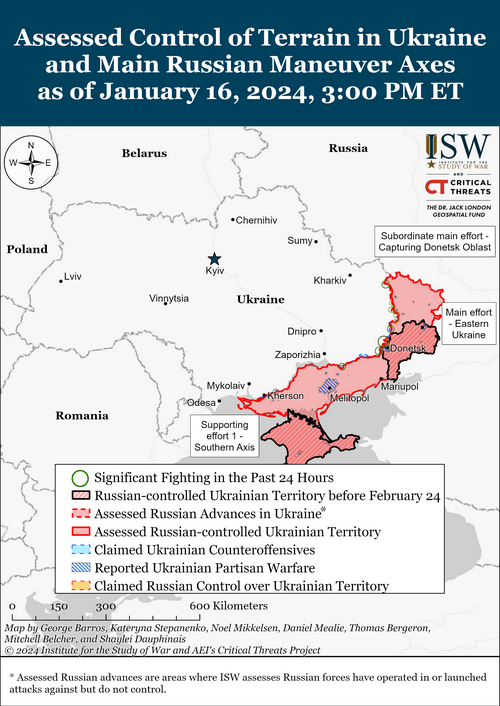
Russian Offensive Campaign Assessment, January 16, 2024
Christina Harward, Riley Bailey, Nicole Wolkov, Grace Mappes, George Barros, and Frederick W. Kagan
January 16, 2024, 7:00pm ET
Click here to see ISW’s interactive map of the Russian invasion of Ukraine. This map is updated daily alongside the static maps present in this report.
Click here to see ISW’s 3D control of terrain topographic map of Ukraine. Use of a computer (not a mobile device) is strongly recommended for using this data-heavy tool.
Click here to access ISW’s archive of interactive time-lapse maps of the Russian invasion of Ukraine. These maps complement the static control-of-terrain map that ISW produces daily by showing a dynamic frontline. ISW will update this time-lapse map archive monthly.
Note: The data cut-off for this product was 12:45pm ET on January 16. ISW will cover subsequent reports in the January 17 Russian Offensive Campaign Assessment.
Note: ISW has added a new section on Ukrainian defense industrial base (DIB) efforts to the daily Russian Offensive Campaign Assessment to track the development of Ukraine’s DIB and the international support for Ukraine’s DIB efforts. ISW will be publishing its assessments in this section based on public announcements, media reporting, and official statements.
Russian President Vladimir Putin continued to demonstrate that Russia is not interested in negotiating with Ukraine in good faith and that Russia’s maximalist objectives in Ukraine – which are tantamount to full Ukrainian and Western surrender – remain unchanged. Putin claimed on January 16 during a meeting with Russian municipal heads that “Ukrainian statehood may suffer an irreparable, very serious blow” if the current battlefield situation continues.[1] Putin also reiterated Kremlin allegations of the prevalence of Nazism in Ukraine and claimed that ”such people…cannot win.”[2] Russia’s continued calls for Ukraine’s “denazification” are thinly veiled demands for the removal of the elected Ukrainian government and its replacement with a government acceptable to the Kremlin.[3] Putin reiterated the Kremlin narrative that Ukraine – not Russia – is to blame for the absence of negotiations, claiming that Ukraine’s “peace formula” is actually a continuation of Ukrainian President Volodymyr Zelensky’s ban on negotiating with Russia and amounts to “prohibitive demands” on the negotiation process.[4] Putin claimed that any negotiation process is an “attempt to encourage [Russia] to abandon gains [it] has made in the past year and a half” and that this is “impossible.”[5]
The Kremlin appears to lack a consistent framing for current Russian offensive operations to present to the Russian public, despite the fact that Putin appears to be – at times – using his role as Commander-in-Chief of the Russian military as part of his election campaign.[6] Putin declared that Russian forces “completely” have the initiative in Ukraine following a failed Ukrainian counteroffensive.[7] This is a notable departure from Putin‘s claim on December 14, 2023, that almost all Russian forces are in “the active stage of action” and from Russian Defense Minister Sergei Shoigu’s previous characterization of Russian offensive operations in Ukraine as an “active defense.”[8] ISW continues to assess that Russian forces have regained the initiative throughout most of the Ukrainian theater but have not seized the battlefield initiative in Kherson Oblast.[9]
Russian President Vladimir Putin notably amplified a longstanding Kremlin effort to set information conditions for future escalations against the Baltic countries, likely as part of his wider effort to weaken NATO. Putin claimed on January 16 that Latvia and other Baltic states are “throwing [ethnic] Russian people” out of their countries and that this situation “directly affects [Russia’s] security.”[10] Previous changes to Latvia’s immigration law stipulated that Russian citizens’ permanent residence permits would become invalid in September 2023 and that Russian citizens would need to follow the general procedure for obtaining EU permanent residence status in Latvia, including passing a Latvian language exam, by November 30, 2023.[11] The Latvian Office of Citizenship and Migration Affairs stated in December 2023 that Latvia would deport about 1,200 Russian citizens who failed to apply for a new residence permit by the deadline.[12] Putin has long employed an expansive definition of Russia’s sovereignty and trivialized the sovereignty of former Soviet republics, and Russia has long claimed that it has the right to protect its “compatriots abroad,” including ethnic Russians and Russian speakers beyond Russia’s borders.[13] ISW has not observed any indication that a Russian attack against the Baltics is imminent or likely, but Putin may be setting information conditions for future aggressive Russian actions abroad under the pretext of protecting its “compatriots.” Putin recently threatened Finland in mid-December 2023 and reiterated a world view illustrating that he continues to pursue demanded changes to the NATO alliance that would amount to dismantling it.[14]
Putin subsequently tied alleged security threats to Russia in Eastern Europe to NATO’s “Open Door Policy,” a core principle of the alliance enshrined in its charter that allows it the discretion to admit new members. Putin claimed that NATO “open[ed] the doors to Ukraine and Georgia” in 2008 – referring to the Bucharest Declaration in which NATO promised Ukraine and Georgia paths to membership but took no concrete steps towards opening such paths – and claimed that this declaration went against Ukraine’s 1991 Declaration of Independence that stated that Ukraine is a neutral state.[15] Putin did not mention that the Russian Federation committed “to respect the independence and sovereignty and the existing borders of Ukraine,” which included Crimea and occupied Donbas, in 1994 in exchange for Ukraine’s return of the Soviet Union’s nuclear weapons on its territory to Russia.[16] Sovereignty includes the right of self-determination. Putin claimed that NATO’s 2008 declaration “completely changed the situation in Eastern Europe” and affected Russia’s security. ISW previously assessed that Putin did not invade Ukraine in 2022 to defend Russia against a threat from NATO but rather to weaken and ultimately destroy NATO – a goal he still pursues.[17] The Kremlin and Kremlin-affiliated actors have recently promoted information operations and conducted hybrid warfare tactics aimed at destabilizing NATO and may now be setting information conditions for possible future aggressive Russian actions against NATO countries and their neighbors.[18]
Ukrainian President Volodymyr Zelensky reiterated the importance of defeating Russia in Ukraine at the Davos World Economic Forum on January 16. Zelensky emphasized that Russian President Vladimir Putin will not change – referring to Putin’s maximalist war aims – and noted that all attempts to restore peace have failed two years after the start of Russia’s full-scale invasion and 10 years since the illegal annexation of Crimea.[19] Zelensky stated that the Ukrainian military is holding Putin back and that it is better to defeat Russia on the battlefield now than later. Zelensky’s statements are consistent with ISW’s longstanding assessment that the Kremlin is very unlikely to engage in good faith, meaningful peace negotiations.[20] European Commission President Ursula von der Leyen stated that Ukraine needs steady funding and supplies of weapons through 2024 and beyond in order to defend and reclaim its territory, indicating that Europe will continue to play an increasingly active role in supporting Ukraine.[21] Von der Leyen stated that Ukraine can win the war but that the West needs to expand Ukraine’s capabilities.[22] Von der Leyen emphasized Ukraine’s successes throughout the war thus far: “Russia has lost roughly half of its military capabilities,” and Ukraine has recaptured half of the territory that Russian forces captured after the full-scale invasion, pushed back the Black Sea Fleet (BSF), and opened a grain corridor in the Black Sea.
Zelensky continued bilateral meetings with world leaders at the Davos World Economic Forum on January 16. Zelensky discussed US-Ukraine defense cooperation with US Secretary of State Antony Blinken, Russian strikes and NATO summit preparations with NATO Secretary General Jens Stoltenberg, the battlefield situation and Ukraine’s defense needs with Luxembourg Prime Minister Luc Frieden, and Ukrainian operations in and corridors through the Black Sea with business representatives.[23] Zelensky also met with Singaporean President Tharman Shanmugaratnam and invited Shanmugaratnam to join the Ukrainian peace formula and global peace summit.[24]
Russian tactical aviation operations are reportedly decreasing near the Sea of Azov, and Russian aviation capabilities may be degraded after Ukrainian forces destroyed a Russian A-50 long-range radar detection aircraft and caused severe damage to a Russian Il-22 airborne command post aircraft on the night of January 14. Ukrainian Air Force spokesperson Colonel Yuriy Ihnat stated on January 16 that Russian tactical aviation presence over the Sea of Azov is currently at a lower level “than ever before.”[25] Ihnat stated that the A-50 and Il-20 aircraft helped Russian forces detect air targets at a range of up to 600 kilometers and transmitted information to Russian control points in Ukraine in real time.[26] Ihnat stated that this monitoring allowed Russian tactical aviation to see Ukrainian aircraft from afar and increased the effectiveness of tactical aviation operations.[27] Ukraine’s Southern Operational Command reported that Russian forces only had three A-50 and six modernized A-50U aircraft in service before January 14, 2024, and Ihnat stated that the destruction of one of these few aircraft would reduce Russian operational capabilities to some extent.[28] Ihnat stated that severe damage to the Il-22 aircraft rendered the aircraft inoperable but that Russian forces would likely replace both the destroyed A-50 and damaged Il-22 aircraft.[29] Ihnat clarified that the destruction of these aircraft will not impact the intensity of Russian missile and drone strikes since Russian forces program these missiles and drones with specified routes and targets from ground positions.[30] Ukrainian President Volodymyr Zelensky stated on January 16 that Ukraine must gain air superiority just as it gained superiority in the Black Sea following strikes on Russian naval assets in occupied Crimea.[31]
At least two state-owned Chinese banks reportedly ordered reviews of their business with Russian clients and will sever ties with sanctioned Russian entities and entities with ties to the Russian defense industry. Bloomberg reported on January 16 that people familiar with the matter stated that at least two People’s Republic of China (PRC)-owned banks ordered reviews of international transactions with Russian clients after the United States authorized secondary sanctions on financial institutions that facilitate Russian sanctions evasion and support the Russian war effort in Ukraine on December 22, 2023.[32] Bloomberg’s sources stated that these Chinese banks are auditing clients’ business registrations, authorized beneficiaries, and ultimate controllers to determine whether the clients are Russian, conduct business in Russia, or transfer critical items to Russia through a third country.[33] Bloomberg’s sources stated that these banks will sever ties with these clients, regardless of the currency or location of the transactions.[34] Bloomberg reported that the PRC’s four largest state-owned banks have a history of complying with previous US sanctions against Iran and North Korea.[35] Kremlin Spokesperson Dmitri Peskov refused to comment on Bloomberg’s reporting on January 16.[36] Russia has relied on Chinese entities for dual-use goods for use in Ukraine and for component parts in Russian military equipment.[37] ISW previously assessed that China has likely been heavily involved in various Russian sanctions evasion schemes, but it appears that US secondary sanctions may be threatening enough to force China to abandon many of these schemes.[38] The reported Chinese reaction to the US secondary sanctions further indicates that China has reservations concerning the Kremlin’s desired “no limits partnership” between the two states.[39]
Russian Foreign Minister Sergei Lavrov thanked North Korean Foreign Minister Choe Son-hui for North Korea’s support for Russia in the war during Choe’s official state visit to Moscow on January 16.[40] Lavrov highlighted his visit to Pyongyang in October 2023 and Russian President Vladimir Putin’s meeting with North Korean dictator Kim Jong Un in Russia in September 2023 as “only the beginning” to comprehensively developing relations between Russia and North Korea.[41] Kremlin Spokesperson Dmitri Peskov stated that Lavrov and Choe met with Putin to discuss new unspecified Russian-North Korean agreements.[42] Russia is likely advancing efforts to procure ammunition and ballistic missiles from abroad amid reported Russian ammunition shortages and missile production constraints. Ukrainian Main Military Intelligence Directorate (GUR) Deputy Chief Major General Vadym Skibitskyi reported that North Korea delivered one million rounds of artillery ammunition to Russia from September to November 2023, and Western and Ukrainian officials have stated that Russian forces have launched at least one North Korean ballistic missile against Ukraine.[43]
The Ukrainian Verkhovna Rada adopted a law on its second reading to digitalize Ukrainian military records on January 16.[44] The law will improve the register for mobilized personnel, conscripts, and reservists and introduce the possibility of creating a digital military accounting document.[45] The Ukrainian Ministry of Defense (MoD) reported that the draft law will also create an electronic services portal for military personnel and conscripts.[46] The Ukrainian MoD also stated that the draft law will allow Ukraine to strengthen its cyber defense, expand its access to unspecified allies’ intelligence, develop and deploy new combat systems, and place its IT systems for military cloud storage in NATO member states, thereby allowing Ukrainian air defense systems currently protecting national data centers to cover military and civilian infrastructure.[47]
Key Takeaways:
- Russian President Vladimir Putin continued to demonstrate that Russia is not interested in negotiating with Ukraine in good faith and that Russia’s maximalist objectives in Ukraine – which are tantamount to full Ukrainian and Western surrender – remain unchanged.
- Russian President Vladimir Putin notably amplified a longstanding Kremlin effort to set information conditions for future escalations against Baltic countries, likely as part of his wider effort to weaken NATO.
- Ukrainian President Volodymyr Zelensky reiterated the importance of defeating Russia in Ukraine at the Davos World Economic Forum on January 16.
- Russian tactical aviation operations are reportedly decreasing near the Sea of Azov, and Russian aviation capabilities may be degraded after Ukrainian forces destroyed a Russian A-50 long-range radar detection aircraft and caused severe damage to a Russian Il-22 airborne command post aircraft on the night of January 14.
- At least two state-owned Chinese banks reportedly ordered reviews of their business with Russian clients and will sever ties with sanctioned Russian entities and entities with ties to the Russian defense industry.
- Russian Foreign Minister Sergei Lavrov thanked North Korean Foreign Minister Choe Son-hui for North Korea’s support for Russia in the war during Choe’s official state visit to Moscow on January 16.
- The Ukrainian Verkhovna Rada adopted a law on its second reading to digitalize Ukrainian military records on January 16.
- Russian forces made confirmed advances near Kreminna and Bakhmut as positional engagements continued along the entire frontline.
- Russian State Duma deputies from the Liberal Democratic Party (LDPR) proposed a bill on January 16 that would create a legal status for volunteers of the Russian war in Ukraine that would grant them compensation in case of injury or death.
- Russian occupation officials from occupied Kherson, Zaporizhia, and Donetsk oblasts attended a meeting of Russian municipal representatives in Moscow with Russian President Vladimir Putin on January 16.
Go here to read the rest.
From Strategy Page:
Putin is working on what he agrees are needed reforms so that the next time Russian troops are in combat they will perform better and perhaps even win. There have been several rounds of unsuccessful military reforms since the Soviet Union collapsed in 1991. One of the major causes of that collapse was their unaffordable and largely ineffective armed forces. In post-Soviet Russia there were far fewer restrictions on criticizing the military. Most Russians had a very negative attitude towards conscription and the reforms underway because of the Ukraine War disaster were seen as typical of several previous efforts to remedy problems that continue to resist any fundamental change.
The new plan calls for a massive training program to replace all the officers lost in the first few months of 2022’s fighting. The immediate problem with that is all the officer instructors were sent to the front in March and April 2022 where they too became casualties. Next is that Putin insists on constant suicidal attacks which maximize Russian casualties and interfere with reform attempts. Finally there is another serious problem that few want to discuss, corruption. Even in wartime, especially during the recent fighting, corruption was still a problem. Officers and other government officials continued to put their own financial gain above the need to equip the troops with what they needed to survive and win. There have been several corruption scandals in Russia since the Ukraine War began. The military’s corruption is rooted in political corruption at the highest levels including Putin and his cronies, and inevitably drifted downward until even supply sergeants routinely steal back and sell gear issued to new troops before they leave for the front. Russia is descending into a Third World state known as a resource kleptocracy but run by a for-real gangster confederacy. The only difference with Russia is that they have nuclear and biological weapons from before the Soviet Union collapsed.
By late 2022 over half of Russian military personnel were volunteers serving on contracts or career officers. The ability of the military to hold onto those contract or contrakti soldiers was always weakened if there were a lot of casualties or too much chance of being sent to a combat zone. Volunteering to be a contract soldier used to be considered a smart move because the Russian economy had been increasingly weak over the last decade. After the fighting began in Ukraine, the contract soldiers suffered as much as the conscripts and junior officers did.
The result of this was contract troops refusing to renew contracts. Most of the combat units sent into Ukraine were composed of contract troops who were killed in large numbers. When the survivors got back to Russia, either because of wounds or because many combat battalions returned because of heavy losses, there was a sudden shortage of contract soldiers. That was because most contract troops were near the end of their two-to-three-year contracts and refused to renew. The army had signed up many soldiers for the new, since 2016, six to twelve month contracts for former soldiers, or conscripts willing to try it, and found that there were far fewer vets willing to sign these short contracts because, so few recent short-term contract soldiers had survived service in Ukraine.
The government then tried to solve this reluctant contract soldier problem by changing the contracts so that contract soldiers had to remain in the army for as long as the fighting continued. Realizing that it was a death sentence if they were sent back to Ukraine, many contract soldiers simply refused to go. There were so many men refusing to go that the government backed off from threats to prosecute the reluctant contrakti.
At this point the Russian armed forces have dire and apparently unsolvable manpower problems. They are taking ghastly casualties making suicidal attacks during winter with their front-line troops knowing very well what is happening. The survivors make certain other troops know it too. They have no junior officers to lead and make sacrifices with them because most officer training staff were killed in 2022 and the rest cannot produce replacements fast enough. At this point almost all prospective contrakti recruits know how little training, support, medical treatment, and effective equipment they will get, and how few of them will survive.
Go here to read the rest. You cannot win a war unless you have sufficient combat soldiers.

