
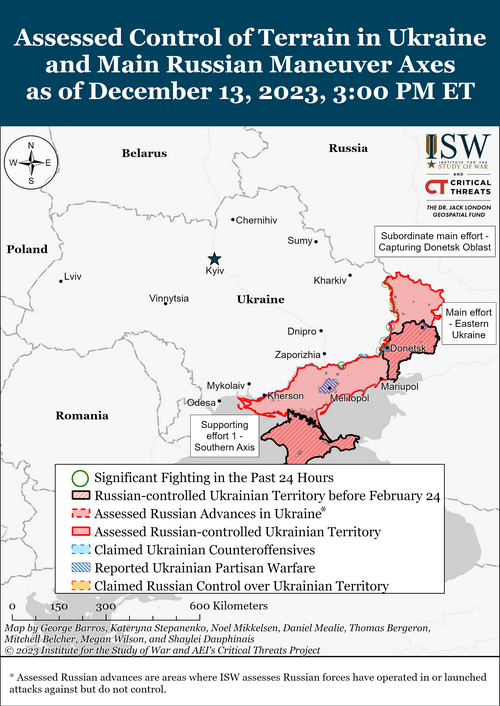
From The Institute for the Study of War:
Russian Offensive Campaign Assessment, December 13, 2023
Kateryna Stepanenko, Christina Harward, Angelica Evans, Nicole Wolkov, and Frederick W. Kagan
December 13, 2023, 8:45pm ET
Click here to see ISW’s interactive map of the Russian invasion of Ukraine. This map is updated daily alongside the static maps present in this report.
Click here to see ISW’s 3D control of terrain topographic map of Ukraine. Use of a computer (not a mobile device) is strongly recommended for using this data-heavy tool.
Click here to access ISW’s archive of interactive time-lapse maps of the Russian invasion of Ukraine. These maps complement the static control-of-terrain map that ISW produces daily by showing a dynamic frontline. ISW will update this time-lapse map archive monthly.
Note: The data cut-off for this product was 1:30pm ET on December 13. ISW will cover subsequent reports in the December 14 Russian Offensive Campaign Assessment.
The Kremlin appears to be returning to expansionist rhetoric last observed before Russia’s full-scale invasion of Ukraine in an effort to resurface its claims that Ukraine is part of historically Russian territory and discuss the borders Russian leaders regard as appropriate for a rump Ukrainian state. Deputy Chairman of the Russian Security Council Dmitry Medvedev misrepresented US President Joe Biden’s response to a media question about whether the United States’ policy is to win the war or help Ukraine to defend itself during a joint press conference with Ukrainian President Volodymyr Zelensky on December 12.[1] Biden stated that the United States wants to see Ukraine win and that “winning means Ukraine is a sovereign, independent nation […] that can afford to defend itself today and deter further aggression.” Medvedev misrepresented Biden’s statements to suggest that the United States would be content if Ukraine simply existed as a country but does not care what Ukraine’s borders look like.[2] Medvedev claimed that Ukraine can still technically be a sovereign country if the whole country remains within the borders of Lviv Oblast, for example.[3] Medvedev also falsely claimed that Biden implied that the United States only supports Ukraine in defending itself but will not help Kyiv launch counteroffensives to liberate more of its land and people. Medvedev added that Ukraine could hypothetically “defend itself” as a rump state within the borders of Lviv Oblast.
Medvedev routinely and deliberately makes outlandish statements, but the timing of these statements and focus on the idea that Ukraine could exist only as a rump state within the territory of Lviv Oblast is consistent with earlier indicators that the Kremlin is returning to its domestic framing that Russia is fighting the war to “liberate its historic lands.” Medvedev’s comments follow shortly after Russian Foreign Ministry Spokesperson Maria Zakharova’s December 9 interview with AFP, which had likely marked an official rhetorical shift in the Kremlin’s framing of the war.[4] Zakharova reiterated the Kremlin’s maximalist demands for full Ukrainian political capitulation and Kyiv’s acceptance of Russia’s military terms and introduced a vague prerequisite that Ukraine must withdraw its troops from “Russian territory” to resolve the war. ISW assessed at the time that Zakharova was likely referring to the illegally annexed four Ukrainian regions – which are not fully under Russia’s occupation.[5] Zakharova’s statement, however, may have been purposely vague to allow Russia the freedom to define what it deems to be “Russian territories.” Medvedev‘s and Zakharova’s comments closely parallel Russia’s long-standing information operation that Ukraine could be partitioned into Russian-controlled “Malorossiya” (most of Ukraine) and a small rump Polish-controlled western Ukraine.[6] ISW observed Russian propagandists intensify this information operation in the lead-up to the full-scale invasion and its notable decrease from then until now.
The return of the Kremlin’s notion of a “partitioned Ukraine” is likely an organized effort to mislead the international community into rejecting key components of Ukraine’s sovereignty: its territorial integrity as defined in 1991 and its right to self-determination. ISW assessed that the Kremlin used similar information operations in late 2021 and early 2022 to create conditions for Russia’s full-scale invasion of Ukraine while misleading the West into the search for a diplomatic de-escalation.[7] Russia is still pursuing its maximalist objective of controlling all of Ukraine and is using these information operations to deter further military aid to Ukraine and to stall for time needed to rebuild its defense industrial complex (DIB) and reconstitute its military.
Medvedev’s musings and Zakharova’s statement considered in the context of the information operations the Kremlin used before the full-scale invasion cast serious doubt on the notion that Moscow would be satisfied even with all the territory of the four Ukrainian oblasts it has illegally annexed, let alone with where the front lines currently stand. It is also noteworthy that the Kremlin appears to be revising its explicit territorial aims upward as US support for Ukraine appears to waver and Western voices reportedly argue for pressing Ukraine to offer territorial concessions.
Ukrainian President Volodymyr Zelensky stated on December 13 that Ukraine’s decision to transition to defensive operations is motivated by winter weather conditions and not a “crisis,” in response to a recent New York Times (NYT) article.[8] Zelensky stated during a joint press conference at the Ukraine-Northern Europe Summit in Oslo, Norway on December 13 that winter weather slows both offensive and defensive operations and added that there were no Russian victories in 2023.[9] Zelensky stated that the most important objective for Ukrainian forces is to hold and destroy the Russian military in Ukraine.[10]
Russian and Ukrainian sources continue to report on the impacts of challenging weather conditions on offensive and reconnaissance operations throughout the front, even as reported freezing and snowy winter conditions in eastern Ukraine offer the prospect of better conditions for maneuver. Ukrainian Southern Operational Command Spokesperson Captain First Rank Nataliya Humenyuk stated on December 13 that poor weather conditions are complicating Russian and Ukrainian combat operations in the east (left) bank of Kherson Oblast.[11] Humenyuk stated that fog and other weather conditions prompted by temperature fluctuations are making it difficult to conduct offensive operations and use drones and artillery.[12] Ukrainian Luhansk Oblast Military Administration Head Artem Lysohor stated that poor weather conditions are affecting Russian air strikes and drone operations in the Kupyansk-Lyman direction.[13] A Russian milblogger claimed that mud, freezing rain, snow, and ice are impeding Ukrainian and Russian ground attacks north of Verbove in western Zaporizhia Oblast.[14] Russian milbloggers claimed that Russian forces continued offensive operations near Bakhmut and Avdiivka despite “extremely unfavorable” weather conditions, including ice, which are negatively impacting Russian FPV and aerial reconnaissance drones.[15] One Russian milblogger suggested that a recent snowstorm improved the conditions for ground operations in occupied Luhansk Oblast, however.[16] It will likely take more than one snowstorm and continual below-freezing temperatures to harden the ground enough to restore maneuver combat. Russian sources claimed that Russian forces are taking advantage of the challenging weather conditions to conduct ground operations while Ukrainian reconnaissance drones cannot operate.[17] Russian forces have likely committed to offensive operations in multiple sectors of the front during a period of the most challenging weather of the fall-winter season in an effort to seize and retain the initiative prior to the Russian presidential elections in March 2024 and to achieve informational effects in the United States and the West while Ukrainian forces establish and consolidate defensive positions to conserve manpower and resources for future offensive efforts.[18]
A Russian “Storm-Z” assault unit instructor complained that deputy commanders of Russian irregular armed formations are spreading illogical and false claims that present an overly optimistic view of the situation on the front in the Russian media and information space. The instructor stated that an unnamed Russian deputy commander of a “Russian Volunteer Corps” detachment “fooled” a “serious” media outlet by stating that volunteer units cut the last Ukrainian supply route near Bakhmut and Soledar (northeast of Bakhmut) and that taking control of this area would open up a route for Russian forces to advance to Kramatorsk.[19] The instructor stated that another deputy commander of a Volunteer Corps unit claimed that Ukrainian forces are abandoning their fortifications near Chasiv Yar (10km west of Bakhmut) and do not control the roads in the area and that these conditions will allow Russian forces to advance to Bohdanivka (5km northwest of Bakhmut) and create a “horseshoe” around Chasiv Yar. The deputy commander effectively claimed that Russian forces were threatening a settlement significantly further from their current lines to achieve a tactical victory in a contested area near Russian positions. The instructor stated that these various claims and forecasts were illogical and questioned if the deputy commanders had confused the names of settlements when making their assessments. The instructor compared the claims about creating a “horseshoe” around Chasiv Yar to repeated Russian claims that Russian forces have done the same around Avdiivka — claims which the instructor sarcastically noted have not prevented Russian forces from continually dying in the area. The instructor also referred to a December 13 post by a Russian milblogger, who, the instructor stated, usually provides adequate reporting from the front. The post highlighted a Russian serviceman from the Volunteer Corps operating near Bakhmut at the front who claimed that Bohdanivka is a “strategic” settlement that if captured will allow Russian forces to advance to Chasiv Yar and cut off Ukrainian logistics.[20] The instructor doubted the Volunteer Corps serviceman’s understanding of the word “strategic” and Ukrainian geography as the instructor stated that Russian forces would have to advance through several settlements in the lowlands to reach Chasiv Yar.[21]
The instructor’s complaint about Russian sources spreading unsubstantiated and maximalist claims largely aligns with ISW’s mapping practices. ISW’s “claimed Russian control over Ukrainian territory” map layer reflects all the claims of ISW’s regular sources, including the most maximalist and unlikely, which is why this layer is often significantly different from ISW’s “assessed Russian advances” map layer. This phenomenon is particularly clear in ISW’s most recent control of terrain maps showing Avdiivka and Donetsk City, where the “Russian claims” map layer is up to 3.5 kilometers closer to Avdiivka than the geolocated “assessed Russian advances” map layer.[22] ISW has chosen this mapping approach to accurately reflect even the most maximalist Russian claims and compare these claims to geo-confirmed Russian advances. ISW has previously observed Russian milbloggers criticize other actors in the Russian information space for distorting the reality of the Russian war efforts and overly positive reporting.[23] Russian milbloggers previously claimed that the Russian General Staff is increasingly requiring positive reports from frontline commanders, and the Russian military may be pressuring the commanders of irregular armed formations and other sources to provide similarly positive reports.[24]
The Russian MoD is likely using formalized irregular unit commanders as a conduit to spread incorrect information about Russian battlefield successes within the Russian information space in order to circumvent the MoD’s responsibility. Kremlin state media is increasingly publishing interviews with servicemen and commanders of irregular formations, who appear to be making exaggerated claims about Russian successes on the battlefield.[25] The instructor observed that it is strange that sources who are not directly affiliated with the Russian MoD are making such exaggerated battlefield claims.[26] The Russian MoD has previously routinely spread exaggerated and absurd claims of Russian battlefield successes, which were subsequently quickly proven false, and Russian milbloggers have criticized the Russian MoD for this practice.[27] The Russian MoD has continually attempted to censor Russian milbloggers, and select milbloggers have exposed and complained about these efforts.[28] The Russian MoD is likely attempting to use irregular unit commanders and servicemen operating on the frontline to give a veneer of legitimacy to Russian MoD-controlled narratives because many Russians are likely unaware that numerous Russian irregular formations are indirectly controlled by the Russian MoD and other security forces.[29]
The Kremlin may also be using Russian milbloggers to promote irregular unit commanders’ incorrect information. Russian President Vladimir Putin is reportedly considering the Russian milblogger who posted the alleged information from the Volunteer Corps serviceman near Bakhmut to be a “trusted person” in his presidential campaign, and ISW previously assessed that the Kremlin will likely use the March 2024 presidential election to leverage milblogger “trusted persons” to reestablish Kremlin dominance over the information space and conduct information operations.[30]
Russian forces conducted a series of drone and missile strikes on the night of December 12 to 13. Ukrainian military officials reported that Russian forces launched 10 Shahed-131/136 drones from occupied Balaklava, Crimea and launched 10 missiles, likely Iskander-M ballistic or S-300/400 anti-aircraft guided missiles, targeting Kyiv City.[31] Ukrainian military officials reported that Ukrainian forces downed all of the missiles and drones, but that missile debris injured civilians in Kyiv City.[32] Ukrainian Air Force Spokesperson Colonel Yuriy Ihnat stated that the Russian military currently has a limited number of missiles and will not be able to conduct missile strikes en masse as Russian forces did in winter 2022 but will launch more Shaheds instead.[33]
A Russian hacker group reportedly linked to the Main Directorate of the Russian General Staff (GRU) and a Russia-aligned hacker group both claimed responsibility for the cyberattack on Ukrainian mobile operator Kyivstar. Pro-Russia hacker group Killnet claimed on December 12 that it conducted an attack on unspecified Ukrainian mobile operators and banks but did not offer any details or evidence of their involvement.[34] Russian hacker group Solntsepek claimed on December 13 that it “takes full responsibility for the cyberattack on Kyivstar” and posted screenshots allegedly showing Kyivstar databases and systems.[35] Solntsepek claimed that it conducted the cyberattack because Kyivstar provides communications to the Ukrainian military, government agencies, and law enforcement agencies.[36] Solntsepek claimed that it destroyed 10,000 computers and more than 4,000 servers including all cloud storage and backup systems, but Kyivstar denied these claims.[37] Solntsepek implied that it was able to access the Kyivstar systems through the company’s employees, and Kyivstar CEO Oleksandr Komarov stated on December 13 that hackers broke through Kyivstar’s cyber security via a compromised account of one of the company’s employees.[38] Ukrainian Head of the Rada Subcommittee on Cyber Security stated on December 13 that cyberattacks against Ukraine are constantly occurring and that the Ukrainian State Intelligence Service and private companies are regularly working to protect Ukrainian digital systems.[39] Solntsepek is reportedly known for claiming responsibility for attacks conducted by other groups and has reportedly been used as a front for GRU Military Unit 74455 “Sandworm.”[40] Kyivstar stated on December 13 that Kyivstar restored voice communications in Ukraine and is continuing work to restore other services.[41]
The Russian Ministry of Internal Affairs (MVD) stripped naturalized Russian citizens of their Russian citizenship for the first time, likely as part of ongoing migrant crackdowns aimed at coercing migrants into Russian military service while placating the xenophobic Russian ultranationalist community. The MVD reported on December 13 that it stripped two naturalized Russian citizens of their Russian citizenship after Russian law enforcement arrested them on drug trafficking charges.[42] Russian opposition outlet Meduza noted that this is the first instance of Russian authorities stripping naturalized citizens of their Russian citizenship since the law, which expanded the list of crimes under which Russian authorities can revoke an individual’s citizenship, came into force in October 2023.[43] Russian reporting did not specify what Russian authorities intend to do with the two individuals stripped of their Russian citizenship, however. The Russian government may send the two individuals to a migrant detention center where Russian authorities routinely coerce migrants without Russian citizenship into signing contracts with the Russian military.[44] Russian state-controlled outlet RIA Novosti reported on December 13 that Russian authorities arrested the former Head of the St. Petersburg and Leningrad Oblast MVD Migration Office, Andrei Kolesnikov, on suspicion of complicity in “legalizing over 100,000 foreigners” in 2022.[45] The Russian government is likely trying to publicize Kolesnikov’s arrest in order to appease the Russian ultranationalist community, which supports the war in Ukraine and opposes the inclusion of migrants into Russian society while continuing to rely on migrants for crypto-mobilization efforts and to offset domestic labor shortages. ISW continues to assess that the Kremlin does not have a clearly defined policy regarding migrants as Russian authorities continue to pursue incoherent and competing efforts to restrict migrant work in Russia, coerce them into the Russian military, and exploit their labor.
Ukrainian President Volodymyr Zelensky attended the second Ukraine-Northern Europe Summit in Oslo, Norway on December 13.[46] Zelensky met with the leaders of Finland, Sweden, Norway, Denmark, and Iceland at the Ukraine-Northern Europe Summit who jointly published a letter in Financial Times on December 12 stating that “this is a critical time for Ukraine, Europe, and global security” and that “Russia is eager to exploit divisions.”[47] Danish Prime Minister Mette Frederiksen announced that Denmark will approve a military aid package to Ukraine including ammunition, tanks, and drones valued at about $1.1 billion.[48] Norwegian Prime Minister Prime Minister Jonas Gahr Store announced that Norway would provide additional air defense equipment to Ukraine.[49] Swedish Prime Minister Ulf Kristersson stated that Sweden will approve a winter aid package to Ukraine to support civilian infrastructure.[50] Finnish President Sauli Niinisto announced that Finland is preparing its next aid package to Ukraine, which will consist of unspecified military equipment, and that Finland plans to double its ammunition production.[51] US President Joe Biden similarly announced on December 12 that Ukraine will receive a military assistance package valued at $200 million consisting of AIM-9M missiles, High-speed Anti-radiation (HARM) missiles; Tube-Launched, Optically-Tracked, Wire-Guided (TOW) missiles; Javelin and AT-4 anti-armor systems, and artillery and small arms ammunition.[52]
Key Takeaways:
- The Kremlin appears to be returning to expansionist rhetoric last observed before Russia’s full-scale invasion of Ukraine in an effort to resurface its claims that Ukraine is part of historically Russian territory and discuss the borders Russian leaders regard as appropriate for a rump Ukrainian state.
- The return of the Kremlin’s notion of a “partitioned Ukraine” is likely an organized effort to mislead the international community into rejecting key components of Ukraine’s sovereignty: its territorial integrity as defined in 1991 and its right to self-determination.
- Ukrainian President Volodymyr Zelensky stated on December 13 that Ukraine’s decision to transition to defensive operations is motivated by winter weather conditions and not a “crisis,” in response to a recent New York Times (NYT) article.
- Russian and Ukrainian sources continue to report on the impacts of challenging weather conditions on offensive and reconnaissance operations throughout the front, even as reported freezing and snowy winter conditions in eastern Ukraine offer the prospect of better conditions for maneuver.
- A Russian “Storm-Z” assault unit instructor complained that deputy commanders of Russian irregular armed formations are spreading illogical and false claims that present an overly optimistic view of the situation on the front in the Russian media and information space.
- The instructor’s complaint about Russian sources spreading unsubstantiated and maximalist claims largely aligns with ISW’s mapping practices.
- The Russian MoD is likely using formalized irregular unit commanders as a conduit to spread incorrect information about Russian battlefield successes within the Russian information space in order to circumvent the MoD’s responsibility.
- Russian forces conducted a series of drone and missile strikes on the night of December 12 to 13.
- A Russian hacker group reportedly linked to the Main Directorate of the Russian General Staff (GRU) and a Russia-aligned hacker group both claimed responsibility for the cyberattack on Ukrainian mobile operator Kyivstar.
- The Russian Ministry of Internal Affairs (MVD) stripped naturalized Russian citizens of their Russian citizenship for the first time, likely as part of ongoing migrant crackdowns aimed at coercing migrants into Russian military service while placating the xenophobic Russian ultranationalist community.
- Ukrainian President Volodymyr Zelensky attended the second Ukraine-Northern Europe Summit in Oslo, Norway on December 13.
- Russian forces continued offensive operations along the Kupyansk-Svatove-Kreminna line, north of and near Bakhmut, near Avdiivka, west of Donetsk City, along the Donetsk-Zaporizhia Oblast border area, and in western Zaporizhia Oblast and advanced in various sectors.
- The Chuvash Republic is offering bonuses to foreigners who fight in the war in Ukraine, likely as part of efforts to recruit migrants to the Russian military.
- Occupation authorities continue efforts to destroy Ukrainian national and historical identity.
Go here to read the rest. The fact that this year has resulted in stalemate has cooled Western ardor for funding the Ukrainians. I think that the funding will ultimately be granted, but it is a warning sign to the Ukraine that 2024 must be a year of victory for them if they do not wish to see 2025 as a year of defeat. This has always been a race between war weariness on the part of the Ukraine’s allies and Putin’s tenure as President of Russia.

