
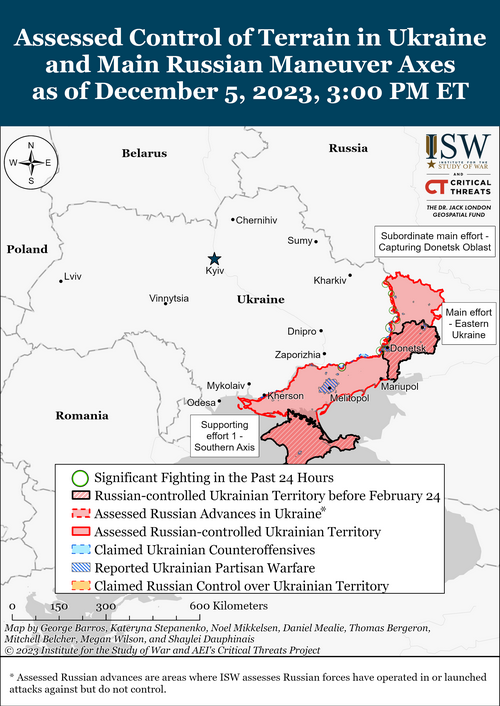
From The Institute For The Study of War:
Russian Offensive Campaign Assessment, December 5, 2023
Christina Harward, Nicole Wolkov, Riley Bailey, Angelica Evans, and Frederick W. Kagan
December 5, 2023, 6:45pm ET
Click here to see ISW’s interactive map of the Russian invasion of Ukraine. This map is updated daily alongside the static maps present in this report.
Click here to see ISW’s 3D control of terrain topographic map of Ukraine. Use of a computer (not a mobile device) is strongly recommended for using this data-heavy tool.
Click here to access ISW’s archive of interactive time-lapse maps of the Russian invasion of Ukraine. These maps complement the static control-of-terrain map that ISW produces daily by showing a dynamic frontline. ISW will update this time-lapse map archive monthly.
Note: The data cut-off for this product was 1:10pm ET on December 5. ISW will cover subsequent reports in the December 6 Russian Offensive Campaign Assessment.
Ukrainian forces reportedly conducted successful drone strikes against Russian military targets in occupied Crimea on the night of December 4 to 5. Ukrainian media reported on December 5, citing sources in the Ukraine’s Main Military Intelligence Directorate (GUR) and Ukrainian Security Service (SBU), that GUR and SBU elements struck a Russian military oil terminal in Feodosia, a Nebo-M radar system near Baherove (13km west of Kerch), and a helicopter landing pad, P-18 Terek radar system, and a Baikal-1M anti-aircraft missile control system in unspecified areas of Crimea.[1] Russian sources, including the Russian Ministry of Defense (MoD), claimed that Russian air defenses, electronic warfare (EW) systems, and small-arms fire downed up to 35 Ukrainian drones near Baherove, Feodosia, Cape Chauda, and over the Sea of Azov but did not say that any Ukrainian drones struck their intended targets.[2] Another group of Russian sources, including Kherson Oblast occupation head Vladimir Saldo, claimed that Russian air defenses downed up to 41 Ukrainian drones over northern Crimea and the Sea of Azov and claimed that Ukrainian forces attempted to strike Russian air defense systems and fuel storage facilities.[3] Ukrainian forces have been conducting an interdiction campaign against Russian military infrastructure in occupied Crimea, primarily Black Sea Fleet assets, since June 2023 to degrade the Russian military’s ability to use Crimea as a staging and rear area for Russian operations in southern Ukraine.[4]
Russian forces conducted a series of missile and drone strikes on civilian infrastructure in Ukraine on the night of December 4 and 5. Ukrainian military officials reported that Russian forces launched 17 Shahed-136/-131 drones from Kursk Oblast and Primorsko-Akhtarsk, Krasnodar Krai, and six S-300 missiles at targets in Ukraine and that Ukrainian air defenses shot down 10 of the drones.[5] The Ukrainian Air Force reported that the Russian missiles targeted civilian objects in Donetsk and Kherson oblasts.[6] Ukrainian officials reported that Russian drones struck civilian residences and infrastructure in Lviv Oblast and Izyum and Chuhuiv raions, Kharkiv Oblast.[7]
The Russian State Duma will reportedly consider a proposed bill that would recognize the Sea of Azov as an internal Russian body of water, likely setting conditions to coerce recognition of Russia’s illegal annexation of occupied Crimea and Kherson, Zaporizhia, and Donetsk oblasts. Russian State Duma Deputy representing occupied Crimea Mikhail Sheremet stated on December 5 that the Duma will try to adopt a proposed bill that would formally designate the Sea of Azov as an internal water of Russia by the end of 2023.[8] Russia and Ukraine signed and ratified a treaty in 2003 and 2004 that included stipulations that the Sea of Azov is a historically internal water of both Russia and Ukraine and that vessels flying Ukrainian or Russian flags in the Sea of Azov enjoy freedom of navigation.[9] The Ukrainian Rada denounced the treaty in February 2023, stating that Russia had violated the stipulation that all issues concerning the Sea of Azov should be resolved by peaceful, bilateral means and that the treaty’s authorization of Russian warships to freely navigate the sea posed a threat to Ukrainian national security.[10] Russian President Vladimir Putin signed a law in June 2023 that also denounced the treaty, claiming that Ukraine lost its status as a littoral state of the Sea of Azov when Russia (illegally) annexed Donetsk, Zaporizhia, and Kherson oblasts in 2022.[11] The proposed bill likely portends a series of corresponding Russian administrative measures that would require maritime traffic en route to or from ports on the Sea of Azov to formally recognize the sea as a Russian internal body of water and, therefore, to de facto recognize Russia’s illegal annexation of occupied Ukrainian territories.
Russian opposition party Yabloko founder Grigory Yavlinsky advocated for a ceasefire in Ukraine as part of his presidential bid on December 5 likely in an attempt to distinguish himself from Russian President Vladimir Putin and give voice to Russians who support a ceasefire. Yavlinsky stated in an interview with Russian state outlet RBK published on December 5 that he believes that it is in Russia’s interest to sign a ceasefire agreement with Ukraine as quickly as possible.[12] Yavlinsky expressed doubt that recent Russian surveys claiming to show that Russians support the war in Ukraine are true given the scale of Russian propaganda, which he believes has created a widespread sense of fear in Russia in the past year and a half.[13] Yavlinsky stated that he is currently collecting the signatures needed to run in the 2024 presidential election and explained that his sequential presidential platform includes signing a ceasefire and exchanging prisoners of war (POWs) with Ukraine first, releasing political prisoners in Russia second, and beginning to reform the Russian judicial system third.[14] Yavlinsky advocated against Russia’s initial invasion of Ukraine in 2014 and the full-scale invasion in 2022 and called for Russia to withdraw from the war in Syria during his 2018 presidential campaign.[15] Yavlinksy likely believes that these anti-war positions and the call for a ceasefire are the most direct way to oppose Putin and to garner support from the public. Recent Russian opinion polls indicate that more Russians support a withdrawal of Russian forces from Ukraine than do not and that a majority of Russians believe that Russia should begin peace negotiations with Ukraine.[16]
The Kremlin may be strategically allowing Yavlinsky to criticize the Russian government in order to preserve its veneer of electoral legitimacy and to delegitimize possible support for a ceasefire among factions in the Kremlin. A Russian insider source claimed on December 4 that Yavlinsky made an agreement with the Russian Presidential Administration that if he were allowed to participate in the 2024 presidential elections, he would criticize the Ukrainian government, especially Ukrainian President Volodymyr Zelensky.[17] The insider source claimed that the Presidential Administration is not against “moderate” criticisms of Russia’s war in Ukraine as this can demonstrate that there is a “pluralism of opinions” in Russian presidential elections.[18] The insider source claimed that the Kremlin would allow Yavlinsky to garner no more than one to 1.5 percent of the vote in the election, which is consistent with Yavlinsky’s results in the 2018 presidential elections.[19] Yavlinsky stated in the RBK interview that Russian authorities have sentenced or are investigating other members of the Yabloko party but that this occurs only at the regional level and that he is unsure why the federal government has not shut down Yabloko.[20] The Kremlin is likely refraining from punishing Yavlinsky and Yabloko at the federal level so as to maintain its carefully crafted façade of opposition, democracy, and electoral legitimacy.[21] The Kremlin is also likely allowing Yavlinsky to widely promote the idea of a ceasefire in a state media outlet so as to associate the idea with the “opposition,” thereby likely deterring factions within the Kremlin that may want to freeze the frontline in Ukraine from publicly or privately voicing their opinions.
Russian President Vladimir Putin emphasized the benefits that migrants provide to the Russian economy, while promoting ongoing efforts to Russify migrants in Russia and citizens of post-Soviet countries at the Russian Council for the Development of Civil Society and Human Rights meeting on December 4. Putin stated that Russian economic demands, including a labor shortage, largely shape policy regarding migrants and noted that Russia must maintain an “ethnocultural balance.”[22] Putin criticized migrants for creating “ethnic enclaves” in Russian cities and failing to register with the Russian military after they acquire Russian citizenship.[23] Putin also stressed that migrants must be linguistically and culturally prepared to work in Russia and must abide by Russian traditions and laws.[24] Putin claimed that 20 to 50 percent of children of migrants have a low level of Russian language proficiency or do not speak Russian at all and noted the Russian government is creating special programs and classes for these children to study the Russian language and integrate into the Russian educational system.[25] Putin also noted that Russia is working with Central Asian and Commonwealth of Independent States (CIS) countries to establish Russian schools and teach the Russian language in these countries.[26] The Russian government has continually promoted opening Russian and Russian-speaking schools and universities in post-Soviet countries and has criticized countries for promoting the use of their indigenous languages in educational institutions.[27] Russia likely uses these educational programs and institutions in Russia and abroad to promote Russian narratives and foster a Russian identity among youth.
Russian milblogger and Russian Human Rights Council member Alexander Kots criticized the Russian government for failing to help ethnic Russian citizens of Central Asian countries receive Russian citizenship while granting Russian citizenship to ethnically Central Asian citizens of Central Asian countries.[28] Kots praised the Russian government for granting citizenship to foreigners who served in the Russian military, however.[29] Kots further commended Russian State Duma Deputy Alexander Khinshtein for successfully requesting that the Russian Ministry of Internal Affairs (MVD) grant Uzbek citizen Alexander Babkov temporary asylum in Russia with the future prospect of obtaining Russian citizenship.[30] Babkov, an ethnic Russian from Uzbekistan who allegedly fought in the Wagner Group near Bakhmut and Soledar, reportedly faced deportation to Uzbekistan in January 2024 and feared subsequent imprisonment.[31] An Uzbek court sentenced an Uzbek citizen to prison for fighting in the Donetsk People’s Republic (DNR) military from 2014–2015, and a Kazakh court sentenced a Kazakh citizen who reportedly served in Wagner to prison on charges of mercenarism.[32] Khinshtein’s intervention on Babkov’s behalf may be a response to increasing calls for the Russian government to protect ethnic Russians abroad, particularly those who served in the Russian military.
Russian President Vladimir Putin will travel to the United Arab Emirates (UAE) and Saudia Arabia on December 6 and will host Iranian President Ibrahim Raisi in Russia on December 7 — a bout of diplomatic outreach likely focused on strengthening Russia’s position with Gulf States while continuing to solidify the deepening Russian–Iranian security partnership. Kremlin spokesperson Dmitri Peskov stated on December 5 that Putin will exchange views on bilateral relations, international agendas, and regional agendas during his meetings with UAE President Mohammed bin Zayed Al Nahyan and Saudi Arabian Crown Prince Mohammed bin Salman.[33] Peskov responded to a question about Russian, Saudi, and Emirati oil cooperation and stated that discussions will occur within the OPEC+ framework.[34] OPEC+ members recently agreed on November 30 to cut oil output in early 2024 to stabilize oil prices.[35] Russian Presidential Assistant Yuri Ushakov stated that Putin intends to discuss the Palestinian–Israeli conflict; the war in Ukraine; and conflicts in Syria, Yemen, and Sudan during his meetings in Saudi Arabia and the UAE.[36] The Kremlin likely aims to use cooperation on oil output and diplomatic engagement on the Israel–Hamas war and other regional conflicts to strengthen engagement with Gulf States while balancing potential Saudi and Emirati concerns about Russia’s increasing reliance on its security partnership with Iran. Peskov and Ushakov stated that Putin will meet with Raisi on December 7, and the Iranian state-owned Islamic Republic News Agency stated that Putin and Raisi will also discuss the situation in Palestine.[37] Ushakov announced that Iran and the Eurasian Economic Union (EAEU) intend to sign a cooperation agreement by the end of 2023, likely to facilitate and expand Iran’s role in Russian sanctions evasion schemes and in the supply of weapons and critical components to Russia.[38]
Armenia appears to be effectively abstaining from participation in the Russian-led Collective Security Treaty Organization (CSTO). The Spokesperson for the Armenian Parliament Chairman, Tsovinar Khachatryan, confirmed on December 5 that Armenia will not send a representative to the CSTO Parliamentary Assembly meeting in Moscow on December 19.[39] The CSTO Parliamentary Assembly meeting represents the fourth consecutive high profile CSTO event or exercise that Armenia has abstained from amid the backdrop of deteriorating Russian–Armenian relations.[40] Armenia did not participate in the CSTO Collective Security Council session in Minsk, Belarus on November 23; the CSTO’s summit in Bishkek, Kyrgyzstan, on October 13; or the CSTO “Indestructible Brotherhood-2023″ exercises in Belarus in early October.[41] Armenian Deputy Foreign Minister Mnatsakan Safaryan reiterated on November 23 that Armenia is not considering leaving the CSTO or discussing the withdrawal of Russia‘s 102nd Military Base in Gyumri, Armenia.[42] CSTO Secretary General Imangali Tasmagambetov stated on November 20 that Armenia asked the CSTO to remove provisions on assistance to Armenia from the agenda of the CSTO summit in Minsk.[43] Armenian Prime Minister Nikol Pashinyan stated in October that Armenia is currently in the process of diversifying its security partnerships, and Armenia signed a military cooperation agreement with France on October 23.[44]
The Kremlin continues to intensify censorship efforts, targeting prominent Russian messaging and social media app Telegram. A Moscow court fined Russian communications company Telegram Messenger Inc. four million rubles ($44,300) on December 5 for refusing to remove prohibited information at the request of Russian federal censor Roskomnadzor.[45] Moscow’s Tagansky Court previously fined Telegram four million rubles for failing to remove false information about the Russian Armed Forces and information aimed at destabilizing Russia on November 21, 2023.[46] These fines are likely a mild punishment for Telegram rather than a concerted effort by Russian authorities to shut down the app.
Key Takeaways:
- Ukrainian forces reportedly conducted successful drone strikes against Russian military targets in occupied Crimea on the night of December 4 to 5.
- Russian forces conducted a series of missile and drone strikes on civilian infrastructure in Ukraine on the night of December 4 and 5.
- The Russian State Duma will reportedly consider a proposed bill that would recognize the Sea of Azov as an internal Russian body of water, likely setting conditions to coerce recognition of Russia’s illegal annexation of occupied Crimea and Kherson, Zaporizhia, and Donetsk oblasts.
- Russian opposition party Yabloko founder Grigory Yavlinsky advocated for a ceasefire in Ukraine as part of his presidential bid likely in an attempt to distinguish himself from Russian President Vladimir Putin and give voice to Russians who support a ceasefire.
- The Kremlin may be strategically allowing Yavlinsky to criticize the Russian government in order to preserve its veneer of electoral legitimacy and to delegitimize possible support for a ceasefire among factions in the Kremlin.
- Russian President Vladimir Putin emphasized the benefits that migrants provide to the Russian economy, while promoting ongoing efforts to Russify migrants in Russia and citizens of post-Soviet countries.
- Russian President Vladimir Putin will travel to the United Arab Emirates (UAE) and Saudia Arabia on December 6 and will host Iranian President Ibrahim Raisi in Russia on December 7- a bout of diplomatic outreach likely focused on strengthening Russia’s position with Gulf States while continuing to solidify the deepening Russian-Iranian security partnership.
- Armenia appears to be effectively abstaining from participation in the Russian-led Collective Security Treaty Organization (CSTO).
- The Kremlin continues to intensify censorship efforts, targeting prominent Russian messaging and social media app Telegram.
- Russian forces continued offensive operations along the Kupyansk-Svatove-Kreminna line, near Bakhmut, near Avdiivka, west and southwest of Donetsk City, in the Donetsk-Zaporizhia Oblast border area, and in western Zaporizhia Oblast but did not make any confirmed advances.
- Russian forces are reportedly quickly sending poorly trained convict recruits to reinforce assaults elements in Ukraine.
- Russian occupation authorities are reportedly intensifying their seizure of Ukrainian property in occupied Berdyansk, Donetsk Oblast.
Go here to read the rest. Russians using poorly trained convict cannon fodder for assault units would underline that the current Russian offensive is being done for electoral rather than military purposes.

