
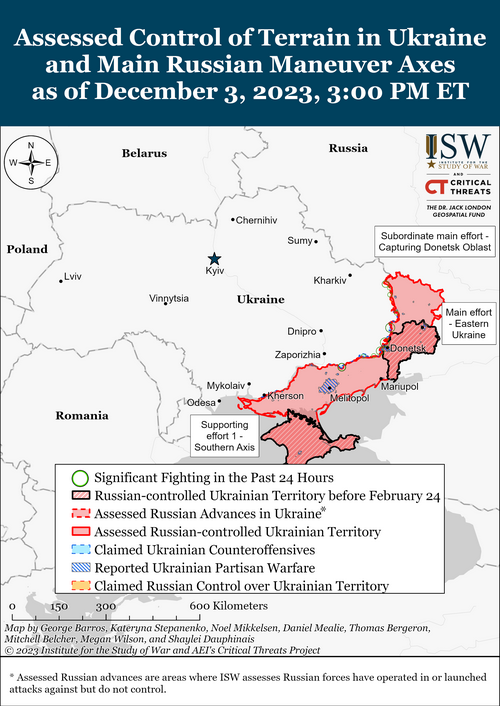
From The Institute For The Study of War:
Russian Offensive Campaign Assessment, December 3, 2023
Nicole Wolkov, Christina Harward, Riley Bailey, Grace Mappes, and Frederick W. Kagan
December 3, 2023, 5:25pm ET
Click here to see ISW’s interactive map of the Russian invasion of Ukraine. This map is updated daily alongside the static maps present in this report.
Click here to see ISW’s 3D control of terrain topographic map of Ukraine. Use of a computer (not a mobile device) is strongly recommended for using this data-heavy tool.
Click here to access ISW’s archive of interactive time-lapse maps of the Russian invasion of Ukraine. These maps complement the static control-of-terrain map that ISW produces daily by showing a dynamic frontline. ISW will update this time-lapse map archive monthly.
Note: The data cut-off for this product was 1:30pm ET on December 3. ISW will cover subsequent reports in the December 4 Russian Offensive Campaign Assessment.
Russian President Vladimir Putin’s December 1 decree is likely a formal recognition of the Russian military’s current end strength and not an order to immediately increase the number of Russian military personnel. Putin signed a decree on December 1 increasing the official end strength of the Russian military from 2.039 million personnel to 2.209 million personnel and total Russian combat personnel from 1.15 million to 1.32 million.[1] The increase of 170,000 Russian combat personnel between Putin’s previous August 25, 2022 decree and the December 1, 2023 decree is likely a formal acknowledgement of a net increase of 170,000 combat personnel between August 25, 2022, and December 1, 2023, and not a call to immediately increase the current number of combat personnel by an additional 170,000.[2] Russian Security Council Deputy Chairperson Dmitry Medvedev claimed on November 9 that the Russian military has recruited 410,000 contract, volunteer, and conscripted military personnel since January 1, 2023, then later claimed on December 1 that the Russian military has recruited over 452,000 personnel since January 1, 2023.[3] The Russian government announced in September 2022 that the Russian military would mobilize 300,000 personnel under Putin’s partial mobilization decree.[4] NATO Secretary General Jens Stoltenberg stated on November 29 that Russian forces have suffered over 300,000 casualties (killed and wounded personnel) in Ukraine since the start of Russia’s full-scale invasion of Ukraine in February 2022.[5] Ongoing widespread crypto-mobilization efforts (such as volunteer recruitment and the coercion of migrants into the Russian military), partial mobilization, the number of Russian personnel concluding military service, and Russian casualties in Ukraine plausibly account for a net 170,000-combat personnel increase between August 25, 2022, and December 1, 2023.[6] Putin’s December 1, 2023 decree is thus likely establishing 2.209 million personnel as the new official end strength rather than ordering a significant new increase in the total size of the Russian military.
Ukrainian air defense coverage along the front line is reportedly incentivizing Russian forces to rely more heavily on remote strikes with glide bombs. Ukrainian Tavriisk Group of Forces Spokesperson Colonel Oleksandr Shtupun stated on December 3 that Ukrainian forces shoot down Russian attack helicopters, such as Ka-52 and Mi-24 helicopters, as soon as they enter the range of Ukrainian air defense systems.[7] Shtupun stated that this Ukrainian air defense capability has prompted Russian forces to use Su-35 and Su-34 attack aircraft to launch remote strikes with glide bombs from 50 to 70 kilometers behind the line of combat engagement.[8] Russian forces effectively used helicopters to defend against Ukrainian counteroffensive operations in western Zaporizhia Oblast in summer 2023 but decreased the use of rotary wing aircraft following the downing of Ka-52 helicopters in the area in mid-August 2023.[9] Shtupun’s statements are consistent with these observations as well as with the increased Russian use of glide bombs throughout the frontline, particularly in southern Ukraine.[10]
Ukrainian Air Force Spokesperson Colonel Yuriy Ihnat stated on December 3 that Ukrainian air defenses are similarly prompting Russian forces to increase their use of KAB glide bombs because FAB glide bombs require Russian aircraft to fly within range of Ukrainian air defenses.[11] Ihnat added that KAB bombs are inaccurate and that Russian forces therefore launch a large number of the glide bombs to strike Ukrainian targets.[12] Ihnat stated that Russian aviation launches about 100 glide bombs on average at Ukrainian targets along the front line each day and stated that Ukraine needs long-range air defense systems and F-16 fighter jets to counter the current Russian aviation threat.[13]
The United Kingdom Ministry of Defense (UK MoD) reported that Russian air defense systems are also constraining Ukrainian operations along the front, specifically Russian SA-15 TOR short-range surface-to-air missile systems (SAMs).[14] The UK MoD reported that Russian forces use the SA-15 SAMs to provide cover for Russian ground forces at the front line and have effectively employed them to counter Ukrainian drone operations.[15]
Ukrainian officials appealed to international organizations to investigate video footage published on December 2 showing Russian forces killing surrendering and reportedly unarmed Ukrainian soldiers. A Russian source published footage on December 2 showing Russian forces shooting two Ukrainian soldiers after they surrendered near Stepove (3km northwest of Avdiivka).[16] Ukrainian Verkhovna Rada Human Rights Ombudsman Dmytro Lubinets appealed to the International Committee of the Red Cross and the United Nations to investigate this violation of international law, and Ukrainian Tavriisk Group of Forces Spokesperson Colonel Oleksandr Shtupun stated on December 3 that Ukrainian authorities will give the evidence of the war crime to the appropriate international institutions.[17] The Ukrainian Prosecutor General’s Office stated that the Security Service of Ukraine (SBU) has begun a pre-trial investigation for criminal proceedings for violations of the Ukrainian Criminal Code.[18] A few Russian milbloggers dismissed the video and the accusations against the Russian forces.[19] Attacking soldiers recognized as hors de combat, specifically including those who have clearly expressed an intention to surrender, is a violation of Article 41 of the Geneva Convention on the Protection of Victims of International Armed Conflicts.[20]
Russian forces launched a series of missile and drone strikes on the night of December 2 and 3. Ukrainian military officials reported that Russian forces launched 12 Shahed drones from Primorsko-Akhtarsk, Krasnodar Krai, and one Kh-59 missile from Belgorod Oblast and that Ukrainian air defenses shot down 10 of the drones over Mykolaiv and Khmelnytskyi oblasts as well as the Kh-59 missile.[21] The Ukrainian Air Force reported that Russian forces launched the drones in waves.[22] The Russian Ministry of Defense (MoD) claimed that Russian aviation, drones, missiles, and artillery struck a Ukrainian command post in Dnipropetrovsk Oblast; fuel depots near Myrhorod, Poltava Oblast and Khmelnytskyi City; and an ammunition depot in Mykolaiv Oblast.[23]
The Russian government is likely continuing attempts to censor relatives of mobilized Russian military personnel on social media out of concern about their protests’ possible negative effect on Russian President Vladimir Putin’s still unannounced 2024 presidential campaign. BBC Russia reported on December 3 that online bots using fake names and profile pictures accused the relatives of mobilized Russian personnel in their “Way Home” Telegram channel of having connections to imprisoned Russian opposition figure Alexei Navalny and his Anti-Corruption Foundation.[24] The “Way Home” group previously issued a manifesto on November 27 calling for the return of mobilized personnel and an end to “indefinite” mobilization.[25] Relatives of mobilized personnel have also repeatedly appealed to the Russian government and military for the release of their relatives from military service and for better treatment of mobilized servicemen in the Russian military, and the Russian government has made efforts to censor these demands and complaints and prevent relatives of mobilized personnel from protesting publicly.[26] Putin‘s presidential campaign will reportedly not focus on the war in Ukraine, and the Kremlin likely considers the relatives of mobilized personnel to be a social group that may pose one of the greatest threats to his campaign.[27]
A prominent Russian milblogger claimed to have given a “masterclass” to press heads and communications personnel at Russian state-owned defense conglomerate Rostec, likely in support of an effort that allows the Russian government to normalize the war without directly involving the Kremlin. The Rybar Telegram channel claimed that its founder, Mikhail Zvinchuk, gave the “masterclass,” which involved an analysis of 23 Telegram accounts of Russian enterprises and a discussion on the importance of Telegram and other social media to achieve results.[28] Zvinchuk recommended that Rostec increase coverage of its production processes, modernize its approaches to publicizing their products, and humanize the corporation. Many of Rostec’s subsidiaries are involved in the Russian Ministry of Defense’s efforts to ramp up DIB production to support Russia’s long war effort in Ukraine.[29] Rostec and its subsidiaries using Telegram to promote DIB products would help normalize the revitalization of Russia’s DIB and the Russian long war effort to the Russian public without directly attributing this normalization to the Kremlin. The Kremlin has consistently failed to bring Russian society to a wartime footing and is unlikely to do so in the near term as the Kremlin reportedly seeks to downplay the war as it prepares for the 2024 Russian presidential elections.[30]
The milblogger’s “masterclass” represents an avenue by which the Kremlin can further benefit from milbloggers and shows how possible financial incentives could temper milbloggers’ criticisms of the Russian leadership. The Kremlin has sought to appeal to select milbloggers, including Rybar, and Zvinchuk is the only prominent Russian milblogger to receive a state award from Russian President Vladimir Putin for war reporting.[31] The Kremlin has consistently struggled to conduct effective information operations inside Russia since the start of the full-scale invasion and may seek to use more milbloggers to help improve the Kremlin’s conduct of its information operations directed at domestic audiences.[32] Rybar publishes calls for donations multiple times per week and has also advertised companies affiliated with Russian Presidential Administration First Deputy Head Sergei Kiriyenko and Russian media.[33] ISW previously assessed that milbloggers’ reliance on advertisements for an income provides a financial incentive to refrain from criticizing the Kremlin as attempted censorship and legal issues may deter advertisement deals.[34] Consultations with Russian officials on public messaging and information operations could become an additional source of income for select milbloggers, which would likely lead to further self-censorship.
Key Takeaways:
- Russian President Vladimir Putin’s December 1 decree is likely a formal recognition of the Russian military’s current end strength and not an order to immediately increase the number of Russian military personnel.
- Ukrainian air defense coverage along the front line is reportedly incentivizing Russian forces to rely more heavily on remote strikes with glide bombs.
- Ukrainian officials appealed to international organizations to investigate video footage published on December 2 showing Russian forces killing surrendering and reportedly unarmed Ukrainian soldiers.
- Russian forces launched a series of missile and drone strikes on the night of December 2 and 3.
- The Russian government is likely continuing attempts to censor relatives of mobilized Russian military personnel on social media out of concern about their protests’ possible negative effect on Russian President Vladimir Putin’s still unannounced 2024 presidential campaign.
- A prominent Russian milblogger claimed to have given a “masterclass” to press heads and communications personnel at Russian state-owned defense conglomerate Rostec, likely in support of an effort that allows the Russian government to normalize the war without directly involving the Kremlin.
- The milblogger’s “masterclass” represents an avenue by which the Kremlin can further benefit from milbloggers and shows how possible financial incentives could temper milbloggers’ criticisms of the Russian leadership.
- Russian forces conducted offensive operations along the Kupyansk-Svatove-Kreminna line, near Bakhmut, near Avdiivka, west and southwest of Donetsk City, in the Donetsk-Zaporizhia Oblast border area, and in western Zaporizhia Oblast and advanced near Avdiivka.
- Russia continues to use the Russian Orthodox Church (ROC) to indoctrinate Russian children into Russian nationalism and set conditions for long-term force generation efforts.
- Russian occupation officials continue to strengthen the Kremlin-backed United Russia party in occupied Ukraine ahead of the March 2024 Russian presidential elections.
Go here to read the rest. The news shifts from the battle fields as weather shuts down operations.

