Donald R. McClarey
Cradle Catholic. Active in the pro-life movement since 1973. Father of three, one in Heaven, and happily married for 43 years. Small town lawyer and amateur historian. Former president of the board of directors of the local crisis pregnancy center for a decade.
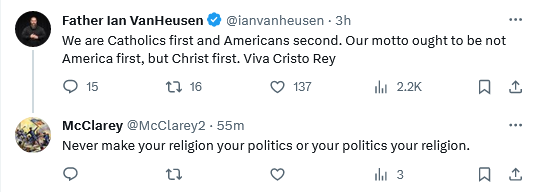



Amen
Christus, Dominus, Salvator, et Rex, primus!
America prima, una natio sub Deo!
I’m perfectly comfortable making my religion my politics. I wish more Christians (and especially Christian politicians) would.
Considering how radically religions differ from one another, that would make our politics even more of a blood sport than they are now. Mixing religion and politics is always bad for both, hence Christ’s admonitions to render unto Caesar the things that are Caesars, and His statement that His Kingdom is not of this world.
https://www.youtube.com/watch?v=PDBiLT3LASk
CAG:
Religion may serve as a reference for making political judgments, but if we are “Catholics first”, we know not to confuse the duties of Caesar and the Kingdom of Christ. To paraphrase Churchill: politics is not about getting to Heaven, just keeping Hell off the earth.
Don: When I hear words like Father’s I know I’m listening to a leftwing cleric who wants social policies that clash with the Constitution or American traditions.
WHEN in the Course of human Events, it becomes necessary for one People to dissolve the Political Bands which have connected them with another, and to assume among the Powers of the Earth, the separate and equal Station to which the Laws of Nature and of Nature’s God entitle them, a decent Respect to the Opinions of Mankind requires that they should declare the causes which impel them to the Separation.
We hold these Truths to be self-evident, that all Men are created equal, that they are endowed by their Creator with certain unalienable Rights, that among these are Life, Liberty, and the Pursuit of Happiness
*****
Gee, I’m sure glad our founding fathers didn’t feel the need to “make religion their politics” 😀
Of course, there are plenty of “Catholic” politicians who claim to adhere to this philosophy. They tend to say things like: “I am personally opposed to abortion, but …”
I don’t think it’s even possible to divorce one’s religion from one’s politics … On the contrary, it seems to me that one’s politics reveals one’s religion.
po·lit·i·cal
[pəˈlidək(ə)l]
ADJECTIVE
1. relating to the government or the public affairs of a country
Don: Rendering to Caesar what is Caesar’s is about taxes, not politics. One would hope that, on the feast of Christ the King, we could recognize that our religion is our politics.
“Gee, I’m sure glad our founding fathers didn’t feel the need to “make religion their politics”
So am I. They kept the references limited and generic to avoid inflaming sectarian passions. God appears in the Constitution only in reference to dates.
Don: Rendering to Caesar what is Caesar’s is about taxes, not politics.
Not at all. When Christ was talking about going an extra mile he was referring to the charming Roman custom of impressing Jewish civilians to maintain the roads. There was plenty, and justifiably so, anti-Roman sentiment in Judea, Samaria and Galilee at the time of Christ. Jesus never entered into any of it, probably to the disappointment of many in his audience.
Jesus never entered into any of it, probably to the disappointment of many in his audience.
True, but just because Jesus wasn’t here as a political figure (yet, when He returns it will be as King, after all) doesn’t mean that Christian politicians today shouldn’t act Christian in their governance. Jesus acted as the God-Man in everything He did. No doubt He wouldn’t have started behaving differently were He to be elected as mayor. “Render unto Caesar what is Caesar’s” has a corollary: “Render unto God what is God’s”
They kept the references limited and generic to avoid inflaming sectarian passions.
Again, that the founding fathers didn’t endorse a specific religion doesn’t mean they expected politicians to ignore their faith. They certainly didn’t ignore theirs when writing the Declaration of independence.
If I vote for a Catholic politician, it would be nice if I could rely on that person to let Catholic moral doctrine influence their decision-making. Far too many of them behave like atheists.
The conversations in the conments below show the topic of separation of Church and State, and, applying Biblical times ideas to modern times and vica versa opens the door to a plethora of possibilities. Some even humorous.
Did Jesus have a fishing license when he directed the apostles to “cast their nets” etc.? Was he over the limit when he multiplied those fish? Did he have a license to make and use a weapon such as that whip? Then there are those crowds he drew, perhaps without a permit? Imagine making wine for the public without having official stamps and taxes attached to his miracle? Raising Lazerus would certainly require some sort of a medical license and harrasing a lady about her sins near a public well…Lots of fun actually applying all of todays requirements to back then, It could fill a book.
They certainly didn’t ignore theirs when writing the Declaration of independence.
Jefferson, who wrote almost all the Declaration, was not a Christian.
“doesn’t mean that Christian politicians today shouldn’t act Christian in their governance.”
That is a far cry from making Christianity into a political party.
Jefferson, who wrote almost all the Declaration, was not a Christian.
Irrelevant. He believed in a Creator and this politically foundational document clearly reflects that, and everybody signed it. Declaring that our rights come from God was a political statement, and a revolutionary one.
That is a far cry from making Christianity into a political party
Ahh … I guess I should’ve asked what you meant by “make religion your politics”. I was interpreting that to be more personal, not an organized national movement … More of an “I am the people’s good servant, but God’s first” kind of thing. St. Paul tells us to do all things for the glory of God, there isn’t any exclusion in there for people who work on Capital Hill.
Declaring that our rights come from God was a political statement, and a revolutionary one.
Actually no. It was rather commonplace. Locke had stated as much in the seventeenth century. Various Catholic saints over the centuries had stated the same thing. As for Jefferson, his deism is about as mild an addition to politics as it is possible to have.
Various Catholic saints over the centuries had stated the same thing.
Yes, the Catholic “feel” of the document has been well argued by people more eloquent than I, but I don’t recall a government declaring that citizen’s rights were given by a higher power previously … Historically, governments have tended to reserve that power for themselves. Ours even seems to be trending in that direction.