
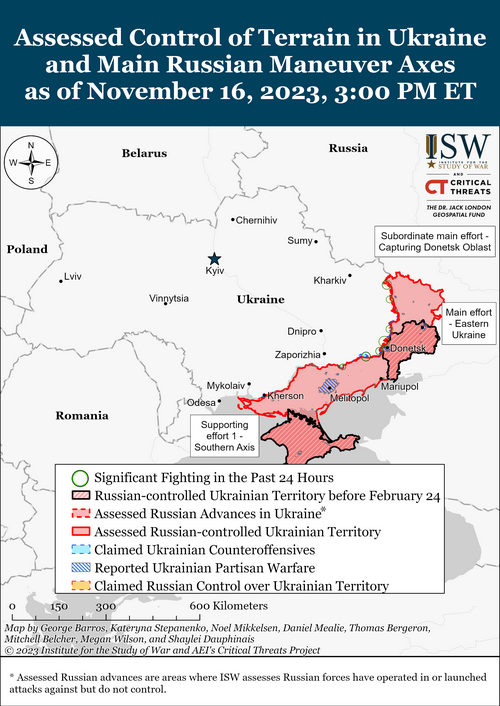
From The Institute For The Study of War:
Russian Offensive Campaign Assessment, November 16, 2023
Grace Mappes, Kateryna Stepanenko, Angelica Evans, Nicole Wolkov, George Barros, and Frederick W. Kagan
November 16, 2023, 8:45pm ET
Click here to see ISW’s interactive map of the Russian invasion of Ukraine. This map is updated daily alongside the static maps present in this report.
Click here to see ISW’s 3D control of terrain topographic map of Ukraine. Use of a computer (not a mobile device) is strongly recommended for using this data-heavy tool.
Click here to access ISW’s archive of interactive time-lapse maps of the Russian invasion of Ukraine. These maps complement the static control-of-terrain map that ISW produces daily by showing a dynamic frontline. ISW will update this time-lapse map archive monthly.
Note: The data cut-off for this product was 1:30pm ET on November 16. ISW will cover subsequent reports in the November 17 Russian Offensive Campaign Assessment.
Russian forces conducted a series of missile and drone strikes against Ukraine on the night of November 15 to 16. The Ukrainian General Staff reported that Russian forces launched 18 Shahed-131/136 drones of which Ukrainian forces destroyed 16.[1] The Ukrainian Air Force reported that Russian forces launched S-300 missiles targeting Kharkiv Oblast and that Ukrainian forces destroyed a Kh-59 cruise missile over Poltava Oblast on the evening of November 15.[2] Ukrainian Air Force Spokesperson Colonel Yuriy Ihnat reported on November 16 that Russian forces changed the timing of the November 16 drone attack from their normal strike pattern by conducting the drone strikes until around 9:30am local time, as opposed to conducting the attacks at their usual time from around 10:00pm to 3:00-4:00am.[3] Ukrainian Southern Operational Command Spokesperson Captain First Rank Nataliya Humenyuk stated that the Russian military has concentrated over 800 missiles, including Kalibr and Onyx missiles, in occupied Crimea and intends to use all of them against Ukrainian energy infrastructure in winter 2023.[4]
Russian Security Council Secretary Nikolai Patrushev announced on November 16 that Russian authorities are strengthening Russian air defense over Russia’s Central Federal Okrug, likely in response to Ukraine’s recently implied intent to conduct an interdiction campaign against Russian supply routes in rear areas during the winter. Patrushev also announced that Russian authorities have organized patrols to protect critical infrastructure facilities to prevent attacks and that the Russian government is funding the creation of “territorial defense lines” for oblasts bordering Ukraine.[5] Patrushev added that Russian authorities are updating a list of all critical infrastructure facilities – including fuel and energy facilities and important transportation objects – that require protection from unspecified threats.[6] The Central Federal Okrug consists of 18 federal subjects including Bryansk, Kursk, and Belgorod oblasts, which border Ukraine.[7] Ukrainian Deputy Prime Minister Iryna Vereshchuk stated on November 13 that Ukraine needs additional air defense systems and long-range missiles to strike Russian rear areas.[8] Ukrainian Ground Forces Spokesperson Lieutenant Colonel Volodymyr Fityo stated on November 12 that Ukrainian forces’ current main task is to disrupt Russian ground lines of communications (GLOCs).[9]
Russian milbloggers continued to criticize actors in the Russian information space for distorting the reality of the Russian war effort, highlighting an emerging cyclical dynamic in the Russian information space in which the majority of Russian sources coalesce around a particular predominant narrative and, in turn, a subset of different sources coalesces to criticize the majority’s prevailing opinion. A prominent Russian milblogger claimed on November 16 that Russian state media may have falsely convinced the Russian people that “everything is fine” in Russia’s war in Ukraine.[10] The milblogger claimed that he does not understand why Russian state media devotes so much time to promoting narratives about the “imminent collapse of Ukraine” and portrays the Russian war effort so positively that Russian viewers think that signing a military service contract is unnecessary. Another Russian milblogger who previously served throughout the front in Ukraine and correctly assessed Russia’s foundational problems in Kharkiv Oblast in spring 2022 criticized several unnamed Russian milbloggers for their recent overly positive reporting about Russian counterattacks on the east (left) bank of Kherson Oblast.[11] The milblogger claimed that the other milbloggers preemptively claimed that Russian forces repelled Ukrainian attacks on the east bank and criticized them for setting unrealistic expectations for Russian forces. The milblogger noted that such overoptimistic claims are forcing Russian servicemen to “catch up” to these Russian politicians’ and commanders’ unrealistic expectations of Russian battlefield successes. The milblogger’s complaint suggests that the situation in Kherson Oblast remains very ambiguous and is dynamic. The milblogger’s complaint mirrors recent reports that the Russian General Staff uses battlefield maps that differ from tactical reality and that local Russian commanders order Russian forces to conduct routine assaults to make gains that align with the Russian General Staff’s inaccurate maps.[12] Disjointed Kremlin efforts to consolidate control over the Russian information space and report overly optimistic news are likely creating these cycles of coalescence and backlash among Russian sources. The Russian information space may grow increasingly volatile as the rift between the Kremlin optimists and their critics expands.
Russian President Vladimir Putin awarded a prominent Russian milblogger who was previously critical of Russia’s military performance during its full-scale invasion with a prestigious state honor, continuing the Kremlin’s long-standing effort to coopt milbloggers and make them loyal to the Kremlin. Putin awarded founder of Rybar Telegram channel, Mikhail Zvinchuk, the Russian Order of Merit of the Fatherland Second Class for his efforts supporting the Russian full-scale invasion of Ukraine on November 16.[13] Other Russian milbloggers congratulated Zvinchuk and praised him for launching the first awarded Telegram channel in Russia.[14] Putin had previously engaged Zvinchuk by recruiting him to join the Kremlin working group on mobilization problems on December 20, 2022, which ISW assessed was Putin’s first concerted attempt to regain control over the segment of Russia’s domestic audience that turned to the Telegram information space for war coverage independent of Russian state media.[15]
Zvinchuk’s Rybar project amassed an audience of over 1.2 million followers by covering Russian military operations in Ukraine and is frequently cited by Russian and Western media alike (including ISW). Russian investigative outlet The Bell reported that Rybar was originally a personal blog from its creation in 2018 until Wagner Group financier Yevgeny Prigozhin reportedly began sponsoring the channel from 2019 to 2021.[16] The Bell observed that Rybar frequently published posts that may have advanced Prigozhin’s business interests in Syria during their partnership. Rybar frequently published contradictory posts since the start of the Russia’s full-scale invasion of Ukraine. Rybar’s posts and tone used to loudly criticize the Russian Ministry of Defense (MoD) only to then defend disgraced Russian Colonel General Aleksandr Lapin against attacks on his command from Chechen Republic Head Ramzan Kadyrov and Prigozhin.[17] The Bell also found that Rybar amplified numerous videos that supported the Russian MoD’s information operation efforts to present partial mobilization in Russia in a more favorable light. Rybar claims to sustain its four million ruble ($44,800) monthly production cost via donations, although the channel also profits from showing advertisements for companies associated with First Deputy Head of the Presidential Administration Sergei Kiriyenko and Russian state media.[18]
ISW had observed a significant shift in the style and focus of Rybar’s war coverage since the Ukrainian counteroffensives in Kharkiv and Kherson oblasts in fall 2022 during which Russian state propagandists were unable to explain away Russia’s military failures and a deeply unpopular mobilization of 300,000 reservists.[19] Zvinchuk began appearing on Russian state television and the Russian state media began heavily relying on Zvinchuk’s content at this time. Rybar’s coverage since fall 2020 has significantly reduced its criticism of the Russian MoD. This observed content and tonal shift is significant and is likely the result of Putin’s efforts to coopt prominent Russian milbloggers to reestablish Kremlin dominance over the Russian language online information space, carry out information operations against Western audiences, and prevent other influential Russian officials from buying milbloggers’ loyalties. Zvinchuk’s award also likely serves as an effort to incentivize other milbloggers to offer their loyalty to the regime in exchange for accolades and Kremlin recognition.
Ukraine stated that the continued Russian occupation of the Zaporizhzhia Nuclear Power Plant (ZNPP) has resulted in equipment and maintenance failures that threaten the plant’s security. Ukrainian nuclear energy operator Energoatom reported on November 16 that Russian ZNPP authorities transferred reactor no. 5 to a hot shutdown state from a cold shutdown state in violation of Ukraine’s nuclear regulatory orders, resulting in a leak of a boric acid solution that entered all the reactor’s steam generators.[20] Energoatom reported that Russian ZNPP authorities’ “incompetence” in bringing reactors from cold shutdowns to hot shutdowns has resulted in a radioactive coolant leak from the first to second circuit of reactor no. 4 and a similar situation involving reactor no. 6.[21] Energoatom also reported that unspecified “incompetent” Russian actions resulted in reactor no. 6 experiencing a temporary blackout on November 14, forcing the reactor to rely on emergency diesel generators.[22] Energoatom stated that equipment at the ZNPP is constantly degrading and that the frequency of such dangerous instances are increasing.[23]
The International Atomic Energy Agency (IAEA) has not yet commented on these incidents but expressed concern on November 13 over the extent and effectiveness of maintenance on ZNPP safety systems and its own ability to monitor ZNPP operations.[24] The IAEA reported that these maintenance issues became apparent in July and August 2023 when the steam generator of reactor no. 4 experienced a leak that contaminated the reactor’s safety systems that had to be recleaned. The IAEA reported that ZNPP operators have not granted its contingent at the ZNPP access to all six reactor turbine halls to assess their safety and that operators restricted IAEA access during recent walkthroughs of the halls in October and on November 10. The IAEA reported that the ZNPP planned maintenance of transformers of reactors no. 4, 5, and 6 after recently completing maintenance of transformers of reactors no. 1, 2, and 3 and noted that reactors no. 4 and 5 are in hot shutdown mode in violation of the Ukrainian regulatory agency’s orders.
The Ukrainian and IAEA reports indicate that Russia’s presence and exclusive control over the ZNPP is increasing, suggesting that similar failures may escalate under continued Russian occupation. The IAEA announced on November 13 that its staff visited a Russian training center for the ZNPP on November 7 and that Russian nuclear regulatory agency Rostekhnadzor is establishing a permanent presence at the ZNPP.[25] This announcement indicates the normalization of the Russian occupation of the ZNPP despite Russian forces’ documented reckless conduct near the plant.[26] In addition to the recent equipment and mechanical failures, Russian forces deployed military equipment on and inside ZNPP facilities in summer-fall 2022 to protect these assets from Ukrainian strikes, while setting conditions to blame Ukrainian forces for any incidents at the ZNPP.[27] The ZNPP has completely lost access to external power sources seven times during its service history – all seven incidents occurring while under Russian occupation.[28]
Cyprus has reportedly been complicit in helping Russian elites, sanctioned for supporting the Russian invasion of Ukraine in 2014 and 2022, launder money. The International Consortium of Investigative Journalists (ICIJ) reported on November 14 that Russians who have been under Western sanctions since 2014 owned or controlled almost 800 companies and trusts secretly registered in various countries and territories including Cyprus, Lichtenstein, the British Virgin Islands, and Hong Kong.[29] The ICIJ also stated that Cypriot professional services firms have worked on behalf of 25 Russians sanctioned after Russia’s 2014 invasion of Ukraine and on behalf of an additional 71 Russians sanctioned after Russia’s full-scale invasion of Ukraine in 2022.[30] The ICIJ found that the Cypriot branch of an international professional service firm helped a Russian billionaire transfer a $1.4 billion in investments out of his name to evade European Union (EU) sanctions.[31] The ICIJ cited figures from the Center for the Study of Democracy in Sofia, Bulgaria, reporting that Russian businessmen have “invested” over $200 million in Cyprus as of 2020, comprising half of all Russian investments in Europe, and that about 300 Russian-owned companies constituted 80 percent of Cyprus’ wealth at one point in time.[32]
Gazprom Media Holdings, a subsidiary of Russian state-owned energy company Gazprom, announced on November 16 that it acquired the majority share of a large Russian blogger agency, likely in an effort to expand its already extensive control over the Russian media space. Gazprom Media Holdings announced that it bought 51 percent of shares in Insight People, reportedly the largest blogging agency in Russia.[33] Gazprom Media Holdings already owns Russian video streaming platform RuTube, Russian social media network VKontakte, and several prominent Russian TV channels and radio stations.[34] Gazprom Media is headed by Alexander Zharov who previously served as the head of Russian state censor Roskomnadzor from 2012 to 2020.[35] Long-time Gazprom Head Alexei Miller notably has associates throughout various power structures, and Gazprom Media’s recent media acquisitions indicates a possible rise in Miller’s influence. Miller is a long-time associate of Russian President Vladimir Putin and likely has ties to former Russian Federal Security Service (FSB) Head and Security Council Secretary Nikolai Patrushev, as Patrushev’s sons previously held senior positions at Gazprom.[36]
Russian authorities discovered former Russian 6th Air Force and Air Defense Army Commander Lieutenant General Vladimir Sviridov dead in his home in Stavropol Krai on November 15. Russian sources reported that authorities found Sviridov dead with a woman, likely his wife, and suggested that the couple likely died around November 9. Russian sources reported that Russian authorities have not yet determined Sviridov’s and the woman’s cause of death but have ruled out carbon monoxide poisoning and “violent” deaths.[37] Sviridov reportedly resigned from his position as commander of the 6th Air Force and Air Defense Army in 2009.[38]
Key Takeaways:
- Russian forces conducted a series of missile and drone strikes against Ukraine on the night of October 15 to 16.
- Russian Security Council Secretary Nikolai Patrushev announced on November 16 that Russian authorities are strengthening Russian air defense over Russia’s Central Federal Okrug, likely in response to Ukraine’s recently implied intent to conduct an interdiction campaign against Russian supply routes in rear areas during the winter.
- Russian milbloggers continued to criticize actors in the Russian information space for distorting the reality of the Russian war effort, highlighting an emerging cyclical dynamic in the Russian information space in which the majority of Russian sources coalesce around a particular predominant narrative and, in turn, a subset of different sources coalesces to criticize the majority’s prevailing opinion.
- Russian President Vladimir Putin awarded a prominent Russian milblogger who was previously critical of Russia’s military performance during its full-scale invasion with a prestigious state honor, continuing the Kremlin’s long-standing effort to coopt milbloggers and make them loyal to the Kremlin.
- Ukraine stated that the continued Russian occupation of the Zaporizhzhia Nuclear Power Plant (ZNPP) has resulted in equipment and maintenance failures that threaten the plant’s security.
- The Ukrainian and IAEA reports indicate that Russia’s presence and exclusive control over the ZNPP is increasing, suggesting that similar failures may escalate under continued Russian occupation.
- Cyprus has reportedly been complicit in helping Russian elites, sanctioned for supporting the Russian invasion of Ukraine in 2014 and 2022, launder money.
- Gazprom Media Holdings, a subsidiary of Russian state-owned energy company Gazprom, announced on November 16 that it acquired the majority share of a large Russian blogger agency, likely in an effort to expand its already extensive control over the Russian media space.
- Russian authorities discovered former Russian 6th Air Force and Air Defense Army Commander Lieutenant General Vladimir Sviridov dead in his home in Stavropol Krai on November 15.
- Russian forces continued offensive operations along the Kupyansk-Svatove-Kreminna line, near Bakhmut, near Avdiivka, west and southwest of Donetsk City, in the Donetsk-Zaporizhia Oblast border area, near Robotyne, and northeast of Vasylivka and advanced near Avdiivka.
- The Russian Ministry of Education issued a draft order establishing a course called “Fundamentals of Security and Defense of the Motherland” for Russian middle and high school students starting in September 2024.
- The Russian government and Russian occupation authorities continue to forcibly deport children in occupied Ukraine to Russia under the rubric of educational programs.
Go here to read the rest. Historically Americans become war weary of a conflict in the third year. It is bad luck for the Ukrainians that the third year of their conflict will be a Presidential election year in the US. I expect the Ukrainians to come under intense pressure from the current administration to enter into negotiations with the Russians. If Trump wins he has promised to resolve the Ukrainian conflict in his first day in office. He has not told us how he will manage this feat. The Ukrainians had their best opportunity to win this War outright this year. Next year promises to be more rocky for them, at least to the degree their war effort depends on US support.

