
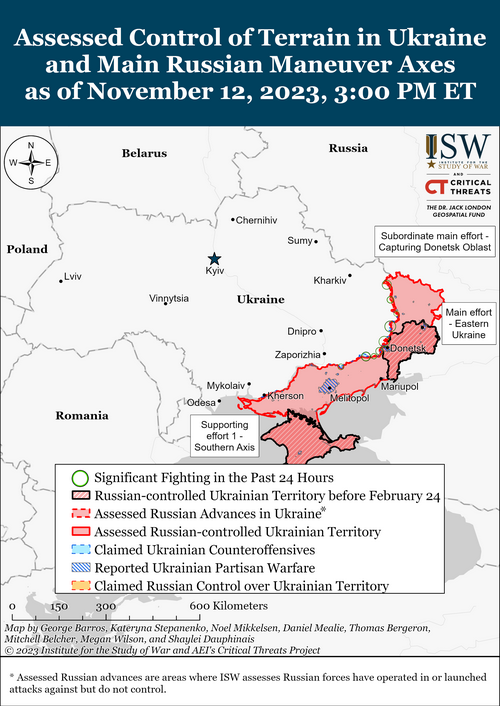
From The Institute For The Study of War:
Russian Offensive Campaign Assessment, November 12, 2023
Grace Mappes, Angelica Evans, Riley Bailey, Karolina Hird, and Frederick W. Kagan
November 12, 2023, 3:55pm ET
Click here to see ISW’s interactive map of the Russian invasion of Ukraine. This map is updated daily alongside the static maps present in this report.
Click here to see ISW’s 3D control of terrain topographic map of Ukraine. Use of a computer (not a mobile device) is strongly recommended for using this data-heavy tool.
Click here to access ISW’s archive of interactive time-lapse maps of the Russian invasion of Ukraine. These maps complement the static control-of-terrain map that ISW produces daily by showing a dynamic frontline. ISW will update this time-lapse map archive monthly.
Note: The data cut-off for this product was 1pm ET on November 12. ISW will cover subsequent reports in the November 13 Russian Offensive Campaign Assessment.
Ukraine appears to be intensifying attacks against Russian military, logistics, and other high-profile assets in rear areas in occupied Ukraine and Russia. The Ukrainian Main Military Intelligence Directorate (GUR) reported on November 12 that Ukrainian partisans attacked a Russian military headquarters in occupied Melitopol, Zaporizhia Oblast on November 11, killing at least three Russian Federal Security Service (FSB) and Rosgvardia officers.[1] The GUR’s November 12 announcement follows a Ukrainian partisan attack against a former Luhansk People’s Republic (LNR) People’s Militia head on November 8; strikes against a Russian military base in occupied Skadovsk, Kherson Oblast and Black Sea Fleet assets in Crimea on November 9; and three rear-area strikes and partisan attacks in Russia on November 11.[2] Ukrainian forces have conducted a strike campaign specifically targeting occupied Crimea since summer 2023.[3]
The Russian government is attempting to downplay the extent of its efforts to strengthen control over the Russian information space. The Russian Ministry of Digital Development claimed on November 12 that it will only block specific virtual private network (VPN) services that an “expert commission” identifies as threats, likely aiming to prevent Russians from bypassing Russian censorship efforts and anonymizing themselves online.[4] The Ministry of Digital Development had responded to an inquiry from the “Novyi Lyudi” faction expressing concern over the Russian government’s efforts to restrict access to information on the internet and fears that the Russian government will simply identify all VPN services as threats and block them.[5] The Russian government recently announced a ban on services that provide virtual and temporary mobile numbers starting on September 1, 2024, and Russians can use these mobile numbers in conjunction with VPN services to form anonymous online personas to evade Russian censorship efforts.[6] The Russian government is very unlikely to allow any VPNs to operate within Russia that would allow Russians to bypass censorship efforts and remain anonymous from the Russian government.
Russia continues to posture itself as a prominent security guarantor for authoritarian countries in Africa. Russian Deputy Defense Minister Alexander Fomin stated during a television interview with the “Voyennaya Priemka” program on November 12 that Russia will sign military cooperation agreements with six additional African countries in the near future.[7] Fomin stated that Russia currently has military agreements with 30 of the 54 African countries and added that Russia is “very active” on the African continent. Fomin did not specify which African countries Russia will sign agreements with, although Russian Defense Minister Sergei Shoigu and Deputy Defense Minister Yunus-Bek Yevkurov have met with delegations from Burkina Faso, Niger, Mali, and Libya in recent months.[8] French-language outlet Jeune Afrique reported on November 11 that a group of Russian servicemen arrived in Burkina Faso to protect President Ibrahim Traore from future coup attempts, which Russian sources credited as an outcome of Shoigu’s November 7 meeting with Burkinabe Minister of Defense and Veteran Affairs Brigadier General Kassoum Coulibaly.[9] The Kremlin appears to be using military agreements with Sahelian juntas to insert itself into the power vacuums created by the withdrawal of Western actors from the region, such as the UN’s withdrawal from Mali.[10]
Russian forces conducted a limited series of missile strikes targeting southern Ukraine on November 12. Ukrainian military officials reported that Russian forces launched two Kh-59 cruise missiles and an Iskander ballistic missile at targets in southern Ukraine.[11] Ukraine’s Southern Operational Command reported that Ukrainian air defenses intercepted a Kh-59 cruise missile over Mykolaiv Oblast and that the second Kh-59 missile and the Iskander missile struck unpopulated areas.[12]
Key Takeaways:
- Ukraine appears to be intensifying attacks against Russian military, logistics, and other high-profile assets in rear areas in occupied Ukraine and Russia.
- The Russian government is attempting to downplay the extent of its efforts to strengthen control over the Russian information space.
- Russia continues to posture itself as a prominent security guarantor for authoritarian countries in Africa.
- Russian forces conducted a limited series of missile strikes targeting southern Ukraine on November 12.
- Russian forces continued offensive operations along the Kupyansk-Kreminna line, near Bakhmut, in the Donetsk-Zaporizhia Oblast border area, and in western Zaporizhia Oblast.
- Ukrainian forces made a marginal gain on the east (left) bank of Kherson Oblast on November 12 amid ongoing ground operations.
Go here to read the rest. The Russians have denuded their rear areas to man their front line in Ukraine. Ukrainian partisans are now demonstrating why stinting on rear area security when you are invaders is almost always a very bad idea.

