
From The Institute For The Study of War:
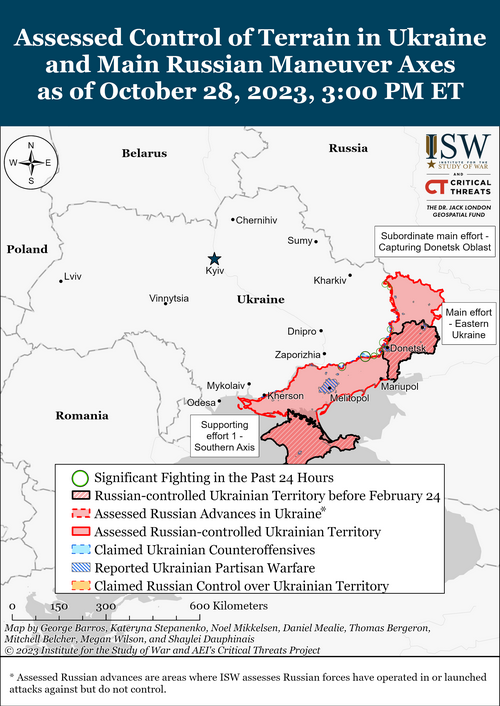
Russian Offensive Campaign Assessment, October 28, 2023
Angelica Evans, Kateryna Stepanenko, Christina Harward, Grace Mappes, and Frederick W. Kagan
October 28, 2023, 7:50pm ET
Click here to see ISW’s interactive map of the Russian invasion of Ukraine. This map is updated daily alongside the static maps present in this report.
Click here to see ISW’s 3D control of terrain topographic map of Ukraine. Use of a computer (not a mobile device) is strongly recommended for using this data-heavy tool.
Click here to access ISW’s archive of interactive time-lapse maps of the Russian invasion of Ukraine. These maps complement the static control-of-terrain map that ISW produces daily by showing a dynamic frontline. ISW will update this time-lapse map archive monthly.
Note: The data cut-off for this product was 1:30pm ET on October 28. ISW will cover subsequent reports in the October 29 Russian Offensive Campaign Assessment.
Remnants of the Wagner Group appear to be fighting in the Avdiivka direction subordinate to Russian Ministry of Defense (MoD) controlled formations. A Russian military correspondent published an interview on October 25 with the commander of the Russian “Arbat” Separate Guards Special Purpose Battalion that is serving the Avdiivka direction, who claimed that an element of the Arbat Battalion is almost entirely composed of former Wagner personnel.[1] The commander claimed that the Avdiivka direction is the Arbat Battalion’s “main direction” because the unit is part of the “Dikaya Division of Donbas” and the “Pyatnashka” Brigade — a Donetsk People’s Republic (DNR) formation that is responsible for the defending Donetsk City.[2] The commander noted that the Wagner-staffed unit sends drone operators, electronic warfare (EW) specialists, and other fighters to other units in different frontline sectors as needed. The correspondent also indicated that the Arbat Battalion is part of the Russian Armed Forces, and it is likely that the brigade consists of former Wagner personnel who signed military contracts directly with the Russian MoD following Wagner financier Yevgeny Prigozhin’s rebellion and or his death.
A Ukrainian military observer also stated on October 25 that Wagner Group remnants are fighting near Avdiivka.[3] Ukrainian and Russian sources have previously stated that small groups of former Wagner personnel, possibly under Russian MoD-controlled formations, are deployed to the Bakhmut area.[4] It is too early to determine what role former Wagner personnel may play in Russian offensive operations against Avdiivka. The Arbat Battalion’s commander noted that the battalion’s situation on the front line is “good but not great” due to heavy personnel losses near Avdiivka.[5] Ukrainian military observers expressed concern about continued Russian operations in the Avdiivka direction, however.[6]
Commander of the “Akhmat” Spetsnaz forces Apty Alaudinov confirmed that Rosgvardia is recruiting former Wagner fighters into Chechen “Akhmat” Spetsnaz units. Alaudinov stated in an interview published on October 28 that a “massive” number of Wagner soldiers have joined various detachments of the “Akhmat” forces and are operating in several unspecified sectors of the front in Ukraine.[7] Alaudinov claimed that former Wagner soldiers are following their former commanders to the “Akhmat” units. Alaudinov noted that Wagner fighters have “always spoken very respectfully about [‘Akhmat’],” likely in an attempt to stifle discussions of possible tension between the Wagner and Chechen forces after the feud between deceased Wagner Group financier Yevgeny Prigozhin and Chechen Republic Head Ramzan Kadyrov.[8] ISW continues to assess that former Wagner forces fragmented between the Russian MoD and Rosgvardia Chechen units across various sectors of the front are unlikely to reemerge as an effective military organization as they will lack the strength Wagner had drawn from being a unitary organization under clear and coherent leadership.[9] They may be tactical combat power multipliers for the units they embed with in some circumstances, however.
Ukrainian forces continued offensive operations near Bakhmut and in western Zaporizhia Oblast on October 28. The Ukrainian General Staff reported that Ukrainian forces continued offensive operations south of Bakhmut and in the Melitopol (western Zaporizhia Oblast) direction.[10] Russian sources claimed that Ukrainian forces attacked near Robotyne, Nesteryanka (12km northwest of Robotyne), Kopani (6km northwest of Robotyne), Rivne (8km west of Robotyne), Novoprokopivka (3km south of Robotyne), and Verbove (9km east of Robotyne).[11] A Kremlin-affiliated Russian milblogger claimed on October 27 that Ukrainian forces achieved “minor successes” during attacks near Robotyne.[12]
Russian forces conducted a series of missile strikes against Dnipropetrovsk Oblast on the night of October 27 to 28. Ukrainian military sources reported on October 28 that Ukrainian air defenses downed three of four Iskander-K cruise missiles that Russian forces launched from Crimea.[13] The fourth missile reportedly did not reach its target.[14] Russian sources claimed that Russian forces struck Ukrainian infrastructure in Kryvyi Rih and Dnipro City, Dnipropetrovsk Oblast, and Izmail, Odesa Oblast.[15]
Russian forces are reportedly using a new version of the “Lancet” kamikaze drone that can autonomously identify targets. Russian sources claimed that Russian forces began using the new “Izdeliye-53” kamikaze drone as of October 21.[16] The sources claimed that the “Izdeliye-53” drone reportedly has an automatic guidance system that can distinguish types of targets and increase strike success rates.[17] Russian forces are reportedly not using the “Izdeliye-53” drones on a wide scale yet, but Russian sources claimed that Russian forces are currently testing the drones for mass synchronized swarm strikes.[18] ISW previously reported on October 24 that Russian forces also allegedly recently used the new “Italmas” (also known as “Izdeliye-54”) drones during a drone strike on Kyiv Oblast.[19] ISW also previously assessed that the Russian command may believe that a large number of strike drones will allow Russian forces to overwhelm Ukrainian air defenses, although the payload of the “Izdeliye-53” drones, which is reportedly between three and five kilograms, may not be sufficient to significantly damage most critical military targets.[20]
Russian authorities are capitalizing on domestic ethnic tensions by increasing public coercion of Central Asian migrants into Russian military service, likely to appeal to Russian ultranationalists ahead of Russian President Vladimir Putin’s expected presidential campaign announcement. The Moscow Investigative Committee announced on October 27 that it began 12 criminal investigations against naturalized migrants for evading military service and claimed that this number rose on October 28 to 22 opened investigations with 80 migrants already sent to military service.[21] Russian Federal Security Service (FSB) and Rosgvardia agents detained 40 migrant taxi drivers during a raid at the Norilsk airport in Krasnoyarsk Krai on October 27 for allegedly failing to register with Russian military registration and enlistment offices.[22] These announcements are part of a series of recent measures and statements that highly publicize Russian intent and efforts to mobilize Central Asian migrants likely aimed to appeal to Russian President Vladimir Putin’s ultranationalist constituency, which has long expressed hatred for Central Asian migrants and increasingly called for these migrants to serve in the Russian military.[23]
The Kremlin maintains a relatively measured stance on alleged migrant crimes against ethnic Russians, likely unintentionally establishing a cycle that keeps these ethnic tensions in frequent Russian ultranationalist dialogue. Russian ultranationalist milbloggers expressed anger on October 28 over criticisms of footage that shows a Russian man insulting migrant children while breaking up an alleged fight between 10 migrant children and an ethnic Russian child in Rostov-on-Don.[24] The milbloggers insulted the children and the wider migrant community, with some even claiming that the migrant children intended to kill the ethnic Russian child, but largely praised the Russian man for intervening.[25] The milbloggers claimed that such incidents are commonplace and that no one cares or steps in to mitigate the incidents.[26] Russian Investigative Committee Head Alexander Bastrykin announced an investigation into the Rostov-on-Don incident on October 27 as well as claims of separate incidents in Chelyabinsk Oblast on October 25 and Novosibirsk and Novgorod oblasts on October 28.[27]
Key Takeaways:
- Remnants of the Wagner Group appear to be fighting in the Avdiivka direction subordinate to Russian Ministry of Defense (MoD) controlled formations.
- Commander of the “Akhmat” Spetsnaz forces Apty Alaudinov confirmed that Rosgvardia is recruiting former Wagner fighters into Chechen “Akhmat” Spetsnaz units.
- Ukrainian forces continued offensive operations near Bakhmut and in western Zaporizhia Oblast on October 28.
- Russian forces conducted a series of missile strikes against Dnipropetrovsk Oblast on the night of October 27 to 28.
- Russian authorities are capitalizing on domestic ethnic tensions by increasing public coercion of Central Asian migrants into Russian military service, likely to appeal to Russian ultranationalists ahead of Russian President Vladimir Putin’s expected presidential campaign announcement.
- Russian forces conducted offensive operations along the Kupyansk-Svatove-Kreminna line, near Bakhmut, near Avdiivka, west and southwest of Donetsk City, in western Donetsk Oblast, in the Donetsk-Zaporizhia Oblast border area, and in western Zaporizhia Oblast and advanced in some areas.
- A prominent Russian milblogger claimed that he personally heard Russian President Vladimir Putin express his decision to send Russian conscripts to serve in the Russian Border Service.
- Pro-Ukrainian actors reportedly conducted a cyber attack against Russian telecom operators in occupied Ukraine.
Go here to read the rest.
From Strategy Page:
October 29, 2023: By early 2023, after several years of effort, Russia had established twelve VOIN (“fighter”) centers. One more was to open in 2024. VOIN is used to expose teenagers to military life by giving them military uniforms, regular military orientation and some training to prepare them for joining the military via conscription or volunteering. The VOIN training for teenagers also includes a lot of education (indoctrination) about the importance of patriotism and preparing to defend Russia. This is one of the reasons Russia never refers to their invasion of Ukraine as an invasion. According to the government the fighting in Ukraine is a Russian internal matter to suppress separatist activity by some people in southern Russia that call themselves Ukrainians and are fighting to create an independent country called Ukraine. Since 2022, VOIN centers also train Russian army reservists headed for Ukraine. Recently, the number of reservists called up has overwhelmed the VOIN system and reservists are sent to Ukraine without any preparation. Losses are higher for these reservists.
Russia also revealed a list of several former parts of the ex-Soviet Union, who are now neighboring countries, that they want to make part of Russia. Some of those neighbors are NATO members. Ukraine wants to join NATO, and NATO agrees, but only after the Russian invaders have been expelled. So far, the Ukrainian resistance has killed about 300,000 Russian soldiers and destroyed most modern Russian tanks. In response Russia took thousands of 1960s-era T-62 tanks out of storage and sent them to Ukraine to provide more targets for Ukrainian tanks and anti-tank weapons. A growing number of the Ukrainian tanks are Western models which have demonstrated a clear superiority over any Russian tank they encounter.
Defeats and losses in Ukraine are downplayed by Russian media. The government explains, but cannot prove, that the fighting is taking longer because of NATO support that this is supposed to include the NATO troops doing a lot of the fighting. No captured NATO soldiers have been revealed because there aren’t any.
Many Russians, including the teenagers and especially Russians who have served in Ukraine, are dubious about their government’s claims about a purported NATO plot to conquer Russia. There are older Russians who remember why the Soviet Union fell apart. It wasn’t because of NATO aggression; it was because most citizens of the Soviet Union saw that the Soviet Union was a failed dictatorship that was not helping the people of Russia. That resulted in the collapse of the Soviet Union, something the Soviets could not suppress with persuasion, threats or the use of armed force. The people had made up their minds and the security forces refused to fight Russians over this. The Soviet Union lost half its population to newly formed nations, including Ukraine, which was one of most prosperous regions of the Union and few Ukrainians wanted to remain under Russian domination. This is why a lot of the VOIN training for teenagers is ideological, stressing the importance of preserving Mother Russia above all else.
Another function of VOIN is to train army reservists in combat techniques before they are activated. Most of these reservists will be called up to fight in Ukraine and VOIN concentrates on that because the VOIN training is likely all that they’ll ever get. Most of these men know what is going on in Ukraine and are not enthusiastic about going there and dying. For Russian troops in Ukraine, morale has been low for some time and that is visible in the reluctance for Russian attacks to move forward with much determination. Even in the defense, Russian troops are more interested in retreating to Russia than in halting the growing number of Ukrainian attacks. There have been growing incidences of Russian troops deliberately seeking an opportunity to surrender to the Ukrainians. Since the invasion began in early 2022, Ukraine has lost about a third as many troops as Russia. In the last year, Ukraine has been losing proportionately less than before because Ukrainian morale and combat ability has improved, and the Russians have suffered because of that.
VOIN centers are important because historically, newly conscripted Russians received nothing like the months of basic and advanced training Western recruits received. The results were more effective Western soldiers and Russian leaders agree Russia should provide the same training and increase the proportion of volunteer, or contract, veterans to the military, especially the army. It was too expensive, as was extensive training for recruits. Typically, new recruits get a week or so of orientation, as in how to wear the uniform and recognize different ranks and how to respond to them. The recruits are quickly sent off to a unit, where they are supposed to receive “on the job” training but rarely do. Traditionally this was even done in wartime when civilians suddenly in uniform had to cope, and survive, as best they could.
Go here to read the rest. The Russians still have failed to solve their lack of trained troops, as demonstrated by their using politically unreliable Wagner troops in their latest offensive.

