
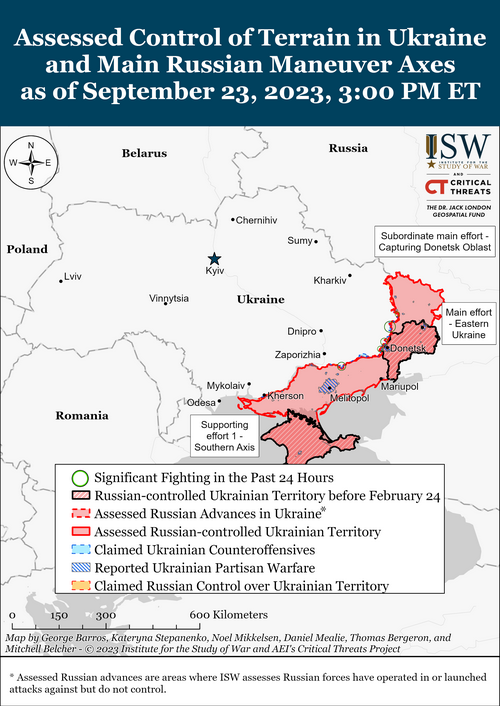
From The Institute For The Study of War:
Russian Offensive Campaign Assessment, September 23, 2023
George Barros, Kateryna Stepanenko, Christina Harward, Nicole Wolkov, and Frederick W. Kagan
September 23, 2023, 8:30pm ET
Click here to see ISW’s interactive map of the Russian invasion of Ukraine. This map is updated daily alongside the static maps present in this report.
Click here to access ISW’s archive of interactive time-lapse maps of the Russian invasion of Ukraine. These maps complement the static control-of-terrain map that ISW produces daily by showing a dynamic frontline. ISW will update this time-lapse map archive monthly.
Note: The data cut-off for this product was 3pm ET on September 23. ISW will cover subsequent reports in the September 24 Russian Offensive Campaign Assessment.
ISW is now prepared to assess that Ukrainian forces have broken through Russian field fortifications west of Verbove in western Zaporizhia Oblast. These fortifications are not the final defensive line in Russia’s defense in depth in western Zaporizhia Oblast, but rather a specific series of the best-prepared field fortifications arrayed as part of a near-contiguous belt of an anti-vehicle ditch, dragon’s teeth, and fighting positions about 1.7 – 3.5 km west of Verbove.[1]
Ukrainian Tavriisk Group of Forces Commander Brigadier General Oleksandr Tarnavskyi stated in an interview with CNN published on September 23 that Ukrainian forces achieved a “breakthrough” on the left flank near Verbove and that Ukrainian forces continue advancing.[2] Combat footage posted on September 22 shows a destroyed Ukrainian Mine-Resistant Ambush Protected (MRAP) and BMP-2 operating slightly beyond Russia’s fighting positions trench line near Verbove, indicating continued Ukrainian progress in deploying more heavy equipment beyond Russia’s triune belt of the anti-vehicle ditch, dragon’s teeth, and fighting positions.[3] Commercially available satellite imagery indicates that Ukrainian forces have brought heavy equipment closer to Verbove over the past 96 hours in a manner consistent with Tarnavskyi’s statement.[4] The Wall Street Journal reported on September 21 that Ukrainian forces achieved a “limited breakthrough” west of Verbove citing an unnamed Ukrainian Air Assault Forces officer.[5]
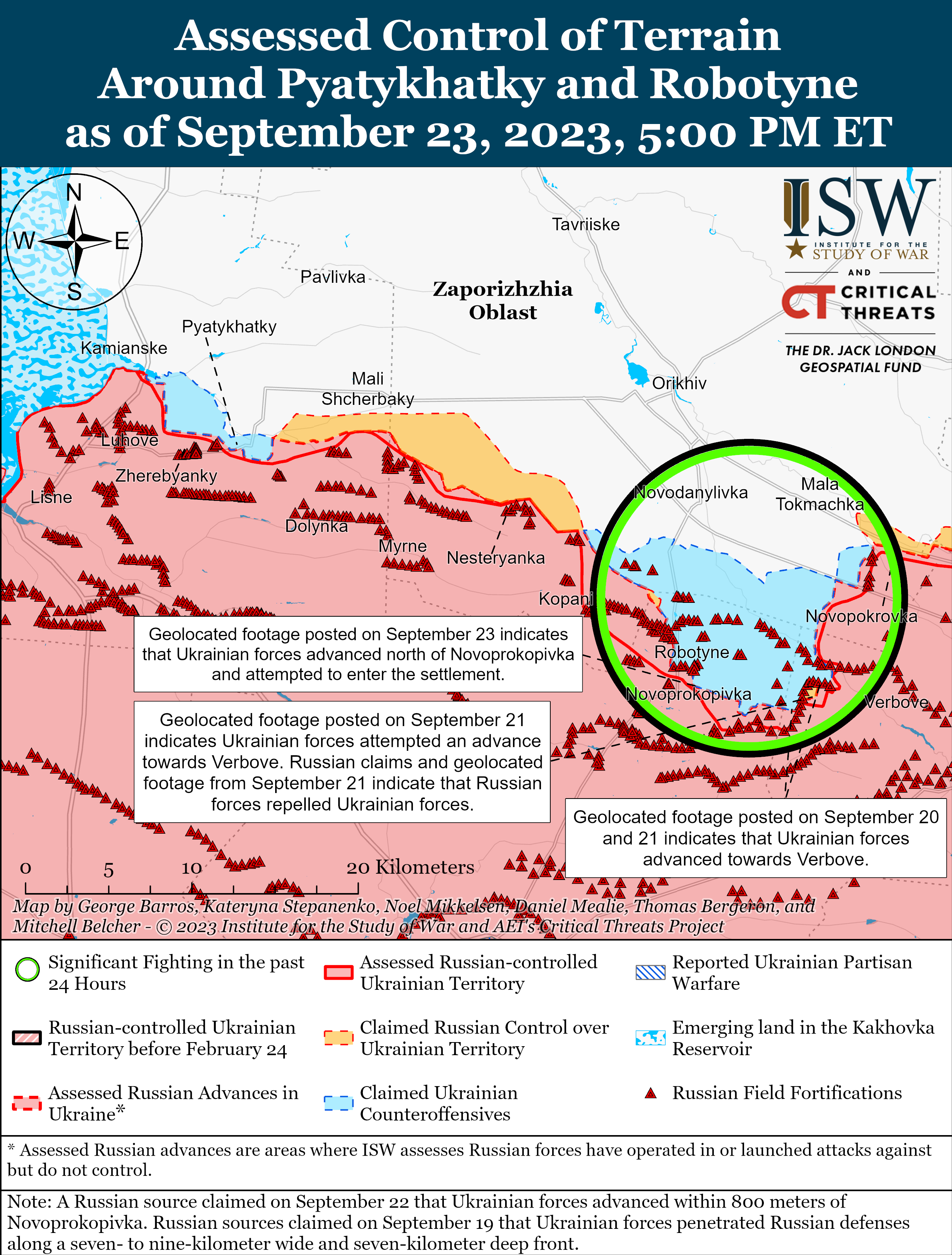
Ukrainian forces have not overcome all of the prepared Russian defensive positions near Verbove. Ukrainian forces’ rate of advance near their breakthrough remains unclear. Russian forces likely still control segments of the long trench line of Russian fighting positions between Robotyne (10km south of Orikhiv) and Verbove, especially near the tactical high ground to the south. Russian forces have reportedly established prepared fighting positions in almost every tree line that Ukrainian infantry are slowly and systematically fighting through. Russian forces have more field fortifications beyond Verbove; there are more anti-vehicle trenches and fighting positions north of Ocheretuvate (26km southeast of Orikhiv), for example. It is unclear the extent to which those positions are manned, however. ISW continues to assess that the Russian military does not have sufficient forces deployed to this sector of the front to completely man its defenses in depth and that Ukrainian forces should be able to operate through Russian field fortifications more rapidly if they are not properly manned.[6]
Ukrainian forces are deepening their penetration in Zaporizhia Oblast and are assaulting Novoprokopivka – a frontline village 1.5 km immediately south of Robotyne. Geolocated combat footage posted on September 23 shows elements of the Russian 70th Regiment (42nd Motorized Rifle Division, 58th Combined Arms Army, Southern Military District) ambushing and killing two Ukrainian infantrymen in Novoprokopivka’s northeastern outskirts, indicating that Ukrainian forces have likely cleared Russian positions between Robotyne and Novoprokopivka.[7] Multiple Russian sources reported that Russian forces repelled a Ukrainian attack against northern Novoprokopivka on September 22.[8] This is the first confirmed Ukrainian ground attack in the immediate vicinity of Novoprokopivka.
Ukrainian military officials stated that the Ukrainian counteroffensive would continue in the winter. Tarnavskyi told CNN that he expected a major Ukrainian breakthrough after Ukrainian forces reach Tokmak (a major Russian stronghold in western Zaporizhia) and that it is important that Ukrainian forces not lose the initiative they currently hold.[9] Tarnavskyi also stated that Ukrainian operations will continue through the winter as Ukrainian forces are mostly advancing on foot without vehicles and that inclement weather will thus not have a major negative effect on the Ukrainian counteroffensive.[10] Ukrainian Main Military Intelligence Directorate (GUR) Head Lieutenant General Kyrylo Budanov echoed a similar assessment about continued Ukrainian winter operations in an interview with The War Zone published on September 22.[11] ISW has previously assessed that, while seasonal weather can slow ground movements and challenge logistics, it will not impose a definite end to Ukrainian counteroffensive operations.[12] The culmination of the Ukrainian counteroffensive will likely depend rather on the Russian and Ukrainian balance of forces as well as on Western aid to Ukraine.
The Ukrainian counteroffensive in western Zaporizhia Oblast has likely destroyed the Russian 810th Naval Infantry Brigade (Black Sea Fleet). Budanov stated in his interview with The War Zone published on September 22 that the 810th Brigade was “completely defeated” in southern Ukraine.[13] Budanov stated that the 810th Brigade has withdrawn and that Russian airborne (VDV) units replaced them on the front. Budanov‘s description of the status of the 810th Brigade corresponds most closely to the US military‘s doctrinal definition of the tactical mission task of “destroy”: “physically render[ing] an enemy force combat-ineffective until reconstituted.”[14] Elements of the 810th Brigade have reportedly been operating in the Zaporizhia direction since March 2023 and in western Zaporizhia Oblast since June 2023.[15] ISW previously observed the 810th Brigade in October 2022, when it was reportedly operating in Kherson Oblast, and the unit was likely reconstituting in the rear in the interim before assuming positions in Zaporizhia Oblast.[16] The 810th Brigade has repeatedly suffered significant losses, and Ukrainian forces have destroyed the unit in the past, following which the Russian military has reconstituted it. The Ukrainian General Staff reported on April 19, 2022, that the 158 soldiers of the 810th Brigade had been killed and about 500 wounded.[17] GUR Deputy Chief Major General Vadym Skibitskyi stated on July 31, 2022, that 200 servicemen of the 810th Brigade refused to return to the war in Ukraine, and the Ukrainian General Staff reported on September 12, 2022, that the 810th Brigade lost more than 85% of its personnel in the Kherson direction and that many again refused to return to combat.[18]
A senior Ukrainian official explicitly confirmed that Ukraine’s objective in Bakhmut is to fix Russian forces. Ukraine’s fixing of Russian forces in Bakhmut may be alleviating pressure on the Kupyansk frontline. Ukrainian Main Military Intelligence Directorate (GUR) Head Lieutenant General Kyrylo Budanov stated that Ukrainian forces achieved their objective of pinning Russian forces in Bakhmut and preventing their transfer to other areas of the theater – such as southern Ukraine – in a September 22 interview.[19] Budanov also stated that the Russian military deployed the recently created and not fully formed 25th Combined Arms Army (CAA) of the Eastern Military District “roughly north of Bakhmut.”[20] Budanov previously reported on August 31 that the Russian military deployed elements of the 25th CAA to replace elements of the 41st CAA (Central Military District) in the Kupyansk direction as elements of the 41st CAA began a “slow” redeployment to southern Ukraine.[21] The Russian deployment of elements of the 25th CAA to Bakhmut instead of Kupyansk will likely disrupt Russian efforts to fix Ukrainian forces in the Kupyansk direction, as Russian forces need these troops to continue assaults in place of the 41st CAA. Ukrainian officials and Russian sources have indicated that the tempo and the intensity of Russian offensives on the Kupyansk-Svatove-Kreminna line has significantly decreased in recent weeks as Russian forces are continuing to regroup and rotate personnel in this direction, and the redirection of the deployment of 25th CAA may have alleviated some of the pressure from this frontline.[22] Budanov’s statement supports ISW’s recent assessment that Ukrainian counteroffensive operations on Bakhmut’s southern flank have fixed a large amount of Russian combat power in Bakhmut that would otherwise be available to reinforce Russian defenses in the south — or, in this case, to attempt to force Ukrainian forces to redeploy to defend against Russian assaults around Kupyansk.[23]
Ukraine’s simultaneous counteroffensives in Bakhmut and southern Ukraine are impeding Russia’s long-term force generation efforts as Russia redeploys its new reserves to defend against Ukrainian advances. Russian Defense Minister Sergei Shoigu announced that the Russian Ministry of Defense (MoD) formed a “reserve army” at the end of June, likely referencing the 25th CAA among other formations, which began recruiting personnel from the Russian Far East in mid-May.[24] The formation of the 25th CAA was likely part of Shoigu’s announced intent to conduct large-scale force restructuring by 2026, and the use of these forces in combat and defensive operations will likely expend reserves intended for the long-term reconstitution and expansion of Russia’s military.[25] The Russian military command has also likely been unable to fully staff or properly train the 25th CAA at this time. Budanov specified that the unfinished 25th CAA has about 15,000 troops, whereas the Russian military had reportedly hoped to recruit 30,000 contract personnel for the 25th CAA.[26] Ukrainian military officials assessed that the 25th CAA would not be combat effective until at least 2024.[27] Russia had previously attempted to form the 3rd Army Corps over the summer of 2022 as a reserve force but had deployed and expended much of this ill-prepared formation defending against Ukrainian counteroffensives in the fall of 2022.[28]
A Ukrainian intelligence chief stated that the September 22 Ukrainian strike on the Russian Black Sea Fleet (BSF) Command headquarters in Sevastopol injured senior Russian commanders. Ukrainian Main Military Intelligence Directorate (GUR) Head Lieutenant General Kyrylo Budanov told Voice of America (VOA) in an interview published on September 23 that the Ukrainian strike on the BSF Command headquarters wounded the commander of the Russian grouping of forces in the Zaporizhia direction, Colonel General Alexander Romanchuk, who is in “very serious condition” and the commander of the 200th Separate Motorized Rifle Brigade (Northern Fleet), Lieutenant General Oleg Tsekov, who is “unconscious.”[29] Budanov also reported that the strike killed at least nine and injured 16 Russian personnel.[30] VOA reported that the GUR has no information about the alleged death of BSF commander Admiral Viktor Sokolov.[31] Ukrainian Special Operations Forces reported that Ukrainian forces “precisely” struck the BSF Command headquarters during a meeting of senior BSF leadership.[32] Satellite imagery published on September 22 showing the BSF Command headquarters before and after the strike indicates that Ukrainian forces conducted a precision strike.[33]
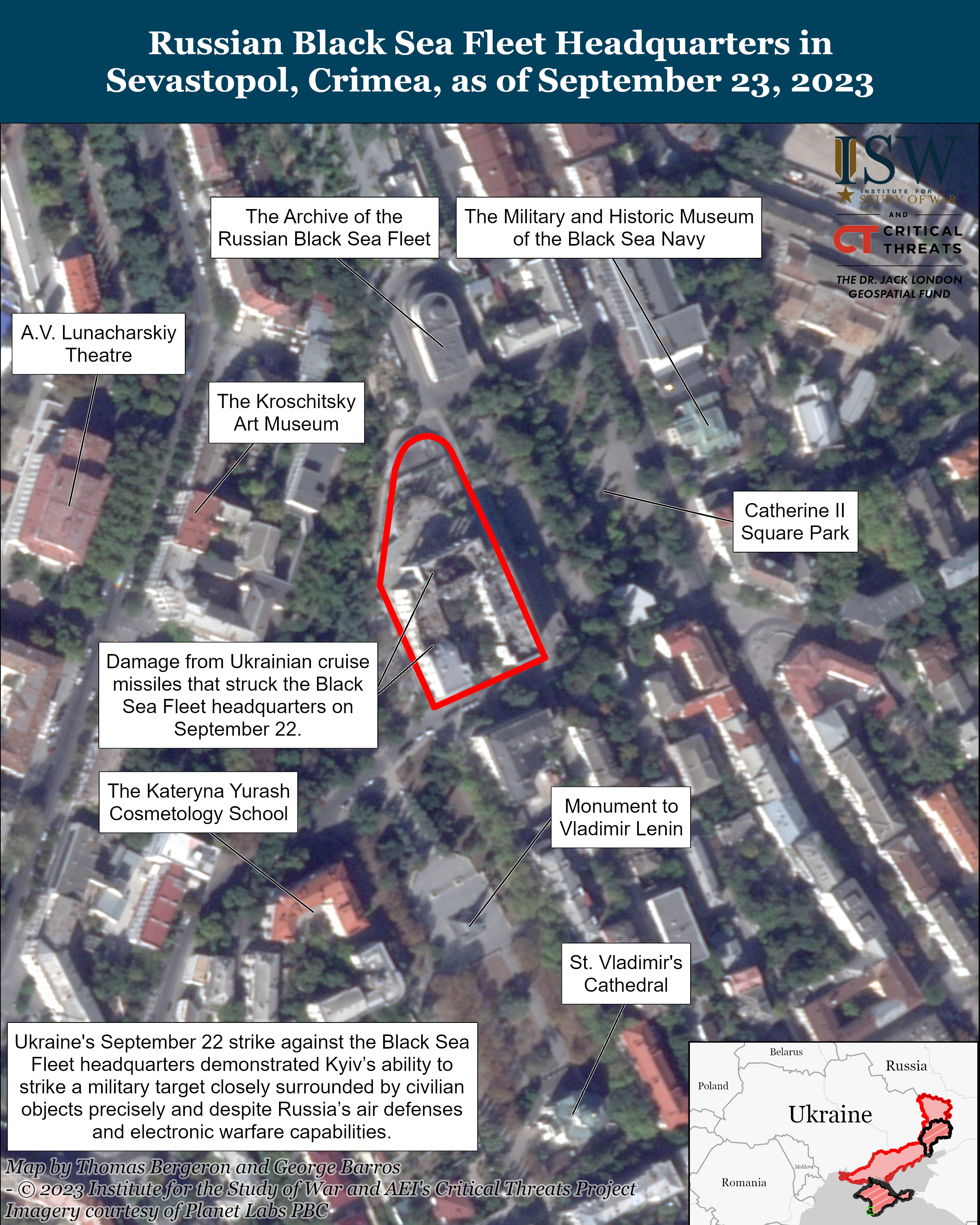
Imagery of the strike against the Black Sea Fleet Headquarters. September 23, 2023.
Imagery courtesy of Planet Labs PBC.
Russian forces conducted a series of missile and drone strikes against Ukraine on the night of September 22 to 23. The Ukrainian General Staff reported that Ukrainian forces destroyed 14 of 15 Shahed-131/136 drones and that Russian forces launched four missiles.[34] The Ukrainian General Staff reported that Russian forces conducted a missile attack on Kremenchuk, Poltava Oblast.[35] Several Russian sources claimed that the Russian forces conducted a retaliatory strike on Kremenchuk airfield after the Ukrainian strike on the BSF Command headquarters.[36]
Zaporizhia Oblast occupation governor Yevgeny Balitsky appointed former Roscosmos (Russian space agency) head and ultranationalist figure Dmitry Rogozin as a Russian Federation Council senator representing occupied Zaporizhia Oblast.[37] Rogozin is affiliated with the “Tsarskiye Volky” (Tsar’s Wolves) volunteer battalion but has not held a position in the Russian government since his dismissal as head of Roskosmos in July 2022.[38] A Russian insider source claimed that Rogozin has ties to the “Convoy” private military company (PMC) and advocated for its use in Africa and Nagorno-Karabakh to Russian Presidental Administration Head Anton Vaino.[39] ISW previously reported that Crimean occupation head Sergey Aksyonov formed a “Convoy” with Wagner-affiliated Konstantin Pikalov.[40] The insider source claimed that unspecified Russian officials forced Rogozin to go on a “business trip (exile)” to defense industrial base enterprises in Belarus after multiple meetings with Vaino.[41] Rogozin’s appointment as occupied Zaporizhia Oblast Federation Council senator may be indicative of his ties to Russian occupation officials and his attempts to secure a new position in the Russian government.
A Russian insider source argued that the Russian military should reintroduce military officers for political affairs (zampolits) to address the Russian military’s problems with political and ideological commitment — a problem that Russian military thinkers identified in September 2018. The insider source claimed that GRU political officers are using an outdated “Soviet template” to conduct information operations against the enemy and are failing to provide political support to Russian military personnel.[42] The insider source noted that Russian political officers must resolve the contradictions between senior Russian political leaders‘ slogans and reality to ensure that military personnel can distinguish between possible and impossible objectives. The insider source claimed that Russian military-political work encourages blind repetition of phrases and orders, which prevents Russian military personnel from understanding and communicating Russian political decisions to their subordinates or explaining contradictions in political leadership messaging. Chairman of the Russian State Duma Defense Committee Colonel General Andrey Kartapolov identified similar issues in his September 2018 essay justifying the creation of the Russian Military-Political Directorate.[43] Kartapolov stated that Russian military-political leadership should adapt Soviet structures to new content. Kartapolov also argued that Russia must ensure the “information protection” of military personnel and create a stable conviction in both the military and broader society about why they must serve Russia. This insider’s argument suggests that the Russian military has not solved the problem that Kartapolov identified over the past five years.
Disjointed Wagner Group contingents reportedly returning to fight in Ukraine are likely to have a marginal impact on Russian combat capabilities without bringing the full suite of effectiveness Wagner had had as a unitary organization under financier Yevgeniy Prigozhin’s and founder Dmitry Utkin’s leadership. Former Luhansk Oblast Administration Head Serhiy Haidai stated on September 23 that Wagner personnel are operating in Luhansk Oblast and across different sectors of the frontline.[44] Haidai also stated that he did not know the number of Wagner personnel or the organization under which these Wagner personnel are operating in Ukraine.[45] A Wagner-affiliated source claimed that about 500 Wagner personnel including those who refused to participate in the Wagner rebellion on June 24 have joined a new unspecified organization organized by the former Wagner personnel department head and will likely return to Ukraine to fight on the southern flank of Bakhmut.[46] ISW previously observed reports that the Wagner personnel department head (previously referred to as Vadim V. “Khrustal”) is attempting to recruit Wagner fighters for a new PMC for operations in Africa.[47] These reports indicate that Wagner forces are fragmented and are unlikely to organize into a cohesive fighting force or have an impact on Russian combat capabilities if they return to fighting in Ukraine.
Key Takeaways:
- ISW is now prepared to assess that Ukrainian forces have broken through Russian field fortifications west of Verbove in western Zaporizhia Oblast.
- Ukrainian forces have not overcome all prepared Russian defensive positions near Verbove.
- Ukrainian forces are deepening their penetration in Zaporizhia Oblast and are assaulting Novoprokopivka – a frontline village 1.5 km immediately south of Robotyne.
- Ukrainian military officials stated that the Ukrainian counteroffensive would continue in the winter.
- The Ukrainian counteroffensive in western Zaporizhia Oblast has likely destroyed the Russian 810th Naval Infantry Brigade (Black Sea Fleet).
- A senior Ukrainian official explicitly confirmed that Ukraine’s objective in Bakhmut is to fix Russian forces. Ukraine’s fixing of Russian forces in Bakhmut may be alleviating pressure on the Kupyansk frontline.
- Ukraine’s simultaneous counteroffensives in Bakhmut and southern Ukraine are impeding Russia’s long-term force generation efforts as Russia redeploys its new reserves to defend against Ukrainian advances.
- A Ukrainian intelligence chief stated that the September 22 Ukrainian strike on the Russian Black Sea Fleet (BSF) Command headquarters in Sevastopol injured senior Russian commanders.
- Russian forces conducted a series of missile and drone strikes against Ukraine on the night of September 22 to 23.
- Zaporizhia Oblast occupation governor Yevgeny Balitsky appointed former Roscosmos (Russian space agency) head and ultranationalist figure Dmitry Rogozin as a Russian Federation Council senator representing occupied Zaporizhia Oblast
- A Russian insider source argued that the Russian military should reintroduce military officers for political affairs (zampolits) to address the Russian military’s problems with political and ideological commitment– a problem that Russian military thinkers identified in September 2018.
- Disjointed Wagner Group contingents reportedly returning to fight in Ukraine are likely to have a marginal impact on Russian combat capabilities without bringing the full suite of effectiveness Wagner had had as a unitary organization under financier Yevgeniy Prigozhin’s and founder Dmitry Utkin’s leadership.
- Russian forces conducted offensive operations along the Kupyansk-Svatove-Kreminna line, near Bakhmut, along the Avdiivka-Donetsk City line, in western Donetsk Oblast, in the western Donetsk-eastern Zaporizhia Oblast border area, and in western Zaporizhia Oblast but did not make any confirmed advances on September 23.
- Russian authorities are reportedly embezzling funds from military facilities near the border of Ukraine.
- Russian government programs continue to forcibly deport children in occupied Ukraine to Russia.
Go here to read the rest.
From Strategy Page:
The senior Russian military leadership is still in shock over the catastrophic losses they suffered since they invaded Ukraine in early 2022. These losses are a military secret in Russia but widely distributed and discussed in the West. So far Russia has lost 279,000 troops (dead, permanently disabled, prisoners, deserters and missing), 13,000 armored vehicles (a third of them tanks), 7,000 artillery systems and over 8,000 unarmored transport vehicles used to carry troops, supplies, fuel, munitions and equipment. The loss of so many trucks has caused delays in supplying the troops and frequent shortages of essential supplies.
There were also heavy losses of command posts and field headquarters. The Ukrainians have the ability to rapidly locate and attack Russian command posts and headquarters which appear in the combat zone. The heavy and constant losses of these crucial Russian C2 (command and control) facilities led to a breakdown in the ability to effectively deploy and control combat units. Russian soldiers who were captured complained of supply shortages, the lack of prompt or any treatment for casualties as well as not reporting the names of soldiers who died so their families would know what happened to their kin and claim death benefits. There was such a shortage of officers that troops often went days or weeks without seeing an officer. Even communication by radio was often absent. While cellphones were forbidden in the combat soldiers, many Russian soldiers had them and used them to report the lack of leadership, supplies and much else in the combat zone. Ukrainian intelligence has long monitored these calls and reported useful information to front line commanders and those who plan attacks with missiles or artillery.
Eventually the Russians did respond to these problems and addressed some of them. Front line command posts were housed in underground bunkers and communications went by wires laid on the ground to troops and higher headquarters. The wire was vulnerable to accidental cuts or deliberate attack. Meanwhile the Ukrainians had access to encrypted wireless communications via the Starlink satellite system. Russia would sometimes use electronic jammers to disrupt the Starlink signal, but the jammers could not operate long because their jamming signal could be located and attacked by missiles, artillery or even ground attack. Nothing like heavy machine-gun and mortar fire from nearby Ukrainian troops to shut down or destroy a Russian jamming effort.
Russian critics also point out that the government does not send enough Krasnopol laser-guided artillery shells to Ukraine. Krasnopol, and a smaller 120mm version for mortars, have been used a lot in Ukraine, but Ukrainian countermeasures are reducing the effectiveness of Krasnopol. The vulnerability is the need for troops on the ground or a UAV equipped with a laser designator to mark targets with laser light that Krasnopol can home in on. No laser designators mean no Krasnopol. The Russians based their Krasnopol on an earlier (1970s) American version called Copperhead. The Americans considered laser guided shells inadequate and introduced GPS guided shells in 2007. The Americans sent Ukraine these GPS guided shells and they gave Ukrainian artillery an edge when it came to destroying Russian artillery. In general, Russian artillery, fire control and counterbattery (destroying enemy artillery with artillery fire) tactics have been inferior to what Ukraine has. This has not nullified Russian artillery but has made it less effective. The Ukrainians have destroyed far more Russian artillery systems than they have lost to Russian artillery fire. This has made Russian artillerymen overly cautious in combat and concentrate on protecting their artillery at the expense of firing at the Ukrainians. This has led to a lot of complaints from Russian troops about the frequent absence of artillery support.
Go here to read the rest. The US incurred combat deaths of 291000 during World War II. If the Russian figure of 279000 is anywhere close to being accurate, those are catastrophic losses for a nation with one of the lowest birthrates in the world. Russia is in the process of losing the Ukraine War because they are unable, or unwilling, to replace their casualties in combat units.

