Donald R. McClarey
Cradle Catholic. Active in the pro-life movement since 1973. Father of three, one in Heaven, and happily married for 43 years. Small town lawyer and amateur historian. Former president of the board of directors of the local crisis pregnancy center for a decade.
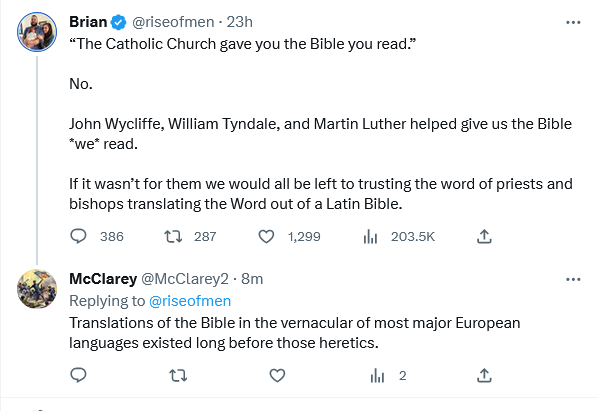



Before the printing press in the 1400s most people could ill afford the expense of an actual written Bible since they were all hand manuscripts painfully copied from previous ones. The only way people learned about Scripture was at Mass in Church. So the issue of Bible translations among the populace did not exist.
History of Bible Translations
https://www.britannica.com/topic/biblical-translation
With the advent of the printing press, it was the Protestants who produced the first FULL Bible translations into English. There were parts of Scripture translated into the vernacular by Catholic scholars long before then. But the Catholic Douay-Rheims was a late comer compared to the Protestant Geneva, the Wycliff, and the Matthews Bibles. The KJV (first issued with Apocrypha) was translated from Hebrew, Aramaic and Greek unlike the Douay-Rheims that was translated from the Latin Vulgate, itself a translation of the original languages.
Translations are divided into three categories:
Formal Equivalency –> word for word translation
Dynamic Equivalency –> thought for thought translation
Paraphrase –> idomatic translation
Each has its benefits and drawbacks. No translation is perfect.
Today we have a vast proliferation of Bible translations into English. Examples of formal equivalent translations include:
English Standard Version (there’s a Catholic edition)
Revised Standard Version (there’s a Catholic edition)
New American Standard Version (no Catholic edition)
Examples of dynamic equivalent translations include:
New American Bible Revised Edition (Catholic)
New Catholic Bible
New International Version (no Catholic edition)
Christian Standard Bible (no Catholic edition)
Examples of paraphrases include:
The Message (no Catholic edition)
The Living Bible (there’s a Catholic edition)
The New Living Translation (there’s a Catholic edition)
These are just a few of the translation available today. I have most every one of them in my extensive Bible collection. Except for the Message and the Catholic New American Bible, they are all worthy of the reader’s use. But they all have their individual problems.
I also have several different Latin editions in my collection, but the Vulgata and Pope St. JP II’s Nova Vulgata. And I have two different editions of the Greek NT and two of the Hebrew OT that with Strong’s concordance I can do in depth word studies. I also recommend the Protestant New English Translation Full Notes Edition for some great word studies (there’s sadly no Catholic edition).
My observation that since Father George C. Haydock’s Douay-Rheims study Bible of 1859, Catholic Biblical scholarship has gone to the dogs. The notes in typical Catholic Bibles like the NABRE deny Creation, the Flood, the Tower of Babel, the Parting of the Red Sea, etc. Even the vaunted Navarre study Bible series in the RSV-2CE with the Latin Vulgate is like that (I have the entire collection at a cost of $500). I was very disappointed. Scott Hahn came out with an Ignatius study Bible in just the New Testament. It is freaking awesome! But I have given up hope he’ll ever finish the Old Testament. If he did, then it would replace Father Haydock’s study Bible. Meanwhile, I rely a lot of Protestant ones where modern Catholic Bible “scholarship” simply stomps on its own toes. And BTW, if it comes out of the Vatican or the USCCB, then you can be assurred that it’s crap.
There’s so much more I could say about this topic. You all should see my collection, and my markups in my Bibles, even the Vulgata. Go to these links below from St. Irenaeus Ministries in Rochester, NY for an orthodox Catholic view on Bible translations and study Bibles.
Top Five Bible Translations of All Time
https://youtu.be/nFNtmmpHotg
What Bible Should I Use?
https://youtu.be/ZvWmJSOFT1w
What Is Your Favorite Study Bible?
https://youtu.be/70BRXzoHAdU
Thank you LQC! I learned more about the various issues/Bibles from your post than from many previous articles. I appreciate it.
“If it wasn’t for them we would all be left to trusting the word of priests and bishops translating the Word out of a Latin Bible.”
I don’t precisely see how it is any more advantageous to trust the word of Wycllife translating the Word out of a Latin Bible, or any other random translator translating it out of the Latin Bible or the Greek Bible or the Hebrew Bible, etc. If anything, this person’s argument would argue for teaching people to read in Latin and Greek, etc., so they wouldn’t have to rely on a translator, although even then one is relying on the older translators as well as their decisions in source material. All that a printed translation does is prioritize a particular translation by means of the mode of transmission; it doesn’t remove the issue the OP proposes.
As far as study bibles go, I’ve largely given up on them, but I do enjoy and daily use the Catena app which functions like the Ancient Christians Commentary on Scripture set.
Every one of us needs to do three things.
1 Acquire a reliable, Catholic Bible – IN PRINT, so AI can’t touch it.
2 Read it often
3 Keep it safe
Reformation scholars who imperfectly loved Our Lord did enough damage – to the point where the books they removed are widely considered to be “extra” books now. Secular society and AI (the digital Frankenstein) have no such love for Christ.
This is long. But I can’t distill this into a Twitter sound bite.
You’re welcome, Father of Seven.
I agree with Jason, and I encourage everyone to use the Catena application that he references. Here is a link to the web version:
https://catenabible.com/mt/1
I also encourage everyone to learn to use the web version of Strong’s Concordance to look up meanings of Greek, Hebrew, and Aramaic words:
https://www.eliyah.com/lexicon.html
I also encourage everyone to TRY to learn Latin, Greek and Hebrew. Yes, I find the right to left script of Hebrew beyond my 65-year-old mental capacity. But for goodness’s sake, TRY!
Sadly, the web site linked above is Protestant because once again Catholic Bible scholars dropped the ball, so the Deuterocanonicals are NOT included. By the way, there is an Ancient Faith Study Bible that includes commentary from the Church Fathers.
https://www.lifeway.com/en/shop/bibles/csb/ancient-faith-study-bibles
The translation is the Christian Standard Bible (a Southern Baptist version) that does not include the Deuterocanonicals, but once again Catholic Bible scholars dropped the ball. I find it unfathomable that there is NO Catholic or even Eastern Orthodox version of this.
The Bruised Optimist wrote, “Acquire a reliable, Catholic Bible.” There ain’t any nowadays. The USCCB and the Vatican have done their best to trash can authentic reliable Catholic Biblical scholarship. See discussion on study Bibles below.
As for study Bibles, there are six basic criteria to consider:
Documentary Hypothesis: does the study Bible attribute the Torah to Moses as Jesus did, or does it attribute the Torah to some post exilic scribe compiling Yahwehist, Elohimist, Deuteronomic and Priestly traditions of mythological stories?
Deutero-Isaiah: did Isaiah write ALL of Isaiah as Jesus and the Apostles claim, or was Isaiah written by two or three different authors (because after all, how could Isaiah know about Persian King Cyrus in his prophecies)?
Pseudopigraphical Daniel: did Daniel write all of Daneil as Jesus stated, or was it written during the time of the Maccabean brothers (because after all, how could he have prophesied about Antiochus IV Epiphanes)?
Two Source Hypothesis: did the Gospel writers really write the Gospels, or were they complied in the 2nd century AD from some unknown “Q” (for the German Quelle) source?
Deutero-Paul: did Paul write all his letters because some (due to changes in style) must have been written by other people using his name?
Pseudopigraphical 2nd Peter: did Peter write his 2nd epistle condemning false teachers or did someone else write it using his name because the Greek style is different?
ALL modern Catholic study Bibles – the NABRE used for the Novus Ordo lectionary, the New Catholic Bible, the New Jerusalem Bible, etc. – fail ALL six questions. How the flying frack does the hierarchy of the Roman Catholic Church expect the faithful to believe in the REAL presence of Christ in the Eucharist when they themselves don’t believe (a) Moses wrote the Torah (though Christ did), (b) Isaiah wrote Isaiah (though Christ did), etc.? I find this INFURIATING. The clerics in the USCCB and the Vatican supporting this damnable nonsense are unworthy of the high office they occupy.
So……………….I use Evangelical and Pentecostal study Bibles because the people who wrote study notes in those BELIEVE that the words of the Bible are God-breathed. Yes, they get the Sacraments and Mary and all that completely wrong. So, I make allowances for that. I can accept their ignorance. But there is NO excuse for the damnable ignorance propagated by those worthless useless Roman Catholic Bible scholars. They are the SAME people who write the study notes in the liberal progressive study editions of the NRSV (like the New Interpreters Study Bible). Why are they allowed in the Church in the first place? Argh!
Ok, I must calm down. Here are my favorite study Bibles:
Father George C. Haydock’s 1859 Study Bible in the Douay-Rheims
Scott Hahn’s Ignatius Study Bible in the New Testament
Protestant ESV Study Bible
Protestant NIV Study Bible (I dislike the gender inclusive language, but the notes are good)
Protestant NLT Illustrated Study Bible (paraphrase translation, but the illustrations are awesome)
Protestant Archeological Study Bible in the ESV or NIV.
Protestant Cultural Backgrounds Study Bible in the NIV, NKJV and NRSV.
My general thumb rule is this: if the study Bible came out of a committee of bona fide scholars (I recognize most of the names of Protestant Bible scholars because of my Pentecostal background, so I know who’s good and who isn’t), then it’s probably ok. If the study Bible is by a single person (like the MacArthur Study Bible), then beware. And make allowances that Evangelicals will get the Sacraments and Mary and all that completely wrong.
Now there are different kinds of study Bibles:
Basic explanatory ones like what I listed above.
Devotional ones like the Life Application Study Bible in the NASB, NKJV and NLT
I like the explanatory ones above, but I have a Life Application Study Bible in the NLT that I use from time to time.
There is so much I can write about this topic. I have hundreds of Bibles – mostly English, some Spanish, a few Latin, and a couple in Greek and in Hebrew – even a Greek Septuagint – in my collection. I have invested thousands and thousands of dollars in this, and hours and hours of study time every morning and every night for years and year. I can’t explain everything that I have learned. And I know so little compared to most of you guys.
By the way, one last thing regarding Donald’s original post. Don’t anger Evangelicals by calling them heretics (especially when that Argentinian sitting on St. Peter’s throne is a worse heretic). I have more in common with Evangelicals than any liberal progressive Katholyck. And realize that the Protestant so-called reformers kept the Deuterocanonicals and some extras in an Apocrypha back in the 1500s and 1600s. And hardly any of us would be able to easily read the Geneva Bible of 1560, the Mathews Bible, the Wycliff Bible, the original KJV of 1611 because the script and the word spelling of late Middle English is so different than what we use today. Finally, what happened to the early Bible translators – death by decapitation or burning at the stake – was wrong. Both Catholics and Protestants are guilty of having murdered each other during that period of time in history, and that was wrong.
I forgot to mention that translations sometimes vary due to the base text that was used. Most translations in the 1500s and 1600s used what is called the Textus Receptus. Then as time passed more archeological discoveries were made. Today there are the Codex Vaticanus, the Codex Alexandrinus and the Codex Sinaiticus. Of course there are also the Dead Sea Scrolls. Each base text has variations in word order, verb tenses, noun declensions, synonym choices, etc., whether it’s the Greek NT or the Hebrew & Aramaic OT. None of these variations have any theological significance. And yes, I do see them in the different Greek NT editions I have as well as the different Latin Vulgate editions. Modern translations tend to use the most recently discovered Greek, Hebrew & Aramaic manuscripts. But some like the NKJV remain with the Textus Receptus. Let me give you an idea of this variation.
The story of the woman caught in adultery in John 7:53-8:11 does NOT exist in the earliest manuscripts. Simply not there. Based on word style in Greek, linguists think Luke wrote it. The Church – Catholic, Protestant and Orthodox – has always accepted it as canonical. But it’s definitely NOT Johannine. Those kinds of variations do exist at different places in the Bible. I find studying them fascinating, and if any of you follow me on Facebook, you know I can get long-winded about this stuff.
Just accept the fact that NO translation is perfect, but the multiplicity of translations is a blessing because by consulting several different key translations, you can get the right meaning. Just don’t rely on the Catholic NABRE. And TRY to learn Latin and Greek! It won’t kill you.