
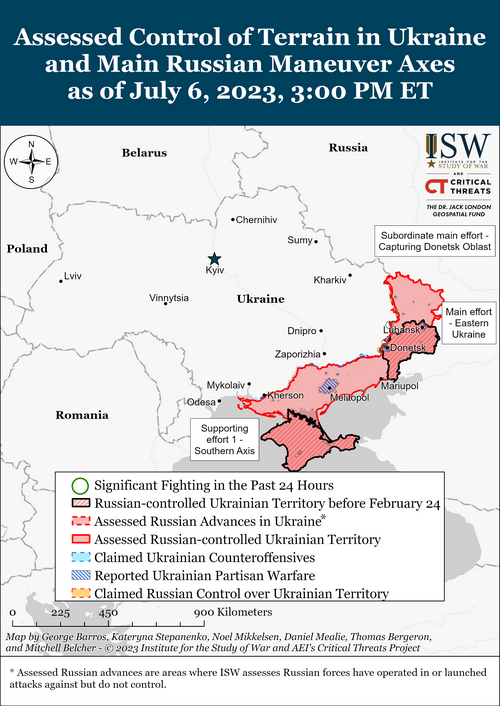
From The Institute For The Study of War:
Russian Offensive Campaign Assessment, July 6, 2023
Kateryna Stepanenko, Riley Bailey, Karolina Hird, Angelica Evans, and Frederick W. Kagan
July 6, 2023, 8:25pm ET
Click here to see ISW’s interactive map of the Russian invasion of Ukraine. This map is updated daily alongside the static maps present in this report.
Click here to access ISW’s archive of interactive time-lapse maps of the Russian invasion of Ukraine. These maps complement the static control-of-terrain map that ISW produces daily by showing a dynamic frontline. ISW will update this time-lapse map archive monthly.
Note: The data cutoff for this product was 2pm ET on July 6. ISW will cover subsequent reports in the July 7 Russian Offensive Campaign Assessment.
Belarusian President Alexander Lukashenko stated that Wagner Group financier Yevgeny Prigozhin and Wagner forces are not in Belarus as of July 6, indicating that Prigozhin may be failing to uphold the deal Lukashenko mediated between Prigozhin and Russian President Vladimir Putin following Wagner’s armed rebellion on June 24. Lukashenko and the Kremlin previously announced that Prigozhin, Putin, and Lukashenko reached an agreement that offered Prigozhin and the Wagner forces that participated in the rebellion unspecified security guarantees in Belarus.[1] The full contents of this agreement have not been revealed, but it appears that Wagner is not fulfilling its end of the deal. Lukashenko stated on July 6 that Wagner forces are currently at their permanent camps (either in Russia or in Ukraine) to which they withdrew following the Battle for Bakhmut.[2] Lukashenko added that Prigozhin is in St. Petersburg or may have even flown to Moscow on the morning of July 6. Lukashenko denied the reports that Belarus is constructing new training camps for Wagner forces and noted that Belarus offered Wagner several former Soviet military camps including some near Asipovichy, Mogilev Oblast.[3] Lukashenko implied that Wagner had not yet agreed to deploy to these bases and that Wagner “has a different vision for [their] deployment,” the details of which Lukashenko refused to share.[4] Lukashenko, however, denied that the deal has been terminated and noted that the question of Wagner forces’ transfer and setup “has not been decided” at the moment.[5]
Russian sources also indicated that Prigozhin is in Russia, although ISW cannot confirm Prigozhin’s whereabouts at this time. A Russian opposition outlet reported that Prigozhin’s plane landed in Rostov Oblast after flying from Moscow Oblast on the morning of July 6.[6] A St. Petersburg outlet reported on July 5 that Prigozhin personally picked up several small arms seized by the Russian Federal Security Service (FSB) from the FSB building in St. Petersburg on July 4.[7] The outlet also reported that Prigozhin was in Moscow over the weekend on July 1 and July 2.[8] ISW had not observed any visual confirmations in the open source that Wagner personnel deployed to Belarus at this time. Kremlin Spokesperson Dmitry Peskov also claimed that the Kremlin does not follow Prigozhin’s movements, noting that the Kremlin cannot and does not want to follow Prigozhin.[9] Peskov’s statement is absurd given that the Kremlin and Russian security forces have the ability to detain Prigozhin or restrict his movements in Russia. It is particularly absurd if Prigozhin was actually able to collect his weapons from an FSB facility.
Lukashenko appears to be distancing himself from the deal he reportedly mediated while continuing to tout his ability to mediate between Putin and a formerly loyal lieutenant in the first place, thus still highlighting Putin’s weakness. Lukashenko demonstratively stated that Wagner and Prigozhin are Russian, and the questions about their whereabouts should not be directed to him. Lukashenko appears to be distancing himself from Wagner, and his rhetoric may suggest that he is pinning the responsibility on the Kremlin to enforce the deal. Lukashenko also continued to boast about his skillful negotiations with Prigozhin after stating that Putin’s authority was not weakened during the armed rebellion in response to a journalist’s question.
Prigozhin’s ability to freely operate in Russia suggests that Prigozhin is still protected by some security guarantees and/or that the Kremlin continues to prioritize undermining his reputation in Russia over targeting Prigozhin physically or legally. Lukashenko noted that neither he nor Russian President Vladimir Putin wanted to assassinate Prigozhin, and dismissed suggestions that Putin might attempt to kill Prigozhin in the future.[10] ISW assessed on June 27 that Putin has likely decided that he cannot directly eliminate Prigozhin without making him a martyr for causes concerning the Russian Ministry of Defense’s (MoD) mishandling of the invasion.[11] ISW also observed on June 27 that the Kremlin launched an information operation aimed at presenting Prigozhin as corrupt and a liar, and Russian state outlets have maintained this narrative since. Russian propaganda networks are extensively covering FSB’s raids of Prigozhin’s mansion and his wealth, and one journalist sarcastically called Prigozhin’s house a “palace belonging to the fighter against corruption” on Russian state TV channel Rossiya 1.[12]
Select Russian ultranationalists criticized Russian state propaganda for attempting to villainize Prigozhin, however, suggesting that the Kremlin’s attempt to alienate the ultranationalist community from Prigozhin is not succeeding. A Wagner-affiliated Telegram channel accused the Russian Ministry of Internal Affairs of deliberately leaking footage of the FSB raids to the media in order to portray Prigozhin as a traitor who is only interested in a lavish lifestyle.[13] Another Wagner-affiliated Telegram channel attempted to disprove Rossiya 1’s suggestion that the FSB may have found narcotics at Prigozhin’s mansion.[14] It is not necessarily surprising that Wagner-affiliated milbloggers are attacking Kremlin efforts to blackguard Prigozhi, but a Kremlin-affiliated milblogger also condemned the Russian media’s efforts to portray Prigozhin as a corrupt individual, noting that Prigozhin’s home is consistent with that of a wealthy individual and that Prigozhin appears to showcase his military awards throughout his mansion.[15] Another milblogger noted that Prigozhin’s house did not appear that lavish when compared to other Russian billionaires.[16]
Ukrainian forces conducted counteroffensive operations on at least three sectors of the front on July 6 and are continuing efforts to gradually degrade Russian manpower and logistics assets. Ukrainian military officials reported that Ukrainian forces are conducting counteroffensive activities in the Bakhmut, western Donetsk, and western Zaporizhia directions.[17] Geolocated footage posted on July 6 shows that Ukrainian troops have advanced towards the western outskirts of Klishchiivka, about 5km southwest of Bakhmut.[18] Russian and Ukrainian sources continued to discuss Ukrainian counteroffensive operations in western Donetsk Oblast south of Velyka Novosilka and in the Orikhiv area in western Zaporizhia Oblast.[19] Ukrainian President Volodymyr Zelensky acknowledged the generally slower pace of Ukrainian counteroffensive gains in an interview with CNN on July 5 and stated that Ukrainian operations have “slowed down” against entrenched Russian defensive positions, remarking that he believes Ukraine still needs certain Western weapons systems before launching new attacks along the front.[20] Ukrainian Deputy Defense Minister Hanna Malyar emphasized that the Ukrainian efforts to strike Russian concentration areas are imperative for the wider counteroffensive and contribute to the slower rate of ground attacks across the theater. Malyar noted that Ukrainian forces destroyed six Russian ammunition depots in the Tavriisk (Zaporizhia) direction alone in the past day and confirmed that the July 4 strike on Makiivka was an effective example of the destruction of Russian artillery and equipment assets.[21]
Ukrainian and Russian officials largely de-escalated their rhetoric regarding the Zaporizhzhia Nuclear Power Plant (ZNPP) on July 6. Ukrainian Main Military Intelligence Directorate (GUR) Head Kyrylo Budanov stated on July 6 that the danger of a man-made disaster at the ZNPP is “gradually decreasing,” following warnings by various Ukrainian officials on July 4 that Russian forces may have placed objects resembling explosive devices on the roofs of two of the ZNPP’s reactor buildings.[22] First Deputy Chief of Staff of the Russian Presidential Administration Sergey Kiriyenko and Zaporizhia Oblast occupation head Yevgeny Balitsky also notably visited the ZNPP on July 6 and posted images reportedly near the plant’s dry nuclear waste storage facility.[23] Kiriyenko and Balitsky noted that the plant continues to “operate normally” under Russian control, thus downplaying previous Russian claims that Ukrainian actions were imminently threatening the safety of the ZNPP.[24] Kiriyenko and Balitsky may have visited the plant to portray Russia as a capable custodian of the ZNPP, and their rhetorical posturing during the visit suggests that Russian officials may be stepping back from harsh warnings of imminent disaster at the plant. ISW continues to assess that Russian rhetoric surrounding the ZNPP is meant to discourage Western support for Ukraine by accusing Ukraine of nuclear irresponsibility, as well as to dissuade Ukrainian forces from conducting counteroffensive operations into occupied Zaporizhia Oblast.[25]
Russian political actors continue attempts to court or control Russian milbloggers, indicating that many view the milblogger community as a critical constituency. Russian Liberal Democratic Party (LDPR) head Leonid Slutsky met with select milbloggers on July 5 to discuss a series of proposals to grant benefits and protections to military correspondents and bloggers covering the war in Ukraine.[26] Slutsky stated that the LDPR will aim to pass legislation that will grant military correspondents the status of combat veterans and provide state guarantees and payments in cases of injury or death.[27] Slutsky claimed that the LDPR sent relevant proposals about Russian military correspondents and bloggers to the Russian MoD and the Ministry of Digital Development.[28] Slutsky added the LDPR and select milbloggers will launch an educational program to teach youth about the “informational realities” of the war in Ukraine.[29] Russian pundits on the Kremlin-affiliated show Solovyov Live recently discussed milbloggers’ potential violation of operational security in Ukraine and urged them to engage in some degree of self-censorship.[30] The Kremlin has routinely sought to appeal to select Russian milbloggers in a bid to win the favor of the community and leverage their connections to the wider Russian ultranationalist community, although the Russian MoD has recently indicated that it once again seeks to curb select milblogger activity.[31] It is unclear what backing the LDPR proposals have from the Kremlin, although the Kremlin could use such measures to exert control over milbloggers and determine who qualifies as a recognized milblogger.
The growing prominence of the milblogger community within the Russian information space and in certain accepted Russian civil society movements is likely creating a competition amongst various political actors vying for control over what is viewed as a critical constituency, either through winning their favor or by establishing authority over their activities. These political actors, both those firmly within the Kremlin’s orbit and those further outside of it, likely believe that it has yet to be decided who will control the political influence of this constituency. Milbloggers, with their own diverging interests and allegiances, have yet to indicate how the overall community will respond to this growing competition for their influence.
Russian opposition media outlet Vertska reported that Russian forces and occupation authorities are conducting a campaign of systematic religious persecution in occupied Ukraine. Verstka found that Russian forces and occupation authorities have committed at least 109 acts of religious persecution and destroyed nearly 600 places of worship in Ukraine since February 24, 2022.[32] Verstka uncovered the stories of people whom Russian forces and occupation authorities kidnapped, arrested, captured, tortured, and killed over their faith.[33] The investigation found that Orthodox and Protestant Christians are the most repressed group in the occupied territories, but that Catholics, Muslims, and Jehovah’s Witnesses have also been persecuted.[34] Verstka cited at least 43 cases in which clergymen were targeted for their faith, including eight who were kidnapped and five who were killed.[35] Verstka reported that at least 66 places of worship have been confiscated or destroyed by Russian forces and turned into warehouses, police departments, National Guard offices, or ‘United Russia’ offices.[36] Verstka noted that the primary purposes of religious oppression in the occupied territories are to suppress the Ukrainian language, which services are commonly conducted, to discourage or punish congregants who refuse to support occupation authorities, and to pressure congregations and priests into supporting the Russian Orthodox Church.[37] ISW previously reported that Russian occupation authorities were likely conducting a campaign of religious persecution in occupied Ukraine to systematically eradicate “undesirable” religious organizations and promote the Moscow Patriarchate.[38] ISW previously assessed that Russian forces would likely intensify their campaign and that Russian authorities are conducting religious persecution in a way that is entirely at odds with efforts to frame Russian President Vladimir Putin as the true protector of the Christian faith.[39]
Russian milbloggers claimed that aspects of Russian defensive operations in southern Ukraine have severe limitations and may not be as effective as Russian sources have previously portrayed them. A Russian milblogger claimed that Russian mobilized service members operating in Zaporizhia Oblast have been on the frontlines since October 2022 without any rotations.[40] The milblogger stated that Russian forces have not been able to rotate these mobilized personnel out of these positions because there are no available personnel to replace them with.[41] The milblogger’s description of acute rotation issues supports ISW’s previous assessment that Russian forces likely lack combat-ready reserves.[42] The failure to conduct any rotations will likely result in a quicker rate of degradation for Russian formations defending against Ukrainian counteroffensives in southern Ukraine. Other Russian milbloggers accused Russian attack helicopters of striking already destroyed Ukrainian military equipment and suggested that the Russian MoD may be using these repeated hits to report inflated Ukrainian losses.[43] The Kremlin has previously used reports of wildly inflated Ukrainian armored vehicle losses to portray Russian defensive operations as extremely effective.[44]
Key Takeaways:
- Belarusian President Alexander Lukashenko stated that Wagner Group financier Yevgeny Prigozhin and Wagner forces are not in Belarus as of July 6, indicating that Prigozhin may be failing to uphold the deal Lukashenko mediated between Prigozhin and Russian President Vladimir Putin following Wagner’s armed rebellion on June 24.
- Russian sources also indicated that Prigozhin is in Russia, although ISW cannot confirm Prigozhin’s whereabouts at this time.
- Lukashenko appears to be distancing himself from the deal he reportedly mediated while continuing to tout his ability to mediate between Putin and a formerly loyal lieutenant in the first place, thus still highlighting Putin’s weakness.
- Prigozhin’s ability to freely operate in Russia suggests that Prigozhin is still protected by some security guarantees and/or that the Kremlin continues to prioritize undermining his reputation in Russia over targeting Prigozhin physically or legally.
- Select Russian ultranationalists criticized Russian state propaganda for attempting to villainize Prigozhin, however, suggesting that the Kremlin’s attempt to alienate the ultranationalist community from Prigozhin is not succeeding.
- Ukrainian forces conducted counteroffensive operations on at least three sectors of the front on July 6 and are continuing efforts to gradually degrade Russian manpower and logistics assets.
- Ukrainian and Russian officials largely de-escalated their rhetoric regarding the Zaporizhzhia Nuclear Power Plant (ZNPP) on July 6.
- Russian political actors continue attempts to court or control Russian milbloggers, indicating that many view the milblogger community as a critical constituency.
- Russian opposition media outlet Vertska reported that Russian forces and occupation authorities are conducting a campaign of systematic religious persecution in occupied Ukraine.
- Russian milbloggers claimed that aspects of Russian defensive operations in southern Ukraine have severe limitations and may not be as effective as Russian sources have previously portrayed them.
- Russian and Ukrainian forces conducted ground attacks along the Svatove-Kreminna line.
- Visual evidence confirms that Ukrainian forces have advanced southwest of Bakhmut as of July 6.
- Russian forces continued ground attacks in the Bakhmut and Avdiivka-Donetsk City areas.
- Ukrainian forces conducted counteroffensive operations along the administrative border between Zaporizhia and Donetsk oblasts and in western Zaporizhia Oblast.
- Russian officials continue efforts to create territorial defense units in Russian border oblasts.
- Occupation officials continue efforts to forcibly assimilate Ukrainian legal and cultural traditions into the Russian system in occupied territories.
- Belarusian President Alexander Lukashenko claimed on July 6 that Russia will transfer all planned tactical nuclear weapons to Belarus by the end of 2023, if not earlier.
Go here to read the rest. What is happening with Yevgeny Prigozhin and his Wagner forces is all quite Russian: opaque to the outside world and quite mysterious. I think that Prigozhin would be dead now, but for the fact that Putin believes that dispatching him to the next world might summon up adversaries that might topple him. Prigozhin did not act alone in the One Day Civil War. He probably had assurances from within the Russian military that they had no ojection if he sought to topple Putin. This is all still playing out in Russia, leaving outsiders to guess, usually badly, as to what will happen next.

