
From The Institute For The Study of War:
Russian Offensive Campaign Assessment, June 11, 2023
Grace Mappes, Nicole Wolkov, Kateryna Stepanenko, George Barros, and Mason Clark
June 11, 2023, 6:40pm ET
Click here to see ISW’s interactive map of the Russian invasion of Ukraine. This map is updated daily alongside the static maps present in this report.
Click here to access ISW’s archive of interactive time-lapse maps of the Russian invasion of Ukraine. These maps complement the static control-of-terrain map that ISW produces daily by showing a dynamic frontline. ISW will update this time-lapse map archive monthly.
Note: The data cutoff for this product was 1:30pm ET on June 11. ISW will cover subsequent reports in the June 12 Russian Offensive Campaign Assessment.
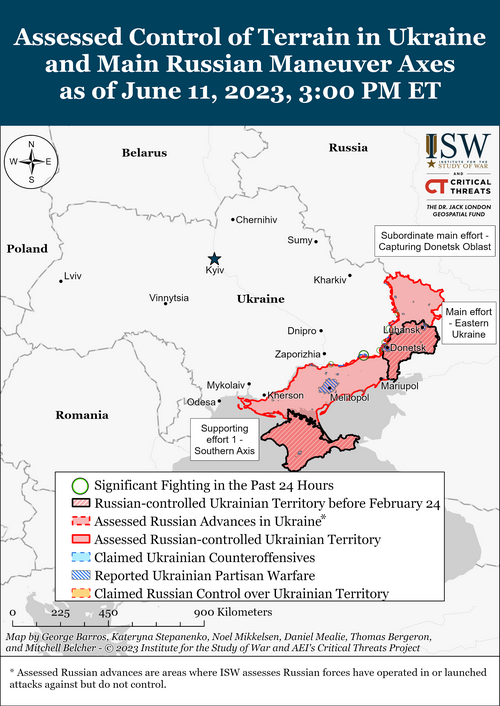
Ukrainian forces conducted counteroffensive operations in at least three areas of the front and made territorial gains on June 10 and 11. Ukrainian Deputy Defense Minister Hanna Malyar reported that Ukrainian forces are conducting offensive operations in the Bakhmut area, and Russian sources reported continued Ukrainian ground attacks on Bakhmut’s northern and southern flanks.[1] Geolocated footage and Russian sources indicated that Ukrainian forces liberated multiple settlements during continued ground attacks south, southwest, and southeast of Velyka Novosilka in western Donetsk Oblast.[2] Russian sources reported that Ukrainian forces continued to attack southwest of Orikhiv in Zaporizhia Oblast, and Ukrainian forces made gains in this area.[3]
Ukrainian forces made visually verified advances in western Donetsk Oblast and western Zaporizhia Oblast, which Russian sources confirmed but sought to downplay. Ukrainian Deputy Defense Minister Hanna Malyar reported that Ukrainian forces advanced 300 to 1,500 meters in southern Ukraine.[4] Malyar and other Ukrainian and Russian sources reported that Ukrainian forces made gains south of Velyka Novosilka between June 10 and 11, including liberating Makarivka, Neskuchne, Blahodatne, Storozheve, and Novodarivka.[5] Some Russian sources reported that battles are ongoing in “grey zone” or contested areas or that Ukrainian forces are operating in areas that Russian forces did not fully occupy before Ukrainian attacks in southern Ukraine.[6] Russian sources are likely referring to Ukrainian territorial advances through Russian defenses as capturing ”grey zones” in order to downplay Ukrainian gains and omit reporting on Ukrainian forces breaking through defensive lines. Ukrainian forces liberated several towns, but claims of a Ukrainian “breakthrough” are premature at this time.
Ukrainian Deputy Defense Minister Hanna Malyar stated that Russian forces are transferring their most combat-capable units from the Kherson direction to the Bakhmut and Zaporizhia directions. Malyar stated on June 11 that Russian forces are transferring elements of the 49th Combined Arms Army (Southern Military District) and unspecified naval infantry and airborne forces elements from the Kherson direction in connection with the destruction of the Kakhovka Hydroelectric Power Plant (KHPP) dam.[7] Malyar noted that Russian forces likely blew the KHPP dam in order to shorten their defensive lines in Kherson Oblast as part of the response to the start of the Ukrainian counteroffensive. Flooding downriver of the KHPP has drained the Kakhovka Reservoir, resulting in landmasses emerging from the water. It is unclear how these terrain changes will affect maneuver warfare in southern Ukraine at this time.[8] If the terrain changes from flooding in the Dnipro River do not foreclose any possible Ukrainian river crossings in coming weeks and months, Russian forces may struggle to defend Kherson Oblast with remaining or then-available units if and when Ukrainian forces choose to conduct offensive operations across the river, assuming they have the ability to do so.
Russian forces conducted a limited series of drone strikes targeting eastern Ukrainian border areas overnight on June 10 to 11. Ukrainian officials reported that Ukrainian forces shot down six Russian Shahed drones that targeted border areas in Sumy and Kharkiv oblasts overnight.[9] Ukrainian Air Force Spokesperson Colonel Yuriy Ihnat noted that Russian forces are working to produce more high-precision, long-range ballistic missiles and stated that Ukraine’s stock of Western air defense systems is currently insufficient to replace its stock of Soviet air defense systems.[10]
Wagner financier Yevgeny Prigozhin characterized the Russian Ministry of Defense’s (MoD) plan to formalize volunteer formations by July 1 as an attack on him and his forces. Russian Defense Minister Sergei Shoigu announced on June 10 that all volunteer formations must sign military contracts with the Russian MoD by July 1.[11] Prigozhin defensively claimed that Wagner private military company’s (PMC) servicemen will not sign contracts with the Russian MoD in his media response to Shoigu’s announcement.[12] Prigozhin proceeded to criticize Shoigu and the structure of the Russian Armed Forces and specified that Wagner is entirely subordinate to the interests of Russia and Russian President Vladimir Putin. Prigozhin’s mention of Putin as the Supreme Commander-in-Chief closely mirrors the language Chechen leader Ramzan Kadyrov used in his accusation on June 9 that Prigozhin is being insubordinate to Putin.[13] Prigozhin also noted that Wagner approves its actions with the Russian military command via Wagner-affiliated Army General Sergei Surovikin.
Some members of Russia’s veteran community indicated Shoigu’s statement is not intended to target Wagner. A member of the Russian State Duma Defense Committee (and former commander of the 58th Combined Arms Army) Viktor Sobolev stated that Shoigu’s order excludes Wagner.[14] Sobolev is an avid critic of Wagner and claimed that Wagner personnel are mercenaries, not volunteers.[15] Former Russian officer and ardent ultranationalist Igor Girkin supported the order and stated that cohesive armies win wars rather than separate detachments or private military companies (PMCs).[16] A Wagner-affiliated milblogger contrarily (baselessly) claimed that Wagner is not a PMC and that a secret decree legalized Wagner’s existence in Russia.[17] The milblogger also claimed that Shoigu and the Russian MoD are Girkin’s patrons who are using Girkin to prevent Prigozhin from assuming more authority and reshuffling leadership in the Russian MoD.
Russia and Ukraine conducted a near one-for-one prisoner of war (POW) exchange on June 11. The Russian Ministry of Defense (MoD) claimed that Ukraine returned 94 Russian POWs of unspecified ranks to Russia.[18] Ukrainian Presidental Office Head Andriy Yermak reported that Russia returned two Ukrainian officers and 93 privates and sergeants to Ukraine.[19]
Key Takeaways
- Ukrainian forces conducted counteroffensive operations in at least three areas of the front and made territorial gains on June 10 and 11.
- Ukrainian forces made visually verified advances in western Donetsk Oblast and western Zaporizhia Oblast, which Russian sources confirmed but sought to downplay.
- Ukrainian Deputy Defense Minister Hanna Malyar stated that Russian forces are transferring their most combat-capable units from the Kherson direction to the Bakhmut and Zaporizhia directions.
- Russian forces conducted a limited series of drone strikes targeting eastern Ukrainian border areas overnight on June 10 to 11.
- Wagner financier Yevgeny Prigozhin characterized the Russian Ministry of Defense’s (MoD) plan to formalize volunteer formations by July 1 as an attack on him and his forces.
- Russia and Ukraine conducted a near one-for-one prisoner of war (POW) exchange.
- Russian forces continued limited ground attacks south of Kreminna.
- Ukrainian and Russian forces continued limited ground attacks around Bakhmut and on the Avdiivka-Donetsk City line.
- Ukrainian forces made gains near the administrative border between Donetsk and Zaporizhia oblasts and in western Zaporizhia Oblast as of June 10.
- Russian milbloggers claimed that rain along the Zaporizhia Oblast front may slow Ukrainian operations in the coming days.
- The Republic of Chechnya reportedly formed two new regiments – Akhmat-Russia and Akhmat-Chechnya – equipped with commercially-available Chinese armored equipment.
- Saboteurs, reportedly including Ukrainian partisans, conducted two discrete improvised explosive device (IED) attacks against railways in occupied Kherson Oblast and Crimea.
Go here to read the rest. The Ukrainian offensive is gaining steam as it makes its way through or around prepared Russian fortifications.

