
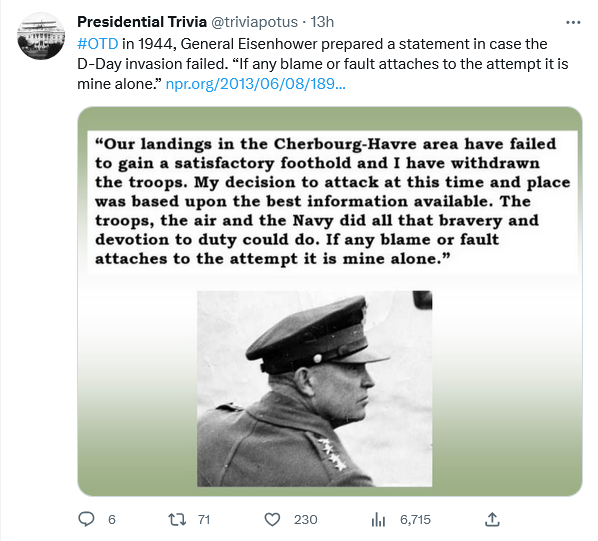
Tomorrow could easily have been the eightieth anniversary of Eisenhower announcing the defeat of D-Day.
What we tend not to recall today is what an immense gamble D-Day appeared to be from the perspective of the Allies. Amphibious landings had a distinctly mixed record for the Allies up to the D-Day landing. Sometimes they worked, but they were just as apt to be bloody shambles like the Dieppe raid in 1942, or, as in the case of Anzio, a costly stalemate for four months with the Allies coming close to being thrown back into the sea. Eisenhower had good reason for drafting a press release shouldering all the blame in case the D-Day invasion was repulsed:
“Our landings in the Cherbourg-Havre area have failed to gain a satisfactory foothold and I have withdrawn the troops. My decision to attack at this time and place was based upon the best information available. The troops, the air and the Navy did all that Bravery and devotion to duty could do. If any blame or fault attaches to the attempt it is mine alone.”
There were many ways the invasion could have ended in defeat.
- If the Germans had guessed correctly that Normandy was the invasion site and positioned their troops accordingly. Hitler, intriguingly enough, had long thought that Normandy would be the invasion site, but eventually bowed to his Generals who thought that the invasion would come at Calais.
- Worse weather. The weather in the Channel was bad to marginal for a cross Channel invasion. If the Allies had faced on D-Day storms of the severity that occurred on June 19, and wrecked the Mulberry harbor at Omaha Beach, the invasion would likely not have succeeded.
- The Omaha Beach landing did come close to defeat. More German troops and the battle could easily have gone the other way.
- Of the ten panzer divisions in France, only one, the 21st, was in striking distance of Normandy on D-Day. Considering the havoc the panzers wreaked in Normandy, after running the gauntlet of Allied air power, if the Germans had a third of their panzer divisions pre-positioned in Normandy they might have tipped the balance on D-Day.
The historical outcome should not blind us to the gamble the Allied leadership engaged in on June 6. They had done what they could to ensure a favorable outcome, but the information they lacked made the entire operation a roll of the iron dice of war.


I do like to think “another hand” had something to do with the outcome.
Donald, a question please: Had the Normandy invasion failed, do you think Sea Lion might have actually been attempted? Or was it too late given the Allied buildup in Britain?
The Western Allies had complete control of the seas and the skies. Sea Lion was the longest of long shots in 1940. By 1944 it was an impossibility.
I read an alternate history of D-Day where Rommel maintained complete control of the German armor and was able to use it to swiftly counterattack.
The writers made a compelling argument for the Germans still losing, and the reasons were Allied aerial supremacy and naval bombardment, both of which would have continued around the clock. The 1000 bomber formations that would be used at St. Lo would be deployed earlier, and the firepower of the armada couldn’t be counteracted even by AA. The storm that later wrecked the Mulberries would be a problem, but the Allied firepower would have disrupted the counterattacks in a demoralizing fashion.
And then you throw in the fact Eisenhower would be speed-rushing the reinforcements from Britain, and German defeat would be sealed. The butcher’s bill would have been far more horrific on both sides, but the Allies would not have been pushed into the sea. And there would have been precious little of the western Panzer forces left.
Perhaps Dale. I think Rommel was correct that if the invasion was to be defeated it had to be at the water’s edge and within 24-48 hours of the landings.
Thanks. Saved me some research time. 😉