
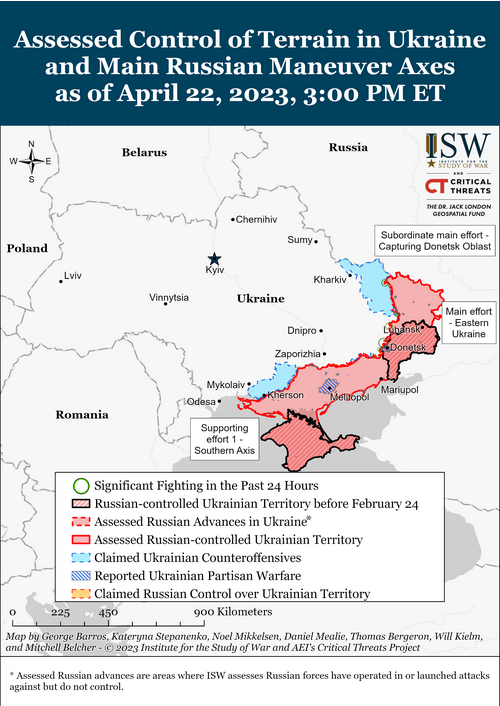
From The Institute For The Study of War:
Russian Offensive Campaign Assessment, April 22, 2023
Kateryna Stepanenko, Riley Bailey, Grace Mappes, Angela Howard, and Frederick W. Kagan
April 22, 9pm ET
Click here to see ISW’s interactive map of the Russian invasion of Ukraine. This map is updated daily alongside the static maps present in this report.
Click here to access ISW’s archive of interactive time-lapse maps of the Russian invasion of Ukraine. These maps complement the static control-of-terrain map that ISW produces daily by showing a dynamic frontline. ISW will update this time-lapse map archive monthly.
Russian milbloggers have provided enough geolocated footage and textual reports to confirm that Ukrainian forces have established positions in east (left) bank Kherson Oblast as of April 22 though not at what scale or with what intentions. Geolocated footage published by a Russian milblogger on April 22 shows that Ukrainian forces have established positions on the Dnipro River bank north of Oleshky (7km southwest of Kherson City) and advanced up to the northern outskirts of the settlement on the E97 highway, as well as west of Dachi (10km south of Kherson City).[1] This footage also indicates that Russian forces may not control islands in the Kinka and Chaika rivers less than half a kilometer north of the geolocated Ukrainian positions near the Antonivsky Bridge. Russian milbloggers claimed on April 20 and 22 that Ukrainian forces have maintained positions in east bank Kherson Oblast for weeks, established stable supply lines to these positions, and regularly conduct sorties in the area—all indicating a lack of Russian control over the area.[2] Another milblogger’s battle map claimed that Russian forces do not control some Dnipro River delta islands southwest of Kherson City as of April 22, suggesting possible Ukrainian advances on these islands.[3] Some milbloggers complained that the slow rate of Russian artillery fire due to the over-centralization of the Russian military command allowed Ukrainian forces to land on the east bank.[4] Russian forces may be prioritizing maintaining defenses in urban areas such as Oleshky and Nova Kakhovka, leaving the islands in the Dnipro River delta unmanned. The extent and intent of these Ukrainian positions remain unclear, as does Ukraine’s ability and willingness to maintain sustained positions in this area. ISW is recoding territory on the east bank of the Dnipro River to Ukrainian-held only now because this is the first time ISW has observed reliable geolocated imagery of Ukrainian positions on the east bank along with multi-sourced Russian reports of an enduring Ukrainian presence there.
Wagner Group financier Yevgeny Prigozhin is likely attempting to persuade Russian President Vladimir Putin to go over to the defensive ahead of a potential Ukrainian counteroffensive. Prigozhin argued on April 21 that Russia needs to “anchor itself in such a way that it is only possible to tear out [Russian forces from their positions] with the claws of the opponent.”[5] Prigozhin’s comment followed a discussion of the Ramstein meeting results, Western commitments to train more Ukrainian personnel and continuous military support for Ukraine. Prigozhin also noted that Ukraine will try to “tear” Russian forces apart and that Russia needs to resist such attacks. Prigozhin has been increasingly alarmist in his recent rhetoric and has made similar statements about the uncertain future of Russian offensive operations in Donbas.[6] Prigozhin’s calls for strengthening Russian defenses in occupied territories and frequent discussions of the prospects of Ukrainian counteroffensives are notable as they indicate that he is trying to amplify the discussion in the Russian domestic information space. Russia, however, continues to conduct offensive operations in Donetsk and Luhansk oblasts.
Prigozhin is also advocating for Russia to focus on holding the current frontlines rather than seeking more gains so that Russian forces can regain their combat effectiveness for later offensive operations. Prigozhin is not arguing for Russia to end the war and negotiate with Ukraine and the West as some Russian and Western sources reported, as ISW previously observed, but is instead condemning the faction within the Kremlin that is hoping to end the war in negotiations.[7] Prigozhin is actually arguing that Russia needs to meet the upcoming Ukrainian counteroffensive at full strength and try to hold the current frontlines without ending the war or entering into peace negotiations.[8] He argues that a pause after the Ukrainian attack culminates would allow Russia to regain combat power and build nationalist support within the Russian society for renewing the fight even in the event of a defeat.[9] Prigozhin is also attempting to redefine and undermine some of Putin’s key maximalist goals in Ukraine—namely the “denazification” and “demilitarization” of Ukraine—likely to minimize the informational impact that might result from going over to the defensive and abandoning efforts to gain more ground now.[10] Russian far-right paramilitary formation Rusich (Sabotage Assault Reconnaissance Group), which facilitates recruitment of Russian ultranationalist and irregular forces, echoed Prigozhin’s rejection of the “denazification” and “demilitarization” goals.[11] Rusich noted that Russia is fighting Ukraine to avenge Donbas, for living space, and for combat experience—rather than fighting claimed Ukrainian “fascism” and “Nazism.” By reframing Putin’s goals, Prigozhin and some factions within the ultranationalist community may be attempting to condition the Russian domestic information space for the prospect of frozen frontlines, potentially near the initial lines of February 23, 2022.
The Russian military command is likely attempting to convince Putin to turn to defensive operations as well—but may be unable to bluntly deliver this message to Putin. Some ultranationalist figures argued that the Russian Ministry of Defense (MoD) signaled efforts to recruit 400,000 contract servicemen to ensure that Russia has enough military personnel to defend existing frontlines and to efficiently freeze the current frontlines in Ukraine.[12] The Russian military command is also reportedly transferring conscripts to hold Russian lines in Crimea and may be planning to prepare other resources to ensure that Russia can retain some lines once the potential Ukrainian counteroffensive culminates.[13] Russian Defense Minister Sergei Shoigu and Chief of the Russian General Staff Army General Valery Gerasimov are likely sensible to the threat of the Ukrainian counteroffensive but are likely continuing to send contract servicemen to reinforce senseless offensive operations at Putin’s insistence.[14] Kremlin sources previously revealed that Putin favors loyalty over competence, and this sentiment likely prevents Shoigu and Gerasimov from focusing on setting optimal conditions for an efficient defense by refusing to expend Russian elite units in grinding attritional battles for marginal gains.[15] ISW previously observed that Shoigu and Gerasimov were likely unable to convince Putin to conduct mobilization in May 2022—despite the fact that Russia needed such a measure to reconstitute forces necessary to maintain offensive operations in Ukraine.[16]
The Russian military command may have partially repaired its strained relationship with Prigozhin to persuade Putin to halt offensive operations via the Russian information space. ISW has observed a sudden improvement in Prigozhin’s relations with the Russian MoD and the Kremlin since early April. The Russian MoD, for example, began to directly acknowledge Wagner forces in its daily situational reports and provided Wagner with ammunition and mobilized personnel as reinforcements in early April 2023.[17] Prigozhin and Kremlin-affiliated milbloggers amplified claims that Kremlin Spokesperson Dmitry Peskov’s son Nikolai Peskov is reportedly serving with Wagner in Ukraine—likely an information operation to publicly mend the relationship and possibly elevate Prigozhin’s loyalty to the Kremlin.[18] Prigozhin had previously been able to impact Putin’s decision-making by engineering the appointment of Wagner-affiliated commanders and the dismissal of inept military officials and breaking through Putin’s close circle with his critiques of the progress of the war.[19] A Russian political expert observed that different Kremlin officials have historically voiced their plans and projects publicly to convince Putin to implement changes, and it is likely that Prigozhin follows the same model of influence.[20] The Russian military command and select Kremlin officials who are advocating for Putin to freeze the war may have reapproached Prigozhin to influence Putin one more time.
Putin’s continued insistence on Russian offensive operations in eastern Ukraine suggests that the group that wants to freeze the war along the current front lines has not fully persuaded Putin. Russian forces are continuing attritional offensives to capture Bakhmut, Avdiivka, and Marinka in Donetsk Oblast as well as limited offensive operations in Luhansk and western Donetsk Oblast, despite increasing Russian fears about the threat of a potential imminent Ukrainian counteroffensive.[21] The Russian winter offensive failed to achieve the Kremlin’s ambitious goals of seizing the Donetsk and Luhansk oblast administrative borders by March 31, but it appears that Russian forces have not subsequently deemphasized their operational focus on tactical gains, no matter how marginal and costly those gains are.[22] Russian forces suffered significant manpower and equipment losses during the winter offensive campaign that are currently constraining their abilities to maintain offensive operations along more than one axis and that will likely limit the Russian military’s ability to respond to possible Ukrainian counteroffensive operations.[23] Russian forces have not responded to these constraints by prioritizing one axis or by conducting an operational pause along any axis that would allow Russian forces to replenish and reconstitute for a decisive defensive effort. Russia forces are continuing to deploy contract servicemen and remaining combat-effective units to support offensive operations in eastern Ukraine instead of conserving this critical pool of combat power to respond to a Ukrainian counter-offensive.[24] Bakhmut, Avdiivka, and Marinka offer no significant operational benefits to Russian forces, and any marginal tactical gains along any axis are unlikely to improve the Russian military’s ability to defend against a Ukrainian counteroffensive.
Putin may be hesitant to commit to a ceasefire due to the influence of select unknown pro-war figures or out of concern for the implications for his regime’s stability. The insistence on tactical gains suggests that the pro-war camp advocating for maintaining offensives at any cost is likely still influencing Putin’s decision-making for the war. A possible shift to preparing for defensive operations ahead of a potential Ukrainian counteroffensive would likely indicate that Putin had finally rejected the pro-war camp’s views in favor of the more pragmatic group’s. The possible success of the upcoming Ukrainian counteroffensive could determine the outcome of this struggle for influence over Putin’s decisions.
Russian occupation authorities are continuing to oppress Roman Catholics in occupied Ukraine, likely in an effort to suppress Ukrainian religious institutions beyond Moscow’s control. Head of the Ukrainian Berdyansk City Military Administration Viktoria Halitsina reported on April 22 that Russian forces seized the Church of the Nativity of the Blessed Virgin Mary in occupied Berdyansk.[25] Halitsina stated that Russian propagandists accused the clergy of hiding weapons and collaborating with Ukrainian forces because of their previous service as chaplains for the Ukrainian Armed Forces in 2015. ISW has also reported on two other instances of Russian occupation authorities persecuting Roman Catholics in occupied Ukraine.[26] ISW has previously reported on Russian authorities’ weaponization of religion in occupied territories as part of an ongoing cultural genocide.[27]
Russian authorities continue to arrest personnel associated with the Russian defense industrial base (DIB) likely to justify crackdowns and further conceal DIB activities. The Russian Federal Security Service (FSB) announced on April 22 that it arrested the deputy head of the testing laboratory at the Promtekhnologiya weapons plant in Moscow on suspicion of treason.[28] The FSB did not provide additional details about the alleged treasonous act. The Promtekhnologiya plant participates in the development and modernization of high-tech weapons. The Promtekhnologiya plant claimed that it had not employed the arrested employee since March 2021.[29] ISW has reported on other recent arrests that are part of an ongoing crackdown using the pretext of threats to Russia’s DIB.[30]
A Russian fighter-bomber accidentally bombed Belgorod on April 21 with two FAB-500 bombs, one of which likely malfunctioned. Russian authorities announced on April 22 the presence of a second, undetonated bomb that landed in Belgorod.[31] Belgorod authorities evacuated 3,000 civilians from the city while sappers extracted and later detonated the bomb.[32] Russian authorities have so far provided no further explanation as to the cause of the accidental bombing. The Russian fighter bomber either intended to drop the bombs on a different target and one bomb failed to detonate, or the fighter bomber did not arm the bombs to drop them, and one bomb improperly detonated.
Key Takeaways
- Russian milbloggers have provided enough geolocated footage and textual reports to confirm that Ukrainian forces have established positions in east (left) bank Kherson Oblast as of April 22 though not at what scale or with what intentions.
- Wagner Group financier Yevgeny Prigozhin is likely attempting to persuade Russian President Vladimir Putin to go over to the defensive ahead of a potential Ukrainian counteroffensive.
- The Russian military command is likely attempting to convince Putin to turn to defensive operations as well—but is unable to bluntly deliver this message to Putin.
- The continued insistence on Russian offensive operations in eastern Ukraine suggests that the group that wants to freeze the war along the current front lines has not fully persuaded Putin of its views.
- Russian occupation authorities are continuing to oppress Roman Catholics in occupied Ukraine, likely in an effort to suppress Ukrainian religious institutions beyond the Kremlin’s control.
- A Russian fighter-bomber accidentally bombed Belgorod on April 21 with two FAB-500 bombs, one of which likely malfunctioned.
- Russian forces conducted limited ground attacks along the Kupyansk-Svatove-Kreminna line and near Siversk.
- Russian forces continued to advance around Bakhmut on April 22, although Russian forces have not completed a turning movement around the city.
- Russian forces continued to conduct offensive operations along the Avdiivka-Donetsk front and conducted a limited ground attack in western Donetsk Oblast.
- Russian authorities have made headway in their attempts to compel international recognition of Russian ownership over the Zaporizhzhia Nuclear Power Plant (ZNPP).
- Continued Russian efforts to block evacuations of wounded soldiers, likely to prevent soldiers from leaving the combat zone, have contributed to the deaths of some Russian soldiers.
- Russian occupation officials are expanding patronage networks in occupied territories.
Go here to read the rest. Will the next Ukrainian offensive come in the south, or is this merely a feint to draw the Russians off? I suspect it is a feint and the Ukrainian offensive will be in the center. We shall see soon enough.

