
From The Institute For The Study of War:
Russian Offensive Campaign Assessment, March 16, 2023
Karolina Hird, Riley Bailey, Angela Howard, George Barros, Nicole Wolkov, Layne Philipson, and Frederick W. Kagan
March 16, 6:15 ET
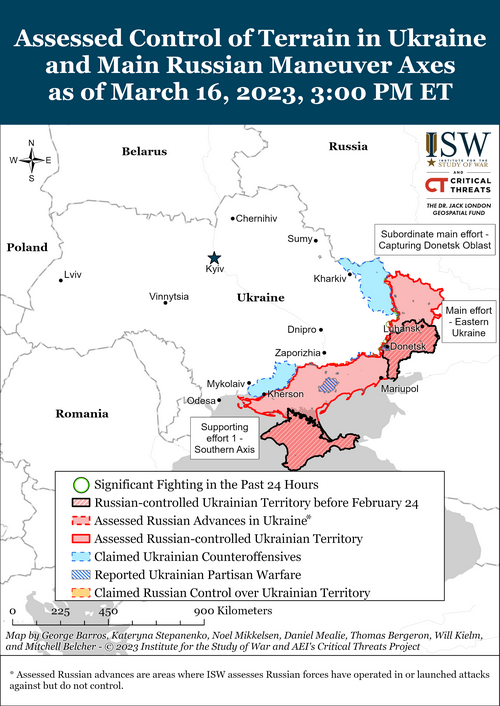
Click here to see ISW’s interactive map of the Russian invasion of Ukraine. This map is updated daily alongside the static maps present in this report.
Click here to access ISW’s archive of interactive time-lapse maps of the Russian invasion of Ukraine. These maps complement the static control-of-terrain maps that ISW produces daily by showing a dynamic frontline. ISW will update this time-lapse map archive monthly.
The Russian Federal State Security Service (FSB) appears to be trying to penetrate the Russian Defense Industrial Base (DIB) in a way that is reminiscent of the KGB’s involvement with the Soviet military establishment. Spokesperson for the Ukrainian Center for the Research of Trophy and Prospective Weapons and Military Equipment of the Ukrainian General Staff Andrii Rudyk remarked on March 16 that Ukrainian experts have found FSB markings on many Russian weapons components that Ukrainian forces have destroyed or captured on the battlefield.[1] Rudyk noted that these markings appear not only on equipment such as T-90M tanks, but also on weapons’ microcircuits, and suggested that this means that the FSB conducted an equipment inspection of such weapons and components.[2] Rudyk concluded that this means that the FSB does not trust Russian military leadership and is conducting inspections of Russian equipment accordingly.[3] FSB markings on Russian equipment and weapons components, if confirmed, would have broader implications for the relationship between the FSB, the Russian DIB, and the broader Russian military apparatus. Either FSB Director Alexander Bortnikov has instructed the FSB to conduct these investigations at the direction of Russian President Vladimir Putin, or Bortnikov has issued this directive independent of Putin. In either case the FSB appears to be directly inserting itself into the inner workings of the Russian DIB, likely penetrating equipment acquisition and inspection processes. The KGB (the FSB’s predecessor) notably penetrated the Red Army and Soviet defense industry in a similar fashion.
Wagner Group financier Yevgeny Prigozhin claimed that he received a press question exposing a plot spearheaded by Russian President Vladimir Putin and Russian Security Council Secretary Nikolai Patrushev to undermine and “neutralize” the Wagner Group. Prigozhin’s press service published a claimed request for comment on March 16 from Russian outlet Nezavisimaya Gazeta asking if Prigozhin was aware of alleged discussions between Putin and Patrushev regarding the future of the Wagner Group.[4] The press comment claims that information on these discussions has recently circulated on Russian and Ukrainian Telegram channels and alleges that Patrushev suggested to Putin that there will be “nothing left” of Wagner in “one and a half to two months.”[5] The post goes on to claim that Patrushev suggested that upon Wagner’s destruction in Ukraine, Prigozhin will try to “unite the former and remaining active Wagner fighters under a far-fetched pretext,” arm them, and “send them to the territory of Russia in order to seize power in the regions bordering Ukraine with a possible advance inland.”[6] The post concludes that Patrushev has already ordered observation and control over the movement of former Wagner fighters and that Putin reportedly agreed with this step and thanked Patrushev for his efforts to “neutralize Wagner in general and Yevgeny Prigozhin in particular.”[7] Prigozhin posted an audio clip in response to the claimed press comment saying that he had not heard about these supposed negotiations or observed speculation on Telegram channels, remarking that Russian special services should work to neutralize threats to Russia regardless of where they come from.[8]
ISW has not observed any information to suggest that these discussions have happened, nor has ISW captured any speculation in the Russian information space about them. Nezivisimaya Gazeta has not published the press comment on its own site, and no record of the comment is visible anywhere other than in references to the post by Prigozhin’s press service. The lack of external confirmation on this subject suggests that Prigozhin has fabricated the alleged plot to further several information operations on behalf of Wagner and his own reputation. First, this exchange clearly identifies Patrushev and possibly the Russian Security Council as enemies of the Wagner Group. Prigozhin appears to be setting careful information conditions to blame Patrushev for Wagner’s failures and potential crackdowns against the group, as well as introducing an invented scenario wherein Wagner poses a direct threat to Russia domestically. This effort appears to be the next evolution of Prigozhin’s campaign against the Russian military establishment, and Patrushev could become Prigozhin’s next target after his concerted informational campaigns against the Russian Ministry of Defense and General Staff.[9]
Western news agencies confirmed on March 16 that Chinese companies have sold rifles, drone parts, and equipment that could be used for military purposes to unidentified Russian entities. Politico cited data provided by customs data aggregator ImportGenius showing that Chinese companies sent equipment including 1,000 assault rifles, 12 shipments of drone parts, and over 12 tons of body armor to unspecified Russian actors between June and December 2022.[10] CNN also reported on March 16 that Ukrainian forces shot down a retrofitted, weaponized commercial Mugin-5 drone produced by a Chinese commercial manufacturer.[11] These sales appear small in scale, concern largely commercial equipment, and — in all but one confirmed case — do not include companies with ties to the Chinese government, according to Politico.[12]
Such Chinese shipments are significant, however, because they could alleviate strain on the overextended Russian defense industrial base (DIB) and circumvent Western attempts to limit Russian access to microchips. ISW has not observed routine Russian small arms shortages, and Russia’s DIB appears capable of producing sufficient quantities of assault rifles. The import of domestically available equipment from China likely enables the Russian DIB to transfer resources — most critically the limited number of skilled Russian defense plant workers — from the production of such goods to the production of military equipment for which Russia has a dire need.[13] Meanwhile, the sale of even commercial drone parts to Russian entities could provide Russia’s DIB with access to valuable microchips vital to the production of sophisticated equipment, which Western sanctions have worked to prevent.[14]
Syrian President Bashar Assad used a staged interview with Russian outlet RIA Novosti to amplify notable Russian information operations. Assad told RIA on March 16 that Russian military bases in Syria should receive the “most advanced weapons” to effectively deter threats in response to a question about the deployment of hypersonic missiles.[15] This comment is explicitly in support of the deployment of Russian hypersonic weapons, likely of the Kinzhal variety, to Syria, which is part of a longstanding Russian information operation to strengthen Assad and increase pressure against Turkey as Ankara considers ratification of Finland and Sweden’s accession into NATO. [16] Assad also notably recognized the Russian-occupied territories of Ukraine as a part of Russia.[17]
Polish President Andrzej Duda stated on March 16 that Poland will give Ukraine four MiG-29 fighter jets. Polish news outlet Wydarzenia reported that Duda said that Poland will deliver the MiG-29s in the coming four to six weeks.[18] Polish news outlet Rzeczpospolita reported that Duda announced that Poland is servicing an unspecified number of additional MiG-29s for delivery to Ukraine.[19] The Ukrainian Air Force operates MiG-29s and would be able to use them in counteroffensive operations if Ukraine receives them with enough time in advance of its next counteroffensive.
Russia’s redeployment of elements of its “peacekeeping force” from Nagorno-Karabakh to Ukraine is eroding Russia’s influence with Armenia. Armenian Prime Minister Nikol Pashinyan accused Azerbaijan of preparing to conduct a new large-scale attack and genocide against ethnic Armenians in Nagorno-Karabakh at an unspecified future time on March 16.[20] Pashinyan stated that Armenia should appeal to the United Nations Security Council if the Russian Federation is unable to uphold the November 9, 2020, Nagorno-Karabakh ceasefire that Moscow helped broker with Azerbaijan.[21] Pashinyan previously accused Russia’s “peacekeeping force” in Nagorno-Karabakh of “not fulfilling its obligation” under this ceasefire in December 2022 after Russian forces failed to secure passage on the only road through the Lachin Corridor between Armenia and Nagorno-Karabakh.[22] Russia’s “peacekeeping force” in Nagorno-Karabakh is very likely understrength. The Russian military redeployed elements of the 15th Separate Guards Motorized Rifle Brigade — Russia’s only dedicated peacekeeping brigade — from Nagorno-Karabakh to Ukraine in March 2022.[23] Ukraine’s General Staff reported that Ukrainian forces severely degraded the 15th Separate Guards Motorized Rifle Brigade, killing about 800 and wounding about 400 soldiers of the brigade’s 1,800 soldiers that deployed to Ukraine as of June 2022.[24] Russia will likely lose military influence in other post-Soviet states since Moscow has redeployed elements of permanently stationed Russian forces from Russian bases in Kyrgyzstan, occupied Georgia (Abkhazia and South Ossetia), and Tajikistan to fight in Ukraine.[25]
Russian President Vladimir Putin attempted to reassure the Russian public that the war in Ukraine will not have significant long-term economic consequences, likely as part of the Kremlin’s effort to prepare Russians for a protracted war. Putin delivered a speech at the Congress of the Russian Union of Industrialists and Entrepreneurs in Moscow on March 16 in which he claimed that the Russian economy has steadily grown in the past eight months following a roughly five percent contraction over the first months of Russia’s invasion of Ukraine.[26] Putin attempted to portray Russia as not being isolated from the international economy by claiming that Russian trade with fast-growing markets has increased at double-digit rates.[27] Putin claimed that the domestic Russian economy will experience sustainable long-term growth and forecasted that Russian industries will significantly grow as they fill niches previously held by Western firms that have left the country and stopped doing business with Russia.[28] Putin suggested that the entire Russian economy will expand in a manner similar to the Russian agricultural sector’s growth following 2014 Western sanctions regimes associated with Russia’s illegal annexation of Crimea.[29] Putin claimed that Russia’s supposed economic resilience has disproven Western analysts who predicted empty store shelves and massive shortages of goods in Russia because of Western sanctions.[30]
Putin’s portrayal of a healthy and resilient Russian economy is at odds with Russia’s issues with sanctions-related supply chain bottlenecks, the Russian defense industrial base’s (DIB) struggle to meet the Russian military’s needs in Ukraine, and the Kremlin’s substantial projected budget deficit problems.[31] Putin likely sought to reassure the Russian public as the Kremlin increasingly signals to Russians that the Kremlin intends to fight a protracted war in Ukraine and implicitly consign the Russian economy to an indefinite period of stringent Western sanctions.[32] The Kremlin also likely sought to reassure the Russian public that war-related production will not detrimentally impact the rest of the Russian economy as Russian officials continue efforts to gradually mobilize more of Russia’s DIB.[33] The Kremlin will likely struggle to not contradict its different informational lines of effort as it attempts to reassure the Russian public about the Russian economy, set informational conditions for a protracted war, and mobilize a wider portion of Russia’s DIB.
Key Takeaways
- The Russian Federal State Security Service (FSB) appears to be trying to penetrate the Russian defense industrial base (DIB) in a way that is reminiscent of the KGB’s involvement with the Soviet military and industrial base.
- Wagner Group financier Yevgeny Prigozhin claimed that he received a press question exposing a plot spearheaded by Russian President Vladimir Putin and Russian Security Council Secretary Nikolai Patrushev to undermine and “neutralize” the Wagner Group.
- Western news agencies confirmed that Chinese companies have sold military and dual-use equipment to unidentified Russian entities. These sales appear small in scale but could alleviate strain on Russia’s defense industrial base (DIB) and circumvent Western attempts to limit Russian access to microchips.
- Syrian President Bashar Assad used a staged interview with Russian outlet RIA Novosti to amplify notable Russian information operations.
- Polish President Andrzej Duda stated that Poland will give Ukraine four MiG-29 fighter jets.
- Russian’s decision to redeploy elements of its “peacekeeping force” from Nagorno-Karabakh to Ukraine is eroding Russia’s influence with Armenia.
- Russian President Vladimir Putin attempted to reassure the Russian public that the war in Ukraine will not have significant long term economic consequences, likely as part of the Kremlin’s effort to prepare Russians for a protracted war.
- Russian forces conducted limited ground attacks northeast of Kupyansk and along the Svatove-Kreminna line.
- Russian forces continued advancing in and around Bakhmut and continued ground attacks along the Avdiivka–Donetsk City line and in Western Donetsk Oblast.
- Russian sources claimed that Ukrainian forces conducted localized assaults in Zaporizhia Oblast.
- Ukrainian sources reported that Russian forces increased their naval presence in the Black Sea.
Go here to read the rest. At this point everyone seems to be marking time until the next Ukrainian offensive.


Prigozhin is partially correct. Putin would like Wagner to operate with the efficiency of the Waffen SS. Instead he got the Rohlm’s criminal Brownshirts with marginal military ability. Dictators tend to run to type and quite reluctant to learn from other’s experiences.
As stated in the article, Poland, along with Slovakia, are donating MIGs to Ukraine. The expectation is that Poland and Slovakia will get more modern fighter jets to replace the MIGs.