
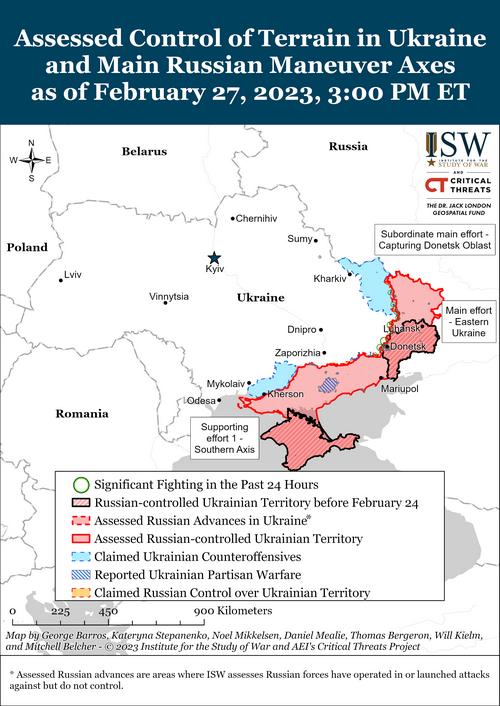
From The Institute For The Study of War:
Karolina Hird, Grace Mappes, Nicole Wolkov, George Barros, Layne Philipson, and Frederick W. Kagan
February 27, 8:15pm ET
Click here to see ISW’s interactive map of the Russian invasion of Ukraine. This map is updated daily alongside the static maps present in this report.
Russian officials are promoting an information operation that falsely frames Russia’s war in Ukraine as existential to the continued existence of the Russian Federation. In an interview with TV channel Rossiya-1 on February 26, Russian President Vladimir Putin warned that he does not know if “such an ethnic group as the Russian people can survive in the form in which it exists today” if the West succeeds in “destroying the Russian Federation and establishing control over its fragments.”[1] Putin accused the collective West of already having plans “set out on paper” for the destruction of the Russian Federation in its current form.[2] Putin also remarked that Russia had to suspend its participation in the START treaty in order to ensure its strategic stability and security in the face of a concerted Western effort to use START to cripple Russia’s strategic prospects.[3]
Putin began to set conditions for the perpetuation of this information operation in his speech to the Federal Assembly on February 21, where he blamed the collective West for using the war in Ukraine to threaten the existence of the Russian Federation.[4] Deputy Chairman of the Russian Security Council Dmitry Medvedev invoked similarly existential sentiments in an essay entitled “Points of No Return” published on February 27 in which he accused the West of fueling the current situation in Ukraine since the fall of the Soviet Union and concluded that “the calm power of our great country and the authority of its partners are the key to preserving the future of our entire world.”[5] Both Putin‘s and Medvedev’s statements engage with an information operation that frames the war in Ukraine as existential to the continued survival of the post-Soviet Russian Federation, which is likely an attempt to present the war as having higher stakes for Russia and the West than it actually does. Putin likely hopes to set informational conditions to accuse Ukraine and the West of threatening the survival of the Russian Federation in response to Russian military failures and Western support for Ukrainian victories. No prominent Western official has called for the dissolution of the Russian Federation, and Western leaders have been very careful to articulate their aims as being to enable Ukraine to liberate all its territory at most. Putin’s language is designed to fuel support for the war in Russia and stoke fears in the West of the instability that would follow the collapse of Russia to deter Western support to Ukraine and persuade the West to coerce Kyiv into accepting Russian demands.
Russian officials continue to engage in information operations in an attempt to discourage the Western provision of military aid to Ukraine. Russian Defense Minister Sergei Shoigu stated during a TV interview with Rossiya-1 on February 26 that the types of weapons that the West decides to provide to Ukraine will determine how far Russian troops will need to “push the threat away” from Russian borders.[6] Putin made a similar statement in his February 21 address to the Federal Assembly.[7] These statements are likely meant to discourage the West from providing long-range systems to Ukraine by suggesting that the provision of such systems will protract the war by “forcing” Russia to take more Ukrainian territory to be “safe.” ISW has previously reported on concerted Russian information operations to discourage Western military aid to Ukraine.[8]
Ukrainian military officials continue to respond to Western concerns about Ukrainian capabilities to liberate Ukrainian people and land and suggest that Ukrainian forces are preparing for a spring counteroffensive in southern Ukraine. Ukrainian Deputy Head of the Main Military Intelligence Directorate (GUR) Vadim Skibitskyi stated on February 26 that Ukrainian forces will be ready for a counteroffensive in spring 2023 and that one Ukrainian strategic goal is to split the Russian frontline between Crimea and mainland Russia. Skibitskyi noted that the supply of Western military aid is one decisive factor in determining the timing of a Ukrainian counteroffensive. Western officials and news outlets have recently expressed a degree of doubt about Ukrainian forces’ ability to conduct a counteroffensive and the West’s ability to provide long-term military aid to Ukraine, as ISW has previously reported.[9] ISW’s prior assessments of Russian military capabilities along the Zaporizhia Oblast front line suggest that there are opportunities for Ukraine to conduct a counter-offensive in that strategically vital region.[10]
A reportedly captured Russian military manual suggests that Russian forces are implementing new assault tactics to compensate for current combat power limitations in response to continued offensive failures. A Ukrainian reserve officer posted a picture on February 26 reportedly of a captured Russian manual that details the tactics of a newly minted “assault detachment,” which is a battalion-sized element that has been optimized for frontal assaults on fortified areas.[11] The assault detachment formation reportedly fields six T-72 main battle tanks, 12 infantry fighting vehicles, and a collection of man-portable thermobaric rocket launchers, anti-tank guided missile systems, towed artillery, and self-propelled mortars.[12] The assault detachment appears to be comprised of three assault companies and a tank section.[13] Each assault company has a command element, two assault “platoons” (at far below normal platoon strength), a UAV team, an armored fighting vehicle (AFV) group, a fire support platoon and an artillery support platoon, a reserve section, and a medevac section. Each company fields one tank and four BMP/BMD-2 infantry fighting vehicles, with anti-tank launchers, heavy machine guns, and mortars. The Ukrainian reserve officer remarked that assault “platoons” of 12 to 15 people, divided into tactical groups of three people, are the formation’s primary maneuver elements.[14] The assault detachment reportedly conducts assaults within less than a minute of the time when artillery fire begins on open fortified positions, with the platoon commander controlling mortar fire.
The manual suggests that Russian forces are trying to adapt maneuver forces into smaller and more agile military formations than were employed earlier in the war. The Ukrainian reserve officer noted that this new tactical formation suggests that Russian forces have replaced the defunct battalion tactical group (BTG) with these smaller and more agile maneuver formations. The manual suggests that Russian forces are using T-72 tanks for direct fire support from the rear rather than as integral parts of a combined arms team. The increased reliance on dismounted infantry and the relegation of tanks to fire support from the rear indicates that Russian military leadership is prioritizing protecting main battle tanks over protecting infantry, which is reflective of recent reports of massive equipment losses that Russian armor units sustained over the first year of the war.[15] The manual indicates that the Russian military is resorting to employing a form of simplified combined arms warfare that has likely been pared down to compensate for the overall degradation of Russian manpower and equipment capacity and which is easier for inexperienced and untrained mobilized personnel slotted into such detachments to employ.
The tactics of the assault detachment additionally suggest that the Russian military may be attempting to institutionalize practices used to marginal tactical effect by the Wagner Group in Bakhmut. The Ukrainian reserve officer suggested that this new formation is likely partially influenced by Wagner Group operations around Bakhmut.[16] ISW has previously reported on the fact that Wagner has largely relied on squad-sized frontal assaults, which have decreased the reliance on massed fires as Russian artillery and equipment stocks have dwindled.[17] The Wagner Group’s highly attritional offensive on Bakhmut has failed to gain operationally significant ground, so the institutionalization of elements of Wagner’s tactics will likely further normalize attritional frontal assaults. Such tactics are likely to waste Russian combat power and not effectively counter conventional Ukrainian battalions and brigades. Assault detachments may be able to make tactical gains at cost due to their simplicity but will likely culminate rapidly due to their small size and attritional tactics. Russian forces are unlikely to make operationally significant breakthroughs rapidly with this formation.
US Central Intelligence Agency (CIA) Director William Burns stated on February 25 that the CIA is confident that Chinese leadership is considering the provision of lethal equipment to Russia but has not made a final decision.[18] In an interview with CBS News, Burns stated that the CIA has not seen evidence of Chinese shipments of lethal equipment to Russia. Burns also stated that the US government chose to make the CIA’s assessment public in order to deter China from sending lethal weapons to Russia.
Key Takeaways
- Russian officials are promoting an information operation that falsely frames Russia’s war in Ukraine as existential to the continued existence of the Russian Federation.
- Russian officials continue to conduct information operations in an attempt to discourage the Western provision of military aid to Ukraine.
- Ukrainian military officials continue to respond to Western concerns over Ukrainian capabilities and suggest that Ukrainian forces are preparing for a spring counteroffensive in southern Ukraine.
- A reportedly captured Russian military manual suggests that Russian forces are implementing new assault tactics to compensate for the current limitations on combat capability in light of continued offensive failures.
- The manual suggests that Russian forces are trying to adopt smaller and more agile combined arms formations than were employed earlier in the war.
- The tactics of the assault detachment additionally suggest that the Russian military may be attempting to institutionalize tactics used to marginal tactical effect by the Wagner Group in Bakhmut.
- US Central Intelligence Director William Burns stated on February 25 that the CIA is confident that Chinese leadership is considering the provision of lethal equipment to Russia but has not made a final decision or provided lethal aid to Russia.
- Ukrainian officials stated that Russian forces have been concentrating and escalating operations along the Luhansk Oblast front line.
- Russian forces continued to conduct ground attacks northwest of Svatove and near Kreminna.
- Russian forces continued to conduct ground attacks across the Donetsk Oblast front line, and Russian sources widely claimed that Wagner Group forces made territorial gains north of Bakhmut.
- Ukrainian officials reported that Russian forces continue to focus on establishing defensive fortifications in east (left) bank Kherson Oblast and Crimea.
- Russian forces are continuing to expend their already limited stocks of precision munitions.
- Russian officials announced that all social support measures will enter into force in occupied territories on March 1.
Go here to read the rest.
From Strategy Page:
February 27, 2023: Soon after Russia invaded Ukraine in 2022 they discovered that they could not afford to keep fighting. Massive sanctions reduced the cash Russia had access to and paying what was promised to new recruits soon became more than Russian could afford. Using the old “the check is in the mail” excuse worked for a while until it didn’t when most troops understood the check was never sent and never would be. This is particularly troublesome when it comes to former Russian soldiers who agreed to join the reserves after they left active service. The pay wasn’t great and there were some training obligations but many former conscript or volunteer (contract) Russian soldiers tried out the new reserve system and were not surprised that it didn’t work. The former Russians soldiers adopted the practice of “no pay, no way am I playing your stupid game”. In 2019, after several years of effort, Russia had fewer than 5,000 soldiers participating in the active reserve program. That was all the government could pay and accommodate at training facilities. The Russian Defense Ministry expected to have over 80,000 reservists participating in the program but the resources and resourcefulness were not available to make that happen.
In 2021 the Defense Ministry came up with another scheme that was much more selective about which former soldiers were eligible for the new reserve system that aimed to attract and keep over 30,000 reservists. The pay was better, the training was more frequent and reservists signed three year contracts, which released the reservist from any obligations at the end of the contract. This new arrangement attracted about 9,000 qualified men. The program soon failed when word got around that reservists mobilized to fight in Ukraine were not getting the active duty pay their contracts specified.
Not paying promised sums to mobilized or already serving soldiers is a growing problem for Russia because as fewer men agree to serve in the military, the incidences of failure to pay the troops or provide the additional sums for their families goes up. Threats of prosecution of men who do not show up or simply walk away from military service are losing their impact because this is happening to so many newly mobilized and already serving Russian troops. The government does not have the resources to carry out that many prosecutions and the troops know it.
Russia is trying to fight a war it can’t afford. Offering pay and other cash benefits to troops that the government can’t afford has made it difficult to rebuild the Russian army that was destroyed in the first six months of fighting in Ukraine. Importing munitions from North Korea and Iran is only possible if Russia pays for it. This is being done on a barter basis because sanctions have blocked Russia’s access to its foreign hard currency assets. North Korea needs food and fuel while Iran needs modern weapons and help with their nuclear weapons program. Helping Iran develop and build nuclear weapons is something that the rest of the world opposes. Putin doesn’t seem to consider this a significant obstacle.
Go here to read the rest. Other than being shot to pieces, nothing impacts the morale of soldiers more than not being paid, or being paid less than was promised.

