
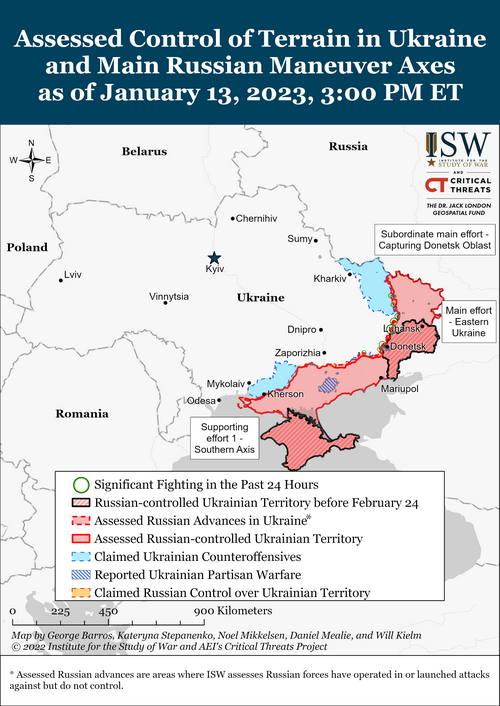
From The Institute For The Study of War:
Kateryna Stepanenko, George Barros, Riley Bailey, Angela Howard, Madison Williams, and Mason Clark
January 13, 8:45 pm ET
Click here to see ISW’s interactive map of the Russian invasion of Ukraine. This map is updated daily alongside the static maps present in this report.
The Russian Ministry of Defense (MoD) announced on January 13 that Russian forces seized Soledar, Donetsk Oblast, on the evening of January 12. The Russian MoD claimed that Russian forces can now form a “cauldron” around Bakhmut and threaten Ukrainian supply lines running southwest of Soledar that support Ukrainian troops in the city.[1] The Russian MoD notably praised assault and army aviation, missile and artillery troops, and Russian airborne forces for seizing Soledar, without acknowledging Wagner Group’s participation in the fighting for the city. Ukrainian Defense Minister Oleksiy Reznikov maintained that the situation around Soledar is difficult and noted that it is unclear if Russian forces control the settlement at this time. At the same time, other Ukrainian military officials reported that Ukrainian forces continued to fight in Soledar during the night of January 12-13.[2] Ukrainian forces may still occupy some positions on the northwestern borders of Soledar but are unlikely to control significant territory within the settlement itself. ISW assessed on January 12 that Russian forces had likely captured Soledar on January 11, but such a victory is unlikely to presage an imminent Russian encirclement of Bakhmut.[3]
The announcement sparked a significant backlash within the Russian information space due to the Russian MoD’s failure to acknowledge the Wagner Group’s participation in the capture of Soledar. The Russian MoD issued a follow-up announcement six hours later recognizing Wagner volunteers and assault detachments as participants in the Battle for Soledar and noting that the Russian MoD received numerous inquiries regarding its original commemoration of select Russian forces.[4] The Russian MoD attempted to justify their snub of Wagner by claiming that a Russian “heterogeneous grouping of troops” executed a “joint plan” in the Soledar direction and attributed the assault against residential areas to Wagner forces. Wagner financier Yevgeny Prigozhin vaguely responded to the Russian MoD’s omission of Wagner, stating that he cannot comment on the situation and noting that journalists’ questions about the matter expose their concern over commemorating Wagner’s “heroic capture of Soledar.”[5]
Wagner financier Yevgeny Prigozhin staged conditions for such backlash by personally visiting Soledar days prior to its capture and taking his cadre of Wagner-affiliated milbloggers to commemorate Wagner forces’ daily advances on Russian social media platforms.[6] Prigozhin likely attempted to preempt the announcement on January 12 by accusing unnamed bureaucrats and government officials of “constantly trying to steal victory from [the] Wagner private military company” and belittling its merits.[7] Milbloggers independent or affiliated with Wagner subsequently generated a series of criticisms calling out the Russian MoD for its misrepresentation of the claimed capture of Soledar.[8]
The Russian MoD’s announcement highlighted the existing conflict between the Wagner Group and the Russian MoD – a dynamic that ISW has previously observed and assessed. Several prominent milbloggers – including those affiliated with the Kremlin – stated that there is an ongoing conflict between the Russian MoD and Prigozhin behind closed doors and within the information space.[9] Some noted that Prigozhin has overpowered the Russian MoD‘s deliberately vague rhetoric, forcing the Russian MoD, and by extension the Kremlin, to end its long-standing policy of refraining from recognizing Wagner and its war efforts.[10] A Kremlin-affiliate milblogger, in turn, claimed that Prigozhin and the Russian MoD are both equally attempting to undermine each other and accused Prigozhin of refusing to recognize the Russian Armed Forces as a participating force on the battlefield.
Former Russian officer and prominent nationalist voice, Igor Girkin, condemned the “acute conflict” between traditional military command and unofficial forces (referring to Wagner) during a time of war and claimed that Russian Defense Minister Sergey Shoigu and Chief of the Russian General Staff Valery Gerasimov seek to disband private military companies like Wagner and incorporate its elements into the MoD structure.[11] Girkin stated that Soledar has exposed a major dilemma for Russian President Vladimir Putin, who he framed as having the options of either intensifying his efforts to appease both the Russian MoD and Prigozhin; doubling down on either side at risk of losing support for his war; or becoming an arbitrator and the commander-in-chief. ISW had previously assessed that Putin’s efforts to balance the at times mutually exclusive lines of effort of retaining Russian MoD support for his war, publicly distancing himself from military failures, and exploiting Prigozhin’s parallel military forces, may have ramifications on his power.[12]
Prigozhin likely seeks to use the victory in Soledar as a bargaining tool to elevate his authority in Russia. The Russian MoD’s subsequent mention of Wagner forces in response to public outcry signals a significant victory for Prigozhin, solidifying him as a crucial actor in this war. Reznikov stated that Prigozhin needed a victory in Soledar to deliver proof to Putin that his forces are better than the conventional army.[13] Prigozhin also publicized a journalist’s question about his reported upcoming meeting with Putin to discuss victory in Soledar, singling out the question amidst an array of other similar questions on his response to the Russian MoD’s announcement.[14] Prigozhin told the journalist to read his original statement on Soledar instead of “doing nonsense,” despite his comment stating that questions on Russian MoD’s exclusion of Wagner will “need answers but not now.” Prigozhin, who has used intentionally vague messaging in the past, also noted that everyone will soon understand why he withheld comment. While ISW cannot confirm that Prigozhin will have a meeting with Putin, he had previously offered his critiques to Putin on the progress of the war and will likely seize this opportunity to his benefit.[15]
Putin may be taking measures to cultivate a cadre of milbloggers loyal to Putin and the Russian MoD to undermine Prigozhin’s effort to elevate himself. United Russia Party Central Executive Committee Head Alexander Sidyakin, United Russia State Duma parliamentarian Artyom Turovyi, and Donetsk People Republic Head and Putin ally Denis Pushilin met with several milbloggers on January 13.[16] These senior Putin allies presented a group of over 10 milbloggers – including Alexander Sladkov and a journalist who works for Wargonzo – an official certificate of thanks signed by Secretary of the General Council of the United Russia Party Andrey Turchak.[17] This is the latest event in a string of Kremlin efforts to cultivate ties with select milbloggers.[18] ISW previously assessed that the Kremlin undertook efforts to co-opt Sladkov, Wargonzo lead milblogger Semen Pegov, and other milbloggers who were willing to sell out in exchange for political prestige.[19] Putin may seek to cultivate ties with these Kremlin-pliant milbloggers to marshal their media reach against the Prigozhin-aligned milbloggers’ efforts to promote Prigozhin and damage Putin’s reputation in the Russian information space.
High-ranking Ukrainian officials continue to forecast that Ukrainian and Russian operations will likely intensify in the spring of 2023, while a Russian offensive from Belarus remains unlikely. Ukrainian Defense Minister Oleksiy Reznikov stated in a January 13 interview with the BBC that “spring is the best period to refresh [military] movement for all sides” and that Ukrainian officials understand that Russian forces will be ready to start a higher pace of operations in the spring and therefore Ukrainian forces need to be ready to do so as well.[20] Reznikov also stated that the Russian military could be trying to accumulate forces, ammunition, and weapons for an offensive from areas it already occupies in southern and eastern Ukraine.[21] Reznikov’s statement follows Ukrainian Main Military Intelligence Directorate (GUR) Chief Kyrylo Budanov’s statement that Ukrainian forces intend to launch a major counteroffensive throughout Ukraine in the spring.[22] ISW has still not observed any indicators that Ukrainian forces intend to halt currently ongoing counteroffensive operations this winter in favor of conducting a major counteroffensive this spring. Ukrainian forces may instead use ongoing counteroffensive operations to set conditions for a potential larger counteroffensive operation this spring.[23] Reznikov’s forecast of a higher pace of Russian operations in the spring partially supports ISW’s assessment that Russian forces are likely preparing for an intended decisive military effort in 2023.[24]
Reznikov also stated that it “would take a lot of time” for Russian forces to prepare an offensive from Belarus and that the Russian military currently “has no resources” to support such an effort.[25] Ukrainian officials continue to routinely state that Russian forces are unlikely to invade Ukraine from Belarusian territory.[26] ISW continues to assess that the most dangerous course of action (MDCOA), a renewed Russian invasion of Ukraine from Belarus, remains unlikely and that Belarusian forces are highly unlikely to join the fighting in Ukraine.
Disagreement over how to respond to Russians who have fled abroad risks dividing Russian officials and exposing the gap between the Kremlin and certain extreme nationalist actors. Chairman of the Russian State Duma Vyacheslav Volodin proposed on January 12 that Russia amend its criminal code to confiscate the property of Russians who fled the country.[27] Occupation Head of Crimea Sergey Aksyonov praised Volodin’s proposal to punish the “scoundrels” who “betrayed” Russia.[28] A prominent Russian milblogger amplified Volodin’s proposal and polled his subscribers, finding that the majority supported or strongly supported Volodin’s proposal.[29] Kremlin Press Secretary Dmitry Peskov opposed Volodin’s proposal, however.[30] Peskov claimed that Russian citizens who left the country “are all our citizens, all equally, and could have different reasons for leaving” and stated that Russian authorities should create conditions to entice Russians abroad to return.[31] The Kremlin may support the return of Russians abroad in hopes of solving growing labor shortages and demographic challenges, avoiding the ostracizing of more moderate Russian audiences, or distancing itself from the demands of the nationalist community. The Kremlin has rhetorically distanced itself from the prevalent nationalist milblogger demands by re-appointing widely criticized and favored military officials and may be attempting to regain control over the Russian information space.[32]
Russian President Vladimir Putin reportedly ordered Russian occupation authorities to deport Ukrainian children to Russia using medical schemes at a meeting with members of the Russian Presidential Council for Civil Society and Human Rights (HRC) on December 7. The Kremlin published a list of official orders on January 12 that Putin gave to HRC members on December 7. The document includes an order for Russian occupation officials to take unspecified measures to “meet healthcare system needs” in occupied Ukraine.[33] Zaporizhia Oblast Occupation Deputy Vladimir Rogov stated on January 12 that Putin personally ordered occupation authorities to administer preventative medical examinations to children in occupied Ukraine and that over 110,000 Ukrainian students have undergone medical examinations in occupied Zaporizhia, Kherson, Donetsk, and Luhansk oblasts.[34] Rogov stated that over 450 Russian “specialists” from Crimea and Adygea are conducting these examinations and are discovering thousands of children with undiagnosed medical conditions and sending them – possibly to Russia – for “treatment.”[35] Putin previously thanked Russians for their efforts to send children from occupied Ukrainian territory on “holidays” in Russia in his annual New Year’s speech.[36] ISW has previously reported instances of Russian officials using the guise of “holidays” and vacation schemes to justify the transfer of Ukrainian children to Russia and Russian-occupied Crimea.[37] ISW maintains that the forced deportation of Ukrainian children represents a possible violation of the Convention on the Prevention and Punishment of the Crime of Genocide.
Key Takeaways
- The Russian Ministry of Defense (MoD) announced on January 13 that Russian forces seized Soledar on the evening of January 12.
- The MoD’s initial announcement (which did not mention the Wagner Group) sparked a significant backlash within the Russian information space, forcing the MoD to issue a second announcement crediting Wagner.
- Prigozhin likely seeks to use the victory in Soledar as a bargaining tool to elevate his authority in Russia.
- Putin may be taking measures to cultivate a cadre of milbloggers loyal to Putin and the Russian MoD to undermine Prigozhin’s effort to elevate himself.
- High-ranking Ukrainian officials continue to forecast an intensification of Ukrainian and Russian operations in the spring of 2023 and that a Russian offensive from Belarus remains unlikely.
- Russian officials’ responses to Russians who have fled abroad risks dividing the Kremlin and the ultra-nationalist pro-war community even further.
- Russian President Vladimir Putin reportedly ordered Russian occupation officials to deport Ukrainian children to Russia under medical relocation schemes.
- Russian forces conducted limited counterattacks along the Svatove-Kreminna line while Ukrainian forces reportedly continued counteroffensive operations near Kreminna.
- Russian forces continued offensive operations around Soledar, Bakhmut, and Avdiivka.
- Ukrainian Intelligence reported that Russian forces seek to raise personnel numbers to two million by an unspecified date.
- Ukrainian partisan attacks continue to divert Russian resources away from the frontline to rear areas in occupied territories.
Go here to read the rest.
From Strategy Page:
January 11, 2023: The war has done enormous damage to both Ukraine and Russia. Ukrainian GDP declined 30 percent in 2022 while Russia’s declined about three percent. Russia was hit hard by economic sanctions in 2014 for taking Crimea and parts of eastern Ukraine, and sanctions for its 2022 invasion made it even more isolated from the global economy. Russia’s only arms imports now come from equally poor North Korea (artillery ammo) and Iran (nearly 2,000 cheap Shahed 131/136 cruise missiles. Payment is by barter. North Korea gets badly needed food and oil supplies while Iran receives modern jet fighters and other military tech. China and India help with the funding by purchasing heavily discounted Russian oil and natural gas.
Russian government debt issuance costs a lot more because of higher interest rates for what lenders call “high risk” (of default) debt. That has forced Russia to be selective in what military equipment it purchases. For example, the government won’t buy many new rifles for their combat troops because there are still lots of older weapons in storage. Those were so poorly maintained as to be often obviously rusty and barely operational. The newly mobilized troops complain but the federal government recognizes that most of these poorly trained and equipped soldiers won’t last long in combat. Local governments suffer most of the blowback for this and often organize efforts to raise money locally to buy new weapons and other equipment for the troops.
Russia depends a lot on its Iranian cruise missiles and North Korea artillery ammo to keep the fighting going. The Iranian missiles are not as useful as predicted because the Ukrainians now shoot down nearly all of them. There is still damage, because the wreckage of the downed missiles often still has its explosives on board and these frequently go off when they hit the ground. If Russia uses a lot of cruise missiles in an attack, more will be downed inside an urban area, where the wreckage does some damage to the Ukrainian infrastructure.
Russia’s enormous prewar artillery munitions stocks are now depleted, while its production facilities are unable to expand. Before 1991 a lot of Soviet-era 122m and 152mm ammunition was produced outside post-1991 Russia. That includes Ukraine, Belarus and other countries that have halted production and dismantled production facilities. Russia was not expecting a long war in Ukraine and did not have the artillery munitions available to fire all their shells their available guns sent to Ukraine. On the front lines Ukrainian troops have noted much fewer Russian shells fired at them. Ukrainian artillery, a combination of old 152mm and new 155mm guns are well supplied with shells and use more effective tactics than the Russians.
Russia sought to import 152mm shells but there were few suppliers available. Only North Korea was able draw on its stockpiled 152mm ammunition and increased production. This is all that prevents Russian forces from being overwhelmed by superior numbers of Ukrainian 152mm and (NATO supplied) 155mm shells. Ukraine has managed to repair the artillery ammo production facilities previously knocked out by Russian missile attacks or that were in Russian occupied Ukraine. Eastern European NATO countries have limited stocks of Soviet-era 122mm and 152nn shells in storage since they adopted NATO-standard 155mm artillery. NATO nations have provided lots of military and economic aid that enabled Ukraine to begin rebuilding the damage Russian missiles and artillery have done to residential and industrial areas.
Russia has used up its own supplies of ballistic and cruise missiles; the few remaining are not enough to reverse the progress Ukraine is making in rebuilding its production capabilities. Ukrainian reconstruction is concentrating on keeping the lights on, along with other utilities (water, sewage disposal and heating). While much housing has been damaged or destroyed, 20 percent of Ukrainians have left the country, at least temporarily, leaving enough unoccupied housing for those needing temporary shelter until their bombed-out homes are repaired or rebuilt. Some of the foreign aid consists of building supplies to speed the restoration of war damaged housing. Russia is also suffering a smaller exodus of population. Most of these are military-age men avoiding mobilization or unemployed Russians with skills who can get jobs anywhere. These refugees have been sufficiently numerous to cause labor shortages inside Russia, forcing the government to import North Korean workers to deal with some of the shortages.
Neighboring Belarus is technically an ally but the relationship is more like Belarus being an unwilling donor of resources to a Russia that makes no secret of the plan to absorb Belarus once Ukraine is conquered. Most Belarussians are pro-Ukraine. The pro-Russia Belarus leaders and their security forces (reinforced with some Russians) keeps Belarus from more actively supporting Ukraine. Central Asian nations that also became independent of Russia in 1991 see themselves as on the Russian’s acquisition list and have adopted a wary neutrality towards the Russia-Ukraine war. Like Belarus, the Central Asians also support Ukraine. This has limited Russian economic opportunities in Central Asia. China has sped up its efforts to replace Russia as the major foreign trading partner with the Central Asian states.
China has avoided any trade with Russia because of all the sanctions but has quietly increased its trade with North Korea and Iran. China does not give things away but is willing to sell to anyone who can pay. Iran has oil and North Korea has coal and minerals plus whatever its hackers can steal. China allows these hackers to work from China as long as they pay their own way and do not hack Chinese. The North Korean hackers have become quite good at stealing cryptocurrency, which China or Russia will accept as payment.
Go here to read the rest. The Ukraine gets by economically due to aid from the West, primarily the US., and increasily from remittances sent by the Ukrainian diaspora. The Russians have an economy that ranks in gdp after the economy in Canada. Except for its inherited nuclear arsenal, Russia is a superpower in name only. Russia spends somewhat less than ten percent of what the US spends on defense and the US economy is roughly twelve times the Russian economy. Russia is already close to spending the maximum it can on its military without engaging in massive economic reordering to go on a World War II style war drive, which the Russians give no sign of doing, and which may well be beyond their current capabilities. For the Ukrainians, their fight is one of national survival: they have demonstrated that they will fight as long as they have anything to fight with. For the Russians, this is a non-essential war and ultimately they likely will weary of it and withdraw, likely after Putin is dead or overthrown.

