
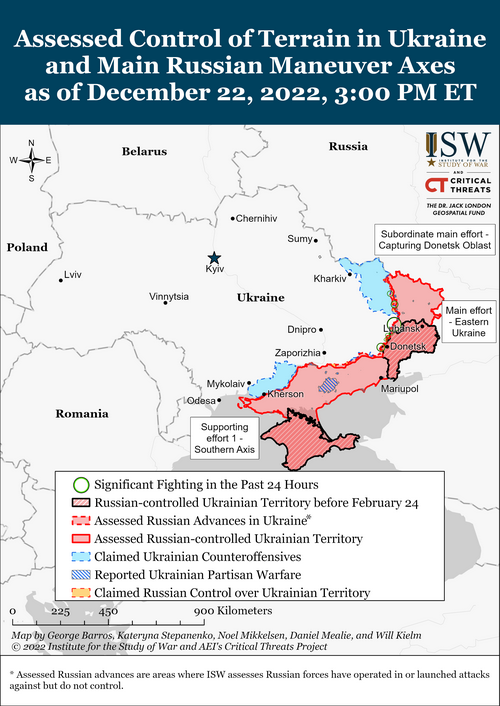
From The Institute For The Study of War:
Kateryna Stepanenko, Riley Bailey, George Barros, Madison Williams, Layne Philipson, and Frederick W. Kagan
December 22, 7 pm ET
Click here to see ISW’s interactive map of the Russian invasion of Ukraine. This map is updated daily alongside the static maps present in this report.
Russian President Vladimir Putin continues to refuse to treat Ukrainian President Volodymyr Zelensky as an equal and sovereign counterpart, further indicating that Putin is not interested in serious negotiations with Ukraine. Putin did not react to Zelensky’s remarks to the United States Congress in Washington, DC on December 22, but instead oriented his December 22 press conference on US and Western influence over Ukraine.[1] Putin reiterated his boilerplate and false claims that the US and Western countries have intervened in Ukraine since the Soviet Union, driving a wedge in the supposed Russian-Ukrainian historic and cultural unity. Such statements are meant to suggest that Ukraine’s 1991 emergence as a sovereign state was a sham. Putin also restated Russia’s maximalist goal of “protecting” the Ukrainian people from their government, implying that Russia intends to force the Kyiv government to capitulate. Putin mentioned Ukraine as a state only to note falsely that Ukraine had barred itself from negotiating with Russia.
Putin’s rhetoric is a part of an ongoing Russian information operation that denies Ukraine’s legitimacy as a sovereign state. Kremlin Spokesperson Dmitry Peskov stated that Zelensky’s speech to the US Congress and the US transfer to Ukraine of the Patriot air-defense systems only “proves” that the United States is fighting a proxy war in Ukraine, and that there are no signs of readiness for peace talks.[2] Putin also implied that Russia had hoped that the West would coach Ukraine into abiding by the Minsk Agreements but instead was fooled by Kyiv. Such framing aims to disqualify Ukraine from future direct negotiations under the false premises that Ukraine violated the Minsk Agreements and that Kyiv is not an independent actor. Putin‘s and Peskov’s framing are components of an effort to persuade the United States and NATO to bypass Ukraine and negotiate directly with Russia over Zelensky’s head. This effort is very unlikely to succeed given repeated statements by US and European leaders regarding their determination that Ukraine will decide its own course. The Kremlin’s information operation is also likely meant to focus blame for ”protracting” the war on Zelensky’s supposed intransigence and thereby wear down US and European willingness to continue supporting Ukrainian efforts to liberate occupied Ukrainian land.
Putin amplified another existing Russian information operation designed to decrease Western security assistance for Ukraine. Putin falsely accused the United States of protracting the war in Ukraine by providing Patriot air defense systems and vaguely implied that these systems will not perform a defensive purpose.[3] Putin has been setting conditions for a protracted war long before the US decision to transfer Patriots to Ukraine, even stating on December 7 that the “special military operation“ would be a lengthy process.[4] The Kremlin has also long falsely framed any Western security assistance to Ukraine as an escalation.[5] The Patriot system will instead augment Ukraine’s ability to protect critical civilian infrastructure against Russia’s air and missile campaign, which is designed to inflict suffering on Ukraine’s civilian population. Patriot systems will interfere with Putin’s ability to hammer Ukraine into surrendering on his terms, which may be what Putin has in mind when he says that it protracts the war.
Putin is also doubling down on an effort to absolve himself of responsibility for conducting a protracted war in Ukraine. Putin made several statements that Russia seeks to end the war as soon as possible while simultaneously noting that Russia will not increase the pace of ”special military operation” because that would lead to ”unjustified losses.” Both statements are a part of the Kremlin’s consolidated effort to justify Putin’s costly war effort to Russian domestic audiences who are increasingly making greater sacrifices to fulfill the Kremlin’s unrealistic goals. The Russian military has not achieved any significant victories in Ukraine since the fall of Lysychansk on July 3. Putin and Russian Ministry of Defense (MoD) officials have made numerous appearances and offered vague justifications for military failures in recent days, also likely in an effort to downplay the effects of the protracted war.
Putin’s use of the term “war” when regarding the invasion of Ukraine has prompted some confusion within the Russian information space. Putin had stated during the press conference that Russia seeks “not to spin this flywheel of a military conflict, but on the contrary – to end this war.” Putin used this word—war–instead of the phrasing “special military operation” when falsely accusing Ukraine of starting a war against its population in 2014. Putin’s mention of “war” prompted a few milbloggers to state that they have always used both terms interchangeably because “every thinking person knows that what is happening in Ukraine is a hot war,” despite the lack of an official declaration of war by Russia.[6] The confusion indicates that Putin’s limited war narrative may conflict with his presentation of the “special military operation” as a fight for Russia’s sovereignty while not being an official war.
The Russian Chief of the General Staff, Army General Valery Gerasimov, attempted to revive a debunked Russian narrative that the Kremlin did not plan to invade Ukraine in an effort to justify Russia’s war in Ukraine. Gerasimov publicly reemerged to brief foreign military attaches on December 22, stating that Russia had to launch the “special military operation” in response to the growing “neo-Nazi ideology” in Ukraine, and Kyiv’s (non-existent) active military preparations to liberate Donbas and Crimea in early 2022.[7] US intelligence had exposed the Kremlin‘s elaborate plan to stage a series of false flag attacks in eastern Ukraine in early February, attacks that the Kremlin intended to trigger and justify a war.[8] Gerasimov may be attempting to revive this nonsensical information operation to help justify the war to a domestic Russian audience. Gerasimov also noted that Russian forces are focusing most of their efforts on seizing Donetsk Oblast, which also signals a return to the pre-war narrative in a likely attempt to regain public support for the war. This statement is also inaccurate—Donetsk Oblast is the site of the only active Russian offensive operation, but the majority of Russia’s combat power is in other parts of Ukraine.
The Kremlin had refrained from publicly showing Gerasimov for almost ten months until December 17 and is likely attempting to reintroduce him as another figure responsible for the war as it heads into the second year of the invasion.[9] Gerasimov continued Putin‘s and Russian Defense Minister Sergey Shoigu’s explanations for mobilization and even attempted to explain away Russia’s withdrawal from right-bank Kherson Oblast as a preventative measure because of the ”threat” of a Ukrainian high-precision strike on the Kakhovka Hydroelectric Power Plant. Gerasimov also claimed that Russia had stabilized the frontline along an 815km stretch of land. Gerasimov’s appearance is likely a continuation of the Kremlin’s recent efforts to rationalize the cost of war in Ukraine, rally support for a protracted war, and reestablish its preferred narratives.[10]
The Kremlin found it necessary to claim that Russian Defense Minister Sergey Shoigu visited the frontlines in Ukraine for the second time in a week, likely to deflect criticism that Shoigu is not an involved wartime leader. The Russian Ministry of Defense (MoD) posted a video on December 22 purporting to show Russian Defense Minister Sergei Shoigu inspecting Russian troop positions near the front in Ukraine.[11] The Russian MoD is on the defensive in the Russian domestic information space. It does not have the informational initiative and is responding to popular criticisms about the Russian military’s shortcomings in the war in Ukraine. The Russian MoD likely felt it necessary to show Shoigu at the front lines because it had falsely claimed that Shoigu visited the frontline on December 18, when he actually visited Russian rear areas for a photo-op near the Crimea-Kherson border.[12] The matter became more embarrassing following Ukrainian President Zelensky’s real frontline visit to Bakhmut on December 20.[13]
Wagner Group financier Yevgeniy Prigozhin continues to seek to elevate the importance of the Wagner Group in Russian military operations in Ukraine in order to establish himself as the central figure of Russia’s ultra-nationalist pro-war community. US National Security Council spokesperson John Kirby reported on December 22 that the Wagner Group received an arms shipment from North Korea to help bolster Russian forces in Ukraine and that this indicates that the Wagner Group’s role in the war may be expanding.[14] Kirby reported on November 2 that North Korea is covertly supplying artillery shells to Russia.[15] Prigozhin denied Kirby’s reporting and claimed that North Korea has not supplied weapons to Russia for a long time.[16] Kirby also reported that Prigozhin is spending more than 100 million US dollars per month to fund the Wagner Group’s operations in Ukraine and that the Wagner Group currently has 50,000 personnel deployed to Ukraine, including 10,000 contractors and 40,000 convicts recruited from Russian prisons.[17] Kirby stated that US intelligence believes that the Wagner Group plays a major role in offensive operations to capture Bakhmut and that more than 1,000 Wagner Group personnel have been killed in recent weeks in the Bakhmut area.[18]
Prigozhin is likely attempting to use his parallel military structures to provide the Russian military with capacities that the Russian military currently lacks in order to increase his influence. North Korea’s reported shipment of weapons to the Russian military using the Wagner Group as an intermediary may suggest that Prigozhin is attempting to use his private military company to secure foreign sources of weapons that would be more difficult for the Russian Ministry of Defense (MoD) to officially procure. Prigozhin is also likely committing a substantial amount of personnel and resources to the Wagner Group’s operations in the Bakhmut area in hopes of providing the Russian military with an operational success that has eluded the Russian Armed Forces in the Bakhmut area as well as the wider theater in Ukraine. ISW assesses that Prigozhin likely has ambitious political goals and seeks to capitalize on the Kremlin’s need for more capable forces to accumulate influence and appeal to the ultra-nationalist constituency he hopes to leverage.[19] Prigozhin will likely continue to expand the Wagner Group’s outsized role in the war in Ukraine in pursuit of these political goals.
International Atomic Energy Agency (IAEA) director general Rafael Grossi held talks with Russian officials on the creation of a security zone around the Zaporizhzhia Nuclear Power Plant (ZNPP). Grossi traveled to Moscow and met with a Russian delegation that included Rosatom head Alexey Likhachev on December 22.[20] Grossi reiterated the IAEA’s position that a safety zone around the ZNPP should be established exclusively to prevent a nuclear accident.[21] Rosatom stated that talks with the IAEA will continue based on an ”understanding of the need to reach a mutually acceptable text as soon as possible.”[22] ISW assesses that Russian officials are attempting to use the negotiations for the creation of a safety zone around the ZNPP to force the IAEA to accept Russian control over the plant and de facto recognize the illegal Russian annexation of occupied Zaporizhia Oblast.[23] The IAEA Board of Governors has announced that it does not recognize the illegal Russian seizure and operation of the ZNPP, but the Kremlin will likely attempt to leverage the IAEA’s stated urgency to reach an agreement on the creation of a security zone to undermine that position.[24]
Key Takeaways
- Russian President Vladimir Putin continues to refuse to treat Ukrainian President Volodymyr Zelensky as an equal and sovereign counterpart, further indicating that he is not interested in serious negotiations with Ukraine.
- Putin’s rhetoric is a part of an ongoing Russian information operation that denies Ukraine’s legitimacy as a sovereign state.
- Putin amplified an existing Russian information operation designed to decrease Western security assistance for Ukraine.
- Putin is continuing to absolve himself of responsibility for conducting a protracted war in Ukraine.
- Russian Chief of General Staff, Army General Valery Gerasimov, attempted to revive a debunked Russian narrative that the Kremlin invaded Ukraine to preempt a fictitious planned Ukrainian attack on Russian-occupied Donbas and Crimea.
- The Kremlin claimed that Russian Defense Minister Sergei Shoigu visited the frontlines in Ukraine for the second time in a week, likely to deflect criticism that Shoigu is not an involved wartime leader.
- Wagner Financier Yevgeny Prigozhin continues to seek to elevate the importance of the Wagner Group to establish himself as the central figure of Russia’s ultra-nationalist pro-war community.
- International Atomic Energy Agency (IAEA) director general Rafael Grossi held talks with Russian officials on the creation of a security zone around the Zaporizhzhia Nuclear Power Plant (ZNPP).
- Russian forces continued to conduct limited counterattacks along the Kreminna-Svatove line and Ukrainian forces continued counteroffensive operations in the Kreminna area.
- Russian forces continued offensive operations in the Bakhmut and Avdiivka areas.
- Russian forces are increasing security measures in Kherson Oblast and Crimea out of fear of Ukrainian counteroffensive operations.
- A senior Russian official denied claims of a second wave of mobilization amidst ongoing crypto-mobilization efforts.
- Ukrainian partisans continued to target Russian occupation authorities.
Go here to read the rest. We see from the Russians lots of talk as usual, but very little to indicate they have learned anything from their disastrous involvement in Ukraine.


Russia learns little because it wants to learn little.
Russia is good at manipulative propaganda in the West. The paleocons and libertarians despise Zelensky and Ukraine.