
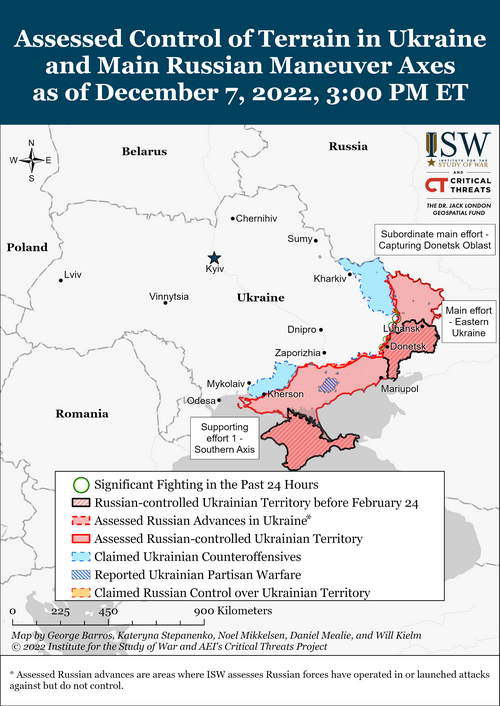
From The Institute For The Study of War:
Karolina Hird, Riley Bailey, George Barros, Madison Williams, Yekaterina Klepanchuk, and Frederick W. Kagan
December 7, 7:00 pm ET
Click here to see ISW’s interactive map of the Russian invasion of Ukraine. This map is updated daily alongside the static maps present in this report.
Russian President Vladimir Putin is setting conditions for a protracted war of conquest in Ukraine. During a meeting with the Russian Presidential Council for the Development of Civil Society and Human Rights (HRC), Putin remarked that the “special operation” in Ukraine can be a “lengthy process” and that the acquisition of new territory is a significant result of this process for Russia.[1] Putin compared himself favorably with Russian Tsar Peter the Great by noting that Russia now controls the Sea of Azov, which Peter the Great also fought for.[2] This invocation of Russian imperial history explicitly frames Putin’s current goals in Ukraine as overtly imperialistic and still maximalist. Putin is conditioning Russian domestic audiences to expect a protracted, grinding war in Ukraine that continues to seek the conquest of additional Ukrainian territory.
The Russian information space responded positively to Putin’s assertions and set further conditions for the protraction of the war, with one milblogger comparing Ukraine to Syria and noting that Russian forces did not start meaningfully experiencing victories on the battlefield until years into the operation.[3] ISW has previously observed that the Kremlin has been setting information conditions for the protraction of the war in Ukraine since the summer following Russian forces’ dismal failures to secure and retain their primary objectives.[4] This informational conditioning is fundamentally incompatible with any discussions regarding a ceasefire or negotiations. Putin seems unwilling to risk losing domestic momentum by halting his offensive operations even briefly, let alone to pursue an off-ramp short of his full objectives, which, as he is making increasingly clear, appear to include the reconstitution of the Russian Empire in some form.
Putin notably is using the Russian HRC as a means to consolidate political power in a way that is fundamentally incompatible with basic principles of international human rights law. As ISW previously reported, Putin changed the composition of the HRC on November 17, removing Russian human rights activists who were critical of Kremlin censorship and installing political and proxy officials as well as a prominent Russian military correspondent.[5] The use of a domestic human rights body to advocate and set conditions for the perpetuation of a genocidal war in Ukraine undermines statements made by the Kremlin on Russia’s purported commitment to human rights. Putin’s comment accusing the West of using human rights to violate state sovereignty undermines a central premise of the international effort to protect human rights.[6]
Putin reiterated Russia’s formal position on the use of nuclear weapons in a statement to the Russian HRC on December 7 with no noteworthy changes. Putin claimed that the threat of nuclear war is growing, but that Russia will not be the first to employ nuclear weapons.[7] Putin added, however, that if Russia is not the first to initiate the first use of nuclear weapons, it will also not be the second to do so, because the “possibility of using [a nuclear weapon] in the event of a nuclear strike on [Russian] territory are very limited.”[8] Putin reiterated that Russian nuclear doctrine is premised on self-defense and stated that any Russian nuclear use would be retaliatory. Putin also emphasized that Russia is not “crazy” and is acutely aware of the power of nuclear weapons but will not “brandish” them. Putin’s statements support ISW’s previous assessment that while Russian officials may engage in forms of nuclear saber-rattling as part of an information operation meant to undermine Western support for Ukraine, Russian officials have no intention of actually using them on the battlefield.[9]
NATO Secretary-General Jens Stoltenberg stated that the Russian military seeks an operational pause in winter 2022-2023 to regain the initiative and conduct a counteroffensive in spring 2023, partially supporting ISW’s prior assessment.[10] Stoltenberg told the Financial Times on December 7 that Russia seeks to “freeze” the fighting in Ukraine “at least for a short period of time so they can regroup, repair, recover… [a]nd then try to launch a bigger offensive next spring.”[11] Stoltenberg‘s statement supports ISW’s assessment that an operational pause would favor Russia by depriving Ukraine of the initiative. An operational pause this winter would likely prematurely culminate Ukraine’s counter-offensive operations, increase the likelihood that Ukraine loses the initiative, and grant degraded Russian forces a valuable three-to-four-month reprieve to reconstitute and prepare to fight on better footing.[12]
Putin continues to seem unwilling to pursue such a cessation of fighting, however. The Russian military is continuing offensive operations around Bakhmut and is—so far—denying itself the operational pause that would be consistent with best military practice. Putin’s current fixation with continuing offensive operations around Bakhmut and elsewhere is contributing to Ukraine’s ability to maintain the military initiative in other parts of the theater. Ukraine’s continued operational successes depend on Ukrainian forces’ ability to continue successive operations through the winter of 2022-2023 without interruption.[13]
Russian forces used Iranian-made drones to strike Ukrainian cities for the first time in three weeks, likely as a result of Russian forces having modified the drones for colder weather. Ukrainian Air Force Command Spokesperson Yuriy Ihnat stated on December 7 that Russian forces resumed the use of Iranian-made loitering munitions after a three-week break and suggested that Russian forces had faced complications using the drones due to icing issues in colder weather.[14] Ukrainian Southern Command Spokesperson Natalia Humenyuk stated on December 7 that Russian forces resumed the use of the Iranian-made drones intending to exhaust Ukrainian air defenses in various areas of activity and open areas of the front in Ukraine.[15] Russian and Ukrainian sources reported that Russian forces deployed Shahed-136 drones in attacks on Kyiv, Dnipropetrovsk, Poltava, Zhytomyr, and Zaporizhia Oblasts.[16] Russian forces have likely modified the drones to operate in colder weather conditions and will likely increase their use in Ukraine in the coming weeks in support of their campaign against Ukrainian critical infrastructure. ISW has previously reported that Russian forces are increasingly reliant on Iranian-made weapon systems due to the depletion of the Russian military’s high-precision weapons arsenal.[17]
Russian efforts to pressure Belarus into joining the war in Ukraine may be causing internal friction in the Belarusian military. The Ukrainian General Staff reported on December 7 that soldiers of the Belarusian border service and the Belarusian Armed forces are growing increasingly dissatisfied with the activities of the Belarusian military-political leadership due to the threat of Belarus entering the war in Ukraine.[18] ISW has previously assessed that Russian Defense Minister Army General Shoigu met with Belarusian President Alexander Lukashenko and Belarusian Defense Minister Major General Viktor Khrenin on December 3 to place further pressure on Belarus to support Russia‘s offensive campaign in Ukraine.[19] ISW has also previously reported that Belarusian officials, including Lukashenko and Khrenin, have used rhetoric to support an ongoing Russian information operation aimed at fixing Ukrainian forces on the Belarusian-Ukrainian border with the threat of Belarus entering the war.[20] Russian pressure and the participation of Belarusian officials in the ongoing Russian information operation may be causing unease among Belarusian military personnel. ISW continues to assess that Belarus is highly unlikely to enter the war in Ukraine due to domestic factors that constrain Lukashenko’s willingness to do so.
Key Takeaways
- Russian President Vladimir Putin is setting conditions for a protracted war of conquest in Ukraine.
- Putin is using Russia’s Human Rights Council to consolidate power while rejecting principles of international human rights law.
- NATO Secretary-General Jens Stoltenberg made comments supporting ISW’s previous assessments that an operational pause in the winter of 2022-2023 would favor Russia.
- Russian forces used Shahed-136 drones in Ukraine for the first time in three weeks.
- Russian efforts to pressure Belarus into joining the war in Ukraine may be causing friction in the Belarusian military.
- Russian forces are likely increasing the pace of their counterattacks in eastern Kharkiv and western Luhansk Oblast.
- Russian forces continued offensive operations in the Bakhmut and Avdiivka-Donetsk City areas.
- Russian forces continued defensive operations and the reorientation of their forces in eastern Kherson Oblast.
- Independent Russian media sources indicated that mobilization efforts will continue despite statements from Russian officials to the contrary.
- Russian occupation authorities are likely transforming Mariupol, Donetsk Oblast, into a rear military and logistics base for Russian forces.
Go here to read the rest.
From Strategy Page:
December 7, 2022: The Ukraine War was another example of “those who do not learn from the past are doomed to repeat it”. The Ukrainians learned from the past, particularly after 2014 when Russia seized Crimea and parts of two eastern Ukrainian provinces (the Donbas). Ukraine immediately wanted to improve its military capabilities and turned to NATO members, especially adjacent formerly Soviet occupied countries that were now free and had joined NATO. This turn to the West (NATO and the European Union), rather than Russia, led Russia to accuse Ukraine of becoming a tool for the West and a scheme to use NATO to weaken and ultimately destroy Russia. In fact, NATO was formed to defend member nations against Russian aggression. This was a centuries-old policy which Russia interpreted as defending Russia by absorbing or simply occupying potential enemies. The Soviet Union fell apart in 1991 because half the Soviet population refused to be part of the Soviet Union any more. Those left were mainly ethnic Russians now living in the Russian Federation. Some Russians believed that the Soviet Union dissolved because of a NATO scheme to undermine the economy and loyalty of about half the citizens of the Soviet Union. This conspiracy theory grew in popularity as the Russian economy declined while NATO member nations prospered.
Until 2014 there were many Ukrainians who agreed with Russia that NATO was evil and determined to weaken its eastern neighbors. Those Ukrainians became pro-NATO after 2014 because the neighboring NATO members had warned that Russia was liable to attack Ukraine. Most Ukrainians believed Russia would observe a 1990s agreement with Ukraine where Russia promised to never seize any Ukrainian territory while Ukraine gave up the nuclear weapons it had inherited after the Soviet Union collapsed. Russia did renege on its solemn promises in 2014 and Ukrainians noticed that Russia was also returning to its police state ways inside Russia. All media was state-owned and a growing portion of the economy was state-controlled. Russia also revived another Soviet bad habit when it failed to implement effective military reforms.
After 2014 Ukraine asked for and received more economic and military assistance from NATO countries. Ukraine also continued to do business with Russia, trading Russian oil and natural gas in exchange for Ukrainian manufactured products, including key components for Russian warships and aircraft. At the same time Ukraine was reforming its economy to make it stronger and doing the same to its armed forces. NATO members made a convincing case that their military practices had always been more effective than Russian ones. This was the case in terms of weapons, training, leadership and tactics. During the Cold War Russia seemed to agree with this assessment and never went to war with NATO. Russia was involved in very few military actions during the Cold War. When other nations went to war equipped with Russian weapons, and using Russian doctrine and tactics, they tended to lose. Russia blamed that on the quality of the foreign troops using Russian weapons. By 2014 there had been many of these situations. This explained why Russia preferred to use special operations troops and Russian soldiers pretending to be Ukrainians to take Crimea and parts of Donbas.
It wasn’t until 2022 that NATO-type forces fought the Russians. In this case the Ukrainians were now seeking NATO membership while using NATO weapons, tactics and training methods to soundly defeat the Russian invaders. NATO saw this as proof that NATO military developments in the 1980s had reached the point where a Russian invasion of Europe was unlikely to succeed. NATO forces had developed the capability to effectively counter-attack while also defending against Russian attacks. Officially the Soviets refused to believe this. But inside the Stavka (Russian military staff and headquarters) there was a growing belief that NATO had developed into a more powerful force than Russian troops could handle. The Cold War ended before that could be demonstrated.
Then came 2022 and the matter was settled. NATO had been more practical and effective in how they armed, equipped and trained their forces. After 1991 there were many Russian military leaders who advocated adopting more effective Western military practices. Many Russian military leaders agreed but acceptance of Western practices was rare. When the 2022 war, occurred it was soon clear how widespread and devastating these failures were against a close-enough to NATO standards medium-size enemy.
The Russians had reformed their weapons, military organization, leadership and training since the 1990s. Russia had adopted many Western designs for weapons and equipment but the Russian versions were adequate at best and usually inferior. This was not obvious until facing a foe equipped with the real thing. This occurred in Ukraine, where even Russian weapons performed more effectively when used by the better trained, organized and led Ukrainians. This was something the Israelis demonstrated frequently during the Cold War when they used captured Russian weapons more effectively than their Arab opponents. Russia blamed the Arabs more than they noted the superior training and leadership of the Israelis.
Russian tactics, training and leadership had not changed much since the Cold War, despite multiple reform efforts after 1991. For example, NATO used “mission orders” in combat. Senior commanders gave subordinates mission objectives and then expected the subordinate commanders to work out solutions to whatever obstacles they encountered. Russia was still using the same Soviet-era centralized command and control. This worked in World War II when the Russians had superiority in numbers of troops, weapons and ammunition. Those victories came at a very high cost in personnel and weapons. Russia attributed this to the fact that “quantity has a quality of its own”. This is true to a certain extent but in the last two years of World War II Russia had a growing number of combat-proven officers and NCOs (non-commissioned officers). Such was not the case during the Cold War and by the 1960s Russian generals were complaining that their troops were less capable because Russian training was unable to regenerate this wartime experience. NCOs were once more eliminated after World War II and the number of officers expanded to make up for the loss of NCOs.
Western forces developed more realistic training and personnel methods and in the 1980s and early 1990s demonstrated that their approach was effective. Western nations were also more effective at testing and improving their weapons. This was also demonstrated in 2022. Ukraine adopted the Western approach not just to spite the Russians, but because their NATO neighbors (Poland, the Baltic states and Romania) had already made the switch and agreed that NATO practices and standers were superior to Russia’s. NATO’s were also more expensive and some new NATO members were still using conscription. The British went all-volunteer in the 1950s and the United States did so in the 1970s. After 1991 most NATO nations ended conscription. Even with conscription, Western nations developed better training methods than the Russians ever did. It helped that the West still maintained a large and experienced force of NCOs. Russia tried to do that but had limited success because there were so many other problems with military service in Russia. Without a lot of NCOs, Russia had no way of quickly replacing heavy officer losses by promoting able NCOs to officer rank.
Go here to read the rest. One of the main military problems for the Russians is that their tactics and strategy hasn’t evolved much from what they were in 1945. What worked for a force of eleven million men, much of it combat experienced, simply does not work with a Russian army of several hundred thousand, especially when little allowance and use is made of the immense changes in technology since 1945.
Language advisory as to the below video which gives a taste of the cost paid by the Red Army in transforming a fairly disorganized and dispirited force into something that could win their war.
The development of the Red Army from 1941-45 was very much sui generis, dependent upon very unusual circumstances. Nothing fails so much long term as old victories that become lodged in a national psyche and the Red Army of 1945 remains very much an incubus for Russian army officers who wish to transform their force into something which can win on 21st century battlefields.

