
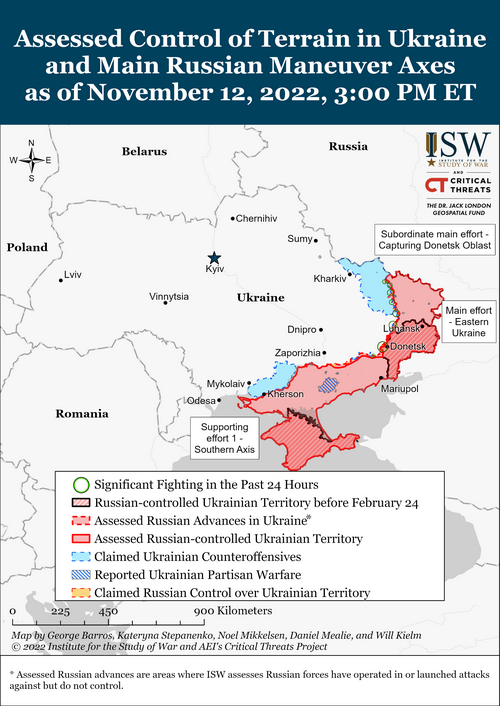
From The Institute For The Study of War:
Kateryna Stepanenko, Grace Mappes, Riley Bailey, Angela Howard, and Frederick W. Kagan
November 12, 7:30 ET
Click here to see ISW’s interactive map of the Russian invasion of Ukraine. This map is updated daily alongside the static maps present in this report.
Russia’s withdrawal from Kherson City is igniting an ideological fracture between pro-war figures and Russian President Vladimir Putin, eroding confidence in Putin’s commitment and ability to deliver his war promises. A pro-war Russian ideologist, Alexander Dugin, openly criticized Putin—whom he referred to as the autocrat—for failing to uphold Russian ideology by surrendering Kherson City on November 12.[1] Dugin said this Russian ideology defines Russia’s responsibility to defend “Russian cities” such as Kherson, Belgorod, Kursk, Donetsk, and Simferopol. Dugin noted that an autocrat has a responsibility to save his nation all by himself or face the fate of “king of the rains,” a reference to Sir James Frazer’s The Golden Bough in which a king was killed because he was unable to deliver rain amidst a drought. Dugin also downplayed the role of Putin’s advisors in failing to protect the Russian world and noted that the commander of Russian Forces in Ukraine, Army General Sergey Surovikin was not responsible for the political decision to withdraw from Kherson City. Dugin noted that the autocrat cannot repair this deviation from ideology merely with public appearances, noting that “the authorities in Russia cannot surrender anything else” and that “the limit has been reached.” He also accused the presidential administration of upholding a “fake” ideology because of its fear of committing to the “Russian Idea.” Dugin also made a reference to the use of tactical nuclear weapons, which he vaguely stated was “the end” and proceeded to note that overdue Russian changes to the military campaign have not generated any effect to change the course of the war. He also suggested, however, that Russia must commit to the Russian Idea rather than pursuing the “stupid” use of nuclear weapons.
Putin is having a harder time appeasing parts of the highly ideological pro-war constituency due to his military’s inability to deliver his maximalist goals of overthrowing the Ukrainian government and seizing all of Ukraine, as ISW has previously assessed.[2] Putin’s nationalist-leaning propagandists such as Vladimir Solovyov are increasingly demanding that the Kremlin and higher military command to fully commit to their goals in Ukraine, and Solovyov even called for full mobilization and the firing of incompetent officials following the Russian surrender of Kherson City.[3] Select milbloggers have previously criticized Putin for his failure to respond to the attack on the Kerch Strait Bridge on October 9, while others noted that Putin has failed to uphold the ideology of Russian superiority since 2014.[4] Direct criticism of Putin within the pro-war community is almost unprecedented, and Dugin’s high-profile and unhinged attack on Putin may indicate a shift among the Russian nationalist ideologues.[5] Putin needs to retain the support of this community and has likely ordered some of his propagandists to suppress any critiques of the Russian withdrawal from Kherson City, since many state TV news programs have been omitting or downplaying the aftermath of withdrawal.[6] The ever-increasing doubts among extreme Russian nationalists about Putin’s commitment to Russian ideology reduce Putin’s appeal to the nationalist community, while mobilization and high casualties will likely continue to upset members of the Russian society.
Wagner-affiliated channels are also turning on the Kremlin following the loss of Kherson Oblast, which may further elevate the influence of the siloviki faction. Some milbloggers implied that the Kremlin has betrayed Kherson City by “selling out,” while others noted that the Kremlin has consistently surrendered its territories without asking the Russian people.[7] Other milbloggers further questioned the legitimacy of the claimed 87% support rate for Russian annexation of Kherson Oblast.[8] Wagner Group financier Yevheny Prigozhin and some milbloggers have previously discussed the possibility of “Russia’s civil society” stepping up to defend Russia.[9] The growing criticism of the decision to withdraw from western Kherson contrasts with the general support for the decision among the milblogger community before today.
Russian officials are increasingly normalizing the public and likely illegal deportation of thousands of Ukrainian children to Russia. Russian Presidential Commissioner for Children’s Rights Maria Lvova-Belova publicized the illegal kidnapping of 52 medically fragile Ukrainian children from Kherson Oblast to an unspecified “safe” area in Russia on November 12, likely under a medical relocation scheme that Luhansk People’s Republic (LNR) Ambassador to Russia Rodion Miroshnik confirmed had started on November 5.[10] High level Kremlin officials, including Lvova-Belova and Russian Deputy Prime Minister Marat Khusnullin have publicly acknowledged and praised the relocation of thousands of Ukrainian children to live with Russian families or in Russian facilities in recent weeks.[11] Russian Zaporizhia Oblast occupation officials have made public statements in recent weeks about the planned forced relocation of over 40,000 Kherson Oblast children to Russia and acknowledged on November 12 that their systems for caring for Ukrainian children are inadequate.[12] Russian and Ukrainian sources have previously reported that Russian and occupation officials have deported Ukrainian children to Russia under education, vacation, and other schemes within the past 10 days.[13] Such frequent and public acknowledgements are a stark contrast to the first Russian official confirmation of such actions on August 23, when Krasnodar Krai authorities deleted an announcement about the arrival of 300 adoptable Ukrainian children from Mariupol and denied ever issuing the statement.[14] As ISW has noted and will continue to observe, the forced deportation of Ukrainian children to Russia represents a possible violation of the Convention on the Prevention and Punishment of the Crime of Genocide.[15]
Russian military leadership is trying and largely failing to integrate combat forces drawn from many different organizations and of many different types and levels of skill and equipment into a more cohesive fighting force in Ukraine. The Ukrainian General Staff reported that Russian officials stopped the distribution of Donetsk People’s Republic (DNR) and Luhansk People’s Republic (LNR) documents, including documents regarding the participation of DNR and LNR forces in combat, on November 11.[16] Russian authorities also ordered Southern Military District commanders to centralize payments to DNR and LNR fighters through Russian financial institutions and offered DNR and LNR soldiers the option to continue their service as contract servicemembers under Russian law.[17] These efforts will likely increase friction between Russian officials and LNR and DNR officials due to the exclusion of DNR and LNR officials from the process. DNR and LNR servicemembers reportedly feel pressured to accept Russian contracts and have expressed fears that refusal of the new Russian contracts would lead to the annulment of their documents and termination of DNR/LNR benefits.[18] ISW has previously reported bureaucratic conflict between DNR, LNR, and Russian authorities over administrative structures in occupied areas.[19]
The lack of structure inherent in the combination of DNR forces, LNR forces, Russian contract servicemembers, Russian regional volunteer servicemembers, Russian mobilized servicemembers, and Wagner Group Private Military Company (PMC) forces creates an environment that fosters intra-force conflict. The Ukrainian General Staff reported on November 12 that tense relations between mobilized soldiers and Chechen volunteer soldiers triggered a brawl in Makiivka that injured three.[20]
Key Takeaways
- Russia’s withdrawal from Kherson City is igniting an ideological fracture between pro-war figures and Russian President Vladimir Putin, eroding confidence in Putin’s commitment to and ability to deliver on his war promises.
- Russian officials are increasingly normalizing the public and likely illegal deportation of thousands of Ukrainian children to Russia.
- The Russian military leadership is trying and failing to integrate ad hoc military formations into a more cohesive fighting force in Ukraine.
- Russian sources claimed that Ukrainian forces continued counteroffensive operations in the direction of Kreminna and Svatove.
- Ukrainian forces continued to liberate settlements on the right (western) bank of the Dnipro River in Kherson Oblast.
- Russian forces continued offensive operations in the direction of Bakhmut, Avdiivka, and Vuhledar.
- Russian officials may be trying to avoid providing military personnel with promised payments.
- Russian forces and occupation officials continue to endanger residents and subject them to coercive measures.
Go here to read the rest.
From Strategy Page:
November 11, 2022: In Russian occupied Ukraine, there have been a growing number of disruptions in the railroads that carry most of the supplies from Russia to Russian forces inside Ukraine. Ukrainian civilians in Russian occupied territory were inspired to sabotage rail lines because of the early example of anti-Russia Belarusians who sabotaged the few rail lines crossing the Ukrainian border. These lines were used by Russia in the first months of the war before Russian forces were driven out of northern Ukraine. One reason the Russians withdrew was this sabotage of the rail lines into Ukraine. When those lines were down, the primary mode of transport into or out of Ukraine was halted as Russia depends on rail lines more than roads or rivers to move people and supplies. Local civilians discovered that they could sabotage the rail by damaging signals and other auxiliary equipment and forcing a temporary halt in traffic. Three months into the war these civilian railroad saboteurs were getting in touch with one another via encrypted Internet apps. Many of these local groups learned what to sabotage by searching the Internet for information, especially about how Ukrainian and Russian partisans sabotaged German rail traffic during World War II. Employees of the Ukrainian railroad were soon on these Internet groups, explaining post-World War II equipment improvements and how to sabotage them. This soon brought the Ukrainian military, especially the special operations and partisan activity support departments, help Ukrainians in Russian occupied territory obtain explosives and advice on how best use this to cut rail lines. Each of these cut lines can take several days to repair. The special operations people also carried out their own major attacks on some Russian rail lines. One such attack was on the rail line across the Kerch Strait bridge from Russia to Crimea. This attack wasn’t completely successful but it weakened the bridge structure to the extent that Russia had to substantially reduce the cargo tonnage of trains using the bridge. There were also attacks on other rail bridges. If successful, these attacks can disrupt traffic for weeks or months. When Ukrainian forces come within 80 kilometers of such choke points, they can be attacked using GMLRS guided missiles.
Russia tried to shut down Ukrainian rail traffic early in the war with air and long-range missile attacks, but the internal railway system was so dense, and track repair capabilities so quickly expanded, that track damage was rapidly fixed and there were usually ways to reroute traffic until repairs were completed. Ukraine has 22,300 kilometers of railway and employs over 400,000 people to operate nearly 2,000 locomotives, 85,000 freight and 4,000 passenger cars. The Ukrainian railroad had its own telephone system, running next to the tracks. Early in the war, before the Starlink system had expanded to all of Ukraine, the railroad telephone was one uninterruptible form of communication. Recently Russia tried another approach to disrupting Ukrainian railroads by bombing electrical power generating facilities all over Ukraine. NATO countries that border Ukraine provide electrical power, especially for Ukrainian railroads.
Go here to read the rest.
If Putin wishes to negotiate a way out of a losing War, this would be the opportune time. Like most dictators however, I expect he will never miss an opportunity to miss an opportunity.

