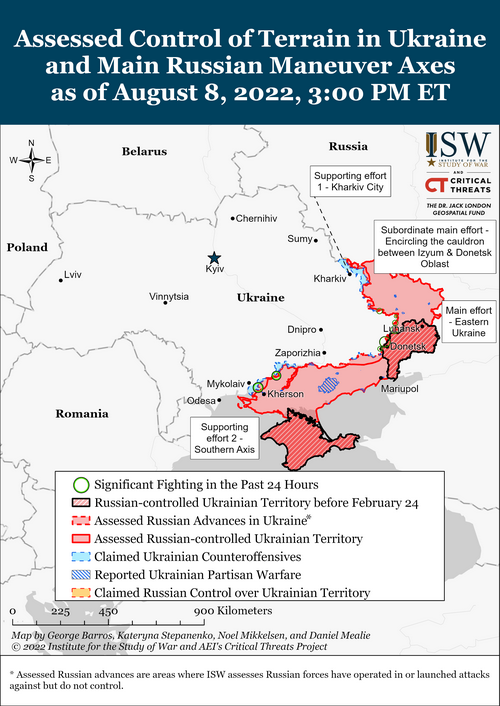
From The Institute For The Study of War:
Layne Philipson, Katherine Lawlor, Karolina Hird, George Barros, Angela Howard, and Frederick W. Kagan
August 8, 7:00 pm ET
Click here to see ISW’s interactive map of the Russian invasion of Ukraine. This map is updated daily alongside the static maps present in this report.
Western and Ukrainian outlets circulated a report, likely false, of a Russian general allegedly threatening to destroy Europe’s largest nuclear facility, the Russian-occupied Zaporizhzhia Nuclear Power Plant (NPP), if Russia could not hold the plant. Multiple news outlets shared a screenshot from the Russian social networking site Vkontakte that claimed to cite the Russian head of the Zaporizhia occupation garrison, Major General Valery Vasilev, stating that Russia had mined the Zaporizhzhia NPP and that the plant would be “either Russian land or a scorched desert.”[1] The screenshot appeared to be a news report posted in a Vkontakte group run by Russian outlet Lenta Novosti Zaporizhia. The outlet itself claimed that the screenshot was from a faked group and denied writing the report.[2] The Russian Ministry of Defense condemned the report and screenshot as a “fake” and claimed that Vasilev was in Uzbekistan at the time he was purported to have made the statement to forces at Zaporizhzhia.[3] Regardless of the origin (or existence) of the original post, the reporting is unreliable. It is indirect and does not claim to cite an official statement or a statement made on any official Russian news or government website.
This likely misreporting distracts from the very real risks of Russia’s militarization of the Zaporizhzhia NPP, which may include mining the plant and almost certainly includes the unsafe storage of military armaments near nuclear reactors and nuclear waste storage facilities.[4] Bellingcat geolocated a drone video of the Zaporizhia NPP that was shared by Russian opposition outlet The Insider on August 5. The video depicts Russian military vehicles moving in and around the plant, including military trucks and armored vehicles moving around and into the building containing the first of the plant’s six nuclear reactors.[5] Russian forces have also dug trenches in and around the plant and may have established firing positions.[6] Russian officials claim that Ukraine has repeatedly attacked the plant, while Ukrainian officials claim that Russian forces are attacking Ukrainian positions from within the plant, preventing Ukrainian return fire and essentially using the plant as a nuclear shield.[7] Russian forces have repeatedly shelled the nearby Ukrainian-controlled town of Nikopol, likely from positions in or around the NPP, since July.[8]
ISW continues to assess that Russian forces are likely leveraging the threat of nuclear disaster to degrade Western will to provide military support to a Ukrainian counteroffensive.[9]
Note: ISW does not receive any classified material from any source, uses only publicly available information, and draws extensively on Russian, Ukrainian, and Western reporting and social media as well as commercially available satellite imagery and other geospatial data as the basis for these reports. References to all sources used are provided in the endnotes of each update.
Key Takeaways
- Reporting of a likely falsified Russian statement distracts from the real risks of a Russian-caused nuclear disaster at Ukraine’s Zaporizhzhia Nuclear Power Plant. Russian forces continue to conduct attacks from and store military equipment near the plant’s nuclear reactors, likely to play upon Western fears of a nuclear disaster and degrade Western will to provide additional military support to Ukraine.
- Russian forces conducted ground attacks northwest of Slovyansk and northeast and southeast of Bakhmut.
- Russian forces continued ground attacks northwest and southwest of Donetsk City.
- Russian officials postponed reopening the Antonivskyi Bridge after a Ukrainian strike damaged the bridge and nearby construction equipment.
- Russian forces are deploying less-professional occupation forces and increasing pressure on Ukrainian populations in occupied areas.
Go here to read the rest.
From Strategy Page:
August 8, 2022: Troop morale was a major problem for Russia during the 2022 invasion of Ukraine and neither the military or the government was able to do much about it. Russia had revived military chaplains in 2010 but only about a hundred chaplains were obtained and they had little impact on military life. Both Russia and Ukraine revived state recognition and other support for religion after the collapse of the Soviet Union in 1991. Before that, religion was making a comeback in the officially atheistic nation. The communists were never able to completely eliminate religion even though most churches and seminaries were closed. Religion made something of an official comeback during World War II when all institutions were mobilized to support the war effort, an effort that was publicized as a national effort to save the motherland. After the war religious practices were tolerated as long as the professional and lay (informal) clergy did not get involved in politics.
Military chaplains were legal after 1991 but not officially recognized for two decades. In 2010 Russia announced that, after an absence of nearly a century, chaplains were being reintroduced into the armed forces. This came after four years of negotiations with the Russian Orthodox Church, which provided some of its priests to be military chaplains. While the Orthodox church agreed, in the 1990s, to provide religious services to military personnel and their families, this did not include chaplains. That’s because, despite the shortage of priests, it was possible to use lay people to provide some priestly functions like counseling and organizing charitable activities. Chaplains, on the other hand, are typically assigned to military units, like other specialists (doctors and staff officers). There were not enough priests for that, because the communists had limited the number of men who could become priests during the Soviet period (1921-91). But the church worked out a compromise with the military, and chaplains were phased in as priests became available.
Chaplains were eliminated in the early 1920s, when the Russian civil war ended, with the victory of the communists. The chaplains were then replaced with “political officers” (Zampolits), who served many of the same functions like maintaining morale and correct thinking. The 2010 reintroduction of chaplains had another motive, to help eliminate the Soviet period custom of older troops hazing and exploiting younger ones.
This hazing developed after World War II, when Russia deliberately avoided developing a professional NCO Corps. They preferred to have officers take care of nearly all troop supervision. The NCOs that did exist were treated as slightly more reliable enlisted men, but given little real authority. Since officers did not live with the men, slack discipline in the barracks gave rise to vicious hazing and exploitation of junior conscripts by senior ones. This led to very low morale and a lot of suicides, theft, sabotage and desertions made military life something to be feared, especially by conscripts. Long recognized as a problem, no solution ever worked. Getting rid of conscripts was believed to be a good first step. Volunteers sign up to be in the military for more than two years, and then one year for conscripts. The government was forced by popular opinion to actively work towards eliminating conscription. Reintroducing chaplains was a minor effort compared to the resources devoted to developing professional NCOs to keep things under control in the barracks. It was soon discovered that even among volunteers, the hazing tends to survive. While the new NCOs have had some success in suppressing the hazing, the generals don’t want to take any chances and backed the attempt to bring back chaplains.
In Russia there was another problem. About a third of the conscripts and volunteer troops didn’t believe in religion at all, and nearly 20 percent of those who did were not Russian Orthodox. Meanwhile, the Russian Orthodox Church actively opposed other religions trying to get established in Russia. The government has gotten involved, passing laws that, in effect, outlaw some “foreign” religions. There’s also hostility towards Roman Catholics. There aren’t many of them, but the Russian Orthodox Church is still sparring with Roman Catholics over a thousand-year-old dispute that split the Christian church into Roman and Orthodox branches. There were fears that the Orthodox Church would want control over the new Chaplains Corps, and provide little support for chaplains of other religions. There was also fear that a Chaplains Corps dominated by Russian Orthodox clergy could lead to trouble for troops whose religions the Russian Orthodox believed should not be allowed in Russia. This included Pentecostals, Mormons and so on. Under the new Chaplain agreement, all these potential problems are to be solved, somehow, in the future. By 2o22 the future solution had still not arrived and chaplains were not much of a factor when it came to maintaining troop morale in combat. When the shooting starts, countries with established support and acceptance for chaplains find that the presence of chaplains in the combat zone is a positive thing. Russian troops went into Ukraine without chaplains or the even more needed senior NCOs.
Russia did have an organized effort to maintain military morale in the form of an organization that was created to conduct cultural and leisure (relaxing) events for soldiers. The most visible aspect of this program was an 8×8 military truck equipped to quickly set up and provide relaxing activities for troops. The truck and all its equipment were called MP KDR (Mobile Point for Cultural and Leisure Work) vehicles. Each MP KDR and its small staff could quickly set up a large tent with a sound system and various relaxing activities for the troops. MP KDR vehicles were used during large scale military exercises in 2017 and 2018. Not much was heard about these efforts since then and none of these vehicles were known to have shown up in Ukraine, where the troops needed all psychological help they could get, especially a ride out of Ukraine.
Ukraine had similar problems with conscription and hazing after 1991. The new Ukrainian armed foresee were much smaller than the Ukrainian Soviet era force. Most Ukrainians were looking West for inspiration, noting the success of adopting Western military practices by Poland, the Baltic States and other nations formerly dominated by the Soviet Union during the Cold War. Western militaries always took better care of their troops with better training and a long tradition of effective NCOs. After 1991 most Western nations eliminated conscription and most nations formerly part of the Soviet Union, or occupied by Soviet troops, joined NATO to help keep the Russians out in the future.
Ukrainian efforts to join NATO were one of the reasons for the Russian attacks in 2014 to seize Crimea and two provinces (Donbas) in eastern Ukraine. The Donbas effort was stalled by rapid mobilization of Ukrainian forces. Less visible, at least to the Russians and many Western governments, was a Ukrainian effort to reform their military and revive the use of chaplains. The extent of these efforts was not appreciated in the West until the Ukrainians quickly defeated and pushed back the 2022 Russian invasion. The presence of chaplains rapidly increased after the invasion because many clergy volunteered for military service. These clergy tended to religious and morale needs on the side. In addition to clergy, many volunteers were religious and some were active in their civilian churches as deacons, prayer leaders and such. They worked with the seminary trained clergy to help with morale, especially in combat zones where the troops had to deal with a lot of stress.
Go here to read the rest. I recall a Union regimental commander during the Civil War summoning the regimental chaplain who had preached a sermon on Hell which had troubled a fair number of soldiers. The Colonel minced no words: “Every one of my boys who dies in this glorious crusade for human freedom is going straight to Heaven, and no other doctrine will be preached in this regiment so long as I am in command!’ Believing that your cause is just and that God looks favorably upon your fight is a force multiplier.