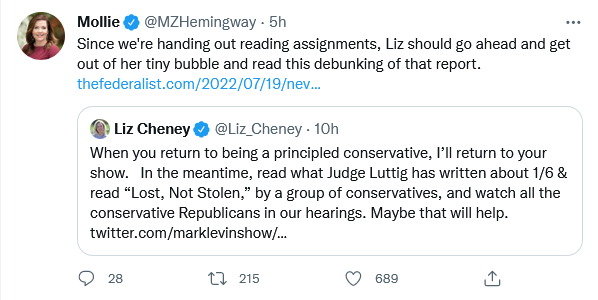
Go here to read her article where she gives chapter and verse as to how the 2020 Presidential election was stolen. That so-called Republicans are complicit in attempting to deny what happened is a perfect example of Trump Derangement Syndrome.
Donald R. McClarey
Cradle Catholic. Active in the pro-life movement since 1973. Father of three, one in Heaven, and happily married for 43 years. Small town lawyer and amateur historian. Former president of the board of directors of the local crisis pregnancy center for a decade.
As for Mollie’s article, it is little more than randomly calling people RINOS and Never Trumpers, while providing no actual evidence of election thievery. But then again, I wouldn’t expect much more from a grifting fraud like Hemmingway.
There are certainly grifting frauds described in that article Paul, we merely disagree as to who they are. The Time article about the “election fortification” efforts of Democrats and some Never Trumpers is the most obtuse confession I have come across in my four decades at the Bar.
A Serious Lawsuit Is Filed
While conspiracy theories about election fraud went wild during this time — ranging from The New York Times’ claim that there was no election fraud anywhere in the entire country to dramatic claims of a global conspiracy involving Venezuela and voting machines — the Trump campaign’s official claims in its lawsuit filed on Dec. 4, 2020, were sober and serious. They weren’t alleging foreign meddling or outside hacking, as The New York Times, Washington Post, Politico, and Atlanta Journal-Constitution warned just months earlier were serious concerns.
The Georgia Supreme Court had previously ruled that challengers to an election don’t need to show definitive fraud with particular votes, just that there were enough irregular ballots or violations of election procedures to place doubt in the result. Judges never want to overturn the results of an election, but under Georgia law, the remedy for showing enough problems to cast doubt was that a new election be held. One was already scheduled for early January for Senate runoff races. Trump’s lawsuit argued that it appeared votes had come from:
2,560 felons,
66,247 underage registrants,
2,423 people who were not on the state’s voter rolls,
4,926 voters who had registered in another state after they registered in Georgia, making them ineligible,
395 people who cast votes in another state for the same election,
15,700 voters who had filed national change of address forms without re-registering,
40,279 people who had moved counties without re-registering,
1,043 people who claimed the physical impossibility of a P.O. Box as their address,
98 people who registered after the deadline, and, among others,
10,315 people who were deceased on election day (8,718 of whom had been registered as dead before their votes were accepted).
Unlike so much of the Trump campaign’s legal efforts, outside observers agreed that this lawsuit was serious:
The 64-page complaint is a linear, cogently presented description of numerous election-law violations, apparently based on hard data. If true, the allegations would potentially disqualify nearly 150,000 illegal votes in a state that Biden won by only 12,000.
But as legitimate as the lawsuit was, it entered a Kafka-esque world where it couldn’t get heard.
The election code in Georgia requires that an election contest has to be served to defendants by the sheriff. The clerk is supposed to quickly give special notice to the relevant sheriffs that it needs to be served, since election lawsuits need extremely quick resolution and require a hearing within 20 days.
Lawyers for Trump had to keep asking the clerk to give that special notice to the sheriffs where the defendants lived. In one case, a county sheriff waited until the end of January of 2021 before asking if he should serve it.
At the same time, all sorts of attorneys associated with Elias and Perkins Coie began filing pro hac vice requests, where you ask to appear in court for a particular trial, even though you’re not admitted to the bar in that state. The powerhouse attorneys began filing all sorts of special motions to dismiss, even before they were given permission. The Trump attorneys were responding anyway, just in case a court took those requests seriously.
Fulton County Judge Constance Russell, assigned by lottery to the case, turned out to be ineligible because the law says the judge hearing the case can’t be an active sitting judge from the county where the suit is filed. But before she left the case, she entered an interim order that the case was going to go on a normal procedural course, “which means it will not be resolved any time soon,” as the Journal-Constitution put it.
The Trump team had filed their lawsuit with an emergency temporary restraining order request to prevent certification of the election. When Raffensperger certified the election, the Trump team withdrew their motion and filed a new emergency motion to decertify.
With no hearing in sight, the Trump team — desperate to get to a court date before the Electoral College convened — appealed to the Georgia Supreme Court, asking it to grant immediate review of that interim order slow-walking the case, as well as the judge. That court said they couldn’t do anything about the interim order because they lacked final jurisdiction.
They did get a liberal senior judge from Cobb County, Adele Grubbs, to handle the case. She set a date for a hearing of Jan. 8, which was of no help to the Trump team as it was after Jan. 6, when Congress would process the Electoral College vote.
In the midst of all this, the Trump team also had a federal case before Judge Mark Cohen on Jan. 5. That case dealt with the Trump team’s view that they had not gotten their day in Fulton County Superior Court, which they perceived as a due process violation.
While he dismissed the case, noting that they’d soon have a hearing before Grubbs, Cohen also noted that the power and authority to do anything about the election dispute lies with Congress, not the court. All the lawsuits being filed over the country were being turned away by courts and dismissed for lack of standing, but this judge provided some direction by saying the power regarding contesting the 2020 election lay with Congress, and not the courts.
Following Trump’s phone call with Raffensperger’s team on Jan. 2, counsel for Raffensperger sent a letter saying that if the Trump team wanted access to the state’s data in order to determine the merits of their claims about improper voting, they would have to drop their lawsuit.
“[W]e are still willing to cooperatively share information with you outside the pending litigation on the condition that all currently pending suits against the Governor, the Secretary of State, and/or the members of the State Election Board be voluntarily dismissed. Absent dismissal, we have no choice but to remain in a litigation posture and to continue resolving these disputes in court,” wrote Christopher Anulewicz.
The Trump team discussed whether to accept the offer. They decided to opt for access to the information. A letter from a Trump attorney said the offer was accepted and that “[w]e look forward to working and meeting with” staff to “receive the heretofore withheld November 3, 2020 election data,” specifically mentioning expert reports, official election records, voter registration records, applications for absentee ballots, investigative reports, and other relevant data and information. The team suggested making a joint statement that the contest had been settled.
Raffensperger’s team opened the email immediately but waited several hours to respond, and when they did, they claimed they’d never made an offer to share information, just that they wouldn’t even consider discussing the matter unless the case was dropped.
Anzlyne
Wednesday, August 3, AD 2022 3:54pm
“ grifting fraud like Hemmingway.” ! What a stunning comment.
This article showed the fraud of these people falsely representing themselves as disinterested, diffident, facts-based conservatives.
The history given of each player in her article describes their insincerity and hypocritical words and actions. This article refers back to the work this Mollie has done in “Rigged”.
..And .. remember the article by another Mollie (Ball).
The broad slam against Mollie Hemingway is not credible.
Rudolph Harrier
Thursday, August 4, AD 2022 10:47am
The narrative for why we shouldn’t look into election fraud has always shifted. It went something like this:
-It’s a conspiracy theory to think that there was anything remotely suspicious about the election. Most secure election in history!
-Okay maybe the anomalies were widespread, and concentrated in areas that benefitted the democrats, but there isn’t a specific count of fraudulent votes so who knows if it had any real effect.
-Okay we’ve now found a lot of votes from felons, late votes, votes with invalid addresses, etc. but the ones we found immediately weren’t enough to change the election.
-Okay so the number of fraudulent votes in a couple of states was well above the margin of error, but even if Biden lost one or two states he still would have won anyway. (This is where we currently are, as far as I can tell.)
Throughout this whole process the left has been almost gleeful to talk about “fortifying” the election whenever they think they can discuss it in a separate context than election fraud. And of course at every stage the strong message is “since you haven’t proven beyond a shadow of a doubt that the election was stolen from Trump, there’s no sense in investigating any further or doing a single thing to fix the problems already found.” It’s like a police investigation going “well we have video of this man breaking into a house, but we don’t yet have definitive proof that he was the one who murdered the inhabitants, so we might as well end the investigation here and not even charge him with breaking and entering.”



That Olson and Danforth are involved in this exercise tells me it’s not to be trusted.
… And when you’re done with that, Liz, read the constitution. That stuff about due process is riveting!
Like her father, Liz Cheesy is a big-government profiteer and $cumbag.
Establishment GOPers and, of course, democrats are liars – 100% of the time.
Biden did not win. We all know it.
Accepting reality is not a sign of Trump Derangement System.
As for Mollie’s article, it is little more than randomly calling people RINOS and Never Trumpers, while providing no actual evidence of election thievery. But then again, I wouldn’t expect much more from a grifting fraud like Hemmingway.
There are certainly grifting frauds described in that article Paul, we merely disagree as to who they are. The Time article about the “election fortification” efforts of Democrats and some Never Trumpers is the most obtuse confession I have come across in my four decades at the Bar.
https://time.com/5936036/secret-2020-election-campaign/
Accepting reality is not a sign of Trump Derangement System.
Agreed. Believing that the 2020 Presidential election wasn’t rife with fraud is.
Because she’s already done the work to show such stuff. That’s why there’s these things called LINKS in the article, going to her earlier work like:
https://thefederalist.com/2021/03/17/medias-entire-georgia-narrative-is-fraudulent-not-just-the-fabricated-trump-quotes/
To quote just one part of it:
A Serious Lawsuit Is Filed
While conspiracy theories about election fraud went wild during this time — ranging from The New York Times’ claim that there was no election fraud anywhere in the entire country to dramatic claims of a global conspiracy involving Venezuela and voting machines — the Trump campaign’s official claims in its lawsuit filed on Dec. 4, 2020, were sober and serious. They weren’t alleging foreign meddling or outside hacking, as The New York Times, Washington Post, Politico, and Atlanta Journal-Constitution warned just months earlier were serious concerns.
The Georgia Supreme Court had previously ruled that challengers to an election don’t need to show definitive fraud with particular votes, just that there were enough irregular ballots or violations of election procedures to place doubt in the result. Judges never want to overturn the results of an election, but under Georgia law, the remedy for showing enough problems to cast doubt was that a new election be held. One was already scheduled for early January for Senate runoff races. Trump’s lawsuit argued that it appeared votes had come from:
2,560 felons,
66,247 underage registrants,
2,423 people who were not on the state’s voter rolls,
4,926 voters who had registered in another state after they registered in Georgia, making them ineligible,
395 people who cast votes in another state for the same election,
15,700 voters who had filed national change of address forms without re-registering,
40,279 people who had moved counties without re-registering,
1,043 people who claimed the physical impossibility of a P.O. Box as their address,
98 people who registered after the deadline, and, among others,
10,315 people who were deceased on election day (8,718 of whom had been registered as dead before their votes were accepted).
Unlike so much of the Trump campaign’s legal efforts, outside observers agreed that this lawsuit was serious:
The 64-page complaint is a linear, cogently presented description of numerous election-law violations, apparently based on hard data. If true, the allegations would potentially disqualify nearly 150,000 illegal votes in a state that Biden won by only 12,000.
But as legitimate as the lawsuit was, it entered a Kafka-esque world where it couldn’t get heard.
The election code in Georgia requires that an election contest has to be served to defendants by the sheriff. The clerk is supposed to quickly give special notice to the relevant sheriffs that it needs to be served, since election lawsuits need extremely quick resolution and require a hearing within 20 days.
Lawyers for Trump had to keep asking the clerk to give that special notice to the sheriffs where the defendants lived. In one case, a county sheriff waited until the end of January of 2021 before asking if he should serve it.
At the same time, all sorts of attorneys associated with Elias and Perkins Coie began filing pro hac vice requests, where you ask to appear in court for a particular trial, even though you’re not admitted to the bar in that state. The powerhouse attorneys began filing all sorts of special motions to dismiss, even before they were given permission. The Trump attorneys were responding anyway, just in case a court took those requests seriously.
Fulton County Judge Constance Russell, assigned by lottery to the case, turned out to be ineligible because the law says the judge hearing the case can’t be an active sitting judge from the county where the suit is filed. But before she left the case, she entered an interim order that the case was going to go on a normal procedural course, “which means it will not be resolved any time soon,” as the Journal-Constitution put it.
The Trump team had filed their lawsuit with an emergency temporary restraining order request to prevent certification of the election. When Raffensperger certified the election, the Trump team withdrew their motion and filed a new emergency motion to decertify.
With no hearing in sight, the Trump team — desperate to get to a court date before the Electoral College convened — appealed to the Georgia Supreme Court, asking it to grant immediate review of that interim order slow-walking the case, as well as the judge. That court said they couldn’t do anything about the interim order because they lacked final jurisdiction.
They did get a liberal senior judge from Cobb County, Adele Grubbs, to handle the case. She set a date for a hearing of Jan. 8, which was of no help to the Trump team as it was after Jan. 6, when Congress would process the Electoral College vote.
In the midst of all this, the Trump team also had a federal case before Judge Mark Cohen on Jan. 5. That case dealt with the Trump team’s view that they had not gotten their day in Fulton County Superior Court, which they perceived as a due process violation.
While he dismissed the case, noting that they’d soon have a hearing before Grubbs, Cohen also noted that the power and authority to do anything about the election dispute lies with Congress, not the court. All the lawsuits being filed over the country were being turned away by courts and dismissed for lack of standing, but this judge provided some direction by saying the power regarding contesting the 2020 election lay with Congress, and not the courts.
Following Trump’s phone call with Raffensperger’s team on Jan. 2, counsel for Raffensperger sent a letter saying that if the Trump team wanted access to the state’s data in order to determine the merits of their claims about improper voting, they would have to drop their lawsuit.
“[W]e are still willing to cooperatively share information with you outside the pending litigation on the condition that all currently pending suits against the Governor, the Secretary of State, and/or the members of the State Election Board be voluntarily dismissed. Absent dismissal, we have no choice but to remain in a litigation posture and to continue resolving these disputes in court,” wrote Christopher Anulewicz.
The Trump team discussed whether to accept the offer. They decided to opt for access to the information. A letter from a Trump attorney said the offer was accepted and that “[w]e look forward to working and meeting with” staff to “receive the heretofore withheld November 3, 2020 election data,” specifically mentioning expert reports, official election records, voter registration records, applications for absentee ballots, investigative reports, and other relevant data and information. The team suggested making a joint statement that the contest had been settled.
Raffensperger’s team opened the email immediately but waited several hours to respond, and when they did, they claimed they’d never made an offer to share information, just that they wouldn’t even consider discussing the matter unless the case was dropped.
“ grifting fraud like Hemmingway.” ! What a stunning comment.
This article showed the fraud of these people falsely representing themselves as disinterested, diffident, facts-based conservatives.
The history given of each player in her article describes their insincerity and hypocritical words and actions. This article refers back to the work this Mollie has done in “Rigged”.
..And .. remember the article by another Mollie (Ball).
The broad slam against Mollie Hemingway is not credible.
The narrative for why we shouldn’t look into election fraud has always shifted. It went something like this:
-It’s a conspiracy theory to think that there was anything remotely suspicious about the election. Most secure election in history!
-Okay maybe the anomalies were widespread, and concentrated in areas that benefitted the democrats, but there isn’t a specific count of fraudulent votes so who knows if it had any real effect.
-Okay we’ve now found a lot of votes from felons, late votes, votes with invalid addresses, etc. but the ones we found immediately weren’t enough to change the election.
-Okay so the number of fraudulent votes in a couple of states was well above the margin of error, but even if Biden lost one or two states he still would have won anyway. (This is where we currently are, as far as I can tell.)
Throughout this whole process the left has been almost gleeful to talk about “fortifying” the election whenever they think they can discuss it in a separate context than election fraud. And of course at every stage the strong message is “since you haven’t proven beyond a shadow of a doubt that the election was stolen from Trump, there’s no sense in investigating any further or doing a single thing to fix the problems already found.” It’s like a police investigation going “well we have video of this man breaking into a house, but we don’t yet have definitive proof that he was the one who murdered the inhabitants, so we might as well end the investigation here and not even charge him with breaking and entering.”