
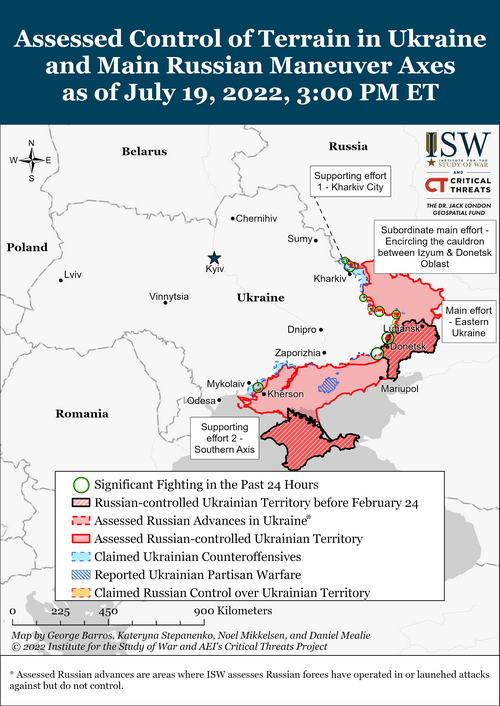
From The Institute For The Study of War:
Karolina Hird, George Barros, Katherine Lawlor, Layne Philipson, and Frederick W. Kagan
July 19, 7:30 pm ET
Click here to see ISW’s interactive map of the Russian invasion of Ukraine. This map is updated daily alongside the static maps present in this report.
Calls among Russian nationalist and pro-war voices for Russian President Vladimir Putin to expand Russia’s war aims, mobilize the state fully for war, and drop the pretext that Russia is not engaged in a war reached a crescendo on July 19. Former Russian militant commander and nationalist milblogger Igor Girkin presented an extensive list of military, economic, and political actions that he argues the Kremlin must take to win the war in Ukraine; first among this list is abandoning the rhetoric of the “special military operation” and defining the official goals of the war in Ukraine.[1] Girkin advocated for expansive territorial aims beyond the Kremlin’s stated ambitions in Donbas, including the reunification of the entire territory of “Novorossiya” (which Girkin maintains includes Kharkiv, Dnipropetrovsk, Mykolaiv, Odesa, Zaporizhzhia, Kherson, Donetsk, and Luhansk oblasts as well as Kryvyi Rih) with the Russian Federation and the creation of a Malorossiya state (all of Ukraine up to the Polish border), which Girkin claims should be reunified with Russia through the Russia-Belarus Union State. Girkin also called for the Kremlin to shift the Russian economy fully to a war footing and to carry out extensive mobilization measures including forced conscription and the (further) suspension of Russians’ rights.[2] Girkin has often criticized what he views as a lack of ambition and decisive action in the Kremlin’s handling of the war in Ukraine through his calls for maximalist objectives and measures to support territorial gains. His newest list of demands adds to the growing discontent within the Russian pro-war nationalist zeitgeist.[3]
While Girkin’s July 19 post is an acerbic critique of the Kremlin’s intentions in Ukraine, other Russian milbloggers sought to shape a narrative favoring Putin while advancing the same maximalist aims by suggesting that the Kremlin has been purposefully setting conditions for a protracted war in Ukraine since the war began. Russian milblogger Yuri Kotyenok claimed that Russia has been pursuing the “Syrianization” of the war in Ukraine by never articulating specific deadlines or goals for operations in Ukraine.[4] The explicit invocation of protracted Russian operations in Syria suggests that certain Russian nationalist voices are setting conditions for a long war in a way that saves face for the Kremlin given Russia’s failure to secure its military objectives in Ukraine in the very short period that the Kremlin initially planned.
Putin could simply ignore the milbloggers, although he has shown concern for their positions in the recent past, or he could play off their narratives in several ways.[5] He might wait and see what resonance their calls for full mobilization and broader war aims have within the portions of the Russian population he cares most about. He might hope that their semi-independent calls for more extreme measures could fuel support for an expansion of aims and mobilization that he desires but feels Russians remain unprepared to accept. He may instead reject their calls for grander ambitions and greater sacrifices, thereby presenting himself as the moderate leader refraining from demanding too much from his people.
US officials reported that Russia plans to annex occupied Ukrainian territory as soon as autumn 2022, confirming ISW’s May 2022 assessment. US National Security Council Spokesperson John Kirby announced that the Kremlin is beginning to roll out a version of its 2014 “annexation playbook” in Ukraine and is “examining detailed plans” to annex Kherson, Zaporizhia, and all of Donetsk and Luhansk oblasts, citing newly declassified intelligence.[6] Kirby confirmed ISW’s long-running assessment that the Kremlin has installed illegitimate proxy officials, forced use of the ruble, replaced Ukrainian telecommunications and broadcast infrastructure with Russian alternatives, and forced Ukrainians to apply for Russian passports to accomplish basic tasks in occupied territories.[7] As ISW wrote on May 13, Putin’s timeline for annexation is likely contingent on the extent to which he understands the degraded state of the Russian military in Ukraine.[8] He may intend to capture the remainder of Donetsk Oblast before annexing all occupied territories, which would likely force him to postpone annexation. Russia’s degraded forces are unlikely to occupy all of Donetsk Oblast before Russia’s September 11 unified voting day for local and gubernatorial elections across the country, the most likely date for annexation referenda to be held.[9] The Kremlin could also postpone these Russian regional and local elections to limit expressions of domestic dissatisfaction with the Russian invasion of Ukraine—independent Latvia-based Russian language newspaper Meduza reported in May that members of Russia’s Federal Security Service and National Security Council were lobbying to postpone the September 2022 elections.[10]
Putin could leverage nuclear threats to deter a Ukrainian counteroffensive into annexed Kherson, Zaporizhia, Donetsk, and Luhansk oblasts.[11] After annexation, Putin may state, directly or obliquely, that Russian doctrine permitting the use of nuclear weapons to defend Russian territory applies to newly annexed territories. Such actions would threaten Ukraine and its partners with nuclear attack if Ukrainian counteroffensives to liberate Russian-occupied territory continue. Putin may believe that the threat or use of nuclear weapons would restore Russian deterrence after his disastrous invasion shattered Russia’s conventional deterrent capabilities, although previous Russian hints at Moscow’s willingness to use nuclear weapons have proven hollow. Ukraine and its Western partners may have a narrowing window of opportunity to support a Ukrainian counteroffensive into occupied Ukrainian territory before the Kremlin annexes that territory.[12]
Russian milbloggers are increasingly openly criticizing the Russian military for failing to address structural problems with Russian Airborne Forces (VDV), highlighting the VDV’s failure to fight the war as it had trained in peacetime, a failing that played no small role in the general Russian failures during the initial invasion. Russian milblogger Military Informant stated that Russian VDV has not adopted force structure and tactics reforms that the Russian military already knew were necessary prior to Russia’s full-scale invasion of Ukraine.[13] Military Informant stated that lightly armored Russian VDV vehicles (such as BMD and BTR-D) are too heavy to enable effective airborne mobility—especially in contested airspace—and too light to provide sufficient protection in maneuver warfare. Russian milblogger Alexander Sladkov similarly noted that Russian VDV forces‘ structural reliance on a small number of lightly armored fighting vehicles is a liability.[14] Military Informant praised how the Russian VDV previously practiced using light unarmored vehicles for higher mobility in three consecutive years of annual capstone command staff exercises (Tsentr 2019, Kavkaz 2020, and Zapad 2021) but noted that these adaptations did not have time to “take root” before the beginning of the invasion of Ukraine in February 2022.[15]
The Russian military’s failure to implement lessons learned—or to learn the right lessons—from previous exercises or combat is an ongoing trend that ISW has observed.[16] The most prominent example of this phenomenon was the Russian military’s failure to create a cohesive command and control system for the amalgamation of approximately 120 Russian battalion tactical groups (BTGs) assembled for the February 2022 invasion of Ukraine after experiencing successes operating smaller numbers of BTGs in Ukraine in 2014 and in Syria in 2016.[17]
Key Takeaways
- Calls made by Russian nationalist and pro-war voices for the Kremlin to officially define operations in Ukraine as a war, conduct general mobilization, and pursue expanded territorial goals reached a crescendo on July 19 with some criticizing the Kremlin and others claiming that Putin has been preparing for the “Syrianization” of the war all along.
- The Kremlin will likely attempt to illegally annex occupied Kherson, Zaporizhia, Donetsk, and Luhansk oblasts into Russia as early as September 11, 2022.
- Russian milbloggers highlighted the Russian Airborne Forces (VDV) failure to fight as they had trained—a critique that helps explain the general Russian failures during the initial invasion of Ukraine.
- Russian forces continued efforts to resume offensive operations toward Slovyansk from southeast of Izyum and around Barvinkove.
- Russian forces continued ground attacks to the east of Siversk and had partial success in ground attacks to the east of Bakhmut.
- Russian authorities are continuing to leverage unconventional sources of combat power to avoid general mobilization.
- Russian occupation authorities are escalating law enforcement measures to protect administrative control of occupied areas.
Go here to read the rest.
From Strategy Page:
July 19, 2022: Ukraine is working its way through its list of Western weapons it needs the most to defeat the Russian invaders as quickly as possible and end the Russian attacks on Ukrainian civilians and economic targets. The list makes sense to Western military leaders, who see fulfilling this list as worth the cost because it will shut down Russian territorial annexation plans for some time to come and cause the fall of Russia’s current Neo-Soviet government. Western politicians question the high economic cost of fulfilling this list as well as the risks of Russia using nuclear or chemical weapons.
For the Chinese, it puts the actual effectiveness of modern military power into perspective. Defeat of the Russians is also depriving China of what seemed to be a powerful military partner and turns Russia into a paranoid (about China) nuclear armed dependent state, much like North Korea. Ukrainians are fighting for their existence as a nation and that is a very big deal for Ukrainians. Russia is fighting to recreate a Russian empire that most Russians don’t see as essential to the existence of Russia as a nation.
The basic Ukrainian needs includes 1,000 155mm howitzers, 300 MLRS (multiple launch rocket system) vehicles. The truck-based HIMARS is preferred but the older M270 tracked vehicles will do. That amounts to 50 battalions of 155mm howitzers and fifteen MLRS battalions. This allows for guns and MLRS vehicles needed for training and some spares. That’s sufficient artillery for fifteen combat divisions or about fifty independent brigades, including some artillery battalions not part of combat brigades but used as a general artillery reserve to be sent where more artillery support is needed. Ammunition for these artillery units should be mainly guided rockets or shells. This is an argument for the MLRS units because the U.S. no longer manufactures unguided MLRS rockets. As for the 155mm shells, the U.S. already knows, from combat experience in eastern Syria, that the less expensive ATK fuze which turns any unguided 155mm shell into a guided one, works well enough to replace the more accurate and much more expensive Excalibur guided shell. Excalibur has also proven its worth in combat but the slightly less accurate ATK shell is, for combat troops, an acceptable alternative.
Ukraine also wants 500 tanks and 2,000 other armored vehicles, for transporting troops, casualties or supplies in a combat zone. Ukraine prefers the American M1 tank, or the German Leopard 2 or British Challenger 2. The M1 is preferred because more of them are available from tanks in storage and it has the most extensive combat record and is known as the most robust and well protected tanks out there. Ukraine has been reluctant to accept retired T-72s from NATO nations that were once communist countries until 1989 or 1991 and have since replaced the more vulnerable T-72s with M-1s or Leopards. All Russian tanks built since the 1960s have autoloaders that put too much 125mm ammo in the crew compartment where any penetration of the armor tends to result in the tank blowing up. Ukrainians who have fought the Russians since February have seen this vulnerability in action and don’t want to be on the receiving end. NATO countries can supply the Ukrainian armored vehicle request, which provides Ukraine with about five tank battalions that would be used to lead offensive operations. Many of the lighter armored vehicles would be distributed to combat brigades that don’t need tank support.
Ukrainians have proved themselves resourceful and faster learners, requiring much less time to master modern weapons systems. All NATO needed to do was deliver the vehicles, in working order, to the Ukrainian border with Poland, Slovakia or Romania and the Ukrainian troops would do the rest, including crossing the border to receive training in operation and maintenance of the armored vehicles. Ukraine insists that M1 tanks would be the ideal weapon to spearhead its offensive operations. These tanks would be high-priority targets for Russian attacks and Ukrainians would do whatever it takes to get the M1s to where they are needed and keep them operational. As in other recent situations, the Ukrainians have demonstrated an ability to be resourceful and inventive in their use of these Western weapons. Many Western tank officers and civilian armor specialists believe Ukraine should get the M1s. How else is anyone going to find out how much the M1 can take and remain operational against a near-peer opponent?
Ukraine wants a thousand UAVs of various sizes, some of them armed with laser-guided missiles. Ukraine wants more anti-aircraft systems and these are already on the way. Ukraine also wants about two dozen modern jet fighters, preferably late model F-16s, F-15s or F-18s to discourage Russian efforts to use warplanes or transports on a large scale .
Ukraine needs to win this war as soon as possible because the Russians are increasingly targeting Ukrainian civilians as well as economic targets. Russia responded to the recent use of GMLRS guided rockets on ammo and fuel storage sites by replacing some of the lost sites with ones built in residential areas. Russia also parked a large number next to a Ukrainian nuclear power plant to discourage Ukrainian attack on them. Ukraine tries to evacuate civilians from any territory they have to retreat from and assist getting civilians out of Russian occupied territory. Ukrainian civilians do not quietly accept being used as human shields and efforts to implement this practice on a large scale will result in more Russian war crimes against civilians. This increases Ukrainian urgency to win the war and motivates more Russian civilians to increase their opposition to the war started by their Stalinist leader.
The impact of these wish-list weapons is already visible. In late June Ukraine received its first four (of twelve) HIMARS launcher trucks and dozens of GMLRS guided rockets. Each HIMARS vehicle carries and launches six GMLRS guided rockets or one 610mm ATACMS guided rocket with a 300 kilometers range. Ukraine would like to get some of the larger missiles but that request is still pending. Only 3,600 ATACMS were produced before that ended in 2007. By then over 2,000 ATACKMS were still available and nearly all had been upgraded, with a new rocket motor if needed. Few ATACMs have been used since 2007 when it was found that GMLRS and guided bombs could handle missions that ATACMS previously specialized in. Each 227mm (diameter) GMLRS rocket weighs 309 kg (680 pounds) and uses GPS (satellite based Global Positioning System) guidance and a less accurate INS (Inertial Navigation System) backup. GPS can be jammed, INS cannot. GMLRS was designed to accurately hit targets 70 kilometers distant but tests in 2008 found that GMLRS was still accurate at up to 85 kilometers. Neighboring Poland has already received HIMARS and GMLRS and shared their experiences with their Ukrainian counterparts. A decade ago, Poland planned to build its own version of HIMARS/GMLRS using licensed U.S. technology. The Polish Homar system was to use a Polish designed Homar launch vehicle that could carry and launch GMLRS or, later, longer range-versions of the GMLRS rocket. Five years ago, Polish manufacturers concluded that Homar and Polish designed rockets would cost more than HIMARS/GMLRS and decided to order the American made system. Fellow NATO member Romania had already done that. Now Poland. Romania and Ukraine all have HIMARS, and everyone is watching to see how Ukrainian forces use it against the Russians.
Before Ukraine received its first HIMARS systems it had already selected dozens of targets for them in Russian-occupied Ukraine. These targets were not revealed in advance but it became obvious what they were as over a dozen Russian ammunition warehouses exploded at night, often in a spectacular fashion that could be seen for long distances. Russian headquarters were also hit and it was obvious to the Russians that the GMLRS rockets were being used to cause an ammunition shortage for Russian forces as well as disrupt Russian planning and coordination of combat operations. Most of the GMLRS targets were mainly in Russian occupied territory in Donbas and north of Crimea. This is Kherson province and the city of Kherson, which is the provincial capital was captured during the first week of the invasion. Russia has held onto most of the province ever since. Kherson city is a major port because it is located near the mouth of the Dnieper River and the Black Sea. The Dnieper is a major navigable river for Ukraine and has long been used to handle the movement of cargo, especially wheat and other grains being exported. Russia is blocking such exports and burning Ukrainian crops before they can be harvested.
Ukraine has been trying to recapture Kherson City and province for three months and was making slow progress because the Russians had lots of artillery, and ammunition brought into Crimea via ship and the new Kerch Strait bridge. Most of the cargo is delivered via the rail line over the bridge. GMLRS or some longer-range missiles like Harpoon, are apparently being used to attack ships at sea or in the Crimean port of Sevastopol and even the Kerch Strait bridge rail line as well as Russian ammo and fuel storage sites just across the border in Russia. A longer-range missile was also used to destroy an offshore Ukrainian natural gas well that the Russians captured early in the war and used the platform for EW (electronic warfare) equipment that enables Russia to monitor air traffic west of Crimea and Odessa. That platform is still on fire from the escaping natural gas. The loss of that platform was one of the reasons Russia abandoned Snake Island in June and Ukrainian forces quickly reoccupied the island.
The initial GMLRS attacks were great for Ukrainian morale because many secondary explosions (of Russian ammo) or fires (from Russian fuel storage tanks) were visible in Ukrainian territory while those deep in occupied territory were captured in cellphone videos and smuggled out to Ukraine. These attacks were especially encouraging for Ukrainian civilians in occupied territory. Ukrainian forces’ efforts to drive Russian out of Kerson province have been aided by a growing partisan movement inside Kherson province and passive resistance to Russian occupation by most Ukrainians there.
Among the air-defense weapons on the way to Ukraine, the NASAMS systems are the most anticipated. NASAMS is far superior to the similar Russian Buk M1 system Ukraine and Russia use. NASAMS is a system developed by Norway in the early 1990s and entered service in 1998. Norway pioneered the use of American AMRAAM air-to-air missiles as surface-to-air weapons and developed the fire control and launcher equipment needed to make it all work. It was a simple but very effective use of air-to-air missiles for air defense. Other air-to-air missiles have been used for ground-based air defense systems but the Norwegian version is seen as the best of the lot. Norway has six NASAMS batteries for its own defense. Eleven other nations, like Hungary, Spain, Holland, Chile, and the United States, Finland and Lithuania also use NASAMS and the system is still in production.
The NASAMS was initially developed for the Norwegian Air Force by Norwegian firm Kongsberg, in cooperation with American partner Raytheon, which produces AMRAAM. A major upgrade, NASAMS 2, officially entered service in 2007 and since then it has gained interest in more nations.
NASAMS popularity is due to a truly open architecture that, unlike the competitor systems, allows NASAMS to be used with a wide variety of radars. Initially NASAMS used the American made MPQ-64 Sentinel radar but some customers requested a system that can work with different radars and air-to-air missiles. NASAMS has been tested and configured to work with more than 25 different radar systems and can fire just about any air-to-air missile that can be fired from NATO aircraft. All that is required is modifications to the size and electrical connections in the NASAMS launcher cells and software modification of the fire control system. Since NATO has long-established standards for “NATO weapons” NASAMS takes full advantage of this.
So far NASAMS has been configured with AIM-120 AMRAAM (together with the longer-range ER variant), AIM-9X Sidewinder and the European IRIS-T. The last one is an interesting story. Norway has a big stock of IRIS-T for their F-16 fighters but the new Norwegian F-35 is not compatible with IRIS-T, so they decided to use this very modern European missile as an anti-aircraft missile in NASAMS systems. This example clearly shows how flexible this system is while the competitor systems are “tied” to a limited number of missiles and radar.
Go here to read the rest. Ukraine, with Western technology and weaponry, is growing strong while Russia is weakening.


Scary stuff. If Russia uses tactical nukes to defend occupied territory, what will Nato do? If NATO opts to respond, what will Turkey do? (We know exactly what China will do)
Reading this report makes me wonder if Putin’s trip to Iran and Biden’s trip to Saudi Arabia were about more than oil and drones.