
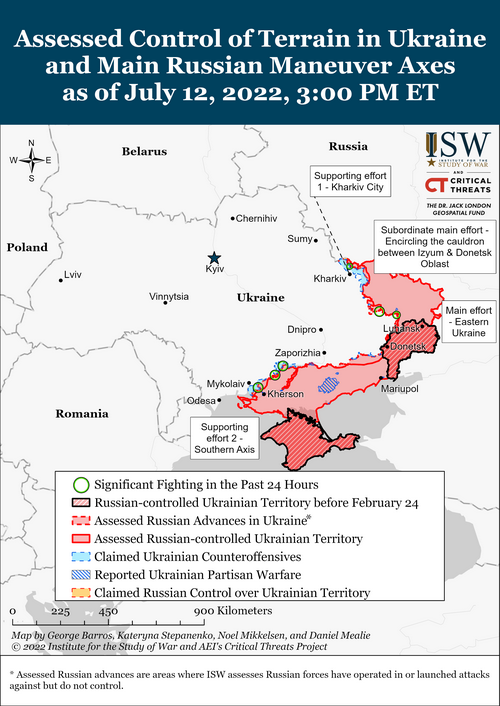
From The Institute For The Study of War:
Kateryna Stepanenko, Grace Mappes, George Barros, Layne Philipson, and Frederick W. Kagan
July 12, 8:10 pm ET
Click here to see ISW’s interactive map of the Russian invasion of Ukraine. This map is updated daily alongside the static maps present in this report.
Russian forces remain in a theater-wide operational pause in Ukraine. Russian forces continue to regroup, rest, refit, and reconstitute; bombard critical areas to set conditions for future ground offensives; and conduct limited probing attacks. The Russian Ministry of Defense did not claim any new territorial control on July 12.[1] ISW has previously noted that an operational pause does not mean a cessation of attacks.[2] Current Russian offensive actions are likely meant to prepare for future offensives, the timing of which remains unclear.
White House National Security Advisor Jake Sullivan reported on July 11 that Iran will provide Russia with “up to several hundred UAVs” on an expedited timeline.[3] Sullivan did not specify the kinds of drones Iran will be supplying. AEI’s Critical Threats Project has provided a quick summary of the basic kinds and capabilities of Iranian drones. Sullivan noted that Iran will also provide weapons-capable UAVs and train Russian forces to use Iranian drones as early as July. Russian milbloggers and war correspondents have long criticized the Kremlin for ineffective aerial reconnaissance and artillery fire correction measures due to the lack of UAVs. Former Russian military commander and milblogger Igor Girkin stated that Ukrainian forces have successfully defended the Donetsk Oblast frontline due to the advantage of Ukrainian UAV capabilities in the area.[4] Russian milblogger Andrey Morozov (also known as Boytsevoi Kot Murz) blamed Russian state media for grossly misrepresenting the availability of Russian UAVs and their ability to support accurate artillery fire.[5] Russian frontline correspondent Alexander Sladkov also complained that Russian forces can build more drones but have not done so.[6]
Key Takeaways
- The Kremlin is reportedly sourcing Iranian UAVs likely to improve Russian aerial reconnaissance and indirect fire accuracy in Ukraine.
- Russian forces conducted limited and unsuccessful ground assaults north of Slovyansk and east of Siversk.
- Russian forces continued air and artillery strikes around Bakhmut and Avdiivka.
- Russian forces conducted multiple unsuccessful ground assaults north of Kharkiv City.
- Russian forces likely conducted a false-flag attack on the Zaporizhzhia Nuclear Power Plant in occupied Enerhodar, Zaporizhia Oblast.
- Russian and Ukrainian sources reported that Ukrainian strikes killed multiple Russian officers in Kherson City on July 10.
- Ukrainian forces continued to strike Russian ammunition depots on the Southern Axis.
Go here to read the rest.
From Strategy Page:
July 12, 2022: Russian GDP will shrink at least 15 percent in 2022. It’s worse in Ukraine, where deliberate Russian missile and artillery attacks on economic targets are causing long-term economic damage. In Russian occupied Ukraine there is no effort to repair economic damage and useful economic assets are shipped back to Russia. Russia is following the ancient strategy of “creating a desert and calling it peace”. Russia is also trying to mobilize its economy for wartime production despite senior government economic officials pointing out that Western sanctions emphasize crippling weapons production. Russian supreme leader Putin insists Russia will find a solution, as it did during World War II. This assessment ignores how Russia lost the Cold War and its empire literally fell apart because of economic mismanagement. The last war Russia won was World War II or the “Great Patriotic War”. That victory was made possible by massive economic aid from the United States and a few other countries not occupied by the Germans. In 2022 Russia is the German aggressor and Ukraine is the Russian defender. This perception is anathema to senior Russian leaders but makes unpleasant sense to Russians closer to the situation. It’s against new Russian laws to contradict the official interpretation of the war. Yet the government has not jailed any of the increasing number of critics with front line experience who assess the war more as Russian aggression than the official explanation that Russia was protecting Ukraine from NATO Nazis.
Reality asserted itself for the Russian occupation forces in parts of Ukraine that were seized early on and are still under Russian control. The occupation was supposed to emphasize winning over the locals without resorting to mass murder and similar atrocious behavior that Russians endured under Nazi occupation. The main occupation zone is north of Crimea and centered around the city of Kherson, which is the capital of Kherson province. Kherson City was captured during the first week of the invasion and Russia has held onto most of the province ever since. The city is a major port because it is located near the mouth of the Dnieper River and the Black Sea. The Dnieper is a major navigable river for Ukraine and has long been used to handle the movement of cargo, especially wheat being exported. Russia is blocking such exports and burning Ukrainian crops before they can be harvested.
Ukraine has been trying to recapture Kherson City and province ever since March, and is making progress, aided by a growing partisan movement inside Kherson province and passive resistance to Russian occupation by most Ukrainians there. Some Ukrainians agreed to work for the Russian occupation, including pro-Russia Ukrainian politicians that were so unpopular in post-2014 Ukraine that they fled to Russia. These officials returned to administer the occupied territories and were soon the targets of attacks by Ukrainian partisans. Some of the turncoats were killed but more worrisome to the Russians were indications that other Ukrainian officials quietly agreed to work for the partisans. The Russians now believe that many of their Ukrainian administrators were working with the resistance from the beginning. At the same time the Russian occupation forces still have their orders to try and win over the Ukrainians or at least discourage them from joining an armed insurrection. To help with that the Russians sought to Russify the province as quickly as possible. That meant replacing the Ukrainian cell phone service with a Russian one. Ukrainian TV and radio transmissions are blocked. Russian ID documents became mandatory and use of any currency but the Russian ruble was forbidden. Russia controlled utilities (especially water and electricity) and every effort was made to link Kherson to the Russian economy. The initial reason for pacifying the population was to make life safe for Russian troops in Kherson. That was never fully achieved and now Russian troops have to worry about roadside bombs or anti-vehicle mines as well as sniper fire and assassination via pistol or a bomb planted in a vehicle. Russian efforts to impose conscription on Ukrainians in Crimea, Donbas and other occupied areas failed, often violently in places like Crimea and Donbas.
The Russian goal in the newly occupied territories was to hold elections that could be depicted as honest and show a majority of Kherson residents supporting annexation by Russia. The Ukrainians are not cooperating and doing so in clever ways that Russian Information War specialists could recognize but struggle to counteract. The Ukrainian resistance is both armed and dangerous but also mindful of the importance of outperforming the Russian Information War campaign.
Russia already had experience with how Ukrainians respond to military occupation. This occurred in the portions of Donbas that Russia occupied since 2014. Since April Russia has been fighting to gain control over all of Donbas. By the end of June Russia controlled nearly all of Luhansk province, which is the northern half of Donbas. Russian experiences with occupied areas of Donbas since 2014 are repeating themselves. In 2014 Donbas comprised about nine percent of Ukrainian territory, 13 percent of the population and 15 percent of the GDP, and was about 38 percent ethnic Russian. The two provinces comprise the Donets Basin (or “Donbas”) which was originally an economic powerhouse for Soviet Russia. That began to decline in the 1980s and accelerated when the Soviet Union fell (and Ukraine became independent) in 1991. Between 2014 and 2016 over two million people fled rebel-controlled parts of the Donbas, most heading for Ukraine and only about three million remain in rebel-controlled areas by 2022. About half of those people are ethnic Russian pensioners who lose their pensions if they leave. Russia held illegal elections in 2014 and created the Donetsk People’s Republic and Luhansk People’s Republic in the portions of those two Ukrainian provinces they controlled. Russian sponsored violence in Donbas has reduced economic activity to less than a third of what it was in 2013. Many businesses moved to Russia and Russia had to supply money to pay over 100,000 military and civilian employees of the new governments. Russian-occupied Donbas was and is sustained by money and supplies trucked in from Russia. This was costing Russia several billion dollars a year. Where Russian occupation forces controlled the Ukraine/Russia border, the border ceased to exist. The Russians controlled only about half of Donbas from 2014 to 2022 and that area gradually became part of Russia. Only the Russian currency is used and any foreign trade is with Russia. Some rebuilding was financed by Russia. Until the 2022 Russian invasion, the Russians offered peace in Donbas if Ukraine recognized the loss of the Russian-occupied Donbas, which would then be free to become part of Russia.
Russia ignored or failed to accurately assess how, since 2014 Ukraine had been expanding and reforming its Soviet-era military. In early 2019 Volodymyr Zelensky was elected president of Ukraine by a large margin. He was not a politician but proved to be a lot more capable than the Russians expected. Worse, Zelensky quickly demonstrated that he was more of a threat than the professional politician he replaced. Since taking power in 2019 Zelensky quickly replaced notoriously corrupt or incompetent government and military officials. Zelensky tried to get negotiations going between himself and Russian leader Putin. The Russians did not want that, and their response was an “invasion threat” that became real in February 2022. Zelensky didn’t flinch because he could do the math. Ukraine could win if it obtained enough military support from nations also threatened by Russia, especially new NATO members who had joined since the 1990s and shared Zelensky’s assessment of Russian goals and the relatively poor state of the Russian economy and military forces. Ukrainian forces stopped the Russian 2022 invasion and forced Russian troops back towards the Russian border. The Russian threat to Europe was revealed as very real, and this prompted Sweden and Finland to abandon their long-held neutrality and join NATO. Russia justified its 2022 invasion by claiming NATO was conspiring to attack Russia and that part of that conspiracy was NATO installing anti-Russian politicians in Ukraine so that Ukraine would become an involuntary NATO member. This was quickly revealed to be a lie as the invading Russian troops were being defeated by better armed and motivated Ukrainians who wanted nothing to do with Russia. That reality slowly got back to Russia despite Russian efforts to deny it and describe such information as another clever NATO lie.
The Russian government is losing the support of its own people, including a growing number of senior officers who speak out, usually via encrypted messages on Telegram, a popular cell phone app in Russia and Ukraine. Early on many of these Russian Telegram based military blogers (“mil-blogers” supported the invasion and were supplied with information by the Russian government, including opportunities to spend some time with the troops inside Ukraine. By June the Russian mil-blogers were no longer reporting the official Russian version of events in Ukraine, but what was being reported by Russian veterans of the fighting in Ukraine.
After Russia announced a pause in offensive military operations in early July, one of these mil-blogers, a former general who had served in occupied Donbas before the invasion, reported a different reality. He insisted that Russia had suffered higher losses in Luhansk than the Ukrainians, who were conducting a classic attrition defense. The Russians had suffered far more losses in men and equipment than the Ukrainians who were not driven out of Luhansk but withdrew deliberately to encourage Russia to keep attacking and losing troops and combat vehicles that could not be replaced. Meanwhile the Ukrainians were receiving more weapons and equipment from NATO and forming new units, including armed resistance groups in Russian occupied Ukraine. This was not the official Russian assessment but it was the reality that Russian troops in Ukraine were experiencing and some Russian mil-blogers were reporting.
All this was nothing new. When the most modern and effective Russian forces were assembled to invade Ukraine in 2022, they quickly discovered they were not facing an inept, poorly trained and armed foe but one that was far more effective. The main offensive in the north against the Ukrainian capital took heavy losses and within weeks was forced to retreat. Russian troops were told by their government that they had encountered NATO troops who were in Ukraine preparing to invade Russia. The surviving Russian troops knew better because all they encountered were Ukrainians, usually armed with weapons similar to what Russia used as well as more effective ones they had received from NATO. The Ukrainians used more effective tactics and some new weapons that were based on Western models but Ukrainian- made. The Russian state-controlled media was ordered to ignore reports like this and stick with the official story that this was all a secret NATO operation to attack Russia via Ukraine.
While this information war played on, the Russian military ordered everything Russia had, short of nuclear weapons, into use in an effort to salvage the situation. Russia was at war with a near-peer opponent and losing. Many Russians, civilian and military, figured out what was happening and were openly criticizing and sometimes physically attacking their government because of the mess in Ukraine that was killing a lot of Russian troops. These Russian critics were often well-educated professionals in regular contact with Westerners, including more than a million Russians who had left since 2014 because of fears Russia was headed for what actually happened in 2022.
Go here to read the rest. Historically Russian generalship has been lacklustre, with the occasional exception like Suvorov. The saving graces for the Russian military has been overwhelming numbers and the stolid courage of their common soldiers. In this War the Russians lack overwhelming numbers and many of their conscripts can’t understand why they are fighting against their ethnic cousins and have shown a definite reluctance to die in Putin’s War.


That Putin is not arresting all his public critics is interesting. Are they just too many for him or does he find it useful to let them talk, to a degree? In the USSR we would never have heard from them again (and that’s if they got one word out in the first place).