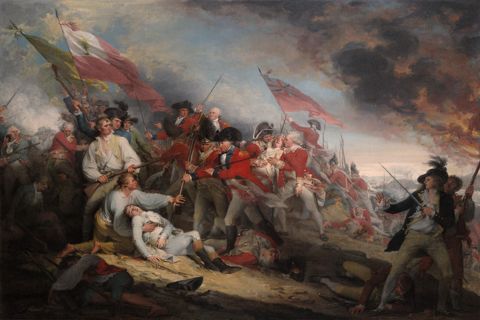
Prior to the Battle of Bunker Hill some British officers believed their American adversaries were cowards.
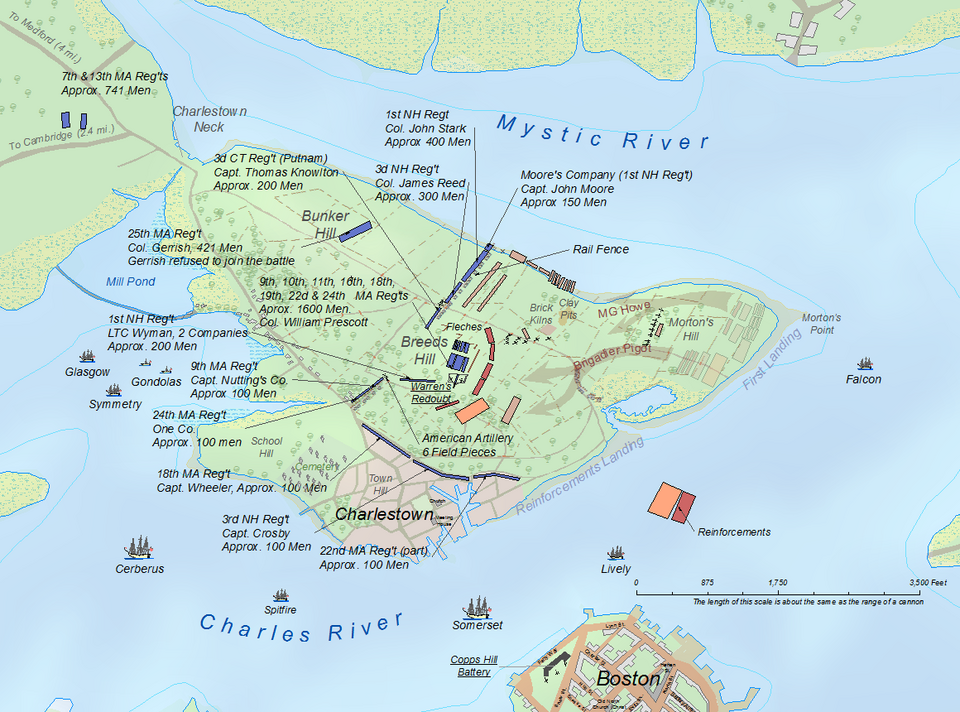
On June 14, 1775 the Second Continental Congress, which convened in Philadelphia on May 10, 1775, authorized the creation of the Continental Army, the first American regular army. On June 15, 1775 Congress appointed Colonel George Washington of Virginia as commander-in-chief of the Continental Army. Before Washington took command, the militia of New England fought a major battle with the British. Fearing that the British planned to advance from Boston to seize the hills surrounding the town, the Americans occupied Bunker and Breed’s Hill on the Charlestown Peninsula, and fortified Breed’s Hill.
The American move demonstrated that the militia were very much amateurs when it came to war. With their control of the sea, and with the failure of the Americans to fortify the neck of the Charlestown Peninsula, the British could have simply landed troops on the neck and easily bagged all the Americans on Breed’s Hill. However, the British, with vast contempt for the fighting prowess of their militia opponents, did not do this.
Instead General Howe, newly arrived from Britain led three charges against the militia on Breed’s Hill, the first two of which were bloodily repulsed. Amateurs they were, but the American militia were more than willing to fight, especially if they could do so from a fortified position. The third attack succeeded, due to the Americans running out of ammunition, disarray in their supplies and munitions being the curse of the militia gathered around Boston. However, the Americans abandoned their position only after ferocious hand to hand fighting.
The Battle of Bunker Hill, so it is misnamed, although a technical American defeat was a very important American victory in its consequences. It was a shot in the arm to American morale, and well it should have been. Raw American militia had stood and faced two charges from the cream of the Royal Army and only retreated due to lack of ammunition. In exchange for 450 American casualties, of which 140 were killed, the Americans inflicted 1,054 casualties, including 226 dead, against some of the best troops in the British Army and the Royal Marines. After Bunker Hill, few British officers spoke again of alleged American cowardice.
Perhaps the most important casualty of the battle from the American standpoint was the confidence of the British commander General William Howe. Howe never got over the number of men that he lost at Bunker Hill, a fact which was displayed by the extreme caution he showed in command of British troops in the key campaigns in New York, New Jersey and Pennsylvania in 1776-1777. With more daring and speed, Howe, on several occasions, might have captured or destroyed Washington’s entire force, but the memory of Bunker Hill kept Howe slow and cautious.