
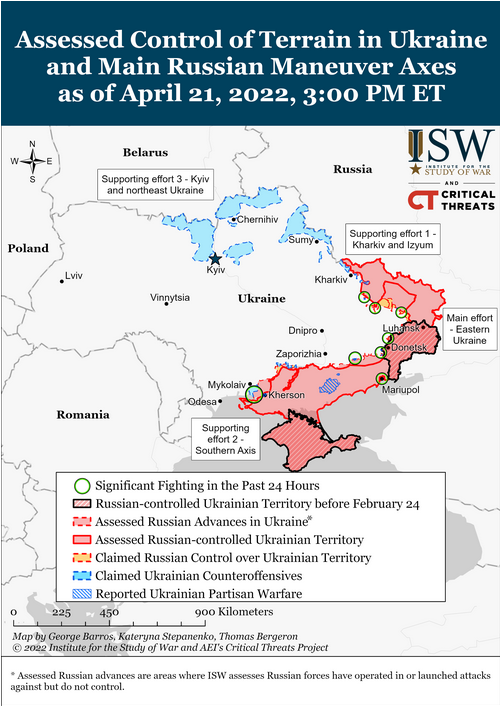
From The Institute For The Study of War:
Mason Clark, George Barros, and Kateryna Stepanenko
April 21, 6:45pm ET
The Kremlin declared victory in the battle of Mariupol. Russian forces will attempt to starve out remaining Ukrainian defenders in the Azovstal Steel Plant rather than clear it through likely costly assaults. Russian President Vladimir Putin and Defense Minister Sergei Shoigu declared victory in the battle of Mariupol on April 21 despite the continued presence of Ukrainian forces in Mariupol’s Azovstal Steel Plant. In a staged, televised meeting, Putin ordered Shoigu to halt assaults on the plant to limit Russian casualties, claiming Russian forces have already captured the entirety of the city. The Kremlin will spin the (still incomplete) capture of Mariupol into a major victory in Ukraine to compensate for stalled or failed Russian offensives elsewhere.
The Kremlin’s reduction of the pace of operations in Mariupol is unlikely to enable the deployment of significant combat power to support other offensive operations in the coming days and weeks. Statements from US officials that Russia has not yet removed a dozen battalion tactical groups (BTGs) from Mariupol despite Putin’s claimed victory do not capture either the status of these Russian forces or other constraints on their use.[1] ISW has consistently assessed that Russian BTGs have taken high casualties in the battle of Mariupol, are degraded, and are unlikely to possess their full complement of personnel (800-900 at full strength). As with Russian operations elsewhere in Ukraine, reporting on numbers of BTGs without additional context and analysis of the combat power of these units is not a useful evaluation of Russian forces. While it is unlikely that all 12 reported BTGs were involved in the final fighting around the Azovstal plant, it will still take some time for those units that were engaged in final assaults to disengage for redeployment elsewhere. Some portion of these Russian forces will be necessary for several other missions—including maintaining the siege of the Azovstal plant, securing the rest of Mariupol against any remaining pockets of Ukrainian forces and likely partisan actions, and possibly redeploying to support Russian forces maintaining control of southern Ukraine. Russian forces will certainly be able to redeploy some units from Mariupol to offensive operations elsewhere—but Ukrainian forces have succeeded in tying down and degrading a substantial Russian force, and the Kremlin’s declaration of victory has not inherently freed up 12 BTGs worth of combat power for other operations.
Key Takeaways
- The Kremlin’s declaration of victory in Mariupol is unlikely to enable the deployment of significant combat power to reinforce offensive operations in eastern Ukraine in the coming days or weeks.
- Russian forces involved in the battle of Mariupol are likely heavily damaged and Ukrainian forces succeeded in tying down and degrading a substantial Russian force.
- Russian forces continued offensive operations in eastern Ukraine but made only marginal gains.
- Ukrainian forces continued to halt Russian attacks around Izyum.
Go here to read the rest. From Strategy Page:
April 21, 2022: The war in Ukraine is turning into a major political and economic, as well as military event. While deaths and injuries are lower than previous conflicts of similar size, the Ukraine conflict has brought about a lot of economic changes that were not expected, as well as some that were.
The current fighting may go on for another year or more, but the economic costs are more likely to cause Russia to quit sooner because the Russian military effort is costing billions of dollars a day and on some days, this has gone over $10 billion. Part of this cost is the unexpectedly heavy economic sanctions that have not only imposed high costs but have fundamentally changed Russian trading relations for the worse. Russia has to rebuild its natural gas pipeline system to reflect the many lost customers and more distant new ones. Russia lost access to the major global banking systems and has to rely on a new, improvised one that means Russia pays more for imports and receives less for exports. The economic sanctions also involved freezing financial assets outside Russia. Many of these assets are threatened with seizure and transfer to Ukraine as reparations for the damage Russian bombs, artillery and missiles have done to cities and infrastructure.
Russian military operations have largely been unsuccessful, except for the amount of damage done. There have been less than 50,000 killed so far, most of them Russian soldiers and most Ukrainians killed have been civilians. Russia avoided killing civilians initially because the Russians believed that most Ukrainians would welcome them as liberators. That was a major error because the reality was that Ukraine was united to oppose the Russian invasion and, once this sunk in, the Russians switched most of their air and artillery attacks to urban areas. Not many of these bombed areas were captured but in the few that were Russia treated all the local civilians as prisoners of war until the civilians could convince the Russians otherwise. Those determined to be dangerous to the occupation were put under guard in makeshift prisons and many were compelled to do manual labor for the Russians. One Ukrainian realized that the Russian were actually enacting these occupation plans, and Ukrainian civilians in areas that might be captured were advised to flee.
Back in Russia there are complaints about these occupation plans, either because the government has been slow to implement them quickly enough or criticism from many Russians who see this as no different than what the Nazis did in Russia during World War II. Back then the Soviet Union was still intact and Ukraine was a subordinate part of the union while the Russians gave the orders. That was why half the population of the Soviet Union chose to leave the union in 1991 and become separate countries. Russians were surprised that even Slavic Belarus and Ukraine left and don’t want to come back. Russia’s current leaders believe the dissolution of the Soviet Union was a major error that should be rectified. There were no willing returnees so Ukraine was chosen to be first to be compelled to return.
This was the strategy that Russia’s current leader, former KGB officer Vladimir Putin developed over the last two decades. He had earlier been elected to office but used that to expand the power of the president and make it possible for him to become president-for-life or until he angered too many powerful Russians and was purged. Putin thought he was purge-proof but due to mistakes he, and many of his key subordinates made, the Ukraine reunification “operation” turned into a disaster, especially for Putin. This was unexpected because early on in his presidency Putin eliminated most of the independent media and made it illegal to openly report on or discuss his less savory deeds, like corruption and getting Russian soldiers killed in foreign wars. Many rural Russians, whose main source of news is state-controlled media, still believe the Putin version of the Ukrainian “operation”. Maintaining that illusions becomes more difficult as more Russian soldiers die in Ukraine and their families are not notified or, if they are, the cause was described as anything but fighting Ukrainians defending their homeland. The worsening economy is impossible to hide but for the moment the official explanation is an unwarranted attack by the West, especially NATO nations, which have long been accused of actively seeking to destroy Russia.
Russian troops in Ukraine or headed there have a more realistic view of what is going on and are refusing to fight or even enter Ukraine. Conscripts point out that Russian law prohibits conscripts from being sent to a foreign war. Military leaders insist that Ukraine belongs to Russia and there is not a war there but a “special operation”. Conscripts respond that the law also specified that only special operations troops, and never conscripts, will deal with special operations.
Many army commanders are in trouble for corruption as the deployment of their units to Ukraine revealed that many battalions contained fewer troops than commanders reported. In some battalions only half the troops the government was paying for were present. This was classic “ghost soldier” corruption in which commanders make extra cash by letting troops, especially conscripts, go if they can pay an exit fee and keep quiet about how they got out. This works until the battalion is ordered into a combat zone and cannot account for the missing troops. These units were sent in anyway and when the survivors got back to Russia they openly refused to retrain, rearm and return to Ukraine. Threats of punishment did not work because most of these men saw returning to Ukraine as a death sentence.
Ghost Soldiers were not the only corrupt practice exposed by the Ukraine fighting. Lots of money meant for vehicle maintenance or building the vehicles correctly had been stolen so these vehicles failed when they entered combat. Shoddy manufacturing meant nearly half the missiles, rockets and shells did not work. That was great for those plundering the munitions budget, and for Ukrainians being fired at. The Ukrainians do have to deal with all those unexploded objects on the ground or inside wrecked buildings. Putin has responded to all this by firing or arresting several hundred military, intelligence or procurement officials. The arrests continue and Putin is trying to gather new staff he can rely on for an accurate picture of what is going on in Russia, Ukraine and elsewhere.
Go here to read the rest. The Russian offensive is thus far amounting to a fizzle. Putin has neither the money nor the troops to win his war. Hopefully he will decide that even a bad peace, from his perspective, is better than losing by inches slowly.


Rumors have floated about alleged ill-health of Putin since at least November, 2020. Most of us probable dismissed these as wishful thinking (I did).
Most recently, clearly in the last 48-72 hours, a video (UK Sun, Daily Mail, others) has been released by the Russian Defense Ministry, of Putin meeting with his defense chief, Sergei Shoigu, which can be accurately dated as contemporary, and not an old altered propaganda flick, because they’re talking about sealing off the remaining Ukrainian fighters in Mariupol.
In the video, Putin’s face is clearly quite puffy and bloated (drug injections? Too much vodka last night?) and his hand, for the entire time, unnaturally gripping the table corner like a vise while he appears pushed into his chair and firmly holding himself there. Initial stages of Parkinson’s is the most often offered guess. (Some observers also note Putin‘s foot toetapping, but that could just be a nervous habit of a very active high-powered exec, and it doesn’t remind me of a Parkinson’s reaction.) By the way, Choigu looks exhausted and defeated as well, also noting his hunched body language: Pardon, but the Russians clearly display show themselves when they are ascendant and proud of their victorious achievements.)
It is a familiar sight. Having had a family member come down with Parkinson’s, this is very similar behavior to me: at first, the person tries to restrain the tremors by sheer muscular force. On the other hand, people shouldn’t get their hopes up: Because this is the initial stages: real incapacitation usually will be some years off. And, relying on the case of this family member, the person also may become subject to some wacky and disconnected thinking, partly due to the drugs, partly due to the sheer effort of struggling with Parkinson’s. Doesn’t bode well.
If it is Parkinson’s at all.
But the bloated and puffy face does not signify a person who is physically well.
Why is Biden polling so poorly on Ukraine? The COVID crisis by design worked very well.
More [Gallows] Humor from Powerline
Ancient Chinese proverb, “To hide dementia use VP that can’t speak above grade school level.” Ron Klain
Cow say, “Moo.”
Pig say “Oink.”
Sheep say, “Putin!”
Having worked with nursing homes for over 8 years, I have noticed that puffiness seems to go with thyroid problems. In the pharmacy we delivered quite a few prescriptions for Synthroid to treat the problem. It seems more common with aging and Putin is 70.
They’re a few feet apart. Maybe Putin’s got over his covidphobia. Shoigu looks about normal. As for Putin, the way he’s seated in the chair (slouched, and pressed against the back), the angle of his head, and the constant table gripping (unrelenting for 11 minutes) do look odd. He doesn’t appear bloated.
@Donald Link: You are correct, thyroid medication also has a tendency to create facial “puffiness.” Other reports state a Russian MD specializing in thyroid cancer treatments has often been seen with him.
Nevertheless, comparing pictures of Putin with even 2-3 years ago, perhaps 2019-2020, the difference in his facial aspect is extremely noticeable.
But the vise-like hand grip on the table throughout this video, total supposed to be over 10 minutes, with the “forced shrug” into his chair, reminds me of something else I’ve seen.