

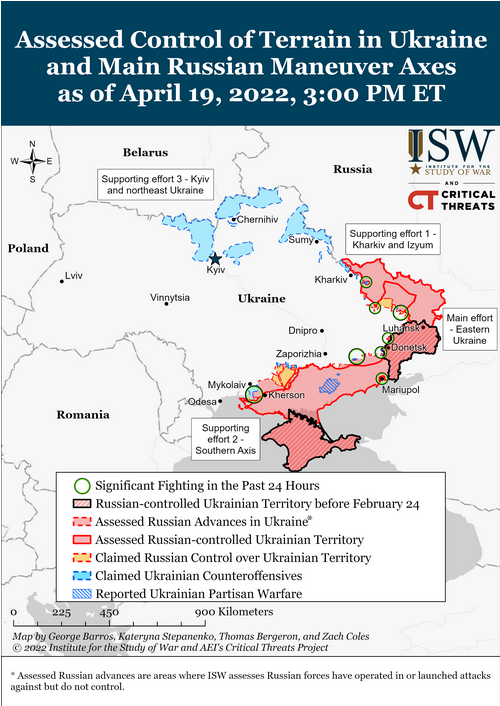
From The Institute For The Study of War:
Frederick W. Kagan, Kateryna Stepanenko, and Karolina Hird
April 19, 5:30 pm ET
Russian and Ukrainian officials announced that the next phase of the Russian invasion of Ukraine began on April 19. Russian forces conducted intensive artillery and air bombardments of many areas along the front line from around Izyum to Mykolaiv but relatively few ground offensive operations. Russian forces continue to receive personnel and equipment reinforcements as well as command-and-control and logistics capabilities even as they conduct air and artillery preparations and some mechanized advances.
The Russians have not fully set conditions for a large-scale offensive operation. The Russians have not had enough time to reconstitute forces withdrawn from the Battle of Kyiv and ready them properly for a new offensive in the east. The Russians appear to be still building logistics and command-and-control capabilities even as they start the next round of major fighting. The tempo of Russian operations continues to suggest that President Vladimir Putin is demanding a hasty offensive to achieve his stated objectives, possibly by “Victory Day” on May 9. The haste and partial preparation of the Russian attack will likely undermine its effectiveness and may compromise its success.
Russian forces appear to be attempting to conduct a wide encirclement of Ukrainian troops along axes from Izyum to the southeast and from Donetsk City to the north even as they push west from Popasna and positions north of Severodonetsk. Russian ground offensives in the last 24 hours occurred around Izyum, Kreminna (north of Severodonetsk), and from Donetsk City toward Avdiivka. Only the advance to and possibly through Kreminna made significant progress. An encirclement on this scale would likely take considerable time to complete against Ukrainian resistance. Even if the Russians did complete such an encirclement and trapped a large concentration of Ukrainian forces inside one or more pockets, the Ukrainian defenders would likely be able to hold out for a considerable period and might well be able to break out.
The Russians may alternatively try to complete several smaller encirclements simultaneously, each trapping fewer Ukrainian forces and therefore taking less time to complete and then reduce. Coordinating such operations is complicated and beyond the planning and execution capacities the Russian army has demonstrated in the conflict thus far.
Ukrainian forces continue to defend parts of the Azovstal complex in Mariupol, but Russian officials and media are gathering in and near the city, likely in preparation to declare victory in the coming days whether or not fighting continues.
Key Takeaways
- The next phase of the Russian offensive in Ukraine’s east has reportedly begun, largely with artillery and air bombardments supporting a few small-scale ground offensives.
- Russian officials and media are likely preparing to declare victory in Mariupol in the coming days, possibly before Ukrainian forces in the Azovstal facility have been fully defeated.
- The Russians may be attempting a single wide encirclement of Ukrainian forces from Izyum to Donetsk City or a series of smaller encirclements within that arc. It is too soon to assess the intended Russian scheme of maneuver.
- Russian operations continue to proceed hastily, as if President Vladimir Putin has set an arbitrary date by which they must succeed. Putin may have decided that he will announce a Russian success and the completion of the operation on Victory Day, May 9. The haste with which Russian forces are moving may compromise the success of their operations.
Go here to read the rest. From Strategy Page:
April 19, 2022: Ukraine’s success against Russian tanks and armored vehicles again revived predictions that tanks are obsolete. Tanks are still relevant and the Russian losses were the result of poor deployment of armored units as well as design differences in Russian tanks that make them much more vulnerable that Western tanks like the American M1, German Leopard or Israeli Merkava. Most Russian armored vehicles were lost while they were on the move, or stationery without adequate infantry support. The first Russian armored units going into Ukraine were told the population would be friendly or neutral. The reality was that the Ukrainians were well armed, hostile and using tactics the Russians were unaware of and unprepared to deal with. Thousands of Russian vehicles were destroyed in the first month, most of them armored, including some of the most modern Russian tanks plus a few that may have been taken from museums. Most of the Ukrainian anti-tank weapons were portable and carried into combat by teams of soldiers, many of them recent volunteers. Many volunteers had no military experience at all. The few days training they received was also an evaluation of their suitability for combat duty. This usually began carrying ammo, including anti-tank missiles and projectiles, These volunteers demonstrated an ability to follow instructions and take cover or resume movement when ordered. Sometimes volunteers were selected for combat duty because knew the area where their ant-tank team would be operating. The anti-tank teams suffered far fewer casualties than the Russians, even after the Russians became aware of the ambush risk. Ukrainians were still able to attack. For one thing most of the portable anti-tank could accurately hit moving vehicles 300 or more meters away. The guided missiles (Javelin and NLAW) were fire and forget. The NLAW had a max range of 600 meters and Javelin 2,500 meters. The Ukrainians were creative with their ambush tactics and the Russians who survived them noted that the Ukrainian always better prepared and one or more steps ahead of Russian commanders. The Russians were losing six dead for every Ukrainian fighter and that included soldiers killed by rocket and ballistic missile attacks away from the combat zone.
Russian armored vehicles had some unique vulnerabilities not found on their NATO counterparts. The Russian tanks used an auto-loader for the main (usually 125mm) gun and that meant there was a magazine of shells in the crew compartment (turret and body of than tank beneath i.) as well as spare shells for the crew to refill the autoloader magazine. If any anti-tank weapon penetrated into the crew compartments, especially the turret, one or more of the 125mm shells were exposed and likely to explode. If one shell went, all those near the autoloader did as well. This usually meant turret would literally be blown off the tank and the entire crew killed. Javelin and NLAW were designed to attack the less protected top of the turret or body of the tank, which at the very least destroyed the engine or wounded some of the three-man crew. The primary Russian infantry armored vehicle was the BMP which was poorly protected against anti-tank weapons, especially the ones the Ukrainians were using. You did need a top-attack ATGM to destroy a BMP.
Trucks carrying supplies (specially fuel and ammo), equipment or personnel were even more vulnerable.
Even when the Russians knew they were facing well-armed defenders their infantry was not well trained in how to scout for and protect their armored vehicles from ambush. NATO tank units train using infantry who know what to look for and are able to call in heavy fire from the armored vehicles they are escorting. NATO forces also have more small UAVs to do some of the scouting. The Russians had few such UAVs and those that were available were poorly used and often shot down by the Ukrainians.
Ukrainian forces have lots of armored vehicles, most of them improved (by the Ukrainians) Russian designs. Ukrainian tank tactics are more practical and more likely to overcome defenders, plus Ukrainian civilians are everywhere and generally eager to let their troops know what’s going on in the area.
After the 2014 initial Russian attack, Ukraine realized they needed new and improved armor vehicles in case the Russian came again in larger numbers. Since 2014 Ukraine has been refurbishing existing equipment with Ukrainian resources. Emphasis is on armored vehicles, which Ukraine has lots of. Most are elderly but were little used in the past and still effective. Initially Ukraine had 250 T-64BMs and 350 T-64BVs. Ukraine also has 1,000 older T-64B tanks in storage. Only the T-64BM and T-64BM are operational and in use with the Ukrainian Army. Since 2007 Ukraine has been upgrading about one of the older T-64Bs to the T-64BM each month. This costs about $600,000 per T-64B. Ukrainian arms factories were also building the T-84 Oplot-M tank and 55 were in service by the end of 2015 and 120 more in 2016 at a cost of $3.7 million each. All this is possible because Ukraine contained many Soviet era armored vehicle plants and inherited them when the Soviet Union dissolved in 1991.
Ukraine also began upgrading about 300 T-72B tanks held in reserve. These were modified to become similar to the Polish PT-91. The official reason for this is that Ukraine wants the T-72Bs to meet NATO requirements but the upgraded tanks would also improve the defensive capabilities of the Ukrainian Army forces fighting in eastern Ukraine. The upgrade idea came as a result of Ukrainian military officials being given an opportunity to test some PT-91s.
Such cooperation between Poland and Ukraine is nothing new because since 2011 defense firms in the two countries have worked together to develop guided 155mm artillery and 120mm mortar shells. Another cooperative effort enabled a Polish firm to develop a less expensive alternative to the Israeli SPIKE ATGM (Anti-Tank Guided Missile) that was based on the Ukrainian RK-3 Corsair ATGM. Ukraine, like Russia, has little choice but to refurbish older vehicles and hope for the best.
Go here to read the rest. Putin needs a big win with this new offensive. If he doesn’t get one I think some sort of Russian effort to end the war by negotiation is inevitable. The Russians are not gearing up for a long war and probably lack the economy to do so. The old mass terror methods of Stalin are not available to Putin, and thus he is battling the clock as much as the Ukrainians.

