

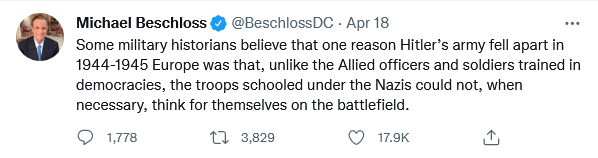
By military historians I assume that he means grade B war movies made during World War II. Actually, since the development of stosstruppen tactics in 1916-1917, German soldiers of all ranks were taught to take the initiative on the battlefield and to be flexible in their tactics. During World War II Allied generals noted this time and again and envied the ability, as a result, of the Germans to take apparently shattered units, weld them together and put useful ad hoc combat forces back into play in remarkably short time.
All of this is very well known and repeated time and again in standard military histories of World War II. To see a historian recycle the stale propaganda of German soldiers being mindless automatons is to despair of basic literacy among too many current scholars who are ever eager to sacrifice historical truth to make a contemporary political point.
Well, if the German infantry was that good how did we win? Numbers partially if we include the Soviet hordes who killed, with the help of American trucks and American food, three out of four of every member of the Wehrmacht who was killed in World War II. More importantly, the Americans and, to a lesser extent the British, had huge advantages in air supremacy, naval supremacy and mechanization of ground units. The average American leg infantry division had more tanks, trucks, halftracks, tank destroyers, etc than the average German panzer division. The Germans relied heavily on horses to move supplies and ammo which struck American GIs as a throwback to our Civil War, if not the Middle Ages. American divisions deployed immense fire power, in addition to on call air power and centralized corps artillery, which meant that unless some special factor was involved, lousy weather in the Ardennes or the dense forests of the Hurtgen, German offensives against American and British units were often an invitation for mass suicide by the landsers. German propaganda sometimes hailed their troops as the Supermen of tomorrow. Actually it was their American and British opponents who were the vanguard of warfare of the future. A fed up GI put it profanely in the concluding episode of Band of Brothers:


He does specialize in the American presidency. OTOH, he wrote a biography of Eisenhower and another work on the 2d World War. He seems to have held a mess of research fellowships over the years, but no regular appointment anywhere (presumably because he never completed a dissertation).
Technically he’s correct. There are some historians who think that. Whether he does or not I don’t know. Though he could be alluding to the fact that the Allied soldiers, especially the US soldiers, did win the admiration of Germans for their ability to improvise on the battlefield. Though that would still be a stretch to get to ‘Germans as ironing board stiffs who couldn’t think for themselves’.
I know of no military historians of World War II who think that Dave. The idea that the Germans had an admiration for how American troops improved is largely from one throw away remark from Rommel, endlessly requoted. The quality of American troops, as opposed to their technological edge, often declined over time in combat due to our atrocious replacement system which sent men often not trained for combat arms into combat units, especially in emergency situations like the Battle of the Bulge. Such replacements often made up the majority of casualties in a unit since they had no idea of how to handle themselves in combat, and veterans often lacked the time and inclination to teach them, since the replacements often arrived in the middle of combat operations. This was endlessly complained about by our combat troops, the issue was often raised in Willie and Joe cartoons in Stars and Stripes. Nothing was done.
I would also note that for all its problems, related mainly to distance from the theatre, Allied supply and logistical functions were largely superior to the Germans. Admiral Donitz thought he could cut the Allied supply lines with his U boats and was quite successful in the early part of the war. By 1943, German losses were unsustainable and the tactic was ineffective at stopping Allied resupply.
Well my college prof from back in the day for one. Don’t know of his military history credentials, but in his History of the 20th Century class, he was very fond of the ‘Germans as ironing boards unable to think’ meme. Of course he also deemphasized the impact that America’s supplies to the Soviet Union had, saying they brought little to nothing to Russia’s overall war effort. In both cases I doubt he is the only one, and I’ve seen that ‘Germans unable to adapt’ meme repeated many times over the years – long before the Internet. As for the American troop abilities, that’s more than a one off quote from Rommel. I’ve seen that referenced many times and seen interviews with German veterans who echo the sentiment. Of course the replacement system left much to be desired, but on equal footing, the nod to the American soldier’s ability is not confined to one German officer. Not that our industrial output and vast resources don’t deserve their share of the credit. But not at the expense of the average soldier who had only months to learn what the Germans spent a decade preparing for, yet still could wing and prayer it and hold his own when the time came.
“Historical malpractice” is correct.
While it is true that they were sometimes “by the book” fighters, as one wag opponent put it: “But it’s one hell of a book.”
The NCO corps was absolutely superb and the Wehrmacht could roll with the punches and improvise with the best of them. The kampfgruppe concept they developed on the fly was a consistent problem for the Allies.
By the end, grinding losses shattered their ability to improvise–or do much of anything else–beyond repair. And there’s no doubt that they got “out-flexibled” by their Western opponents, who learned a lot from 1940-42. The American “blitzkrieg” across France in the summer of ’44 was 1940 in reverse, for example. But automatons? Nonsense.
Wouldn’t it be nice if we had impartial data/facts collection?
Almost all scholarship is propaganda and commercials pushing the agenda.
They have the intellectual integrity of a used car salesman.
Act accordingly.
Firepower and quantity were American advantages in the West–along with air supremacy.
I recall a German veteran of Arracourt, a Panther tank driver, ruefully recalling the problem of fighting American armored formations:
“We’d kill 10 Shermans. But there was always another Sherman.”
Of course he also deemphasized the impact that America’s supplies to the Soviet Union had, saying they brought little to nothing to Russia’s overall war effort.
Your Professor was an ignorant fool Dave. Khrushchev himself said that without American spam the Red Army would have starved. Over 400,000 trucks and jeeps were sent to the Soviet Union through lend lease. Without these the Russian offensives would have have been impossible. Riding in American trucks and eating American food was referred to by Red Army troops as going Hollywood.
As for the Germans, the British military maxim that those who have not fought the Germans do not know war says it all. Your average German landser in the West had as little combat experience as the average American GI by 1944-45 when almost all the combat between them occurred, the North African and Italian campaigns being on a much smaller scale than the fighting which ensued from D-Day forward. The American army had strengths that more than compensated for its weaknesses, but its main weakness was its infantry due to the replacement system and the fact that most high testing GIs were placed in technical and support units. Once again something that was noted at the time, and nothing was done about.
The NCO corps was absolutely superb
The Germans had relatively few officers in their units, and men who would have been routinely commissioned in Western armies served as NCO’s. As I previously noted, Allied firepower in the West made German offensives problematic, but they remained formidable on defense to almost the very end, as their rapid response to Operation Market Garden demonstrated.
Allied supply and logistical functions were largely superior to the Germans.
Incomparably so. It was a difference in kind rather than in magnitude. German weakness in logistics was the key to the defeat of Operation Barbarossa in 1941.
I didn’t say I agreed with him. I always thought his extreme trashing of the Germans in light of the Soviets was foolish and based on ignoring swaths of evidence. Nonetheless, it was there. And in his defense, he isn’t the only one I’ve heard make the claim. I’ve seen more than once the old trope that the USSR won the war by its lonesome, with nothing special from the West, in either troop quality or industrial leasing. Likewise I’ve seen the old story of the German soldier as a droid operating on programming versus the clever as street fighter US soldier narrative.
But then I’ve also heard the other trope that the US soldiers, being US anything, were inept dolts who were unworthy to untie the sandals of the Wehrmacht. It was only our vast industrial war machine making bank off the slaughter that tipped the scale. Something that I’ve also seen debunked by interviews and accounts from Axis vets. Not to say there weren’t problems in the replacement system, or other systems. But that doesn’t diminish the testimony of those who noted the ability of the American soldier one on one, all things equal.
I prefer the idea that the Germans, highly trained and in a culture that had mentally prepared an entire generation for the fight, found out the American mongrel wasn’t quite so inept. Something Japanese vets also later admitted as well.
“I prefer the idea that the Germans, highly trained and in a culture that had mentally prepared an entire generation for the fight, found out the American mongrel wasn’t quite so inept. Something Japanese vets also later admitted as well.”
Three very different military systems. The American system emphasized technology and mechanization, taking full advantage of American industry and the fact that most GIs had a familiarity of some sort with motor vehicles. The Germans fielded magnificent infantry but they lacked the productive capacity and resources to produce the type of mechanized military the US produced,and the Luftwaffe could not compete with the US Army Air Forces in either quantity or quality. The Japanese were second to none in courage on the battlefield, but in many ways their Army was World War I vintage and they simply could not stand against American troops except from well constructed and fortified positions, or where the American troops were starving, wracked with malaria and low on ammo as occurred at Bataan. For Japan the Navy was always the senior service and it showed with their Army being reduced to doomed resistance on isolated islands, and in New Guinea and the Philippines in the War against the US.
Of that I certainly agree. Especially with the sometimes overlooked understanding of Americans having that mechanical aptitude that could be relied upon in a pinch. Though the Japanese Navy, of top importance though it was, also failed in its ability to withstand America’s industrial might, as well as the quality and quantity of both its planes and aviators and sailors.
GIs were great scroungers. They would often repair a vehicle and suddenly an infantry platoon would have an unofficial new vehicle attached to it. GIs loved fire power and if they could get their hands on a recoilless rifle or extra machine guns, bazookas or mortars they would do so. Midnight requisitions are an old Army tradition!
I’m reminded of how the Germans, typically advanced on the technological side, were bonkers over the bazooka. Something so simplistic and yet so effective. Naturally the Germans brought out their own Panzerschreck as a result. But that was always to me symbolic of the American ability to improvise. As my sons say, if they needed some new military vehicle for a specific task, slap in on a Sherman. A combination of American industrial output, the proliferation of motor vehicles in American society and the American tendency for ‘down home’ ingenuity all seemed to combine to make that a well earned reputation.
Here I am wading into an argument with a historian….Maybe the original tweet was referring to the caliber of troops coming aboard in 44-45? They can’t have been the best-trained or schooled in the most free-thinking environment.
“Soldiers not thinking” was literally done as a gag in the show “Malcolm In the Middle” like a decade ago.
https://www.youtube.com/watch?v=og2unLDWNHg
“Soldiers not thinking” was literally done as a gag in the show “Malcolm In the Middle” like a decade ago.
A very amusing program.
Entertainment programs propagate the worldview of the sort of people who land jobs as screenwriters. Remember Ted Cruz college roommate? Would you want such a specimen in your family?