
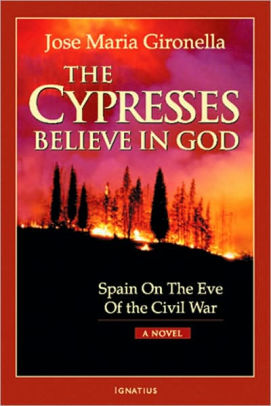
Dale Price at Dyspeptic Mutterings has finished up The Cypresses Believe in God:
The classic novel of the run-up to the Spanish Civil War, it is back in print thanks to the efforts of Cluny Media. CM also just republished the second book in the trilogy, One Million Dead, and presumably Peace After War will follow.
As to the first book, it’s…a lot. A meditative, slow-burn elegy which shows how political polarization can make good people bay for blood and turn neighbors into enemies.
Yes, Gironella was a Nationalist soldier. But while he was a believing Catholic whose sympathies are obvious, he creates no strawmen and deplores the failures of the Church and right wing politicos to address economic and spiritual destitution.
The Gospel verses that leap to mind as one reads it are from the Olivet Discourse:
For as in those days before the flood they were eating and drinking, marrying and giving in marriage, until the day when Noah entered the ark and they did not know until the flood came and swept them all away…
A full review to come.
Go here to comment. I’ve always had a fascination with the history and culture of Spain. This fascination has centered on the Spanish Civil War, 1936-1939, where Spaniards, in a war marked by great atrocities and great heroism, played out all the popular political mistakes of the Twentieth Century: Fascism, Communism, Anarchism, Nationalism and Separatism. The best book on this topic, either fiction or non-fiction, is The Cypresses Believe in God by Jose Maria Gironella. In the first volume in his trilogy, the lead up to the war is depicted in Cypresses; the war is set forth unforgettably in One Million Dead, and the aftermath of the war in Peace After War. Gironella, a veteran of the Nationalist Army, achieves the remarkable feat of creating sympathetic characters in all the warring factions. Many of these characters do terrible things, but Gironella skillfully leads the reader to understand why they did them without condoning their actions. Spain is very much a figure in these novels as the characters act out the various aspects of the Spanish character and fight over what Spain was, is and should be. The whole work is suffused by a deeply Catholic spirit and sensibility as the characters come closer to God or repel themselves away from Him.
“Author’s Note for the American Edition
Spain is an unknown country. Experience proves that it is hard to view my country impartially. Even writers of high order succumb to the temptation to adulterate the truth, to treat our customs and our psychology as though everything about them were of a piece, of a single color. Legends and labels pile up: black Spain, inquisitorial Spain, beautiful Spain, tragic Spain, folkloric Spain, unhappy Spain, a projection of Africa into the map of Europe.
I defend the complexity of Spain. If this book attempts to demonstrate anything it is this: that there are in this land thousands of possible ways of life. Through a Spanish family of the middle class–the Alvears–and the day-by-day living of a provincial capital–Gerona–I have tried to capture the everyday traits, the mentality, the inner ambiance of my compatriots in all their pettiness and all their grandeur. In Spain the reaction to this novel has been that it is “implacable”. Nothing could satisfy me more.
This book spans a period of five years, five years in the private and public life of the nation: those which preceded the last civil war, which speeded its inevitable coming. The explosion of that war, its scope, and its significance are described in minute detail.
A single warning to the American reader: Spain is a peculiar country and its institutions therefore take on unique coloration. Certain constants of the Spanish temperament operate under any circumstance. A Spanish Freemason is not an international Freemason. A Spanish Communist is not even an orthodox Communist. In every instance what is characteristic is a tendency toward the instinctive, toward the individualistic, and toward the anarchic. Spaniards follow men better than they follow ideas, which are judged not by their content, but by the men who embody them. This accounts for the inclemency of personal relationships, the small respect for laws; this, too, is what causes our periodic civil wars.
To bear all this in mind is important in understanding this book. When the narrative deals with a priest, a policeman, a Socialist, a bootblack, it is essential to remember that it is dealing with a Spanish priest, a Spanish policeman, a Spanish Socialist, a Spanish bootblack, not with generic types. This warning is doubly necessary with reference to Freemasonry, Communism, and Catholicism, the interpretation of which will undoubtedly clash with the American reader’s concept of these doctrines.
The book’s protagonist–Ignacio Alvear–is a type of young man who abounds in present-day Spain.
Palma de Mallorca, Spain
August 1954
José Maria Gironella”


I was stationed in Spain from ’91 – ’93. We were told even then not to bring up the Civil War with Spaniards as still a sensitive subject for many.
Read the first book which I loved. Put aside the second two as life on many fronts took over. Will sit down again one day and read all three start to finish.
OT, but perhaps not so off-topic,
https://thefederalist.com/2022/02/07/report-red-state-public-schools-encourage-kids-to-go-transgender-behind-their-parents-backs/
I put the trilogy on my Amazon book list last year, and am slowly making my way towards them.
BTW, glad they’re being reissued. I could only find used, which translated into pricey. Will need to check the new books.
The Spanish civil war was the first full on red revolution in the Western World. Despite the name Popular Front, it was controlled by the Communists with other factions as junior partners. Whatever you think of Franco, and he was not a very nice person, he did save the country. Unfortunately, a look at Spain today would seem to indicate that the remedy was not permanent.
Despite the name Popular Front, it was controlled by the Communists with other factions as junior partners.
Certainly not at the beginning. Perhaps as the war wore on and the manpower and matériel was coming from certain sources.
One problem was that all elements of the government were troublesome and at war with civil society in Spain. Manuel Azaña was out of the bourgeois republican parties and quite bad enough. Note, the Democratic Party is the electoral vehicle of the Azañas of this age. The idiot babble about ‘marixism’, ‘cultural marxism’, and ‘communism’ obscures this.
The Communists tended to be considered the moderates on the Republican side compared to the Anarchists and other far Left wing groups often lacking in discipline and sanity. The Communists produced the most effective troops, had control of the Soviet aid, the International Brigades, operated fairly sinister secret police organizations and they became increasingly important in the Republican coalition. However, from first to last no one group completely controlled the Republican government, one of many reasons that they lost.
Thank you kindly! Over halfway done and it will be published tomorrow.
I will add to Don’s analysis that the Nationalists had their logistical ducks in a row during the War and did not waste a scrap of internal resources. The Red Terror ensured that that the unity of the various National factions would be unwavering until the end. All other things being equal, that is enough to win.
The Red Terror ensured that that the unity of the various National factions would be unwavering until the end.
As the Nationalists noted, they were fighting with nooses about their necks. The Republicans often lamented throughout the War that they had very little luck in taking away a town or city from the Nationalists, with the defenders almost always determined to fight to the last. Such was usually not the case when Republicans were defending a city or town, with the major exception of Madrid. This also reflected also another key advantage for the Nationalists: their forces were professionally trained and led.