A Word Before (2026)
Yesterday, 22 October, was the feast of St. John Paul II, the anniversary of his papal inauguration in 1978. It is a fitting week to recall how he reconciled the Church and science. I first wrote this essay for Catholic Stand in September 2014, a few months after St. John Paul II was canonized and later added it for The American Catholic. I republish it here, corrected and lightly revised, because what he did then is exactly what the Church needs to do now.
In June I commented on this blog on Pope Leo XIV’s encyclical on artificial intelligence (“Another ‘Curate’s Egg?’ Comments on Magnifica Humanitas”). My verdict was that its theology is sound but that it overreaches into empirical territory where the Church has no special competence. St. John Paul II showed how to avoid that error: before the Church spoke about science, he brought scientists into the room and listened to them. I return to that point at the end.
St. John Paul II’s Rapprochement with Science
“Science can purify religion from error and superstition; religion can purify science from idolatry and false absolutes. Each can draw the other into a wider world, a world in which both can flourish.” St. John Paul II, Letter to Rev. George V. Coyne, S.J., Director of the Vatican Observatory, 1 June 1988.
“Christianity possesses the source of its justification within itself and does not expect science to constitute its primary apologetic.” ibid.
“Faith and reason are like two wings on which the human spirit rises to the contemplation of truth.” St. John Paul II, Fides et Ratio.
“Research, by exploring the greatest and the smallest, contributes to the glory of God which is reflected in every part of the universe.” St. John Paul II, Address for the Jubilee of Scientists, 2000.
Little has been written about St. John Paul II’s efforts to bring about a rapprochement between the Church and science (note the upper case and lack thereof).* The word “rapprochement” is chosen with care: “an establishment or resumption of harmonious relations” (Oxford English Dictionary).
The term is applied to peace treaties after a state of war. The Catholic Church has not declared war on science. But some scientists do think there is such a war, and advocates of scientism — the belief that science explains all we need to know about the world — have declared war on the Church. They ignore the Church’s founding contribution to science (see Stacy Trasancos, Science Was Born of Christianity) and the work of Catholic clergy and religious such as Mendel and Lemaître (see Fathers of Science).
St. John Paul II sought this rapprochement in three ways:
- redressing the Galileo affair;
- making the Church’s position on evolution clear and consistent with both dogma and science;
- encouraging a long series of conferences, held at Castel Gandolfo, on how the sciences bear on our understanding of God’s action in the world.
The first two have been treated at length elsewhere, so I deal with them briefly. I focus on the third, which has been an invaluable resource in my own writing on science and religion.
*To avoid the cumbersome “Pope St. John Paul II,” and meaning no disrespect (he is my hero!), I will refer to him as St. JP II.
The Galileo Affair
As George Sim Johnston puts it in The Galileo Affair:
“The Galileo affair is the one stock argument used to show that science and Catholic dogma are antagonistic. While Galileo’s eventual condemnation was certainly unjust a close look at the facts puts to rout almost every aspect of the reigning Galileo legend.”
In sum, both Galileo and some Church officials were at fault, in a different time with different concerns. High officials, initially sympathetic to Galileo, were defending orthodoxy against the Reformation. The 1633 sentence did condemn him for holding the Copernican view. But he had been warned in 1616 not to teach it as established fact, and he pressed his own reading of Scripture on the theologians (though St. Augustine had made the same point about Scripture and nature long before). His physical arguments were also weak: he held to circular planetary orbits, and his theory of the tides was wrong.
Nevertheless, this one episode has been the cannon fired by materialists in their perceived war between Church and science. In 1979 St. JP II asked the Pontifical Academy of Sciences to study the affair in depth. Commenting on their report in 1992, he said:
“Thanks to his intuition as a brilliant physicist and by relying on different arguments, Galileo, who practically invented the experimental method, understood why only the sun could function as the centre of the world, as it was then known, that is to say, as a planetary system. The error of the theologians of the time, when they maintained the centrality of the Earth, was to think that our understanding of the physical world’s structure was, in some way, imposed by the literal sense of Sacred Scripture….” St. John Paul II, Address to the Pontifical Academy of Sciences, L’Osservatore Romano, 4 November 1992.
The media made much of this “apology.” But it formally recognized earlier actions of the Church — removing Galileo’s Dialogue from the Index, founding the Vatican Observatory — and set the affair in its historical context. What mattered most was his affirmation that science and the Church each have domains of truth that do not deny each other. As he said in his address on evolution, “Truth cannot contradict truth.”
Note the method. St. JP II did not issue a quick verdict. He commissioned a thirteen-year study by scientists and historians, and spoke only after it was done.
On Evolution
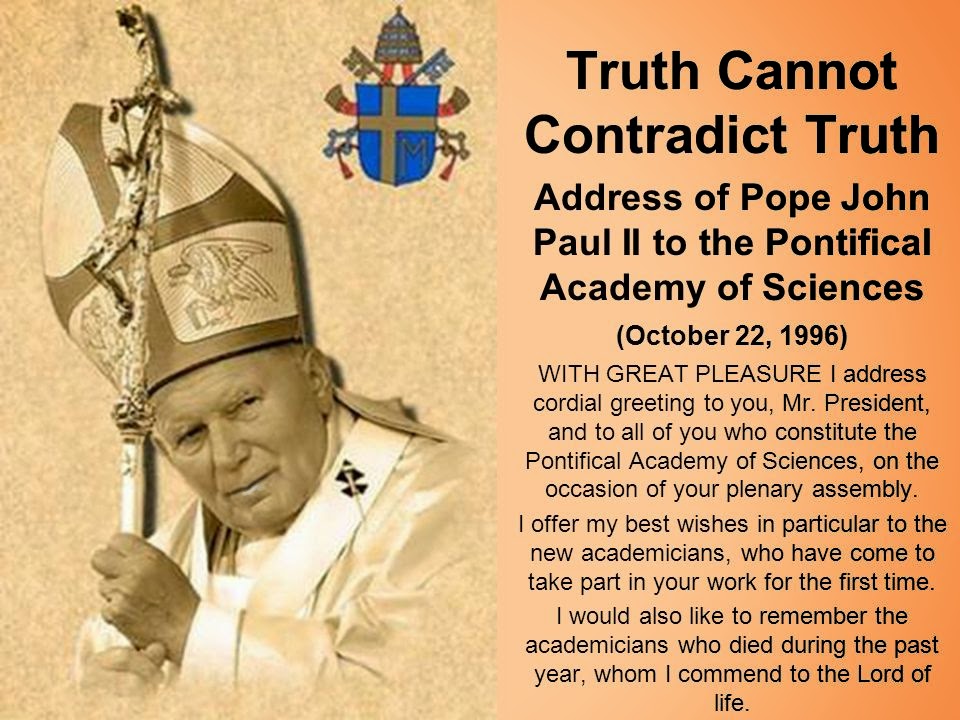
In his message to the Pontifical Academy of Sciences of 22 October 1996 — eighteen years to the day after his inauguration — St. JP II built on Pope Pius XII’s encyclical Humani Generis (1950). He noted that new knowledge had led to recognizing the theory of evolution as more than a hypothesis. In the same message he restated Pius XII’s position:
“There is no conflict between evolution and the doctrine of the faith regarding man and his vocation, provided that we do not lose sight of certain fixed points.”
The most important of these fixed points is that the human soul is created directly by God, not constructed from matter:
“It is by virtue of his eternal soul that the whole person, including his body, possesses such great dignity. Pius XII underlined the essential point: if the origin of the human body comes through living matter which existed previously, the spiritual soul is created directly by God (‘animas enim a Deo immediate creari catholica fides nos retinere iubet’).”
He also showed real insight into the science. The descent of species is well established, but more than one theory — more than one mechanism — has been proposed to explain it. And some theories carry philosophical baggage:
“Consequently, theories of evolution which, in accordance with the philosophies inspiring them, consider the spirit as emerging from the forces of living matter or as a mere epiphenomenon of this matter, are incompatible with the truth about man. Nor are they able to ground the dignity of the person.”
Unfortunately, many scientists and lay people do not share his understanding. They equate the Darwinian model — “survival of the fittest” — with evolution itself, the descent of species. And as with the Galileo address, the media seized on his acknowledgment of evolution while neglecting the historical and theological context he gave it.
A Common Quest for Understanding: The Castel Gandolfo Conferences
In September 1987, marking the tercentenary of Newton’s Principia, the Vatican Observatory brought scientists, philosophers and theologians together at the papal summer residence, Castel Gandolfo. Not all were Catholic; a few were not theists in any usual sense. St. JP II responded with his letter to Fr. George Coyne, S.J., published with the proceedings, Physics, Philosophy and Theology: A Common Quest for Understanding (1988). I urge readers to read the whole letter.
That meeting launched a series co-sponsored by the Vatican Observatory and the Center for Theology and the Natural Sciences (Berkeley): Scientific Perspectives on Divine Action. Over five conferences, physicists, biologists, neuroscientists, philosophers and theologians asked how God acts in a world described by modern science.
In the letter, St. JP II stressed what each partner offers the other: “Science can purify religion from error and superstition; religion can purify science from idolatry and false absolutes.” He also showed a sophisticated grasp of frontier research:
“The unity we perceive in creation on the basis of our faith in Jesus Christ as Lord of the universe… seems to be reflected and even reinforced in what contemporary science is revealing to us…. Contemporary physics furnishes a striking example. The quest for the unification of all four fundamental physical forces — gravitation, electro-magnetism, the strong and weak nuclear interactions — has met with increasing success…. In the life sciences, too, something similar has happened. Molecular biologists have probed the structure of living material… [and] have discovered that the same underlying constituents serve in the make-up of all living organisms on earth.”
Yet he did not want science and theology merged into one discipline:
“By encouraging openness between the Church and the scientific communities, we are not envisioning a disciplinary unity between theology and science like that which exists within a given scientific field or within theology proper…. The Church does not propose that science should become religion or religion science…. Both religion and science must preserve their autonomy and their distinctiveness…. Christianity possesses the source of its justification within itself and does not expect science to constitute its primary apologetic. Science must bear witness to its own worth…. Neither ought to assume that it forms a necessary premise for the other.” (emphasis added)
This reminds me of playing harmony parts (tenor and bass) in our parish instrumental group. The lines are distinct and mostly different, but the harmony enriches the melody — as science enriches theology.
He also saw how hard it is to put scientific findings in proper context:
“For the truth of the matter is that the Church and the scientific community will inevitably interact…. Christians will inevitably assimilate the prevailing ideas about the world, and today these are deeply shaped by science. The only question is whether they will do this critically or unreflectively, with depth and nuance or with a shallowness that debases the Gospel and leaves us ashamed before history. Scientists, like all human beings, will make decisions upon what ultimately gives meaning and value to their lives and to their work. This they will do well or poorly, with the reflective depth that theological wisdom can help them attain, or with an unconsidered absolutizing of their results beyond their reasonable and proper limits.”
That last sentence fits those, like the late Stephen Hawking or the cognitive scientist Steven Pinker, who deny God on the basis of a limitless science.
All the insights above (with the possible exception of the musical analogy) are St. JP II’s. I have been blessed to bring them to the attention of others.
What the Church Needs Now: Expertise on AI
St. JP II’s method was simple. Before the Church spoke on a question touching science, he gathered people who knew the science — believers and unbelievers alike — and listened. The Galileo study took thirteen years. The divine action conferences ran for well over a decade. He did not want the Church’s teaching to be an absolute standard, as he warned scientists not to make theirs the ultimate truth.
Pope Leo XIV’s Magnifica Humanitas shows what happens when that method is not followed. As I argued in “Another ‘Curate’s Egg?’,” parts of the encyclical are excellent. It rightly teaches that AI is not and cannot be a person. It rightly says AI lacks conscience and moral agency. And it rightly rejects transhumanism as a new Gnosticism, a flight from the body that the Incarnation refutes. On these points the Church speaks with full authority.
But the encyclical also attaches empirical predictions to its moral teaching:
- Data centers and the environment. It treats the energy-hungry cloud model as the inevitable face of AI. It says nothing of the memory-chip shortage already braking data-center growth, or of on-device AI that could make much of that buildout unnecessary.
- Employment. It treats mass technological unemployment as nearly certain. Economists and economic historians are divided; technology has historically destroyed jobs but not work.
- Autonomous weapons. The moral principle protecting non-combatants is sound. But the claim that no algorithm could ever apply just-war norms more reliably than an exhausted soldier at 3 a.m. is an engineering question, not a theological one.
In each case a sound moral intuition is tied to a prediction the Church has no special competence to make. When the prediction proves wrong, the moral teaching is discredited along with it. We saw this with Laudato Si’. We need not repeat the Galileo affair to learn the lesson.
St. JP II’s own words name the remedy: “Science can purify religion from error.” Here the needed purification is not of doctrine but of empirical claims that crept into doctrinal documents. The Church already has the instruments: the Pontifical Academy of Sciences, the Vatican Observatory, and many Catholic scientists and engineers who work in AI. What is missing is the habit of convening them, with dissenting voices included, before a document is written.
I propose a modest step. Before the next major teaching on AI, hold a Castel Gandolfo-style conference. Bring together computer scientists, AI engineers, economists, military ethicists, neuroscientists, Thomist philosophers and theologians. Publish the proceedings, disagreements and all. Then, in the teaching document, mark clearly what the Church teaches with authority (the nature and dignity of the human person) and what is a prudential judgment on contested facts.
The Church also has expertise of its own that the encyclical left unused. St. Thomas’s distinction between intellectus and ratio, and between esse intentionale and esse naturale, gives a real argument that a machine cannot understand. The encyclical asserts the conclusion without the argument. St. JP II, a philosopher himself, wrote Fides et Ratio to insist that faith needs reason’s best work. That work exists. It should be used.
“Truth cannot contradict truth.” But a forecast is not yet a truth. Science and theology play different lines in one piece of music. When one tries to sing the other’s part, harmony becomes noise. St. JP II knew how to keep the parts distinct and let them enrich each other. On AI, the Church would do well to follow its saint.
Postscript: The Conference Proceedings
Published by Vatican Observatory Publications with the Center for Theology and the Natural Sciences (some with University of Notre Dame Press):
- Physics, Philosophy and Theology: A Common Quest for Understanding (1988)
- Quantum Cosmology and the Laws of Nature (1993)
- Chaos and Complexity (1995)
- Evolutionary and Molecular Biology (1998)
- Neuroscience and the Person (1999)
- Quantum Mechanics (2001)
Volumes 2–6 carry the subtitle Scientific Perspectives on Divine Action.


“In each case a sound moral intuition is tied to a prediction the Church has no special competence to make.“
Yes..
and kissing a copy of Koran…. was an even greater miss step… not saying JP2 isn’t in Heaven, but the bar towards being proclaimed a saint has certainly been lowered.
“AI” (marketing term) or large language format computing.. is the white collar version of the blue collar upset that happened with electric power tools. Forgive me but… “That’s” not The End, but denying the Kingship of Christ Is.
@David WS; thanks for your comment.. please see this article concerning St JPII kissing the Koran.