

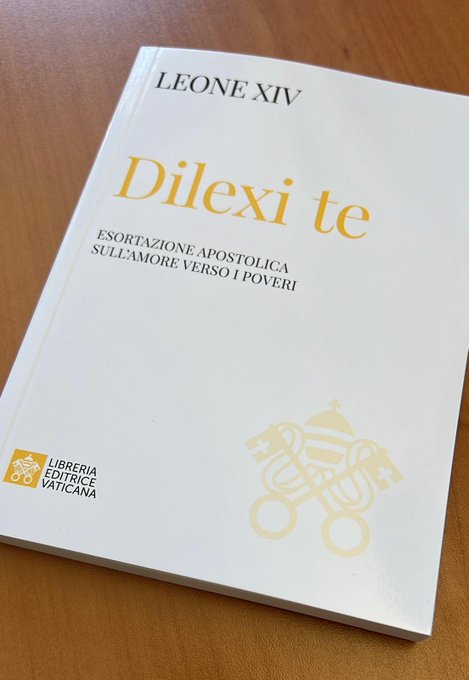
Pope Leo has released Dilexi Te, an apostolic exhortation that Pope Francis was working on prior to his death. Much of it is warmed over Francis, as one would expect, but it underlines how our current Pope apparently is satisfied being a sock puppet for his dead predecessor. As the saying goes attributed to an apocryphal college professor returning an essay to a student: This essay is both good and original, but where it is good it is not original, and where it is original it is not good.
1. “I HAVE LOVED YOU” (Rev 3:9). The Lord speaks these words to a Christian community that, unlike some others, had no influence or resources, and was treated instead with violence and contempt: “You have but little power… I will make them come and bow down before your feet” (Rev 3:8-9). This text reminds us of the words of the canticle of Mary: “He has cast down the mighty from their thrones, and lifted up the lowly; he has filled the hungry with good things, and sent the rich away empty” (Lk 1:52-53).
So far, so bad. Christianity as class struggle. Quite a whiff of Latin American Liberation Theology
2. This declaration of love, taken from the Book of Revelation, reflects the inexhaustible mystery that Pope Francis reflected upon in the Encyclical Dilexit Nos on the human and divine love of the heart of Jesus Christ. There we saw how Jesus identified himself “with the lowest ranks of society” and how, with his love poured out to the end, he confirms the dignity of every human being, especially when “they are weak, scorned, or suffering.” [1] As we contemplate Christ’s love, “we too are inspired to be more attentive to the sufferings and needs of others, and confirmed in our efforts to share in his work of liberation as instruments for the spread of his love.” [2]
Christ of course came to free us from sin. He said nothing about liberating the Jews from the Romans, although that was the pressing secular issue of His time and place. Interpreting His mission as having anything to do with Earthly politics is always a temptation and usually ends in disaster.
3. For this reason, in continuity with the Encyclical Dilexit Nos, Pope Francis was preparing in the last months of his life an Apostolic Exhortation on the Church’s care for the poor, to which he gave the title Dilexi Te, as if Christ speaks those words to each of them, saying: “You have but little power,” yet “I have loved you” ( Rev 3:9). I am happy to make this document my own — adding some reflections — and to issue it at the beginning of my own pontificate, since I share the desire of my beloved predecessor that all Christians come to appreciate the close connection between Christ’s love and his summons to care for the poor. I too consider it essential to insist on this path to holiness, for “in this call to recognize him in the poor and the suffering, we see revealed the very heart of Christ, his deepest feelings and choices, which every saint seeks to imitate.” [3]
Helping the poor is an essential duty. How to do it, aye there is the rub.
4. Jesus’ disciples criticized the woman who poured costly perfumed oil on his head. They said: “Why this waste? For this ointment could have been sold for a large sum, and the money given to the poor.” However, the Lord said to them in response: “You always have the poor with you, but you will not always have me” (Mt 26:8-9,11). That woman saw in Jesus the lowly and suffering Messiah on whom she could pour out all her love. What comfort that anointing must have brought to the very head that within a few days would be pierced by thorns! It was a small gesture, of course, but those who suffer know how great even a small gesture of affection can be, and how much relief it can bring. Jesus understood this and told the disciples that the memory of her gesture would endure: “Wherever this good news is proclaimed in the whole world, what she has done will be told in remembrance of her” (Mt 26:13). The simplicity of that woman’s gesture speaks volumes. No sign of affection, even the smallest, will ever be forgotten, especially if it is shown to those who are suffering, lonely or in need, as was the Lord at that time.
The critique of Judas of this gesture is usually the mantra of Left wing Christians.
5. Love for the Lord, then, is one with love for the poor. The same Jesus who tells us, “The poor you will always have with you” (Mt 26:11), also promises the disciples: “I am with you always” (Mt 28:20). We likewise think of his saying: “Just as you did it to one of the least of these brothers and sisters of mine, you did it to me” (Mt 25:40). This is not a matter of mere human kindness but a revelation: contact with those who are lowly and powerless is a fundamental way of encountering the Lord of history. In the poor, he continues to speak to us.
Fetishizing the poor is an error, it confuses a duty to help with the poor being a substitute Christ.
Saint Francis
6. Pope Francis, explaining his choice of that name, related how, after his election, a Cardinal friend of his embraced him, kissed him and told him: “Do not forget the poor!” [4] It is the same appeal that the leaders of the Church made to Saint Paul when he went up to Jerusalem to confirm his mission (cf. Gal 2:1-10). Years later, the Apostle could still reaffirm that this was “actually what I was eager to do” ( Gal 2:10). Care for the poor was also a great concern of Saint Francis of Assisi: in the person of a leper, Christ himself embraced Francis and changed his life. Even today, Saint Francis, as the Poor Man of Assisi, continues to inspire us by his outstanding example.
The historical Saint Francis bears almost no relationship to the Francis myth which became popular in the last century, and has gathered steam in this one. Francis was a highly orthodox medieval saint, and in no way a precursor of the predilections and prejudices of contemporary Leftists. One of the great concerns of Francis, for example, was the correct saying of Mass and that proper reverence be paid to the Eucharist. His modern fans often turn superficial aspects of his life, preaching to birds for example, as his essence, and jury rig those into support of their contemporary causes, and forget the core of his mission: a return to God through His Church.
7. Eight centuries ago, Saint Francis prompted an evangelical renewal in the Christians and society of his time. Wealthy and self-confident, the young Francis was taken aback and converted by his direct contact with the poor and outcast of society. The story of his life continues to appeal to the minds and hearts of believers, and many non-believers as well. It “changed history.” [5] A further step on the same path was taken by the Second Vatican Council, as Saint Paul VI pointed out when he said that “the ancient parable of the Samaritan served as the model for the Council’s spirituality.” [6] I am convinced that the preferential choice for the poor is a source of extraordinary renewal both for the Church and for society, if we can only set ourselves free of our self-centeredness and open our ears to their cry.
Please spare us mentioning Saint Francis one of our greatest saints, and that kidney stone of a council, Vatican II, a monument to clerical malpractice, in the same paragraph.
The cry of the poor
8. The passage of Sacred Scripture in which God reveals himself to Moses in the burning bush can serve as a constant starting-point for this effort. There he says: “I have observed the misery of my people who are in Egypt; I have heard their cry on account of their taskmasters. Indeed, I know their sufferings, and I have come down to deliver them… So come, I will send you” ( Ex 3:7-8,10). [7] God thus shows his concern for the needs of the poor: “When the Israelites cried out to the Lord, he raised up for them a deliverer” ( Judg 3:15). In hearing the cry of the poor, we are asked to enter into the heart of God, who is always concerned for the needs of his children, especially those in greatest need. If we remain unresponsive to that cry, the poor might well cry out to the Lord against us, and we would incur guilt (cf. Deut 15:9) and turn away from the very heart of God.
A standard trope of Liberation theologians is to confuse the story of the Exodus with class struggle. Forgotten is the fact that the initial demand of Moses was that Pharaoh allow the Israelites to go into the desert and sacrifice to Him. God was liberating the Jews because they were His people, and not because they were poor.
9. The condition of the poor is a cry that, throughout human history, constantly challenges our lives, societies, political and economic systems, and, not least, the Church. On the wounded faces of the poor, we see the suffering of the innocent and, therefore, the suffering of Christ himself. At the same time, we should perhaps speak more correctly of the many faces of the poor and of poverty, since it is a multifaceted phenomenon. In fact, there are many forms of poverty: the poverty of those who lack material means of subsistence, the poverty of those who are socially marginalized and lack the means to give voice to their dignity and abilities, moral and spiritual poverty, cultural poverty, the poverty of those who find themselves in a condition of personal or social weakness or fragility, the poverty of those who have no rights, no space, no freedom.
No recognition of course as to how capitalism and industrialization have lifted so many out of poverty around the globe for the first time in history. The Pope goes on to make poverty a curse word for anything that draws his ire, rendering the word devoid of precise meaning, a common Leftist tactic. The Pope treads into areas where he has no special expertise and in those areas a Pope may not stand on his office, and his words must be judged as to whether they are true or not, the way all the rest of us have our words judged.
10. In this sense, it can be said that the commitment to the poor and to removing the social and structural causes of poverty has gained importance in recent decades, but it remains insufficient. This is also the case because our societies often favor criteria for orienting life and politics that are marked by numerous inequalities. As a result, the old forms of poverty that we have become aware of and are trying to combat are being joined by new ones, sometimes more subtle and dangerous. From this point of view, it is to be welcomed that the United Nations has made the eradication of poverty one of its Millennium Goals.
The Pope’s praise of the UN’s Millennium Goals indicates that he desires to be the chaplain of the Left of Center chattering classes of the West, a role that his predecessor played ad nauseam. The most distressing feature of this entire work is how banal and predictable it is. It could have been produced by any AI that was given all the speeches and writings of the last Pope. Pope Leo is doing his worst to ensure that Francis has a post mortem reign.
11. A concrete commitment to the poor must also be accompanied by a change in mentality that can have an impact at the cultural level. In fact, the illusion of happiness derived from a comfortable life pushes many people towards a vision of life centered on the accumulation of wealth and social success at all costs, even at the expense of others and by taking advantage of unjust social ideals and political-economic systems that favor the strongest. Thus, in a world where the poor are increasingly numerous, we paradoxically see the growth of a wealthy elite, living in a bubble of comfort and luxury, almost in another world compared to ordinary people. This means that a culture still persists — sometimes well disguised — that discards others without even realizing it and tolerates with indifference that millions of people die of hunger or survive in conditions unfit for human beings. A few years ago, the photo of a lifeless child lying on a Mediterranean beach caused an uproar; unfortunately, apart from some momentary outcry, similar events are becoming increasingly irrelevant and seen as marginal news items.
The Pope paints a dystopia out of the portion of the world that has the highest general standard of living, and does not draw the elementary conclusion that the capitalism he damns might have valuable lessons and applications for the places on the planet where it is not practiced.
12. We must not let our guard down when it comes to poverty. We should be particularly concerned about the serious conditions in which many people find themselves due to lack of food and water. In wealthy countries too, the growing numbers of the poor are equally a source of concern. In Europe, more and more families find themselves unable to make it to the end of the month. In general, we are witnessing an increase in different kinds of poverty, which is no longer a single, uniform reality but now involves multiple forms of economic and social impoverishment, reflecting the spread of inequality even in largely affluent contexts. Let us not forget that “doubly poor are those women who endure situations of exclusion, mistreatment and violence, since they are frequently less able to defend their rights. Even so, we constantly witness among them impressive examples of daily heroism in defending and protecting their vulnerable families.” [8] While significant changes are under way in some countries, “the organization of societies worldwide is still far from reflecting clearly that women possess the same dignity and identical rights as men. We say one thing with our words, but our decisions and reality tell another story,” [9] especially if we consider the numbers of women who are in fact destitute.
Predictable praise of women, as if they, at least in the West, are not free actors as much as men. Of course one cause of poverty among some women is the collapse of marriage as a life time union, but I suspect the Pope would sooner chew glass than dwell upon that observation.
Ideological prejudices
13. Looking beyond the data — which is sometimes “interpreted” to convince us that the situation of the poor is not so serious — the overall reality is quite evident: “Some economic rules have proved effective for growth, but not for integral human development. Wealth has increased, but together with inequality, with the result that ‘new forms of poverty are emerging.’ The claim that the modern world has reduced poverty is made by measuring poverty with criteria from the past that do not correspond to present-day realities. In other times, for example, lack of access to electric energy was not considered a sign of poverty, nor was it a source of hardship. Poverty must always be understood and gauged in the context of the actual opportunities available in each concrete historical period.” [10] Looking beyond specific situations and contexts, however, a 1984 document of the European Community declared that “‘the poor’ shall be taken to mean persons, families and groups of persons whose resources (material, cultural and social) are so limited as to exclude them from the minimum acceptable way of life in the Member States in which they live.” [11] Yet if we acknowledge that all human beings have the same dignity, independent of their place of birth, the immense differences existing between countries and regions must not be ignored.
The sock puppet Pope and his predecessor always attack others for being ideological, while being complete ideologues themselves. Gaslighting as a pontifical ruling technique.
14. The poor are not there by chance or by blind and cruel fate. Nor, for most of them, is poverty a choice. Yet, there are those who still presume to make this claim, thus revealing their own blindness and cruelty. Of course, among the poor there are also those who do not want to work, perhaps because their ancestors, who worked all their lives, died poor. However, there are so many others — men and women — who nonetheless work from dawn to dusk, perhaps collecting scraps or the like, even though they know that their hard work will only help them to scrape by, but never really improve their lives. Nor can it be said that most of the poor are such because they do not “deserve” otherwise, as maintained by that specious view of meritocracy that sees only the successful as “deserving.”
The Apostle Paul can give the rejoinder to this cant: 10 For also when we were with you, this we declared to you: that, if any man will not work, neither let him eat. (Second Thessalonians 3: 10) Making endless excuses for the shiftless, detracts from those who need charity through no fault of their own. Take ‘er away Duke:
15. Christians too, on a number of occasions, have succumbed to attitudes shaped by secular ideologies or political and economic approaches that lead to gross generalizations and mistaken conclusions. The fact that some dismiss or ridicule charitable works, as if they were an obsession on the part of a few and not the burning heart of the Church’s mission, convinces me of the need to go back and re-read the Gospel, lest we risk replacing it with the wisdom of this world. The poor cannot be neglected if we are to remain within the great current of the Church’s life that has its source in the Gospel and bears fruit in every time and place.
The Church has no special wisdom in how to lift people out of poverty. Insisting on governmental action that leads to more poverty is to harm the poor rather than to help them, and is a sad tradition of the Church in Latin America in the last half of the last century up to today, and Pope Francis and Pope Leo wish to impose this distorted view upon the world.
The fisk continues tomorrow.





I’m willing to keep giving Pope Leo the benefit of the doubt as he begins to actually make decisions. Again, this is a moping up operation left behind by Pope Francis, and I will await his first unique encyclical. We need to pray and make acts of reparation for him, the Church and the world more than ever.
One second praising the poor… the next calling for the poor not to be poor…
Attacking capitalism which lifts people out of poverty… never criticizing countries of origin that cause their people to leave for America…..
Never mentioning detachment from riches and all goods of this world..
At least we know now we don’t have an American pope.
Leo is a Latin American pope.
The usual Indefinable slouches into the document: “the minimum acceptable way of life in the Member States in which they live…”
First off, what IS the “minimum acceptable way of life”? Don’t leave us hanging, dear Leo!!
Secondly, is poverty on a sliding scale dependent on ‘in which they live’?
I am confused.
“Christians too, on a number of occasions, have succumbed to attitudes shaped by secular ideologies or political and economic approaches that lead to gross generalizations and mistaken conclusions.”
Irony alert!
This encyclical (or at least this portion of it) seems to romanticize the problems of poverty, offering nothing in the way of concrete solutions but much in the way of very thinly veiled condemnations of a multitude of straw men.
This waste of ones and zeros stinks to high Heaven of Bergoglio.
I’m around paragraph 35. I don’t think it’s bad at all. I think it’s imprecise in its use of the term “the poor” though. The modern word “poverty” has many meanings, some of which probably don’t fit the way the word has been used historically. Should we use the same word to describe modern Appalachian poverty and the effects of a 1st century drought?
More thoughts to come.
Christ gave us the Spiritual and Corporal works of Mercy. Acting in these rules Jesus blesses us. Feeding the hungry, clothing the naked begins with us, our own bodies “Love your neighbor as yourself.” In Justice all of us, mankind, are “the poor”.
The poor, the poor, the poor!
The environment, the environment, the environment!
The immigrant, the immigrant, the immigrant!
John 12:4-8
4 But Judas Iscariot, one of his disciples (the one who was about to betray him), said, 5 “Why was this perfume not sold for three hundred denarii and the money given to the poor?” 6 (He said this not because he cared about the poor, but because he was a thief; he kept the common purse and used to steal what was put into it.) 7 Jesus said, “Leave her alone. She bought it so that she might keep it for the day of my burial. 8 You always have the poor with you, but you do not always have me.”
I’m noticing a pattern here….
Prudential judgements are made absolute, while judgement is with held on Intrinsic evils.
Good observation David WS!
It may be a bit early to change the divinely revealed doctrine on sodomy, but capital punishment on the other hand …
I won’t critique the Pope. I am a trainwreck and to voice my opinion against Pope Francis didn’t make me holy. Nor will criticizing Pope Leo the 14th.
So I leave it all to Jesus and His Word;
Mark 12: 30, 31
30
You shall love the Lord your God with all your heart, with all your soul, with all your mind, and with all your strength.’j
31
The second is this: ‘You shall love your neighbor as yourself.’ There is no other commandment greater than these.”k
Our Church, our country, our cities, our schools, our townships, our neighborhood, our family.
Lord. Make our hearts like unto thine. And
help me, a sinner in the last pew, for I’m not worthy to even raise my head. And one last thing Lord. Forgive me when I sit in the front pew and bemoan the one sitting way behind me. How pitiful he is.
Our final exam is on Mark 12: 30-31.
Phillip one need not say:
“ But though we, or an angel from heaven, should preach unto you any gospel other than that which we preached unto you, let him be anathema.”
That’s already been said!
It’s enough for us to say:
“That’s not what The Church Teaches!”
A pope is bound by Tradition, Scripture and what the Magisterium has Taught before him. A vicar… not A King.
There we saw how Jesus identified himself “with the lowest ranks of society” and how, with his love poured out to the end, he confirms the dignity of every human being, especially when “they are weak, scorned, or suffering.” [1] As we contemplate Christ’s love, “we too are inspired to be more attentive to the sufferings and needs of others, and confirmed in our efforts to share in his work of liberation as instruments for the spread of his love.” [2]
The liberation is selfless love given to others.
A get off your horse and bandage up the victim who lays bleeding in the street. Hands on love.
Yes. Christ came to free us from sin. He commands us to sin no more. He uses examples for the lawyers of the day who thinks themselves wiser than He. “Who is my neighbor?”
The good Samaritan story highlights the need for mercy.
Mercy is sparse, imo, but rebukes are plentiful in regard to this post, Dilexi T: A Multi -Part Fisk.
So where is the magisterium to rebuke Pope Francis and Pope Leo for their heretical statements?
The good….take what’s good, walk away from what isn’t.
There is plenty of abuses that Pope Francis lavished upon traditional conservative Catholics and I disliked them all. My hope for restoring TLM rests with Pope Leo, but to go after him with fine tooth comb picking out the dandruff seems a bit much.
Praying for Leo the XIV.
So where is the magisterium to rebuke Pope Francis and Pope Leo for their heretical statements?
God now, and their successors eventually.
“confirmed in our efforts to share in his work of liberation..” ?
Did Leo mean Christ’s death as a ransom for many? Meaning He sacrificed Himself to save humanity from sin and death?
No, the document cloaks itself in love for the poor, but to spin a different narrative.
It’s not dandruff, it’s rot. I’m sorry.
(I wish it need not have happened in my time,” said Frodo.
“So do I,” said Gandalf, “and so do all who live to see such times. But that is not for them to decide. All we have to decide is what to do with the time that is given us.)
[…] here to read part one of the […]
[…] here to read part one of the fisk, and go here to read part […]
[…] here to read part one of the fisk, go here to read part two, go here to read part three and go here to read […]