
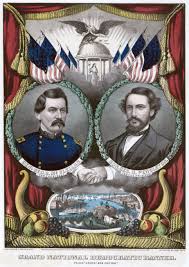
The convention of the Democrats in 1864 to nominate a standard bearer for President opened on August 29, 1864 in Chicago. The convention was badly split between War Democrats and Peace Democrats. The Peace Democrats were strong enough to have a platform approved which dealt with one issue, the War, and which was highly critical of a continuation of the War and called for immediate peace negotiations:
Resolved, That in the future, as in the past, we will adhere with unswerving fidelity to the Union under the Constitution as the only solid foundation of our strength, security, and happiness as a people, and as a framework of government equally conducive to the welfare and prosperity of all the States, both Northern and Southern.
Resolved, That this convention does explicitly declare, as the sense of the American people, that after four years of failure to restore the Union by the experiment of war, during which, under the pretense of a military necessity of war-power higher than the Constitution, the Constitution itself has been disregarded in every part, and public liberty and private right alike trodden down, and the material prosperity of the country essentially impaired, justice, humanity, liberty, and the public welfare demand that immediate efforts be made for a cessation of hostilities, with a view of an ultimate convention of the States, or other peaceable means, to the end that, at the earliest practicable moment, peace may be restored on the basis of the Federal Union of the States.
Resolved, That the direct interference of the military authorities of the United States in the recent elections held in Kentucky, Maryland, Missouri, and Delaware was a shameful violation of the Constitution, and a repetition of such acts in the approaching election will be held as revolutionary, and resisted with all the means and power under our control.
Resolved, That the aim and object of the Democratic party is to preserve the Federal Union and the rights of the States unimpaired, and they hereby declare that they consider that the administrative usurpation of extraordinary and dangerous powers not granted by the Constitution; the subversion of the civil by military law in States not in insurrection; the arbitrary military arrest, imprisonment, trial, and sentence of American citizens in States where civil law exists in full force; the suppression of freedom of speech and of the press; the denial of the right of asylum; the open and avowed disregard of State rights; the employment of unusual test-oaths; and the interference with and denial of the right of the people to bear arms in their defense is calculated to prevent a restoration of the Union and the perpetuation of a Government deriving its just powers from the consent of the governed.
Resolved, That the shameful disregard of the Administration to its duty in respect to our fellow-citizens who now are and long have been prisoners of war and in a suffering condition, deserves the severest reprobation on the score alike of public policy and common humanity.
Resolved, That the sympathy of the Democratic party is heartily and earnestly extended to the soldiery of our army and sailors of our navy, who are and have been in the field and on the sea under the flag of our country, and, in the events of its attaining power, they will receive all the care, protection, and regard that the brave soldiers and sailors of the republic have so nobly earned.
Ultimately the Democrats would nominate a War Democrat, George B. McClellan, to face Lincoln. McClellan repudiated the platform, but if he had won, the most powerful members of his party would have been opposed to a continuation of the War.


And four days later….
The fall of Atlanta! Without that there would likely be two successor Republics to the old pre-1860 United States and perhaps more, with California eventually breaking away from the Union as the Republic of the Pacific and Texas resuming its independence from the Confederacy. Perhaps the Mormons in Utah would have formed the Republic of Zion. A Disunited States would have been ill equipped to face the menaces of the 20th.
Although McClellan is regarded as a war Democrat, his diffident attitude while in command toward aggressive actions would probably have colored his presidency if elected. The country’s split along the lines suggested would probably have taken place in some form or fashion with possible adjustments to account for the differing interests of the border states. The actual presidency of Johnson was certainly bad enough in the reflection of two areas, North and South plus the semi-organized West.
Maybe.
What would have happened in Europe if no doughboys had come to tip the scales of WWI?
A negotiated peace, a diminished Europe a hundred years before the current diminished Europe. No clear causus belli for WWII?
The successor republics to the USA might have, in 19th Century vigor, sought expansion through treaty and conflict with areas of Mexico and a still disorganized Canada. Perhaps such successor states would be more united than the current successor state of the UnUnited States of America, as surely divided red and blue as our forefathers were divided slave and free.
Hard to say. As CS Lewis once said “No one is ever allowed to know what might have happened.”