Cradle Catholic. Active in the pro-life movement since 1973. Father of three, one in Heaven, and happily married for 43 years. Small town lawyer and amateur historian. Former president of the board of directors of the local crisis pregnancy center for a decade.
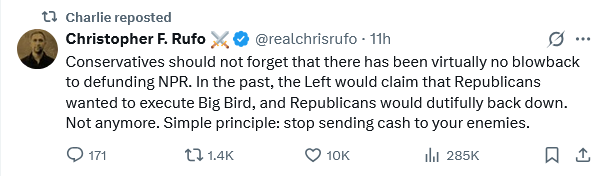
The CPB fell on its own pride (shocking, right?). They could have existed longer and off the fed teat had they simply embraced even a modicum of advertising. Instead, they insisted on the subsidies and their haughtiness about how they were different than other media organizations. Good day to them.
Lead Kindly Light
Saturday, August 2, AD 2025 7:51am
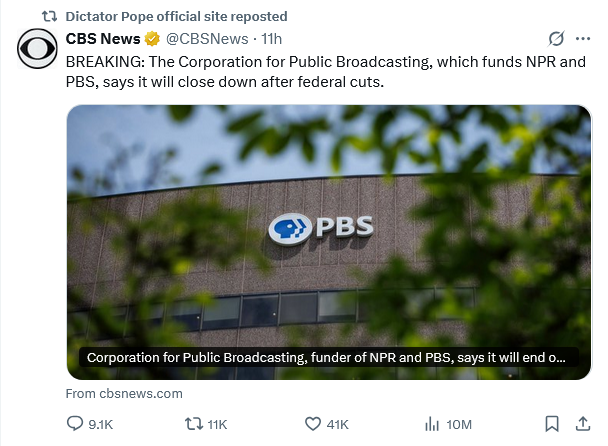
The Corporation for Public Broadcasting had absolutely no reason to exist from the beginning. Unlike a lot of other networks, they didn’t really produce many of the shows that appeared. Most of them were produced locally and then syndicated to the other public TV stations.
Lucius Quinctius Cincinnatus
Saturday, August 2, AD 2025 8:17am
Every day on which a liberal progressive “news” outlet shuts down is a good day.
The Bruised Optimist
Saturday, August 2, AD 2025 9:00am
As far as I can see, the CPB existed as a middleman to funnel government money from the Treasury to PBS & NPR?
Maybe the reason why there’s so little liberal resistance is because it’s as simple as that?
Art Deco
Saturday, August 2, AD 2025 9:23am
“Don’t fund your enemies” is a satisfactory principle. A more generic one is that the distribution of tax revenue to the private sector should be limited to the following circumstances: (1) compensation in accordance with contracts awarded consequent to the submission of sealed bids; (2) intermediated through members of the public, who have elected to purchase goods and / or services from a private provider making use of vouchers or insurance programs financed by the government; (3) disaster relief, which may mean indemnities paid to the private body for their losses or emergency financing to an actual relief service provider. Roughly the same principles should apply in re autonomous government corporations like state colleges.
==
CPB is a grant distributor, not a content creator. They have no money to distribute, so bye bye.
==
The stations, who are the ones doing the fundraising, may continue. They produce some local programming, purchase programming from a menu of stations which produce for syndication (e.g. WGBH in Boston and WNET in New York), purchase from British vendors (of which London Weekend Television was a common source). They’ve just lost a quarter of their revenue stream. They’re going to have to make up revenue or reduce costs if they’re to survive. Enhanced fundraising from local households, grants from various philanthropic bodies and state colleges, grants from local government, grants from state government are options. Local stations have to pay fees to PBS and to NPR if they want to continue receiving programming distributed through that channel. Unless I’m mistaken, there’s a baseline charge and then you purchase programming a la carte. NPR and PBS will be in crisis because some stations will leave the networks and others reduce the number of programs to which they subscribe.
==
IMO, after the networks were established and a critical mass of households could receive UHF broadcasts of similar quality to VHF broadcasts (i.e around 1978), it was time to shut down the federal grant source and tell the stations to hit up state and county governments. Around about 1986, the majority of households had cable television which could serve niche audiences and it was also clear that NPR’s public affairs programming was regulated by gliberal and leftoid narratives. The justification for public funding dissipated around that time.
==
My wager is that higher education will pick up the slack, but who knows?
The Christian Teacher
Saturday, August 2, AD 2025 6:45pm
Oh. The Lefties are whining on social media about how horrible this is. I keep encouraging them to fund it with their private funds now that tax dollars are no longer available.
[…] Analysis, Punditry, and News:And the Good News Keeps Coming – Donald R. McClarey, J.D., at The American […]
Tom Byrne
Sunday, August 3, AD 2025 4:31pm
Art:
Many universities in the old days had AM broadcasting licenses (mine in San Francisco had KUSF), but I imagine podcasting and online stuff would be cheaper in today’s market.



Brit Box
-was another nail in the coffin.
The CPB fell on its own pride (shocking, right?). They could have existed longer and off the fed teat had they simply embraced even a modicum of advertising. Instead, they insisted on the subsidies and their haughtiness about how they were different than other media organizations. Good day to them.
The Corporation for Public Broadcasting had absolutely no reason to exist from the beginning. Unlike a lot of other networks, they didn’t really produce many of the shows that appeared. Most of them were produced locally and then syndicated to the other public TV stations.
Every day on which a liberal progressive “news” outlet shuts down is a good day.
As far as I can see, the CPB existed as a middleman to funnel government money from the Treasury to PBS & NPR?
Maybe the reason why there’s so little liberal resistance is because it’s as simple as that?
“Don’t fund your enemies” is a satisfactory principle. A more generic one is that the distribution of tax revenue to the private sector should be limited to the following circumstances: (1) compensation in accordance with contracts awarded consequent to the submission of sealed bids; (2) intermediated through members of the public, who have elected to purchase goods and / or services from a private provider making use of vouchers or insurance programs financed by the government; (3) disaster relief, which may mean indemnities paid to the private body for their losses or emergency financing to an actual relief service provider. Roughly the same principles should apply in re autonomous government corporations like state colleges.
==
CPB is a grant distributor, not a content creator. They have no money to distribute, so bye bye.
==
The stations, who are the ones doing the fundraising, may continue. They produce some local programming, purchase programming from a menu of stations which produce for syndication (e.g. WGBH in Boston and WNET in New York), purchase from British vendors (of which London Weekend Television was a common source). They’ve just lost a quarter of their revenue stream. They’re going to have to make up revenue or reduce costs if they’re to survive. Enhanced fundraising from local households, grants from various philanthropic bodies and state colleges, grants from local government, grants from state government are options. Local stations have to pay fees to PBS and to NPR if they want to continue receiving programming distributed through that channel. Unless I’m mistaken, there’s a baseline charge and then you purchase programming a la carte. NPR and PBS will be in crisis because some stations will leave the networks and others reduce the number of programs to which they subscribe.
==
IMO, after the networks were established and a critical mass of households could receive UHF broadcasts of similar quality to VHF broadcasts (i.e around 1978), it was time to shut down the federal grant source and tell the stations to hit up state and county governments. Around about 1986, the majority of households had cable television which could serve niche audiences and it was also clear that NPR’s public affairs programming was regulated by gliberal and leftoid narratives. The justification for public funding dissipated around that time.
==
My wager is that higher education will pick up the slack, but who knows?
Oh. The Lefties are whining on social media about how horrible this is. I keep encouraging them to fund it with their private funds now that tax dollars are no longer available.
[…] Analysis, Punditry, and News:And the Good News Keeps Coming – Donald R. McClarey, J.D., at The American […]
Art:
Many universities in the old days had AM broadcasting licenses (mine in San Francisco had KUSF), but I imagine podcasting and online stuff would be cheaper in today’s market.