

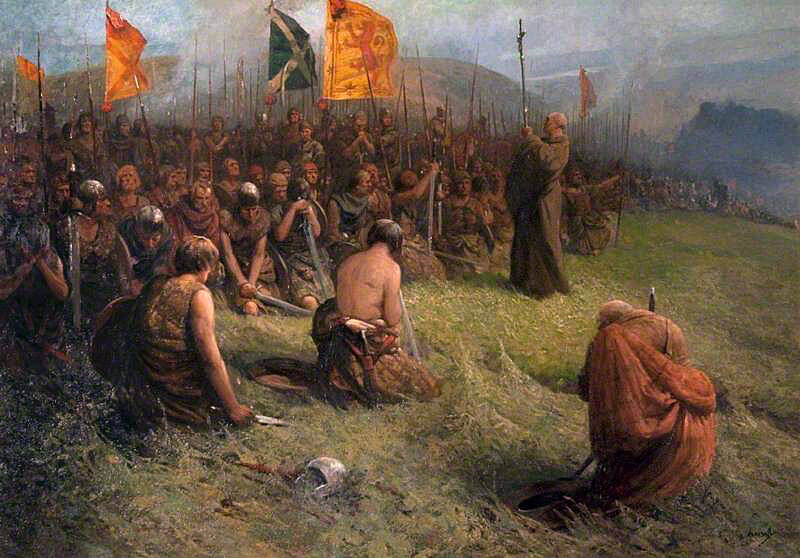
Seven hundred and eleven years ago the Scots regained their independence in a two day fight at Bannockburn. The Scots, led by Robert the Bruce, were heavily outnumbered by the English under Edward II, perhaps as badly as 2-1 or more. The English cavalry outnumbered the Scottish cavalry four to one, usually the decisive factor in battles at this time. The Scottish infantry formed in schiltrons, defensive circles bristling with pikes.
On the first day in hard fighting the Scots forced the English across Bannock Burn, the stream that flowed through the battle field. The English recrossed the stream during the night and took up position in the plain beyond. Robert the Bruce, learning from Alexander Seton, a Scottish knight serving with the English army who deserted to the Scots, that morale was low among the English, decided to attack. The English and Welsh long-bowmen should have made Swiss cheese of the Scots as they charged, but a daring and skillful charge of the 500 Scottish cavalry dispersed the archers. An English counter charge by the Earl of Gloucester was defeated by the Scots, few of the English cavalry choosing to follow the Earl. The Scottish infantry closed in on the English infantry and cavalry, the English cavalry now being hemmed in and unable to maneuver. Edward fled with his personal guard, English morale collapsed on the flight of the King, and a defeat promptly turned into a rout. The Scots had scored one of the greatest upset victories in the Middle Ages.
Let’s give Bobbie Burns the last word:
AT Bannockburn the English lay,
–The Scots they were na far away,
But waited for the break o’ day
That glinted in the east.
But soon the sun broke through the heath
And lighted up that field of death,
When Bruce, wi’ saul-inspiring breath,
His heralds thus addressed:–
“Scots, wha hae wi’ Wallace bled–
Scots, wham Bruce has aften led–
Welcome to your gory bed.Or to victorie!
“Now’s the day, and now’s the hour;
See the front o’ battle lower;
See approach proud Edward’s power–
Chains and slaverie!
“Wha will be a traitor knave?
Wha can fill a coward’s grave?
Wha sae base as be a slave?
Let him turn and flee!
“Wha for Scotland’s king and law
Freedom’s sword will strongly draw,
Freeman stand or freeman fa’–
Let him follow me!
“By Oppression’s woes and pains!
By your sons in servile chains!
We will drain our dearest veins,
But they shall be free!
“Lay the proud usurpers low!
Tyrants fall in every foe!
Liberty’s in every blow!
Let us do or die!”


Very good. An encouraging word for all counter-cultural warriors of our time who take on Godless Progressive oppression. Someday victory will be ours under the banner of a reformed Catholic Church.
Good history.
Homer’s Iliad names Ares’ two chariot horses Panic and Terror, which emotions heavily play on men in battle.
And, some crypto-history says that sudden cavalry charge may have been made by outlawed Knights Templars hiding out in Scotland. The Order had been fatally suppressed in 1308 or 1309; though in common law England, the Inquisition gained little traction.
https://www.youtube.com/watch?v=Oi7xBe5-M8k
Had paternal an estors leading the Scots. Had maternal ancestors leading the English. Which goes a long way towards explaining my family dynamics.
“low moral” of the English. No reason or purpose to die.
morale