
[Note: A previous version of this article appears at the site Catholic Stand. The Comments there are interesting]
The Virgin Mary herself in the year 1214 A.D. gifted St. Dominic, and all of us, with the rosary. He and his fellow priests had been preaching against heresy and he believed he was failing to bring the heretics back to the church. In a vision, Mary, accompanied by three angels, asked Dominic, “Dear Dominic, do you know which weapon the Blessed Trinity wants to use to reform the world?”
Dominic humbly replied that Mary knew about salvation. Mary responded,
I want you to know that, in this kind of warfare, the battering ram has always been the Angelic Psalter which is the foundation stone of the New Testament. Therefore if you want to reach these hardened souls and win them over to God, preach my Psalter.
Mary’s “Psalter” is what we now know as the rosary. Initially “Mary’s Psalter,” or the “Poor Man’s Psalter,” was prayed as a substitution for the Divine Office said by priests. When recited with 15 mysteries, Joyful, Glorious, and Sorrowful, the 15 decades account for 150 Hail Marys, corresponding to the 150 Psalms.
In an Apostolic Letter in 2002, Rosarium Virginis Mariae, Saint Pope John Paul II published a new set of themes which he had authored called the Luminous Mysteries.
JPII made it very clear that he was proposing this as an option and that there was no obligation or duty to use his personal new set of mysteries when praying the rosary.
This is true of all the mysteries of the rosary. None of them has to be recited, none of them has to be stated:
You are always free to pray using any mysteries of the rosary you desire. There is no obligation to do all of them, or to follow them in order, although that is what most people do (Catholic Answers).
So you may use the luminous mysteries if you desire .
Comments [note: comments made over the years before this article was previously published] by those who choose not to use JPII’s own mysteries are varied:
- The Rosary is a private devotion and there is no church requirement about the mysteries
- They don’t fit as well with the system I use to meditate during the rosary.
- Because they’re not what I grew up with, they’re not traditional.
- This is just another Vatican effort at globalism via creation of a new “tradition” from whole cloth.
- The practical effect in this new neoconservative hyper-papal-personality-cult Catholic ecosystem of the early 2000s was equivalent to an imposition.
- Every old pamphlet or sermon a Saint might have written about the rosary is now obsolete, or needs to have a footnote added or an appendix written by a modern person inserted.
- If you want to reflect on the rosary as you practice it, your only choice is documents 20 years old or less. You should have been able to inherit your great-grandmother’s hand missal and still have it be seamlessly useable. Instead, across the twentieth century, it’s you need a new edition every 15 years.
- When Mary prayed the Rosary with the children at Fatima and with St. Bernadette at Lourdes, she did not use these new mysteries
Only Three “Great” Popes
Church history includes three, only three, popes who have been accorded the unofficial title “Great.” This title is not officially proclaimed, but rather is a description some, and then many, give to a pope to honor his abilities, contributions, and leadership. The three “great” popes are: Pope St. Leo I (440–61 A.D.), Pope St. Gregory I (590–604 A.D.), and Pope St. Nicholas I (858–67 A.D.).
Pope Leo the Great led the church in a time of great upheaval and troubles, and dealt with the barbarian, Attila the Hun.
Pope Gregory I the Great was a leader in developing monasticism and he was celebrated for his writings and pastoral care.
Pope Nicholas I the Great was a staunch upholder of papal authority and resolved many disputes within the Church.
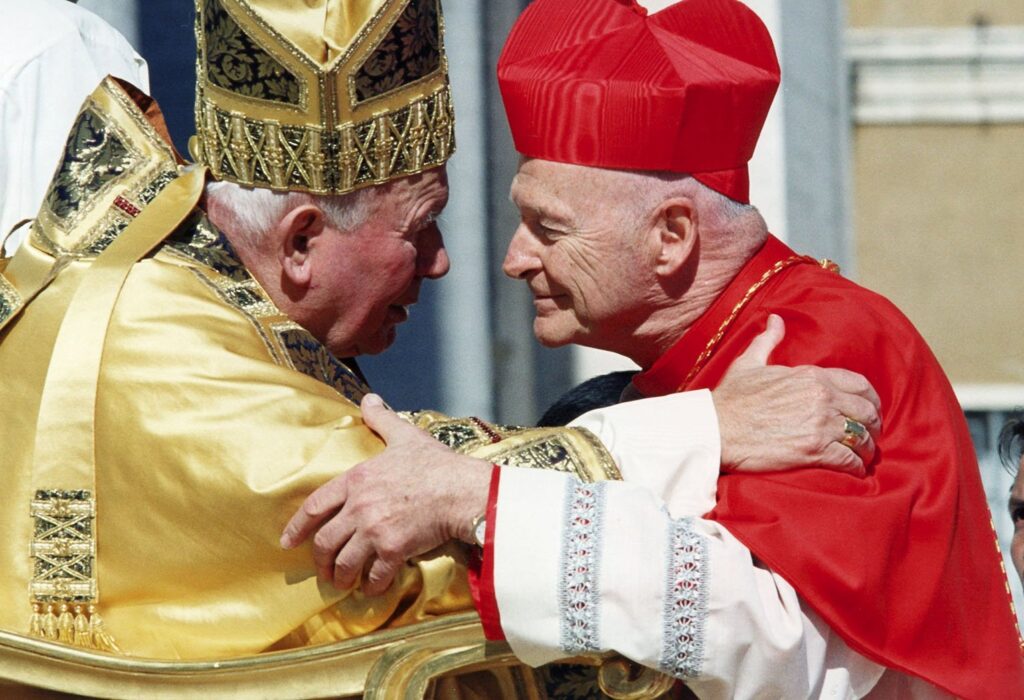
In my opinion, John Paul II achieved many things and provided leadership for many years; but he is not among the “great” popes. My primary reason for this opinion is that I cannot unthink the truth about: his knowledge of the crimes of priest and bishop sexual predators within the clergy such as Marcial Maciel Degollano and Theodore McCarrick; and his ignoring McCarrick’s sexual predations and promoting him while aware of the numerous reports over many years about what he had done.
Although he had been warned in 1999 by then-New York Cardinal John O’Connor about McCarrick’s crimes and that he was widely known to single out seminarians and invite them to sleep with him in the same bed, JPII appointed McCarrick as archbishop of Washington in 2000 and made him a cardinal in 2001.
Unfortunately I cannot erase from my memory the court testimony I have read about McCarrick’s homosexual rapes and other crimes and at the same time recite mysteries authored by the man who not only refused to punish McCarrick, but who also, knowing all that he did, promoted the man to the highest level of responsibility, service and honor in the church.
Yes, John Paul II achieved much but, in my opinion, he is not among the “great” popes. This is why, when the circumstances permit, whenever anyone in my presence refers to “John Paul the Great,” I voice my opinion, politely: “No he is not great.”


With the abuse scandals, JP II fell victim to one of the devil’s favorite tricks: Attacking the faith from both extremes.
The future pope was ordained and exercised his early ministry in Communist Poland, under the rule of hostile atheists whose assaults on the Church routinely included false accusations of sexual misconduct.
The experience left him predisposed to disbelieve any such claims–and ill-equipped to handle Satan’s attack from the other side, when he successfully tempted many priests, bishops, and cardinals into engaging in those same acts.
(I recall reading once that near the end of his life, JP II finally realized what was actually going on, and blew his top. By that point, though, it was too late for him to actually do anything about it.)
These are two very good points, and certainly apply far beyond the Rosary. When I was first becoming Catholic, I was wanting to learn more about the Mass and the theology of the Mass and so I bought a book (its name escapes me at present) that was written prior to 1970, although at the time that significance didn’t occur to me. I had some small knowledge of the distinction between the NO and TLM from perusing Father Z’s blog from time to time, but thought (incorrectly) that it was more on the lines of some different rubrics or the translations or small things like that. As I started reading through this book I quickly realized that there were many portions I wasn’t familiar with, and the author’s points, which I thought were profound, had no corollary to what I was experiencing at Mass; even something like the Introit which is an option at the NO (although I’ve never seen it used in my experience; maybe once). I eventually went to the TLM and it all made way more sense.
It’s funny, because back when I was a protestant a co-worker’s friend or sister or something was becoming a nun (I think?), and although I only met her once, she randomly gave me a 1962 Angelus Missal, which at the time I had no idea what it was or why she gave it to me. And the TLM was millions of light years from my mind. I kept it though and glanced at it from time to time, and apparently my wife read through it quite a bit as we were becoming Catholic. I now use that same hand missal every Sunday or whenever I’m at Mass, so it’s interesting how providence works in ways we never expect.
The Luminous Mysteries fills the gap between the Joyful and Sorrowful Mysteries, focusing on Jesus Public Life.
They are the Baptism of the Lord, the Wedding at Cana, the Proclamation of the Kingdom, the Transfiguration and the Institution of the Eucharist.
They reveal that our Lord Jesus was both fully human and fully divine.
The luminous mysteries are prayed on Thursdays.
All four mysteries together reveals the life of a Jesus from Conception through to Death and Resurrection, with special emphasis on Our Lady’s co-operative role in the redemption of mankind.
You could ignore the Luminous Mysteries as a modern addition. You will miss out on the graces you could receive in contemplating Christs public life through the mediation and prayer of the Rosary.
LV summed it up correctly. St John Paul 2 interceded for me in an illness. I know he has helped others. He was more than an earthly “great”. He is a Saint in heaven.
Guy your writing is always beautiful and thought-proving and intelligent. I found this post upsetting and don’t understand the point of it or how it brings anyone closer to God.
L.V. wrote something parenthetically that I think puts Pope St. JP II in perspective:
“I recall reading once that near the end of his life, JP II finally realized what was actually going on, and blew his top. By that point, though, it was too late for him to actually do anything about it.”
Yes, Pope St. JP II made mistakes (like kissing the Koran and the 1986 Assisi for the World Day of Prayer). I’ve made far worse mistakes. But when I converted from Pentecostalism, he was Pope and I was in awe of him, especially for his steadfast opposition to communism.
So yes, I pray the Luminous Mysteries for the reasons which Ezabelle enumerated. Praying them is neither required nor prohibited. But for me, they help. And yes, I understand the correlation between 150 Psalms and 150 Rosary beads of prayer. Nevertheless, anything that gets me to pray and meditate on our Lord’s life is a good thing.
BTW, I sympathize with Guy McClung’s revulsion of Marcial Maciel Degollano and Theodore McCarrick, and being aghast that for whatever reasons, Pope St. JP II failed to deal with these men (even promoting McCarrick). We live in a fallen world, and even Saints make mistakes.
LQC:
In his biography of St. Francis, GK Chesterton describes the conflict of Francis with Pope Innocent III over the statutes of the Friars Minor. Francis thought the Gospel was enough, but the pope insisted on rules and regs. Chesterton observed (after reviewing the disaster of the Fraticelli controversies) that, while St. Francis was clearly a greater man than the pope, in this case the greater man was wrong and the lesser man was right.
Pope John Paul II wasn’t the first to suggest new Rosary mysteries; he most likely got the idea from the writings of St. George Preca, a priest from Malta whom the pope beatified in 2001. In 1957, St. Preca proposed five “Mysteries of Light” that correspond closely to the current Luminous Mysteries: the Baptism of Christ and his Temptation in the Desert; Jesus “reveal(ing) himself as true God by word and miracles”; Jesus “teach(ing) the Beatitudes on the mountain”; Jesus “transfigured on the mountain”; and Jesus “tak(ing) his last supper with the Apostles”.
Also, in 1993 retired Bishop Edward W. O’Rourke of Peoria IL proposed 5 new “Mysteries of Jesus the Divine Teacher”: the Baptism of Jesus, the Wedding at Cana, the Sermon on the Mount, the Parable of the Prodigal Son, and the Transfiguration (I wrote about them for The Catholic Post at the time). 3 of the 5 are now included in JPII’s Luminous Mysteries, and the other 2 can be included in meditation on the Proclamation of the Kingdom (3rd Luminous Mystery).
It’s not merely that the three chaplets of 50 make 150 as in the number of the Psalms, it’s also that these 150 Aves preceded by the initial opening 3 make for 153, as in the number of fish taken by the Apostles, representing the number of the nations of men. Adding another 50 Aves to the cycle destroys both of these symbolic parallels.
I’m in agreement with Ezabelle.
•…the voice from the sky says ” This is my beloved son on whom my favor rests.” The baptism of Our Lord and a biblical proof of the Trinity,
Great addition for contemplating our Lord, the 1st mystery of Light.
•”Do what ever my Son asks of you.”
Great advice from Our Lady.
•In the Transfiguration The Father commands us to “Listen to Him” Jesus.
•The best meditation, imo, The Eurchrist.
Our spiritual nurishment for our journey. “This is my Body…”
We are members of His body.
Are these meditations contrary to the Gospel message? Nope.
Are they helpful in growing closer to God?
Absolutely.
I don’t know my way around specific promises or indulgences. I wouldn’t discourage anyone from meditative prayer or a sacramental that they’re attracted to.
I feel like the upcoming Divine Mercy Novena throws off the rhythm of Holy Week and and the Octave of Easter. Would I insist that someone stop praying it? Of course not. Do I practice it? No. Am I missing out on some graces because of it? Let’s say that I miss out on all kinds of graces every day. My prayer life, and my life in general, isn’t optimized. If some meditation clicks for me, I’m going to latch onto it.
As for Saint John Paul, I think it takes a few centuries before we should throw around honorifics like “the Great”.
While I loath McCarrick (he confirmed me), he’s not the reason to avoid the Luminous Mysteries, at least for me. They work for some but not others. I think they’re another modern affectation to improve on something sublime; as if our predecessors, like St. Dominic were somehow deficient.
My main reason for avoiding the Luminous Mysteries is that, save the Wedding at Cana, they exclude Mary. I’ve always felt that Mary, as the only person to be present from the Annunciation to Pentacost, provides us the viewpoint that is the essence of the Rosary.
I suppose one could always say 2 Rosaries on Luminous days.
A point or two might be in order, I think.
First, …perhaps most importantly, while I don’t dispute the symbolic nature of the traditional rosary. …I DO have a terrible time embracing it. It–the rosary–was first introduced to me as a mostly mindless recitation, in church-school. Everyone went into the sanctuary, well, the nave more accurately. Someone handed us a slip of paper that listed the Hail Mary, maybe the Our Father. We all knelt in the pews. ..Such gave us little competence to actually follow along. After about the third or fourth Hail Mary of the first decade, …I mostly lost track. …and interest.
..I was perhaps 8 or 9 years old. I could read well enough, but was not ready for a long prayer, never mind in concert with others.
Second, …perhaps in consequence of this, JP IIs additions caused the rosary to make a good deal more sense to me. Even making it mildly prayable. ..It still took 3 tries and a CD by Ken Hensley–talking about our Jewish mother–before it worked.
Notably, I only ultimately succeeded by first having memorized the requisite prayers, next by imagining scenes from each mystery as I went along. Granted, that seems to be the point of the prayer.
I didn’t know that when I started.
“they exclude Mary.”
The first 4 Sorrowful Mysteries do not have Our Lady present – The Agony in the Garden ; The Scourging at the Pillar; Crowning
with Thorns; Carrying of the Cross (maybe some may argue Our Lady was present in the crowd but Scripture does not make it clear because it was not central to the purpose of Our Lord carrying His Cross..)
Our Lady was only present at the Crucifixion.
The Sorrowful Mysteries do not exclude Mary as they centre around Her Sons suffering and death. The Rosary is Mary’s way of bringing us closer to Her Son. Otherwise the purpose of the Rosary is futile.
Similarly, The Luminous Mysteries do not exclude Mary as they centre around our Lords Public Ministry and revelation of His Divinity. Our Lady was not present during Our Lords Public Ministry and She already knew about her Sons Divinity.
The Wedding at Cana demonstrates clearly that a sure way to Jesus is through His Beloved Mother – Jesus listens to His mothers requests every time.
Philip – it’s always nice to read your comments. I hope the Lenten Season has been a fruitful time for you. God Bless
Pope Jon Paul II summoned the American bishops to Rome. John Paul II told the bishops: “One crime and the priest is out.” The American bishops returned to Dallas and wrote the Dallas Charter. Besides relieving themselves of any responsibility, the bishops said “No” to one crime and the priest is out. The bishops said two crimes and the priest goes to counseling.
Benedict Groeschell was chosen to counsel the abusive priest.
On EWTN Groeschel said that only several priests reverted to committing abuse…and that fourteen year old boys were seducing thirty year old priests. (Fourteen year old boys have no informed consent to seduce anybody. They do not vote, serve in the military or drink alcoholic beverages because their brains are not yet developed until emancipation or later.) The spiritual and corporal works of mercy must be employed by the priests: counsel the doubtful, correct the sinner.)
Frank Keating stepped down, Keating knew when he was being blindsided. Anne M. Burke assumed the job of adjudicating the Dallas Charter. Wholesale disobedience to the Pope.
Pope John Paul II wrote Theology of the Body.
Pope John Paull II stood up to the communists in Solidarnosc with Lech Walesa and the Gdansk ship builders, at Nowa Huta John Paul said the Mass. The communists knew the end was near. Mikhail Gorbachev was told by President Ronald Reagan to: “Tear down this wall.” Ronald Reagan, Margaret Thatcher (the Iron Lady) and John Paul II prevented the spread of Communism into the West.
The Luminous Mysteries of the Rosary:
Jesus blessed all the waters of the earth and instituted the Sacrament of Baptism (and implicit Baptism for the unborn, newly begotten, immortal, rational soul imbued with sovereign personhood) when Jesus set the example of Baptism.
The Creator instituted the Sacrament of Matrimony when God, the Father, brought Eve To Adam and instructed Adam and Eve, the Mother of the Living, in covenant with Him, to increase and multiply. Had Adam remained obedient to God all people would be living in Paradise without death, war, famine and pestilence.
Proclamation of the Kingdom of Heaven
“The kingdom of heaven is at hand.” Mother Angelica told her audience “Tell everybody: Jesus love you.” “Jesus loves you.”
The Transfiguration:
Jesus brought Peter, James and John to witness to His Divinity. Moses and Elijah were in conversation with the Transfigured Christ, as all people might.
The Institution of the Holy Eucharist:
God created Adam in original innocence and breathed an immortal human soul into him so that Adam was like unto God. And God saw that it was very good. God walked the paths of Paradise with Adam in the evening. God rejoiced in His creation of Adam and thanked Adam for his existence…for Adam’s being.
When Adam left God’s presence and God’s friendship, God sent His Son Jesus into the Real Presence to be with Adam for all time. The Son of God, Jesus Christ, blessed the children of Adam in their comings and in their goings. Jesus commanded that His Real Presence be observed and commemorated in the Holy Eucharist, to drive anorexia, and bulimia, scrupulosity, timidity, dislike of the sovereign personhood of man and the destruction of self-respect for the self and the neighbor and the disintegration of happiness from humankind.
In the Sacrament of the Holy Eucharist, Jesus thanks humankind for being human.
Pope John Paul II forgave his assassin. He asked the state to release the assassin from the temporal punishment of prison for the crime of attempting to murder the Pope. The state ought to have denied the Pope’s request, for now, if the assassin commits another assassination. Pope John Paull II is an enabler and an accomplice.
Pope John Paul’s authority having been emasculated by the American bishops, what could be done? What could be done to save the Bride of Christ?
Taxing the Catholic Church:
The candidates for Trudeau’s job in Canada, catering to the anti Catholic mob have promised to tax the Catholic Church. The parishioners have paid their taxes as citizens. Now, paying their Church’s taxes makes two taxes, one vote.
Gifts, donations and behests are not to be taxed.
But if taxation of the Catholic church comes to pass and who knows with the law C16 that charged every citizen with using LGBTQ+’s 72 pronouns. coopting the citizens’ freedom of speech. C16 was vanquished by Dr. Jordan B. Peterson for which Dr. Jordan Peterson was blacklisted, he and his supporters.
Divine Providence says that if the Catholic Church is taxed, then the Catholic Church becomes the beneficiary of all taxed citizens’ benefits. Government supported Catholic education, maintenance of Catholic school buildings, playgrounds, and everything else the public gets. Not to mention the Mosques, the synagogues, the indigenous natives totem poles, Diwali, the elephant headed god and everything else. That ought to balance their budget.
“Fourteen year old boys have no informed consent to seduce anybody.”
Mary, had I been of age in 1980, I would have agreed with that statement.
Not now.
No, a fourteen-year-old cannot vote, serve in the military, or drink.
I have still heard of children of 8 years who have ..seen.. pornography.
When public schools teach “safe” sex… our youth no longer enjoy their innocence.
I can easily believe a 14-year-old could be corrupted enough to seduce an adult.
..There have been a few scandals involving teachers and underage students.
Father Groeschel was reportedly recovering from a head injury when he gave that interview, and subsequently apologized for his comments.
Pinky:
Thank you.
John Flaherty:
Legally, according to law, fourteen year old children are tried as children. Why did not thirty year old priests know their job to correct minor children? The reason the American bishops ignored John Paul II’s order was they said that it cost $249,000 to educate a priest. The money was not well spent.
Ezabelle…
Thank you.
Sacrum facere.
I pray the the 90 has benefited those whom I have sacrificed for. In asking Christ to participate with me at each offering I feel as though a stronger bond and reliance upon Him has come about.
Not quite to the 90 yet…..
Ezabelle,
Mary was at the crucifixion and the devotion of the stations of the cross have her meet Him. She may not have seen her son scourged and crowned with thorns, but she saw that he was so. She knew his agony and she was there, and we can experience that mystery through her eyes.
I agree that she was aware of, and a part of his public ministry, but the events of the Luminous mystery, particularly the Baptism, the Transfiguration, the Proclamation, and the Institute of the Eucharist are not events at which she is remotely identified.
That said, to each there own. If Pope Pius V can change the Hail Mary, Pope St. John Paul II can change the rosary.
“Why did not thirty year old priests know their job to correct minor children?”
Indeed, they should.
Sadly, the cases I referenced mostly involved public school teachers, not priests. Certainly, public school teachers should know better too. However, … if your school system teaches extra-marital sex between consenting parties, … you can expect what has occurred.
Teen boys and girls who’ve been poorly taught will sometimes be inclined toward ..um, “trying their hand” at “being adults”, however inappropriate this may be. Teachers even in 1980 might well have corrected such a student–and informed the parents, yet the Sexual Revolution had serious consequences.
We do have great need for fidelity to the rosary.
And now this.
“Cardinal Kevin Farrell, McCarrick’s former roommate, is the Camerlengo,”
“ At 9:45 AM, Cardinal Kevin Farrell, Camerlengo of the Apostolic Chamber, announced the death of Pope Francis from the Casa Santa Marta with these words: “Dearest brothers and sisters, with deep sorrow I must announce the death of our Holy Father Francis. At 7:35 this morning, ”
“Until a successor Pope can be elected, the Camerlengo serves as Vatican City’s Acting Sovereign. He is no longer, however, responsible for the government of the Catholic Church when the papacy is vacant; that task was placed in the hands of the College of Cardinals by Universi Dominici gregis (1996). “
“At the same time as McCarrick was being defrocked, Irish-born Cardinal Kevin Farrell, former Archbishop of Dallas, was appointed to a very significant office in the Vatican, that of Camerlengo or Chamberlain, responsible for the functioning of the church after the pope dies and until his successor is chosen.As Camerlengo, Cardinal Farrell will oversee the preparations for a papal conclave to elect a new pope, and will also handle the administration of the Holy See in the wake of a pope’s death or resignation. He is the man who will announce the next pope.”
“Cardinal Kevin Farrell, McCarrick’s former roommate, is the Camerlengo, the title given to a cardinal who manages the papal treasury and serves as the pope’s financial secretary. Bishop Brian Farrell, his brother, was head of another curial office. Nepotism. Francis appointed Farrell as sole director of the Holy See’s pension fund, covering the Roman curia and Vatican City former employees. More than a few news agencies have noticed that the fund is $90 million in the red.”