Donald R. McClarey
Cradle Catholic. Active in the pro-life movement since 1973. Father of three, one in Heaven, and happily married for 43 years. Small town lawyer and amateur historian. Former president of the board of directors of the local crisis pregnancy center for a decade.
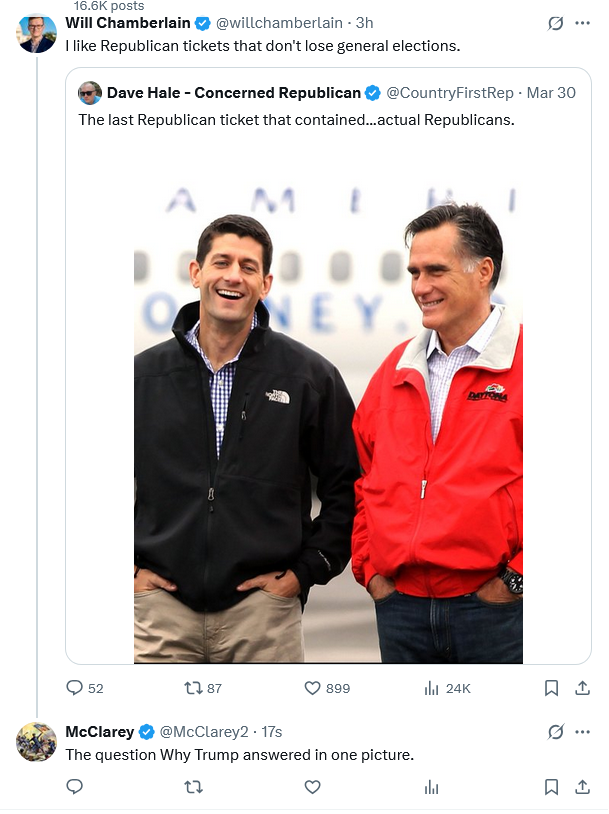



They could have been better at the time, but that’s generally the case. The trouble was how they reacted subsequently. So much has been revealed in the years since 2012 and so much in the last three months. Mr. Hale is telling you he’s not a serious person or he’s on the other side trying to con you, just like this pair.
Yeah, and Rockefeller too. They like Republicans so long as they’re just like Democrats.
I think there are quite a few people who question Romney’s credentials as a Republican. Primary winner or not, …he’s been challenged as a true-blue (er, true- red) Republican many times. McCain was too, for that matter. and Bush.
Rockefeller was at the midpoint of his time in public life around about 1960. The political parties were not neatly differentiated by programmatic preferences at that time. The Republican Senate caucus was during the period running from 1969 to 1977 led by one Hugh Scott, whose voting record (per the American Conservative Union) was to the left of about 70% of the Senate Republican caucus and to the left of about 15% of the Senate Democratic caucus as well.
Rockefeller was the avatar of a north eastern liberal Republicanism that is now extinct. Ford’s pick for him as Veep showed that Ford had the political instincts of a stunned duck. When Ford got completely predictable heat for this, he picked Bob Dole of Kansas as his running mate. If a Republican needs to worry about Kansas, the election is lost anyway. Both Rockefeller and Dole were popular among Congressional Republicans and that is the only frame of reference that Ford had. He never understood Reagan or the conservative movement that Reagan led. Ford was a decent enough man, but it is sad to being in a period of transition, and being on the side of the transition that is about to be one with Nineveh and Tyre, and not having a clue about what is going on.
“Actual Republican” apparently means “talks a big game, messes up the big election, continue to betray promises afterwards.” John McCain fits that mold too.
I think you’ve called it. The social dynamics and the busywork of Congress were the trees Ford and Dole could see. The couldn’t see the forest. That limited their imagination in a crippling way.
==
The more you contemplate Ford retrospectively, the more you can see his deficits. One was his repeated use of antiquated frames of reference. The WIN program suggested a man who never studied economics and whose mind was addled by WWii era scrap metal drives. (Alan Greenspan told him the WIN program was stupid and he did not listen). His selection of Rockefeller and turning the White House domestic policy staff over to Rockefeller’s supervision made no sense except that he thought he had to propitiate an influential element (not realizing that was being chewed up by the actuarial tables and had founded no policy shops or publications of its own).
==
See Wm. Schneider on VP picks: your single best guess is that they will net you 2% of the vote in the candidate’s home state. The risk in such picks is that your candidate will prove a distraction. See Thos. Eagleton and Geraldine Ferraro.
==
See Ron Nessen on Ford’s considerations in selecting a VP candidate. Per Nessen, he wanted someone who could take over the presidency on a moment’s notice, someone who was in agreement with him on policy, and someone who was a good campaigner. His priorities were in that order. He wasn’t giving consideration to electoral advantage. See the cautionary example that year: Reagan resorted to conventional ‘ticket-balancing’ considerations and selected Richard Schweiker pre-emptively. It blew up in his face.
==
My sense of the problem with McCain (whose voting record was conventional) was that he was readily flattered by reporters and he was often motivated by personal pique (see his spanner-in-the-works over Obamacare). Camille Paglia took a look at him in 2000 and concluded he was a man devoid of an inner life. As for Paul Ryan, just what did he accomplish between 2009 and 2019?
I wonder how much the do-nothing establishment Republicans, like those pictured above, contributed to the delinquency of the Democratic party? Establishment Republicans appear to have an aversion to the practice of governance. They have shown a preference for talking the talk while failing to walk the walk for their voters.