

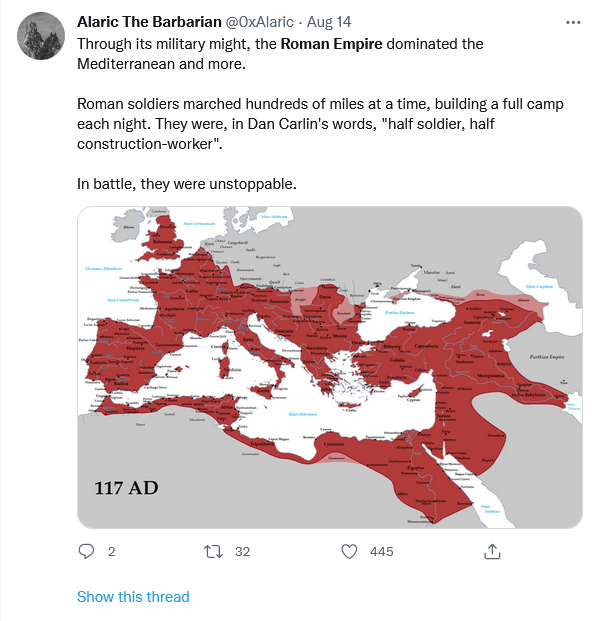
When Caesar’s sun fell out of the sky
And whoso hearkened right
Could only hear the plunging
Of the nations in the night.
GK Chesterton, Ballad of the White Horse
The reasons given for the Fall of the Roman Empire are endless, but I think usually beside the point. Civilization is hard work, while barbarism is easy. Taking a civilization for granted, and enough people refusing to do the hard work to maintain it, is always a large step to losing it. We have no reason for thinking that this will not occur in the future.
“Listen, are we helpless? Are we doomed to do it again and again and again? Have we no choice but to play the Phoenix in an unending sequence of rise and fall? Assyria, Babylon, Egypt, Greece, Carthage, Rome, the Empires of Charlemagne and the Turk: Ground to dust and plowed with salt. Spain, France, Britain, America—burned into the oblivion of the centuries. And again and again and again. Are we doomed to it, Lord, chained to the pendulum of our own mad clockwork, helpless to halt its swing? This time, it will swing us clean to oblivion.”
― Walter M. Miller Jr., A Canticle for Leibowitz
― Walter M. Miller Jr., A Canticle for Leibowitz





Wise words: “civilization is hard work, barbarism is easy.”
One of the most interesting phenomena of recent years is the deep interest many young men have in the Roman Empire. And apparently, it’s not superficial or sensationalistic.
They will talk about the Gracchan reforms, the Social War, the Crisis of the Third Century, etc., etc., with great familiarity. One YouTube series, put together by a young man in his 20’s, is mainly a tongue-in-cheek hyper-jingoistic telling of Roman history from the beginnings to Heraclius’s recovery of the True Cross (with various figures depicted as “chads” or “soyjacks” or “crater-brains,” etc.).
But underneath it all is a deep love and sympathy for the dream of Rome–and it shows in several moving passages where he drops the parodic style, not least of which is the significance of the recovery of the True Cross and its return to Jerusalem.
Thanks for the quote from “Canticle for Leibowitz.” The book gives hope: at the end, when the world is about to undergo another devastating atomic war, there is the ship headed for the stars, carrying children and the newly ordained bishops, to propagate the faith.
So if birth, maturity, and death are as inevitable for civilizations as they are for humans, there is the new birth to carry on God’s work.
Bob K., I agree about the hope at the end of “Canticle”. But I am also oddly unsettled by the ending. The escapees not only take the Church with them (good), but also all known human knowledge, including, presumably, the knowledge of those destructive technologies from which they flee. A new apple for a new Eden? Unsettling.
There was a 400 year long demographic implosion (250-650 ad) which was injurious to prosperity and maintaining political institutions. Philip Daileader has written about this; not sure there’s a well-understood reason why this took place, but we are living through an incipient demographic implosion right now.
==
NB, civilization evaporated in Britannia and receded in Gaul. In Hispania, North Africa, and Italy, the Roman Empire was replaced with Germanic kingdoms and life went on, though with a lower standard of living. Justinian’s attempt to reconquer the western Empire did a great deal of damage, especially in Italy.
Art:
The old Latin student will agree with you on some points:
Major events as cited by Tom Byrne are quite correct. Also are the “thousand cuts” over the centuries that festered into full on infections. The fall of Roman virtues, honor, responsibility, self worth, foreign mercenary armies and finally, a slothful and self indulgent life by what would have been the industrious and constructive class. Cicero, Cato and the Gracchi all predicted it but were ignored. Also ignored was the redemptive religion from the East. All to no avail to stop the inevitable. A lesson not diminished by time.
I’ve been having my slave, Ubiquitus Goolgeplex, read Book 2 Ch20 of City of God – in between trips to the Theatre Primus and snacking on dainties imported from around the Empire…
Have to agree with St Augustine – love of pleasure, particularly sexual, greed, and low character was (and will be) the death of the Empire.
“We have no reason for thinking that this will not occur in the future.”
It is occurring now. We are yet to see what the tipping point will be. The West does not resemble the Roman Empire. It’s fragmented.
Let’s be real, those in positions of power are rolling the dice because they are in a financial and economic position to do so. Take that away and they will not be rolling the dice because they won’t have the privilege of comfort or boredem.
Trump taking away the comforts is a start. It takes a while for the rest of the world to catch on. So he will need to power through the defiant tantrums.
The glimmers of hope are the young pro-lifers, the bold people on campuses challenging the ideology, the invisible hardworking young person who has the grit forgoes a lifestyle his/her peers are enjoying to save up for a house. Those who take the time to worship on Sunday.
The counter-cultural road is a lonely one. But there are others out there. And God is with us.
Like I said, there is a tipping point, praying it tips the right way.
I learned a lot from all these great comments. Thank you, Everyone!
Ditto, LQC.
I never had a problem conquering all of Germania in Rome: Total War. I don’t understand why the real Romans couldn’t.
Steven:
They tried in the time of Augustus, but couldn’t hold the territory. Later historians suggested that the Elbe was a less defensible frontier than the Rhine, even though it would have shortened their lines (“limes”) by many hundreds of miles.
“I have recorded the triumph of barbarism and religion.” (Gibbon)
Gibbon had precious little experience of either. He was the arch English fop, and his youthful conversion to Catholicism, short lived, left him with an apostate’s enmity against Christianity.
https://crisismagazine.com/opinion/the-decline-and-fall-of-edward-gibbon
He also never related why his thesis failed to apply to the Eastern (Byzantine) Empire.
Wonderful stylist though. Making my fourth way through his Decline and Fall.
While the Empire fell in the West, the East managed to survive until 1453. The Ottoman Empire did not last nearly as long.
Pat Buchanan, who became an isolationist after Vietnam, long labeled the USA as an empire. He was and is wrong. No nation has or will have as many military bases around the world as the USA, but a military base is not equal to governing the nation in which it is located. Geez, we have put up with a Communist dictatorship in Cuba for over 60 years, turning that island into a hellhole where hostile foreign interests use it as a base to spy on the US.
No foreign nation will invade and destroy the US. If destruction happens we will do it to ourselves.
There have been others to point out the dangers but only Trump has had the back bone to take the fight to the bureaucratic dictatorship we find ourselves under…that would destroy this nation.
Canada may be too far gone. Western Europe, too.
[…] Prefer Bread & Water for a Week – Donald R. McClarey, J.D., at the American Catholic10. Why Rome Fell – Donald R. McClarey, J.D., at the American […]