Donald R. McClarey
Cradle Catholic. Active in the pro-life movement since 1973. Father of three, one in Heaven, and happily married for 43 years. Small town lawyer and amateur historian. Former president of the board of directors of the local crisis pregnancy center for a decade.
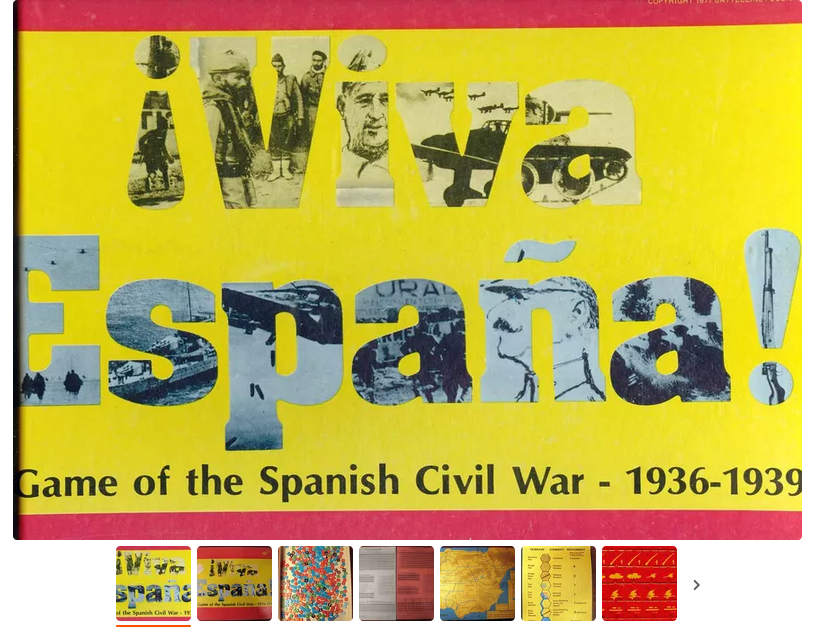



Now all I can think about is that dang board game. I need to know more!
Here you go Father:
https://boardgamegeek.com/boardgame/4971/viva-espana-a-game-of-the-spanish-civil-war-1936-1
I have almost every game on the Spanish Civil War, and this is in the top ten percent.
Two things, Don:
1. Where did you find this video? Are there others from whoever made it?
2. Here’s another thing we have in common—interest in the Spanish Civil War! I wrote my Junior Year college dissertation on it! Arriba Espana!
It’s a Live Action video Dan. I first got interested in the Spanish Civil War in high school when I read Hugh Thomas’ history of the War. It awakened a passion in me as to that conflict, along with a passion for Spanish history in general. Spain is a vast world all by itself. As was said by the author of The Cypresses Believe in God:
“Author’s Note for the American Edition
Spain is an unknown country. Experience proves that it is hard to view my country impartially. Even writers of high order succumb to the temptation to adulterate the truth, to treat our customs and our psychology as though everything about them were of a piece, of a single color. Legends and labels pile up: black Spain, inquisitorial Spain, beautiful Spain, tragic Spain, folkloric Spain, unhappy Spain, a projection of Africa into the map of Europe.
I defend the complexity of Spain. If this book attempts to demonstrate anything it is this: that there are in this land thousands of possible ways of life. Through a Spanish family of the middle class–the Alvears–and the day-by-day living of a provincial capital–Gerona–I have tried to capture the everyday traits, the mentality, the inner ambiance of my compatriots in all their pettiness and all their grandeur. In Spain the reaction to this novel has been that it is “implacable”. Nothing could satisfy me more.
This book spans a period of five years, five years in the private and public life of the nation: those which preceded the last civil war, which speeded its inevitable coming. The explosion of that war, its scope, and its significance are described in minute detail.
A single warning to the American reader: Spain is a peculiar country and its institutions therefore take on unique coloration. Certain constants of the Spanish temperament operate under any circumstance. A Spanish Freemason is not an international Freemason. A Spanish Communist is not even an orthodox Communist. In every instance what is characteristic is a tendency toward the instinctive, toward the individualistic, and toward the anarchic. Spaniards follow men better than they follow ideas, which are judged not by their content, but by the men who embody them. This accounts for the inclemency of personal relationships, the small respect for laws; this, too, is what causes our periodic civil wars.
To bear all this in mind is important in understanding this book. When the narrative deals with a priest, a policeman, a Socialist, a bootblack, it is essential to remember that it is dealing with a Spanish priest, a Spanish policeman, a Spanish Socialist, a Spanish bootblack, not with generic types. This warning is doubly necessary with reference to Freemasonry, Communism, and Catholicism, the interpretation of which will undoubtedly clash with the American reader’s concept of these doctrines.
The book’s protagonist–Ignacio Alvear–is a type of young man who abounds in present-day Spain.
Palma de Mallorca, Spain
August 1954
José Maria Gironella”