
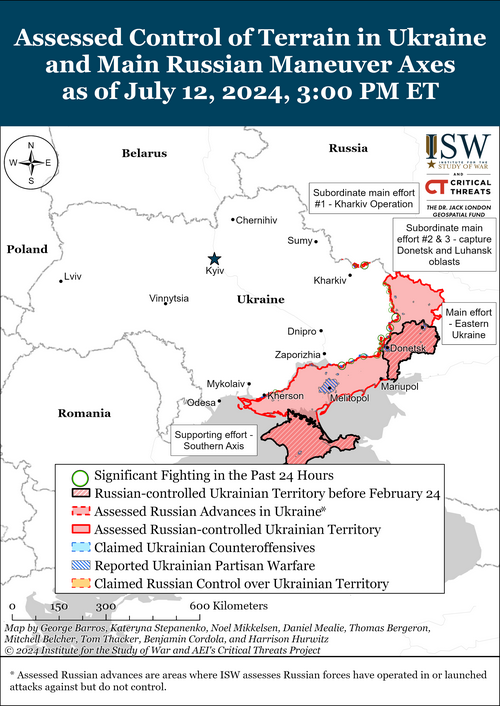
From The Institute for the Study of War:
Russian Offensive Campaign Assessment, July 12, 2024
Riley Bailey, Angelica Evans, Grace Mappes, Christina Harward, and Frederick W. Kagan
July 12, 2024, 7:45pm ET
Click here to see ISW’s interactive map of the Russian invasion of Ukraine. This map is updated daily alongside the static maps present in this report.
Click here to see ISW’s 3D control of terrain topographic map of Ukraine. Use of a computer (not a mobile device) is strongly recommended for using this data-heavy tool.
Click here to access ISW’s archive of interactive time-lapse maps of the Russian invasion of Ukraine. These maps complement the static control-of-terrain map that ISW produces daily by showing a dynamic frontline. ISW will update this time-lapse map archive monthly.
Note: The data cut-off for this product was 1:30pm ET on July 12. ISW will cover subsequent reports in the July 13 Russian Offensive Campaign Assessment.
Western and US officials reportedly assess that Ukrainian forces will continue to be on the defensive for the next six months and will not be able to conduct a large-scale counteroffensive operation until 2025. Ukrainian forces are already attempting to contest the tactical initiative in limited counterattacks in select sectors of the front, however, and Ukrainian forces may be able to conduct limited counteroffensive operations even while largely on the defensive depending on the arrival of Western aid. The New York Times (NYT) reported on July 11 that a senior NATO official stated that Ukraine would have to wait for more Western security assistance and deploy more of its forces to the frontline before conducting counteroffensive operations and that Ukraine would likely not be able to conduct these operations until 2025.[1] A senior US defense official stated that Ukrainian forces would remain on the defensive for the next six months (until January 2025) and that Russian forces will be unlikely to gain significant ground during this time.[2] ISW continues to assess that Russian forces currently remain unlikely to achieve operationally significant gains in Ukraine, and Russian President Vladimir Putin’s articulated theory of victory aims for Russian forces to make consistent gradual creeping advances instead of pursuing rapid operationally significant maneuver.[3]
Ukraine is currently addressing its manpower challenges and forming several new brigades that Ukraine could commit to support contesting the initiative, and the provision of Western security assistance needed for equipping these brigades will determine when and at what scale Ukraine can contest the initiative.[4] The arrival of Western-provided aid to the frontlines has allowed Ukrainian forces to stabilize critical areas of the front, and Ukrainian forces have conducted tactically significant and successful localized counterattacks in northern Kharkiv Oblast and towards Kreminna (in the Donetsk-Luhansk Oblast border area) starting in mid-May 2024.[5] Ukrainian forces will likely be able to intensify both the scale and regularity of counterattacks over the coming months as further Western security assistance arrives at the frontline and as Ukraine continues to build out reserves and new brigades.[6] Russian forces are currently attempting to maintain consistent offensive pressure on Ukraine to force Ukrainian forces to commit manpower and materiel to defensive operations instead of accumulating these resources for counteroffensive operations.[7] Russian forces are attempting to achieve this effect through consistent offensive operations throughout eastern and northeastern Ukraine that stretch Ukrainian forces, but nevertheless, Ukrainian forces are leveraging their capabilities and exploiting Russian vulnerabilities to conduct tactical counterattacks.
Ukrainian forces have so far conducted several large-scale counteroffensive operations that have been operationally successful throughout the full-scale invasion, but this approach to liberating territory is not the only possible approach for Ukrainian forces. Breaking out of the current positional warfare in Ukraine is a challenging task for both Russian and Ukrainian forces, and smaller-scale Ukrainian counteroffensive operations present opportunities for pursuing operationally significant objectives without the challenges associated with conducting larger-scale counteroffensive operations. Smaller-scale counteroffensive operations would likely allow Ukraine to start degrading Russia’s ability to leverage the theater-wide initiative sooner and more quickly reduce some of the theater-wide pressures on Ukrainian forces. Western security assistance that provides Ukrainian forces with the necessary equipment and weapons at the scale, timing, and regularity that Ukrainian forces require for operations that liberate significant swaths of occupied Ukraine remains the only likely path for reducing Putin’s current commitment to destroying Ukrainian statehood and identity regardless of time or cost. These Ukrainian operations do not need to be individual, distinct large-scale endeavors, however, and instead can be a series of compounding counteroffensive operations over the course of late 2024 and throughout 2025.
The Kremlin continues to signal its unwillingness to participate in peace negotiations that do not result in complete Ukrainian and Western capitulation to the Kremlin’s demands amid ongoing Ukrainian efforts to form an international consensus for future negotiations. Russian Deputy Foreign Minister Yuriy Galuzin stated on July 12 that Russia is aware of Ukraine’s and the West’s intentions to invite Russia to attend a second Global Peace Summit later in 2024 but that Russia does not “accept such ultimatums” and does not “intend to participate in such summits.”[8] Galuzin claimed that Ukraine’s peace formula (which calls for, among other issues, the withdrawal of Russian forces from Ukraine, free and safe passage through the Black Sea, the restoration of Ukraine’s territorial integrity, and a binding long-term peace agreement) is an “ultimatum” and an “absolute dead-end.”[9]
The United Nations (UN) General Assembly passed a resolution on July 12 demanding that Russia “urgently withdraw” its forces and unauthorized personnel from the occupied Zaporizhzhia Nuclear Power Plant (ZNPP) and “immediately return” the plant to full Ukrainian control, which the Russian Permanent Mission to the UN called a “politicized project” with only Western support.[10] Russian First Deputy Permanent Representative to the UN Dmitry Polyanskyi claimed that the resolution is an “ultimatum” and an effort to create the appearance that Ukraine has widespread support.[11] Russian Ministry of Foreign Affairs (MFA) Spokesperson Maria Zakharova attempted to frame the UN General Assembly’s majority support for the resolution as a failure for Ukraine.[12] Notably, only eight states–all Russian “allies” – Belarus, Burundi, Cuba, North Korea, Eritrea, Mali, Nicaragua, and Syria – voted against the resolution.[13] Kremlin officials will likely continue to frame legitimate Ukrainian negotiating positions as “ultimatums” in order to justify the Kremlin’s disinterest in peace negotiations and its continued war against Ukraine.
Ukrainian President Volodymyr Zelensky met with Turkish President Recep Tayyip Erdogan during the NATO summit on July 11 and announced that Ukraine will hold a conference dedicated to food security and freedom of navigation in Turkey within the framework of the June 2024 Peace Summit.[14] Zelensky also thanked Erdogan for his support for Ukraine’s sovereignty and territorial integrity and Erdogan stated that Turkey has begun work to revitalize the Black Sea Grain Initiative.[15] Erdogan has previously attempted to present Turkey as a possible mediator in future peace negotiations between Russia and Ukraine, and Kremlin officials have repeatedly denied the possibility of Erdogan serving as a future mediator.[16]
Russian Defense Minister Andrei Belousov used a phone call with US Secretary of Defense Lloyd Austin on July 12, his second in three weeks, to reiterate standard Russian threats intended to coerce the US out of supporting Ukraine as part of an ongoing reflexive control campaign targeting Western decision-makers.[17] Austin stressed to Belousov the importance of maintaining lines of communication amid Russia’s ongoing war against Ukraine, while Belousov discussed “preventing security threats” and reducing the “risk of possible escalation.” Austin and Belousov held their first phone call on June 26, and Belousov issued similarly vague threats about the “danger of further escalation” if the United States continues to supply weapons to Ukraine.[18] Russian officials consistently use vague threats of escalation against the United States or other Western countries as part of efforts to discourage Western support for Ukraine.[19]
The United Kingdom (UK) government has reportedly not permitted Ukraine to use UK-supplied Storm Shadow missiles to strike military targets within Russia, despite previous Western reporting and UK official statements to the contrary. The Telegraph reported on July 11 that unspecified sources in the UK government stated that the UK’s policy “had not changed” and that the UK had not permitted Ukraine to use UK-provided Storm Shadow missiles to strike military targets within Russia.[20] A senior UK defense source reportedly stated that the situation is “more nuanced” and that Ukrainian Storm Shadow strikes into Russia are “not going to happen.” The source reportedly stated that Ukraine would require permission from three countries, including the UK and France, to conduct Storm Shadow strikes against Russian territory. The Telegraph did not specify the third country. New UK Foreign Secretary David Lammy stated in an interview with European Pravda published on July 12 that the UK is “reflecting on” Ukrainian President Volodymyr Zelensky’s requests for Western states to lift restrictions on the use of Western-provided weapons against Russian territory.”[21] Lammy stated that the UK has held discussions with Zelensky over the last few days and has decided to “look at some other things.” Lammy stated that the UK supports Ukraine’s right to self-defense but declined to detail the UK’s “operational decisions” about the matter. Western media interpreted statements by former UK Prime Minister David Cameron about Ukraine’s possible use of Storm Shadows on May 3 differently, with Reuters reporting that Cameron stated that the UK had no objection to Ukraine using UK-provided weapons to strike targets within Russia, and BBC stating the Cameron did not directly support Ukraine’s use of British weapons in these strikes.[22] Bloomberg reported on July 10 that new UK Prime Minister Keir Starmer, however, stated that it is Ukraine’s decision how to deploy Storm Shadows missiles for defensive purposes.[23] Zelensky stated on July 10 that he learned of the UK’s permission for Ukraine to use Storm Shadows against military targets in Russia and met with Starmer to “discuss the practical implementation of this decision.”[24] The exact contours of the UK’s policy regarding Ukraine’s use of Storm Shadow cruise missiles remain unclear.
The US Department of Defense (DoD) announced on July 11 a military aid package for Ukraine worth $225 million.[25] The package includes one Patriot air defense battery; munitions for National Advanced Surface-to-Air Missile Systems (NASAMS); Stinger anti-aircraft missiles; High Mobility Artillery Rocket Systems (HIMARS) ammunition; 155mm and 105mm artillery rounds; and Tube-Launched, Optically-Tracked, Wire-Guided (TOW) equipment and missiles.
Indian state-run oil refineries are reportedly negotiating an oil import deal with Russia, likely as a result of the recent meetings between Indian Prime Minister Narendra Modi and Russian President Vladimir Putin and improving Russo-Indian energy relations in recent months. Reuters reported on July 11 that an Indian government source stated that Indian state-run oil refineries are negotiating a long-term oil import deal with Russia but have yet to agree on issues such as the payment currency.[26] The source reportedly stated that private Indian oil refineries may also join the negotiations later. Modi met with Putin in Moscow on July 8 and 9 and issued a joint statement about strengthening mutually beneficial energy cooperation.[27] Russian Deputy Prime Minister Alexander Novak stated on July 9 that India and Russia are considering entering a long-term agreement on oil supplies.[28] Indian private and state-run oil refineries reportedly refused to accept Russian crude oil transported on Russian PJSC Sovcomflot tankers due to US sanctions in early 2024, but Bloomberg reported on May 1 that Indian state-owned Indian Oil Corporation resumed buying Russian crude oil delivered on a PJSC Sovcomflot tanker.[29]
The Kremlin continues to intensify efforts to encourage self-censorship among information space voices and consolidate physical control over internet infrastructure. Russian State Duma Information Policy Committee member Anton Nemkin stated on July 11 that Russian federal censor Roskomnadzor will crack down against users registering for anonymous social media accounts by forcing applications, including Telegram and WhatsApp, to require phone numbers to register for an account and to establish communications with telecommunications companies to prevent Russians from registering accounts using gray market SIM cards.[30] Nemkin stated that Roskomnadzor will work with Telegram and WhatsApp specifically but will develop new rules for user verification and content moderation by late 2024 or late 2025. The Russian Ministry of Justice designated two small, anonymous Russian Telegram channels claiming to have insider information about the Russian government, VChK-OGPU and Russkiy Criminal, as foreign agents on July 12, just one day after announcing that Roskomnadzor may require channels with a daily audience of more than 1,000 people to provide identifying information in the future.[31] Russian opposition outlet Astra stated that the Russian Ministry of Justice alleged that the administrators of the two insider source channels are two defendants in an extortion case involving Russian oligarch Alisher Usmanov.[32] The Kremlin likely means to punish these channels in order to illustrate to the rest of the Russian ultranationalist information space that Russians cannot hide behind anonymous Telegram accounts to spread criticisms or rumors about the Kremlin without retribution.
Russian authorities are also throttling speeds for users accessing certain Western social media sites likely to discourage the use of these sites ahead of possible domestic bans. Nemkin stated that Roskomnadzor is not currently considering blocking WhatsApp like it has other Western social media sites but noted that Russia is applying “technological measures such as slowdowns” to WhatsApp, particularly in the Republic of Dagestan.[33] Russia’s largest telecommunications operator Rostelecom stated on July 12 that Russians may experience slow load times and low video resolution when accessing YouTube regardless of telecom operator due to a lack of servers hosting content within Russia, but a telecom source told Russian opposition outlet Meduza that this narrative is false.[34] The Russian telecom source instead claimed that Russian authorities have begun deliberately slowing down speeds for users accessing YouTube within Russia, and Meduza cited the University of Michigan’s Censored Planet project as saying that Roskomnadzor used its specialized TSPU (technical means of countering threats) system to slow down access to X (formerly Twitter) in 2021.[35] Russian news outlet Gazeta reported that Russia is considering blocking YouTube in September 2024, but Kremlin Spokesperson Dmitry Peskov denied such reports.[36]
Key Takeaways:
- Western and US officials reportedly assess that Ukrainian forces will continue to be on the defensive for the next six months and will not be able to conduct a large-scale counteroffensive operation until 2025. Ukrainian forces are already attempting to contest the tactical initiative in limited counterattacks in select sectors of the front, however, and Ukrainian forces may be able to conduct limited counteroffensive operations even while largely on the defensive depending on the arrival of Western aid.
- The Kremlin continues to signal its unwillingness to participate in peace negotiations that do not result in complete Ukrainian and Western capitulation to the Kremlin’s demands amid ongoing Ukrainian efforts to form an international consensus for future negotiations.
- Russian Defense Minister Andrei Belousov used a phone call with US Secretary of Defense Lloyd Austin on July 12, his second in three weeks, to reiterate standard Russian threats intended to coerce the US out of supporting Ukraine as part of an ongoing reflexive control campaign targeting Western decision-makers.
- The United Kingdom (UK) government has reportedly not permitted Ukraine to use UK-supplied Storm Shadow missiles to strike military targets within Russia, despite previous Western reporting and UK official statements to the contrary.
- The US Department of Defense (DoD) announced on July 11 a military aid package for Ukraine worth $225 million.
- Indian state-run oil refineries are reportedly negotiating an oil import deal with Russia, likely as a result of the recent meetings between Indian Prime Minister Narendra Modi and Russian President Vladimir Putin and improving Russo-Indian energy relations in recent months.
- The Kremlin continues to intensify efforts to encourage self-censorship among information space voices and consolidate physical control over internet infrastructure.
- Russian forces recently made confirmed advances near Avdiivka and in the Donetsk-Zaporizhia Oblast border area.
- Russian infantry units are reportedly assaulting Ukrainian trench positions in single-file columns due to pervasive Ukrainian minefields and poor assault training.
- Russian President Vladimir Putin met with Zaporizhia Oblast occupation administration head Yevgeny Balitsky on July 12 and discussed social and infrastructure projects in occupied Zaporizhia Oblast.
Go here to read the rest. The Russians using single file columns in attack I can easily believe. That shows untrained infantry and idiot, and callous, officers. Putin’s show micro offensives have no doubt largely used up the trained infantry and competent officers of Russia.

