
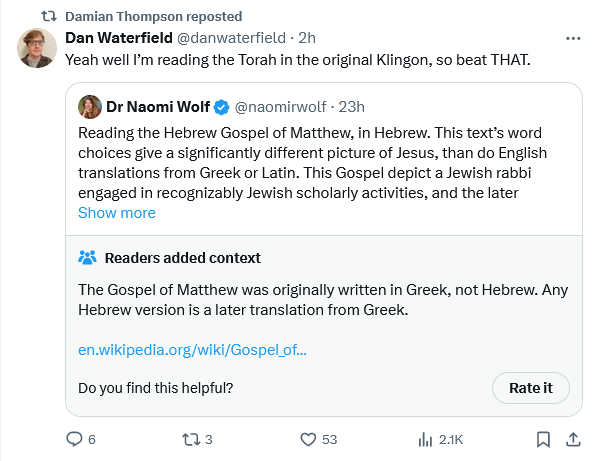
To be fair, translations can bring out meanings that can escape us. My Bride reads The Helliand sometimes at bed time. This is the retelling of the life of Christ in Old Saxon of the ninth century. Placing Christ and the Apostles in an early Middle Ages Germanic setting brings out aspects of the Gospels that normally sail right by me. Mad and brilliant poet Ezra Pound accomplished something similar in his poem The Goodly Fere:
Simon Zelotes speaking after the Crucifixion. Fere=Mate, Companion.
Ha’ we lost the goodliest fere o’ all
For the priests and the gallows tree?
Aye lover he was of brawny men,
O’ ships and the open sea.
When they came wi’ a host to take Our Man
His smile was good to see,
“First let these go!” quo’ our Goodly Fere,
“Or I’ll see ye damned,” says he.
Aye he sent us out through the crossed high spears
And the scorn of his laugh rang free,
“Why took ye not me when I walked about
Alone in the town?” says he.
Oh we drank his “Hale” in the good red wine
When we last made company,
No capon priest was the Goodly Fere
But a man o’ men was he.
I ha’ seen him drive a hundred men
Wi’ a bundle o’ cords swung free,
That they took the high and holy house
For their pawn and treasury.
They’ll no’ get him a’ in a book I think
Though they write it cunningly;
No mouse of the scrolls was the Goodly Fere
But aye loved the open sea.
If they think they ha’ snared our Goodly Fere
They are fools to the last degree.
“I’ll go to the feast,” quo’ our Goodly Fere,
“Though I go to the gallows tree.”
“Ye ha’ seen me heal the lame and blind,
And wake the dead,” says he,
“Ye shall see one thing to master all:
‘Tis how a brave man dies on the tree.”
A son of God was the Goodly Fere
That bade us his brothers be.
I ha’ seen him cow a thousand men.
I have seen him upon the tree.
He cried no cry when they drave the nails
And the blood gushed hot and free,
The hounds of the crimson sky gave tongue
But never a cry cried he.
I ha’ seen him cow a thousand men
On the hills o’ Galilee,
They whined as he walked out calm between,
Wi’ his eyes like the grey o’ the sea,
Like the sea that brooks no voyaging
With the winds unleashed and free,
Like the sea that he cowed at Genseret
Wi’ twey words spoke’ suddently.
A master of men was the Goodly Fere,
A mate of the wind and sea,
If they think they ha’ slain our Goodly Fere
They are fools eternally.
I ha’ seen him eat o’ the honey-comb
Sin’ they nailed him to the tree.


Scholars with complete versions of early writings of all kinds can trace the meanings through the ages to determine original intent. However, “new” versions of the bible and commentary are constantly appearing and the average reader has no idea if this is original intent or if the translator/interpreter has allowed a personal view or opinion to enter into the process. Some of the so-called modern bibles have extensive context and appearance almost completely unrelatable to traditional meaning. Little wonder that theology, particularly moral theology, has been twisted to a point that bears little resemblance to the intent of the source material.
Donald- my default has become don’t trust the new stuff.
Unless you think that generally speaking the Church is healthier now than in previous times. I don’t.
Certain authors and scholars rise above the default, but that does not change my initial wariness.
There’s a quorum of scholarship that says Matthew was first written in Aramaic, kinda quasi-Hebrew. Wouldn’t surprise me if that was Hebrew-Hebrewed pre-Greek translation. Theo-egghead red meat: Then which is the inspired text?
From what I’ve been told in Catholic Bible study the original cultural context for the Bible was first century Judaism. Competent Bible presenters will give this cultural context and bring out the connections between the Old and New Testaments, which has a direct bearing on Biblical interpretation. Many modernist interpretations tear the Bible raw and bleeding from out of its cultural context. Competent Bible presenters can distill hours of study and reading that the student would otherwise have to do. The only inerrant part of the Bible is its actual texts of the books. This doesn’t apply to the footnotes and the study guides.
When I want to find the real meaning of something in the New Testament I go to an interlinear translation of the Greek (Demotic). Many times I have found something quite different from that in a newly revised version.
Aramaic is to Hebrew what Spanish is to Latin.
There are several different editions of the Hebrew / Aramaic OT and the Greek NT. These editions differ somewhat in rendering a verse, or in missing content or extra content. Indeed, at home I have several different editions of the Greek NT and the Latin Vulgate. I sometimes get asked on-line about differences, and these editions are handy for answering questions. Using Strong’s Concordance for the Greek and my knowledge of the Latin, I can tease out the meaning. Sadly, while I do have different editions of the Hebrew OT, my Hebrew ability is lacking. My 66-year old brain can’t manage right to left Semitic text, so I use interlinears. I also have the Greek Septuagint for the Deuterocanonicals – two different editions. None of the differences impact an article of the Faith. But they do cause fantastic arguments with Baptist KJV-only folks that I sometimes enjoy. 😉 No offense Donald, but Douay-Rheims-only folks can be similar. 😉
I don’t have time here to explain why one Greek manuscript is missing a part of Luke 9:56, and another isn’t, or why one Greek manuscript has John’s story of the woman caught in adultery and another doesn’t. Too complicated. But I will say this: the Protestant Evangelical New English Translation (NET) Full Notes Edition is the very best when it comes to giving an explanation to an English reader with zero knowledge of ancient languages a critical word-by-word analysis of translation choices. Sadly, it doesn’t have the Deuterocanonicals and it messes up one key part of the Bread of Life Discourse in John 6 (hey, it’s Protestant, so why would you expect?), but other than that it is far superior to any modern Catholic translation (here’s my plug for Father George C. Haydock’s Douay-Rheims Study Bible of 1859 – the very best in authentic teaching, but no translation notes 🙁 ). I just bought a 2nd NET copy (one for downstairs kitchen table Morning Prayer with coffee at 4 am and another for upstairs in my office Evening Prayer when my house is full of Filipinos). My wife hates it when I do my evening study on the kitchen table with Greek and Latin Bibles strewned about along with my NET.
BTW, the Catholic NABRE and the Protestant NIV suck big time. If we ever have a book burning, those two have gotta go. 😉
Polyglot Bibles have always intrigued me bob, but Greek will always be Greek to me!
[…] Language:Original Languages – Donald R. McClarey, Esq., at The American Catholic […]
I think the original was Aramaic – community note wrong
Mrs Oprey may be correct. There is some speculation that the Gospel of St. Matthew may have originally been written in Aramaic, but the original autograph is lost and all we have left are the Greek translation manuscripts. Around AD 180 Irenaeus of Lyons wrote the following:
Dr. Brant Pitre has a presentation where he covers the origins of the Bible. He points out that there were many false writings that the Church had to deal with.
You can buy Dr. Brant Pitre’s CDs, DVDs, MP3 lectures on the origin of the Bible here:
https://catholicproductions.com/products/the-origin-of-the-bible-human-invention-or-divine-intervention
I highly recommend anything by Dr. Pitre.