
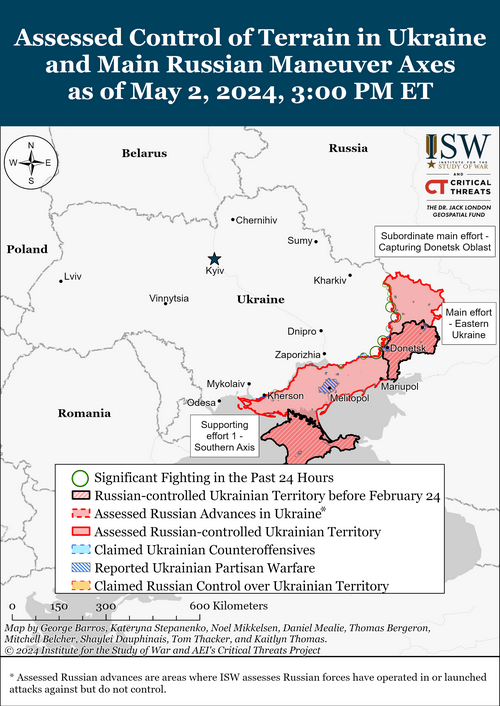
From The Institute for the Study of War:
Russian Offensive Campaign Assessment, May 2, 2024
Riley Bailey, Grace Mappes, Nicole Wolkov, Kateryna Stepanenko, and Frederick W. Kagan
May 2, 2024, 8pm ET
Click here to see ISW’s interactive map of the Russian invasion of Ukraine. This map is updated daily alongside the static maps present in this report.
Click here to see ISW’s 3D control of terrain topographic map of Ukraine. Use of a computer (not a mobile device) is strongly recommended for using this data-heavy tool.
Click here to access ISW’s archive of interactive time-lapse maps of the Russian invasion of Ukraine. These maps complement the static control-of-terrain map that ISW produces daily by showing a dynamic frontline. ISW will update this time-lapse map archive monthly.
Note: The data cut-off for this product was 1pm ET on May 2. ISW will cover subsequent reports in the May 3 Russian Offensive Campaign Assessment.
Ukrainian intelligence officials identified three Russian efforts to destabilize Ukraine and achieve victory, and both Ukrainian and US intelligence officials issued assessments about the battlefield situation that are consistent with prior ISW forecasts that Russian forces may take Chasiv Yar but are very unlikely to seize major Ukrainian cities. Ukrainian Main Military Intelligence Directorate (GUR) Deputy Chief Major General Vadym Skibitskyi stated in an interview with the Economist published on May 2 that the first effort to destabilize Ukraine is comprised of military operations that aim to take advantage of Ukraine’s ongoing materiel and manpower shortages.[1] Skibitskyi stated that Russian forces knew that April and May 2024 would be difficult months for the Ukrainian military as existing supplies dwindled and as Ukraine waits for sufficient quantities of fresh US military assistance to filter to the frontline.[2] Skibitskyi stated that Russian forces will likely continue pursuing their longtime goal of completely seizing Donetsk and Luhansk oblasts, and that the Russian command wants to achieve a battlefield victory before the May 9 Victory Day holiday or Russian President Vladimir Putin‘s visit to Beijing in mid-May.[3] Skibitskyi stated that Ukraine is currently focusing on Chasiv Yar, Donetsk Oblast, where ISW assesses that Russian forces have the best opportunity to achieve operationally-significant gains, and that while it is “probably a matter of time” before Chasiv Yar falls, Russian forces will not seize the town “today or tomorrow.[4] Skibitskyi stated that Russian forces have achieved only tactical successes near Avdiivka, Donetsk Oblast following a recent tactical penetration northwest of the city, and ISW has noted that Russian forces remain far from any operationally-significant objective in the area and are unlikely to pose such a threat here in the near-term.[5]
Skibitskyi assessed that Russian forces will likely begin an offensive effort towards Kharkiv and Sumy oblasts at the end of May or start of June 2024 but that Russian forces will not be able to take Kharkiv or Sumy cities. Skibitskyi stated that Russian forces have currently concentrated roughly 35,000 personnel in the international border area and plan to concentrate a total of 50,000 to 70,000 personnel for this effort, presumably before the start of the offensive operation.[6] Skibitskyi stated that this grouping will be insufficient for achieving anything beyond localized gains, consistent with ISW’s assessments that Russian forces would likely struggle to take Kharkiv City but that Russian offensive operations in the area would draw and fix Ukrainian forces from other parts of the frontline.[7] Ukrainian Commander-in-Chief Oleksandr Syrskyi stated on April 28 that Ukrainian forces are monitoring the increased number of Russian forces regrouping in the Kharkiv direction, likely referring to Belgorod Oblast, and that Ukrainian forces have reinforced defensive positions in the “most threatened” areas with additional artillery and tank units.[8]
US Director of National Intelligence (DNI) Avril Haines stated to US Senate Armed Services Committee on Global Threats on May 2 that Russian President Vladimir Putin believes that domestic and international trends are in his favor and views his personal staying power, the state of Russia’s economy, and Russian rearmament efforts as advantageous compared to the current challenges facing Ukraine.[9] Haines stated that Russian forces are capable of achieving tactical breakthroughs, particularly in Kharkiv and Donetsk oblasts, although she did not specify any operational direction.[10] Haines stated that Putin is portraying Russia as revitalizing its defense industrial base (DIB) and portraying Russia’s artillery ammunition and missile production as increasing while Western production struggles to meet Ukraine‘s needs. Haines stated that Putin’s “increasingly aggressive tactics,” such as strikes against Ukrainian energy and critical infrastructure, intend to signal to Ukrainians that continuing to fight will only increase the damage to Ukraine with no clear path to victory. Haines stated that Russian forces are also striking Ukrainian military logistics to interdict supplies to the front, slow defense production, and further pressure Ukraine to consider pathways out of the war, such as through negotiations, even though the Kremlin has shown no willingness to make any concessions in good-faith negotiations.
Skibitskyi noted that the Kremlin views information operations as a second line of effort to defeat Ukraine and that current Russian information operations heavily focus on undermining Ukrainian mobilization efforts and the legitimacy of Ukrainian President Volodymyr Zelensky.[11] Kremlin-affiliated former Ukrainian MP Viktor Medvedchuk notably supported the Kremlin’s informational efforts to delegitimize Zelensky on May 2 and falsely claimed that Zelensky will not be a legitimate president starting on May 21.[12] Ukraine would have held its presidential election on March 31 and would have begun a new presidential term on May 20 if Russia had not illegally invaded Ukraine.[13] Ukraine’s constitution permits postponing elections and allows a sitting president to continue to serve after the designated end of his term under martial law, and Zelensky’s decision not to hold elections given Ukraine’s ongoing existential defensive war is fully in accord with the Ukrainian constitution.[14] Ukrainian officials have warned that Russian actors intend to intensify an existing information operation called ”Maidan 3“ in May 2024 to spread doubts about Zelensky’s legitimacy as president, specifically among Ukrainian military personnel.[15] Medvedchuk is a key ally of Russian President Vladimir Putin and was rumored to be a candidate for the head of the Russian-controlled Ukrainian government that the Kremlin sought to establish following the envisioned quick regime change in Ukraine in 2022.[16] Several prominent Russian milbloggers dismissed Medvedchuk as an irrelevant information actor for failing to properly organize a pro-Russian opposition in Ukraine, however.[17] Ukrainian officials have warned that ”Maidan 3” will peak around late May 2024, and former Ukrainian officials who have sided with the Kremlin, like Medvedchuk, may become increasingly involved with this information operation in the coming weeks to try to foment further internal Ukrainian division.[18]
Skibitskyi stressed that Russia’s third line of effort to achieve victory in Ukraine is an ongoing campaign to diplomatically isolate Ukraine.[19] Ukrainian Foreign Minister Dmytro Kuleba stated in an interview with Foreign Policy published on May 1 that Russia believes that it still can litigate Ukraine’s future on the battlefield and urged the West to pursue a strategy that impresses upon Russia an understanding that Ukraine is a part of the West.[20] Delays in US security assistance have placed heavy constraints on Ukrainian forces along the frontline, and Kuleba noted that a window before the arrival of critically needed air defense assets and artillery ammunition from the US will allow Russian forces to cause further damage through drone and missile strikes and pursue tactical gains on the front.[21] The Kremlin has routinely engaged in rhetorical efforts to prompt the West into self-deterring from providing military and other support to Ukraine over fears of escalation, and the Kremlin has previously intensified offensive operations alongside debates in the West about support for Ukraine to strengthen Western defeatism.[22] The Kremlin may have expected delays in US and Western security assistance to persist, and the recent passage of the US supplemental aid bill may prompt the Kremlin to recalibrate its efforts to compel the West into self-deterrence. Kuleba also noted that Russia inherited relationships with many non-Western states from the Soviet Union and is better positioned than Ukraine to engage these countries.[23] The Kremlin has increasingly cast Russia as the leader of the “world majority,“ a group of countries including post-Soviet and non-Western states that Russia intends to rally to oppose the West, and Russian officials may seek to intensify this line of outreach as Ukraine seeks to involve post-Soviet and non-Western states in the Global Peace Summit in Switzerland in June 2024.[24]
Skibitskyi stated that he does not see a way for Ukraine to win solely on the battlefield and that the Ukrainian liberation of all occupied territory would not necessarily end the war.[25] Skibitskyi stated that wars like the one in Ukraine only end with treaties and that both Russia and Ukraine are competing for the most favorable position ahead of potential talks that could begin as early as the second half of 2025.[26] Kuleba added that the only way to compel Russia to consider meaningful negotiations is through military operations or the creation of a coalition of countries with the same values and approach to a negotiated end to the war in Ukraine.[27] Russian efforts to diplomatically isolate Ukraine aim to constrain critical provisions of consistent and timely security assistance to the Ukrainian military and degrade Ukraine’s ability to form a bloc of partners that can support Zelensky’s peace formula.
The US Department of State (DoS) announced on May 1 that it has determined that Russian forces are violating the Chemical Weapons Convention (CWC), to which Russia is a signatory. The US DoS stated that it made a determination under the Chemical and Biological Weapons Control and Warfare Elimination Act of 1991 (CBW Act) that Russian forces have used chloropicrin and riot control agents (RCAs) against Ukrainian forces in Ukraine in violation of the CWC.[28] Chloropicrin is a pesticide and lung damaging agent, and Ukrainian officials have previously reported that Russian forces are increasingly equipping grenades with chloropicrin.[29] Russian forces have reportedly extensively used chlorobenzylidenemalononitrile (CS) gas, a type of RCA, in grenades dropped from drones on Ukrainian positions throughout the frontline.[30] The US DoS noted that Russian forces likely use chemical weapons in an effort to dislodge Ukrainian forces from fortified positions and achieve tactical gains.[31] Kremlin Spokesperson Dmitri Peskov denied the US DoS determination and claimed on May 2 that Russia is abiding by its obligations to the CWC.[32] ISW previously observed the Russian 810th Naval Infantry Brigade acknowledge in a now-deleted post that elements of the brigade deliberately used K-51 grenades with CS gas on Ukrainian positions near Krynky in east (left) bank Kherson Oblast in December 2023.[33] The US DoS also announced sanctions against the Russian Ministry of Defense’s (MoD) Radiological, Chemical, and Biological (RCB) Defense Forces; the stated-owned Scientific Research Institute of Applied Acoustics; and the MoD’s 48th Central Scientific and Research Institute as well as four Russian companies for their involvement in the development and use of chemical weapons.[34]
Human Rights Watch (HRW) released a report on May 2 in which it confirmed that Russian forces have executed at least 15 surrendering Ukrainian soldiers since December 2023.[35] HRW reported that combat footage shows that Russian forces likely executed an additional six surrendering Ukrainian soldiers since December 2023.[36] HRW noted that in one case Russian commanders explicitly ordered Russian forces to execute Ukrainian soldiers instead of letting them surrender.[37] Attacking soldiers recognized as hors de combat, specifically including those who have clearly expressed an intention to surrender, is a violation of Article 41 of the Geneva Convention on the Protection of Victims of International Armed Conflict.[38]
Russian President Vladimir Putin met with Tula Oblast Governor and known Wagner Group-affiliate Alexei Dyumin on May 2, further indicating that Putin may be seeking to reduce Russian Defense Minister Sergei Shoigu’s power by balancing him with rivals. Dyumin notably briefed Putin about Tula Oblast’s contributions to Russia’s full-scale invasion of Ukraine at the presidential estate in Novo-Ogaryovo, Moscow Oblast.[39] Dyumin focused on three topics: support and housing for participants of Russian military personnel fighting in Ukraine, improvements to the Russian defense industrial base (DIB) and improving the medical system in Tula Oblast. Dyumin claimed that the Tula Oblast administration is cooperating with the Russian MoD to fully equip Russian military units with necessary materiel identified by the local commanders. Dyumin also boasted that Tula Oblast opened one of the first training centers for drone operators in cooperation with the Russian MoD to support the Russian MoD and other security agencies’ interests. Dyumin emphasized the Tula Oblast administration’s commitment to producing weapons and supporting Russia’s industrial base (DIB). Dyumin welcomed Russian Deputy Prime Minister and Minister of Trade and Industry Denis Manturov’s proposal for the federal government to assist with the construction of additional DIB enterprises and bragged about Russia’s increasing DIB production capabilities. Dyumin’s brief appeared to be an attempt to win Putin’s favor following Dyumin’s notable fall from Putin’s grace during Wagner Group Yevgeny Prigozhin’s mutiny in late June 2023.[40] Dyumin repeatedly sided with Prigozhin throughout 2022 and 2023 reportedly in an attempt to facilitate firings within the Russian MoD and possibly hoping to replace Russian Defense Minister Sergei Shoigu himself.[41]
Putin likely deliberately publicized his meeting with Dyumin following the high-profile arrest of Russian Deputy Defense Minister Timur Ivanov on April 24 and before the presidential inauguration on May 7, possibly to punish the Shoigu-led MoD for failing to accomplish the Kremlin’s military goals. The Putin-Dyumin meeting generated a significant amount of discourse within the Russian information space, with numerous milbloggers and political commentators pointing out that the meeting occurred between Ivanov’s arrest and the expected government reshuffle following the inauguration.[42] Russian insider sources speculated that the Kremlin may appoint Dyumin to a new role involving the Russian DIB, such as deputy chairman of the Russian Military Industrial Commission.[43] These speculations may be the result of Dyumin’s hyperfocus on DIB and mention of Manturov during his meeting with Putin. Russian insider sources also interpreted Shoigu’s May 1 statement that Russia needs to increase the volume and quality of weapons and military equipment to ”maintain the required pace of the offensive” during the meeting at the Joint Headquarters of the ”Special Military Operation” on the night of May 1 as a direct attack on certain Russian political figures.[44] (Prigozhin similarly justified Wagner Group’s slow and bloody advance in Bakhmut, Donetsk Oblast in winter 2023 with claims of ammunition shortages that he colorfully blamed on Shoigu.) One political commentator claimed that Shoigu is trying to shift the blame for his military and DIB failures onto Manturov and the CEO of Russian state-owned defense conglomerate Rostec, Sergei Chemezov. Another Russian insider source similarly claimed on May 1 that Shoigu heavily criticized Manturov, Rostec, and Deputy Chairman of the Russian Security Council Dmitry Medvedev in response to Ivanov’s arrest.[45] Shoigu reportedly had a particularly close relationship with Ivanov and that Ivanov’s arrest alongside the sudden reemergence to prominence of Dyumin may indicate that the Kremlin is dissatisfied with Shoigu’s performance.[46] One Russian source, however, assessed that Shoigu‘s dismissal is unlikely in 2024.[47]
The Putin-Dyumin meeting suggests that Putin is likely the responsible decision-maker behind Ivanov’s arrest. ISW has routinely observed that Putin regularly rotates officials and military commanders in and out of favor in hopes of incentivizing different factions to strive to accomplish his objectives.[48] ISW has also observed that Putin routinely marks a shift in his favor by offering high-profile meetings with members of the opposing faction or dismissing military commanders. Putin, for example, humiliated Dyumin in August 2023 by reportedly cancelling their one-on-one meeting and ordering him to publicly escort Shoigu at an event.[49] ISW assessed that this gesture signified a notable victory for Shoigu’s circle within the Russian MoD and marked the confirmation of Dyumin’s fall from Putin’s favor.[50] Russian officials also arrested and dismissed some officials and commanders following Prigozhin’s mutiny in summer 2023.[51]
Putin awarded the rank of lieutenant general to several Russian commanders on May 2. Putin promoted deputy commander of the Eastern Grouping of Forces (deployed in western Donetsk Oblast and the Donetsk-Zaporizhia Oblast border area) Oleg Luchansky, the commander of the 68th Army Corps (Eastern Military District [EMD]) Vitaly Podlesny, and head of the Russian General Staff’s Operational Training Department Fanil Sarvarov to lieutenant general.[52]
Recent Russian government crackdowns against Central Asian migrants living in and entering Russia following the March 22 Crocus City Hall attack appear to be straining Kyrgyz-Russian relations in addition to Tajik-Russian relations. The Kyrgyz Ministry of Foreign Affairs (MFA) warned Kyrgyz citizens on May 2 to temporarily refrain from visiting Russia while Russia continues to conduct increased security measures and enhance border control measures.[53] The Kyrgyz MFA additionally stated that Russia did not inform Kyrgyzstan about recent mass refusals of Kyrgyz citizens entering Russia. The Russian MFA has not responded to the Kyrgyz MFA’s statement at the time of this publication. Russian Foreign Minister Sergei Lavrov claimed in an April 30 phone call with Tajik Foreign Minister Sirojiddin Muhriddin that Russia has not taken measures against specific ethnicities and religious minorities, which Muhriddin called false.[54] ISW has observed increased crackdowns targeting Russian indigenous and migrant Muslim communities, especially Central Asian migrants, following the Crocus City Hall attack and continues to assess that Russia has no intention of scaling back crackdowns.[55]
The Georgian parliament passed Georgia’s Russian-style “foreign agents” law in its second reading on May 1 amid continued protests against the law in Tbilisi.[56] Russian opposition news outlets widely reported that the 83 of 150 Georgian parliament members voted for the bill – the same number of members who supported the bill in its first reading on April 17 since the Georgian opposition refused to participate in both votes.[57] The Georgian parliament is expected to vote on May 17 on the third and final reading of the bill, after which the bill will go to the Georgian president for the final signature.[58] Georgian President Salome Zurabishvili has stated her intent to veto the bill, but the BBC noted that the ruling Georgian Dream party has sufficient numbers to overrule that veto.[59] The bill, which was first proposed by the Georgian Dream party in 2023 and quickly withdrawn due to large protests, would require non-governmental organizations (NGOs) and media outlets that receive foreign funding amounting to over 20 percent of their annual income to register with the government.[60] The bill resembles Russia’s foreign agent law, which the Kremlin has used to crack down against independent media and opposition organizations, consolidate control over the domestic information space, and eliminate domestic objections to the Kremlin.[61] Georgian opposition figures and Western officials have expressed concern that the Georgian government could also utilize the bill to target and justify domestic repression and that its passage blocks Georgia’s path to joining the European Union (EU).[62] US Ambassador to Georgia Robin Dunnigan stated on May 2 that senior Georgian leaders recently rejected a US invitation to discuss the US–Georgian “strategic partnership and any concerns with US assistance.”[63] Former Georgian Prime Minister and founder of the Georgian Dream party Bidzina Ivanishvili recently reiterated a series of standard anti-Western and pseudohistorical Kremlin narratives during his first public speech since announcing his return Ivanishvili’s decision to rhetorically align with Russia against the West indicates that Ivanishvili and the Georgian Dream party likely intend to purposefully derail long-term Georgian efforts for Euro-Atlantic integration, which plays into continued Russian hybrid operations to divide, destabilize, and weaken Georgia.[64]
Key Takeaways:
- Ukrainian intelligence officials identified three Russian efforts to destabilize Ukraine and achieve victory, and both Ukrainian and US intelligence officials issued assessments about the battlefield situation that are consistent with prior ISW forecasts that Russian forces may take Chasiv Yar but are very unlikely to seize major Ukrainian cities.
- Ukrainian Main Military Intelligence Directorate (GUR) Deputy Chief Major General Vadym Skibitskyi assessed that Russian forces will likely begin an offensive effort towards Kharkiv and Sumy oblasts at the end of May or start of June 2024 but that Russian forces will not be able to take Kharkiv or Sumy cities.
- Skibitskyi noted that the Kremlin views information operations as a second line of effort to defeat Ukraine and that current Russian information operations heavily focus on undermining Ukrainian mobilization efforts and the legitimacy of Ukrainian President Volodymyr Zelensky.
- Skibitskyi stressed that Russia’s third line of effort to achieve victory in Ukraine is an ongoing campaign to diplomatically isolate Ukraine.
- The US Department of State (DoS) announced on May 1 that it has determined that Russian forces are violating the Chemical Weapons Convention (CWC), to which Russia is a signatory.
- Russian President Vladimir Putin met with Tula Oblast Governor and known Wagner Group-affiliate Alexei Dyumin on May 2, further indicating that Putin may be seeking to reduce Russian Defense Minister Sergei Shoigu’s power by balancing him with rivals.
- Putin likely deliberately publicized his meeting with Dyumin following the high-profile arrest of Russian Deputy Defense Minister Timur Ivanov on April 24 and before the presidential inauguration on May 7, possibly to punish the Shoigu-led MoD for failing to accomplish the Kremlin’s military goals.
- The Putin-Dyumin meeting suggests that Putin is likely the responsible decision-maker behind Ivanov’s arrest.
- Recent Russian government crackdowns against Central Asian migrants living in and entering Russia following the March 22 Crocus City Hall attack appear to be straining Kyrgyz-Russian relations in addition to Tajik-Russian relations.
- The Georgian parliament passed Georgia’s Russian-style “foreign agents” law in its second reading on May 1 amid continued protests against the law in Tbilisi.
- Russian forces recently made confirmed advances west of Avdiivka.
- The Russian military may have recruited numerous prisoners with convictions for serious crimes in fall of 2023.
Go here to read the rest. The smart thing for the Russians to do now would be to entrench on the ground they gained and wait for the Ukrainians to come to them. I suspect that Putin wants to win this War this year, and that he will whip his generals forward, which will make the Russians vulnerable to a Ukrainian riposte. We shall see.

